So you’re ready to schedule Step 1. This can feel like a test before the actual test, but getting it sorted out comes down to one simple question: where do you go to medical school?
For students in the U.S. and Canada, your path runs through the NBME. For International Medical Graduates (IMGs), your journey starts with the ECFMG. Let's break down exactly what you need to do.
Your USMLE Step 1 Scheduling Blueprint
Figuring out how to schedule Step 1 is more than just picking a date on a calendar—it's the first real strategic move in your board prep. Nail the logistics now, and you can pour all your energy into studying without that nagging administrative stress.
A classic mistake is underestimating how long the application process takes. To dodge any last-minute panic, you absolutely need to submit your application a minimum of 3-4 months before you hope to sit for the exam.
This buffer is crucial. It gives your medical school time to verify your eligibility and ensures you get your scheduling permit with enough time to book a good seat at a Prometric center. The registration path you'll follow depends entirely on your medical school's location.
- US & Canadian Medical Students: You’ll register directly through the National Board of Medical Examiners (NBME) portal. Your school handles the eligibility verification as part of the process.
- International Medical Graduates (IMGs): You’ll start with the Educational Commission for Foreign Medical Graduates (ECFMG). This is a more involved process that includes verifying your credentials and your school's status before you can even apply for the exam.
This flowchart gives you a bird's-eye view of how these two paths work.
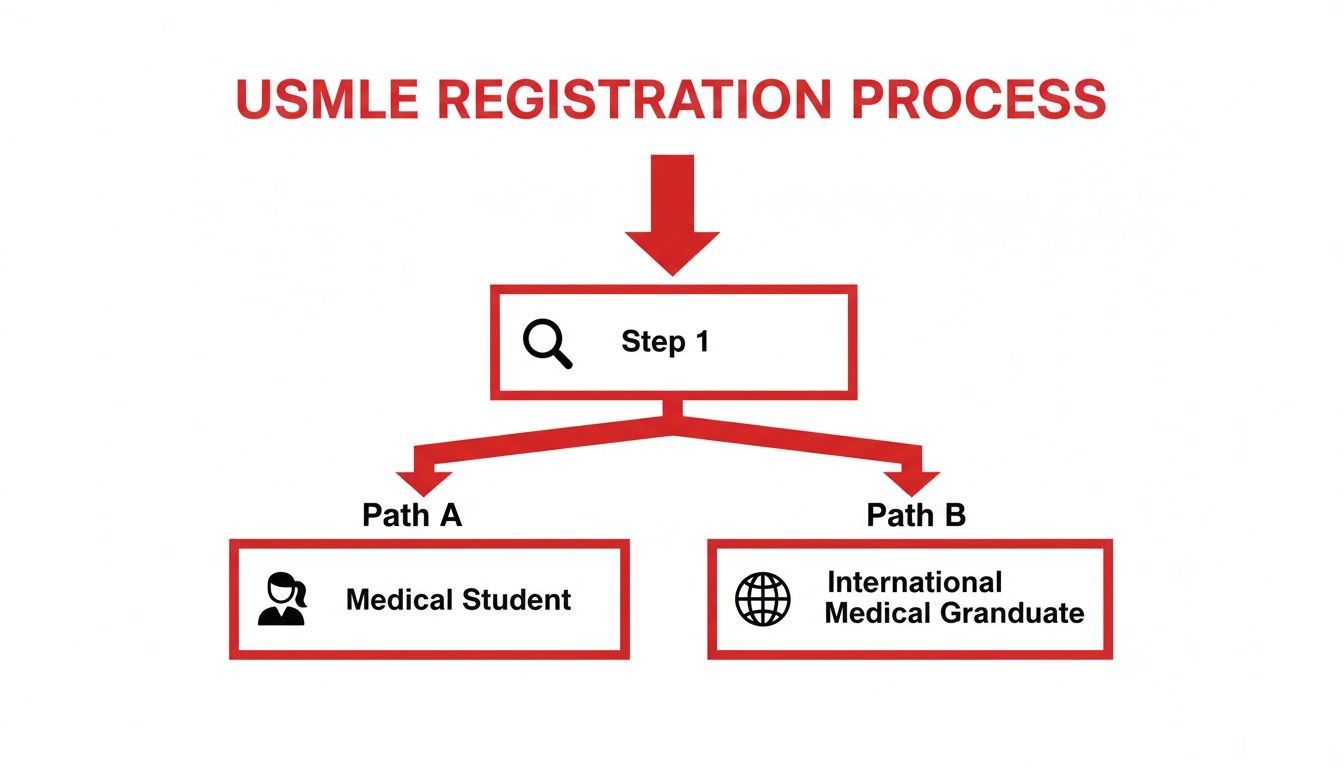
As you can see, everyone ends up at Prometric, but the road to get there is completely different depending on where you started.
To make this crystal clear, here’s a quick side-by-side comparison.
USMLE Step 1 Registration Pathways At a Glance
| Registration Step | US & Canadian Students (via NBME) | International Medical Graduates (via ECFMG) |
|---|---|---|
| Primary Body | National Board of Medical Examiners (NBME) | Educational Commission for Foreign Medical Graduates (ECFMG) |
| Initial Action | Create NBME account and apply for USMLE Step 1. | Create ECFMG account and request a USMLE/ECFMG ID. |
| Verification | Medical school verifies student status directly with NBME. | ECFMG verifies medical school credentials and student status. |
| Typical Timeline | 2-4 weeks for permit issuance after school verification. | Can take 4-12 weeks due to extensive credential verification. |
| Scheduling Permit | Received directly from NBME after approval. | Received from ECFMG after application and verification are complete. |
This table highlights why IMGs, in particular, need to start their registration process much earlier. The ECFMG's verification steps are thorough and simply take more time.
Why Strategic Scheduling Matters More Than Ever
Picking your test date isn't just about finding an open Tuesday. Your timing can have a real impact on your outcome. After Step 1 shifted to pass/fail, overall pass rates for US/Canadian students dropped from 88% to 82%, and for first-time IMGs, the rate fell from 82% to 74%. The passing standard was also raised, making dedicated prep non-negotiable.
A well-timed exam date is one that aligns perfectly with the end of your dedicated study period. Don't just squeeze it in before a deadline, and definitely don't book it for the last possible day of your eligibility period. Give yourself a buffer.
To get the most out of your study hours, it’s smart to incorporate proven online course study tips into your daily routine. As you plan your schedule, think about how it fits with your coursework and other commitments.
For a deep dive into building a powerful timeline, check out our guide on creating a USMLE Step 1 study calendar at https://acemedboards.com/usmle-step-1-study-calendar/. We designed this overview to help you clear the administrative hurdles quickly so you can get back to what matters: mastering the material.
Securing Your Spot on Prometric

Once your application is in, the waiting game officially begins. This is where your careful planning really pays off, because the time it takes to get your scheduling permit can vary—a lot.
If you’re a US or Canadian student using the NBME, you can often expect it within a few weeks. But for IMGs going through the ECFMG, the credential verification process can easily stretch this to a month or even longer.
During this waiting period, keep a close eye on your email and the application portal. A simple request for a missing document can throw off your entire timeline, so you want to be on top of it.
The second you receive that scheduling permit, it’s go-time. This email contains your unique scheduling number, which is your golden ticket into the Prometric system. Don’t hang around—popular testing centers fill up ridiculously fast, especially during the peak May to July season.
Finding and Booking Your Exam Slot
With your permit in hand, go straight to the Prometric website to schedule your exam. The process is pretty straightforward. You'll punch in your scheduling number and the first four letters of your last name to get into the system, which will show you a live calendar of available dates and locations.
Here’s a pro tip that so many students overlook: don't just search your own zip code.
Expanding your search radius by just 50 or 100 miles can reveal a surprising number of open appointments. A quieter, suburban testing center often has way more availability than one in the middle of a major city.
When you find a date and center that works, book it. Right away. You can always reschedule later if your plans change, but locking in a spot saves you from the massive stress of finding out everything is full.
What Happens After You Book
Once you confirm your appointment, Prometric will send you a confirmation email. It is absolutely essential to read this email carefully and make sure every single detail is correct.
- Your Name: Does it match your government-issued ID perfectly? Even a small discrepancy can cause huge problems on test day.
- Exam Name: It must say "USMLE Step 1."
- Test Center Address: Double-check that the location is the one you actually meant to book.
- Date and Time: Confirm the appointment details are exactly what you selected.
Keep this email somewhere safe. I recommend printing a hard copy and saving a digital version in a dedicated folder. Then, about a week before your test, give the Prometric center a quick call to personally confirm your appointment. It's rare, but system glitches or unexpected closures can happen, and that phone call provides priceless peace of mind.
Booking your Step 1 date is the final logistical hurdle. For a complete look at how this piece fits into your overall study plan, our USMLE Step Timing guide maps out the entire process. Getting this done clears the way for you to focus 100% on what really matters: your final prep.
Choosing the Right Test Date and Center

Picking where and when you'll sit for Step 1 feels like a simple checkbox, but it's a critical strategic move that can absolutely influence your performance. The right date isn't just an open slot on the calendar—it's the day you'll be at your peak.
Your scheduling permit gives you a three-month eligibility window. It’s tempting to either book the earliest possible date to get it over with or push it to the very last day to cram more in. Resist both urges. The sweet spot is almost always in the middle.
Aiming for a date in the middle of your eligibility period is your built-in safety net. If life happens and your dedicated study period gets derailed, you have a buffer to reschedule without the panic of your eligibility expiring. It’s the perfect balance of solid prep time and much-needed flexibility.
Vetting Your Prometric Test Center
Don't underestimate how much your physical environment can impact your focus and mental state on test day. Picking the closest Prometric center without doing any homework is a rookie mistake. A little bit of recon now can save you a world of hurt later.
Go beyond just looking at the official Prometric website. Dive into some real-world intel. A great place to start is checking Google Maps reviews for the centers you're considering. Keep an eye out for comments on factors that could wreck your concentration:
- Noise Levels: Are people complaining about paper-thin walls, deafeningly loud keyboards, or chatty staff?
- Room Temperature: Do reviewers constantly mention it being an icebox or uncomfortably stuffy?
- Staff Attitude: Is the team described as professional and helpful, or stressed and dismissive?
- Technical Glitches: Do you see recurring reports of computers freezing or other equipment failing?
A comfortable, quiet, and familiar testing environment is a massive advantage. Your goal is to find a spot that lets you perform at your best, not one that adds another layer of stress to an already intense day.
Aligning Your Schedule with Residency Goals
When you schedule USMLE Step 1 also has ripple effects on your residency application down the line. With the exam now pass/fail, the pressure is on to pass the first time. A failure is a major red flag, especially since Step 2 CK scores have become so much more important for residency programs.
For IMGs, this shift has been particularly tough. First-time pass rates dropped to 74% after the transition, making the match even more competitive. This just underscores how crucial it is to schedule your exam only when you are genuinely ready. You can get more insights from the NRMP's report on charting outcomes for the USMLE Step 1 exam.
Ultimately, this all comes down to self-awareness. You have to be brutally honest with yourself about your progress and how much study time you really need. A thoughtfully chosen date and a comfortable center create the ideal conditions for you to walk in and confidently show what you know.
Need help mapping out your study plan? Check out our guide on creating a USMLE Step 1 preparation timetable.
Handling Fees, Rescheduling, and Cancellations
Life happens. No matter how perfectly you map out your dedicated study period, an unexpected illness, family emergency, or academic hurdle can throw a wrench in your plans. Knowing the financial rules of the game before you need to make a change is the key to managing both the cost and the stress.
First, let's get the initial investment out of the way. For students in LCME- or COCA-accredited programs across the US and Canada, the Step 1 registration fee is $660. International Medical Graduates (IMGs) face a higher price tag of $975, which doesn't include potential surcharges for testing outside of North America. It's a hefty sum, which makes understanding the change policies even more critical.
So, what happens when that perfectly chosen test date just isn't going to work? This is where a little knowledge of the Prometric and USMLE policies can save you a ton of money and heartache.
Navigating Prometric's Rescheduling Rules
Prometric's fee structure is built on one simple principle: the sooner you act, the less you pay. If you think you might need to move your date, don't wait. Procrastination is expensive here.
Here’s how the timeline and fees break down:
- 46 or more days before your test: This is your "safe zone." You can reschedule or cancel with no financial penalty. It's totally free.
- 31-45 days before your test: If you need to make a change in this window, you'll have to pay a fee.
- 6-30 days before your test: The fee jumps up as you get closer to your date, making those last-minute changes more painful for your wallet.
- 5 or fewer days before your test: This is the most expensive time to reschedule. At this point, you also lose the option to cancel. Your only choices are to reschedule for a significant fee or forfeit your entire exam fee.
Think of the 46-day mark as your critical deadline. If you have any doubt about your readiness or your schedule, make the call before you cross that threshold. It's the single best way to avoid throwing money away.
When a Simple Reschedule Isn’t Enough
Sometimes, you need more than just a few extra weeks. A major life event or a significant gap in your knowledge might mean you can't realistically test within your original three-month eligibility period.
If that's your situation, you have one final safety net: a one-time eligibility period extension.
You have to request this extension directly from your registration entity (NBME or ECFMG) before your current eligibility period expires. Yes, there's a fee, but it's a fraction of the cost of forfeiting your entire $660 or $975 registration fee and starting the whole application process over.
Just remember, you can only use this lifeline once per application. If things still don't work out after an extension, you may need to look at a USMLE retake strategy guide to plan your next attempt.
Avoiding Common Test Day Pitfalls
After months of intense preparation and meticulous scheduling, the absolute last thing you need is a logistical snag on exam day. Avoiding the common trip-ups is that final, critical step in your USMLE journey, making sure nothing stands between you and a passing score.
Think of this as your pre-flight check. A few simple verifications now can prevent a major headache later. For instance, I always tell my students to call their Prometric center about a week before their exam to personally confirm the appointment. It’s a quick call that protects you against any unlikely—but possible—system glitches or unexpected closures.
Your ID Is Your Entry Ticket
Let me be blunt: the single most common reason students get turned away from the testing center is an ID mismatch. The rules are incredibly strict and completely non-negotiable, so you have to get this right.
Your identification must be:
- Government-issued: Think driver's license, passport, or state ID card.
- Unaltered and unexpired: Check that expiration date on your ID right now. Seriously.
- Signed: Make sure your signature is on the ID.
- A perfect name match: The name on your ID has to match the name on your scheduling permit exactly. This includes middle names, initials, and suffixes.
If your ID says "John A. Smith" but your permit is for "John Adam Smith," you could be denied entry. Double-check this detail the moment you receive your permit. If there's a discrepancy, you'll have time to get it corrected.
Strategic scheduling has also become more vital since the exam moved to pass/fail. After the passing standard was raised to 196 in January 2022, overall pass rates dropped. Research shows that students who delayed their exams after this transition—often due to scheduling problems or feeling unprepared—had higher failure rates. This just confirms that avoiding logistical pitfalls and testing only when you are truly ready is more important than ever. You can dig into the data from the study about USMLE Step 1 performance post-transition on ncbi.nlm.nih.gov.
What to Bring and What to Leave Behind
Your focus should be 100% on the exam, not on what you did or didn't pack. Keep it simple.
You'll get a locker to store your personal belongings. The only things you can usually bring into the testing room itself are your ID and the locker key. Everything else—your phone, wallet, watch, and any study materials—has to stay locked up.
- Snacks and Drinks: Pack a simple, high-energy lunch and plenty of water to stay fueled during breaks. Think protein bars, nuts, or a sandwich—nothing that will make you crash.
- Comfortable Clothing: Dress in layers. Testing centers are notoriously unpredictable with their temperatures, and being too hot or too cold is a huge distraction.
- Earplugs: The center will provide noise-canceling headphones, but you're also allowed to bring your own soft, foam earplugs (the kind without strings) if you have a preferred type.
The Special Case of Accommodations
A major pitfall for many students is underestimating the timeline for requesting testing accommodations. If you need special arrangements for a documented disability, this is not something you can sort out last minute.
The application process for accommodations is entirely separate from your exam registration and must be started months in advance. It involves submitting detailed documentation to the NBME or ECFMG for a thorough review. Don't wait on this. Begin the process as soon as you decide to schedule USMLE Step 1.
By managing these details, you clear the path for a smooth, focused performance. If you're worried about test day jitters getting the best of you, check out our guide on how to overcome test anxiety.
Common Questions About Scheduling Your USMLE Exam
Even with the best-laid plans, the USMLE scheduling process can throw a few curveballs. Let's tackle some of the most common questions that pop up, so you can sidestep potential headaches and costly errors.
What Happens If My Scheduling Permit Expires?
This is the one scenario you absolutely want to avoid. If your three-month eligibility window closes and your permit expires, you forfeit the entire exam fee. No exceptions. You'll have to start the whole process over with a brand-new application and pay the full fee all over again.
There is a safety net, but it's a small one. Before your permit expires, you can apply for a one-time eligibility period extension directly with the NBME or ECFMG. There’s a fee for this, of course, but it’s far less than paying for a whole new application from scratch.
How Far in Advance Should I Book My Prometric Date?
The simple answer? The second you get your scheduling permit. I can't stress this enough.
Popular testing centers and high-demand dates—especially during the peak season from May to July—get snatched up months ahead of time. To give yourself the best shot at getting the date and location you want, book your appointment at least 3-4 months in advance.
If you get your permit and see a sea of "no availability," don't give up. Check the Prometric website daily, particularly in the mornings. People cancel, and slots open up unexpectedly. You just have to be persistent to grab one.
The biggest mistake I see students make is underestimating the demand. Waiting just a week after getting your permit can be the difference between booking your ideal local spot and having to travel to a test center three hours away.
Can I Change My Testing Region After Applying?
Yes, it’s possible to change your testing region—say, from North America to Asia—but it's not as simple as clicking a button online. This is a formal request that you have to submit through your original registration entity (NBME or ECFMG).
Be prepared for a hefty surcharge and a processing time that can take several weeks. Because of the cost and the delay, this is a decision you need to make as early as humanly possible to keep your study plan from getting completely derailed.
What Is the Most Common (and Painful) Scheduling Mistake?
Hands down, the most frequent and heartbreaking mistake is a name mismatch. The name on your unexpired, government-issued photo ID must be an exact match to the name printed on your scheduling permit.
And when I say exact, I mean exact.
- First and last names need to be spelled identically.
- Middle names or initials must be present and correct on both documents.
- Suffixes like "Jr." or "III" cannot be missing from one or the other.
Any little discrepancy gives the test center the right to turn you away. If that happens, you lose your entire exam fee and have to start over. Double-check your name on the application before you submit it, and then check it again against your ID the moment your permit arrives. It’s a five-second check that can save you from a test-day catastrophe.
Figuring out the logistics of scheduling is just one piece of the puzzle. To make sure you walk into your exam completely prepared, consider getting personalized guidance from an expert tutor at Ace Med Boards. We help students build study plans that sync up perfectly with their test date. Get started with a free consultation and let's make a plan.