So, you’re ready to tackle the MCAT. Where do you even begin?
It’s tempting to just crack open a prep book and start memorizing facts, but that’s like setting sail without a map—you'll put in a ton of effort but might end up completely lost. The smartest way to start is by building a solid foundation. This comes down to three key things: taking a diagnostic exam, setting a target score, and picking a realistic study timeline.
Getting these three pieces right from the very beginning is the single most important factor in creating a study plan that actually works.
Your MCAT Game Plan Starts With a Strong Foundation
The first, non-negotiable step? Take a full-length diagnostic exam. Yes, it’s long, and no, the score probably won’t be pretty. That’s not the point. You need to do this under real testing conditions to gather raw data about where you stand right now.
A diagnostic test is your personal roadmap. It shines a light on your content gaps, reveals your natural strengths, and gives you an unfiltered taste of the exam’s grueling pace and structure.
Once you have that baseline score, you can set a meaningful target. Don't just pick a number out of thin air. Do your homework and look up the median MCAT scores for the medical schools on your list. Aiming for a score that makes you a competitive applicant for your dream programs gives you a clear, motivating goal to work toward. Suddenly, "studying hard" becomes a focused, targeted mission.
Choosing Your Study Timeline
With a starting point (your diagnostic score) and a destination (your target score), it's time to build the bridge between them: your study schedule. The right timeline is deeply personal and depends entirely on your life—your classes, your job, your family commitments.
There’s no magic formula here, but most students find themselves fitting into one of three common frameworks.
This visual breaks down the most popular MCAT study plans, from an intense, all-out sprint to a more measured, long-term marathon.
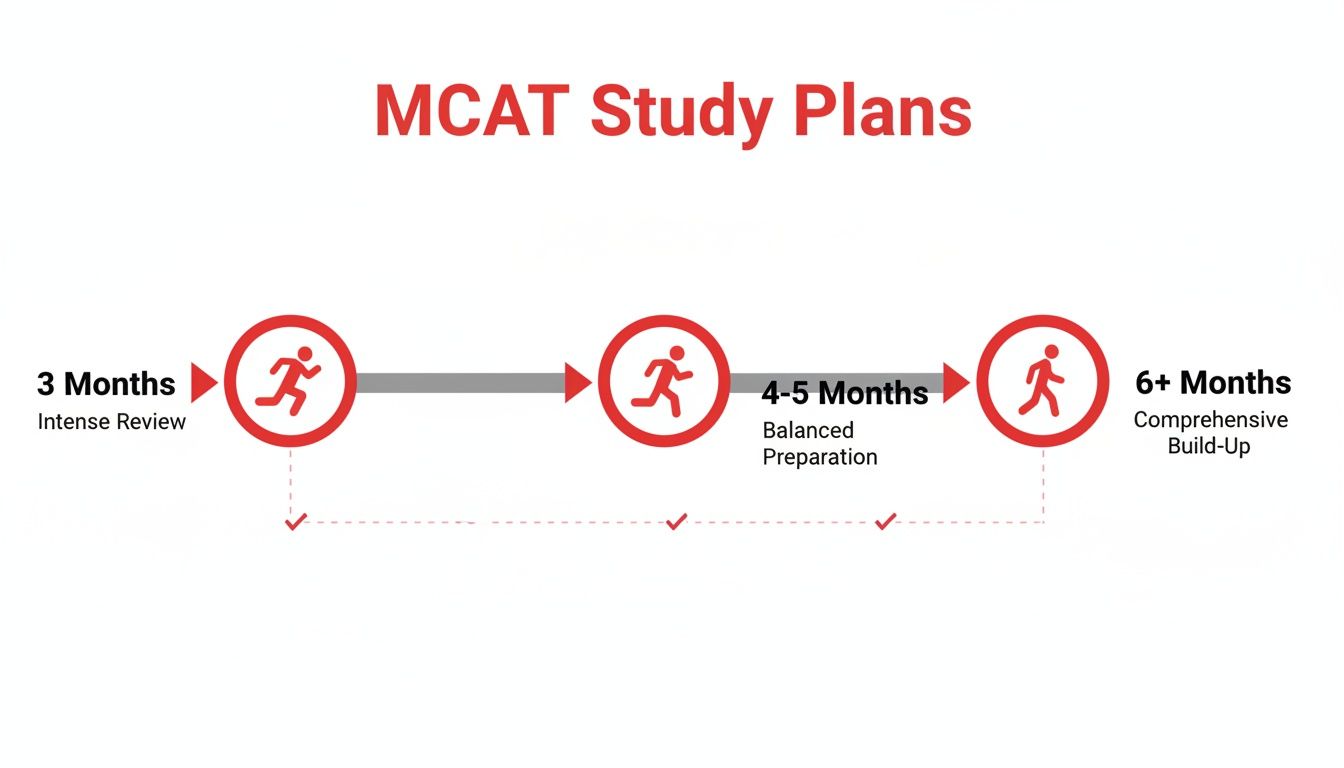
As you can see, each path demands a different weekly commitment, forcing you to find the right balance between intensity and duration for your specific situation.
To help you decide, here’s a quick comparison of the three most common study timelines. This table should give you a clearer picture of what each path entails and who it’s best suited for.
Sample MCAT Study Timelines At a Glance
| Study Timeline | Best For | Typical Weekly Hours | Key Focus |
|---|---|---|---|
| The 3-Month Sprint | Students with a completely free schedule (like a summer break). | 30-40 hours/week | Intense, full-time immersion in content and practice. |
| The 4-5 Month Balance | Students juggling a moderate course load or a part-time job. | 15-25 hours/week | Integrating consistent study sessions without burnout. |
| The 6+ Month Marathon | Non-traditional students, full-time workers, or those with heavy academic loads. | 10-15 hours/week | Slow, steady, and sustainable progress over a longer period. |
Ultimately, the best timeline is the one you can realistically stick to without completely burning out. Consistency is far more important than intensity when it comes to long-term retention and success on the MCAT.
Your MCAT preparation is a mental marathon, not just an academic one. The principle of progressive overload, often used in fitness, applies perfectly here—you must consistently and gradually increase the difficulty of your practice to build mental stamina and knowledge.
Laying the Groundwork for Success
No matter which timeline you choose, the core principles of effective prep don't change. Successful MCAT takers are almost always proactive planners. Research shows that over 80% of students start by deeply understanding what the exam covers, and a massive 75% create detailed study schedules from the outset.
They don't just study; they strategize. They consistently use practice exams—especially the official AAMC full-lengths—and laser-focus on their weak areas. This approach is far more common among high-scorers than simply enrolling in a generic prep course.
To start building out your plan, you can dive deeper into our guide on MCAT content review strategies. This whole initial stage is about creating a personalized, actionable roadmap that will guide you all the way to test day.
Designing a Weekly Schedule That Actually Works
Turning your big-picture MCAT plan into a sustainable, week-by-week routine is where the real work begins. This isn't just about blocking out time on a calendar; it's about building a system that makes every hour count without driving you toward burnout. The best schedules are both structured and flexible, built around the most effective ways to actually learn and retain information.
The key is to ditch passive learning habits. Simply re-reading chapters or highlighting notes feels productive, but it gives you a false sense of security that crumbles under pressure. Your weekly schedule must be built around active recall—forcing your brain to retrieve information rather than just recognizing it on a page.

This means your schedule has to include techniques that actively engage your mind. Spaced repetition systems like Anki are perfect for this, as they prompt you to review concepts right at the moment you're about to forget them, locking them into your long-term memory.
Building Your Core Weekly Structure
A balanced week should weave together content review, practice questions, and pure skill-building in a way that feels manageable. A great way to start is by theming your days around specific MCAT subjects or skills. This stops you from getting stuck in one area for too long while others get rusty.
For example, you might dedicate two days to the big science topics. Maybe you tackle Biology and Biochemistry on Monday, then pivot to Chemistry and Physics on Wednesday. This lets you do deep dives into related subjects without completely overwhelming yourself.
One non-negotiable? Daily CARS practice. Unlike the other sections, CARS is a skill that only improves with consistent, daily effort. Carving out 30-60 minutes every single day for CARS passages is a habit that pays massive dividends on test day.
A Sample Student's Weekly Blueprint
Let's look at a real-world example. Imagine a pre-med student, Alex, who's juggling a part-time job and a full course load. Here’s how Alex could realistically structure a 20-hour study week:
Monday (4 hours):
- Morning (1 hr): Daily Anki review + 2 CARS passages.
- Afternoon (3 hrs): Deep dive into a high-yield Biology topic (like cellular respiration), immediately followed by 15-20 UWorld practice questions on that specific topic.
Tuesday (3 hours):
- Morning (1 hr): Daily Anki review + 2 CARS passages.
- Evening (2 hrs): Focus on a Psychology/Sociology chapter, adding new terms to an Anki deck as they come up.
Wednesday (4 hours):
- Morning (1 hr): Daily Anki review + 2 CARS passages.
- Afternoon (3 hrs): Tackle a tough Physics concept (like fluids), find a supplemental video explanation, and then work through related practice problems.
This structure allows Alex to cover all the bases without feeling like every day is a marathon. Each session has a clear purpose, combining new content with immediate application. For more detailed examples, check out our complete guide to building an https://acemedboards.com/mcat-study-schedule/.
Your most valuable resource isn't just time; it's your mental energy. Scheduling your toughest subjects, like organic chemistry or quantum physics, during your peak focus hours can dramatically improve your learning efficiency.
Integrating Active Study Techniques
Beyond scheduling what to study, you need to define how you'll study. This is where active learning really shines. Instead of just taking notes, try the Feynman Technique—explain a concept out loud in simple terms, as if you were teaching it to a friend. If you get stuck or can't explain it clearly, you haven't really mastered it yet.
This proactive approach is critical for finding your real knowledge gaps. After every block of practice questions, your review process needs to be just as disciplined as your study session was. I recommend creating a spreadsheet to log every mistake. Categorize it by type: was it a content gap, a misread question, or a simple calculation error? This data is gold—it tells you exactly where to focus your energy next.
Finally, remember that your schedule is a living document. Life happens. You have to be ready to adjust your plan based on how you feel and how you're scoring on practice questions. More than just blocking out time, think about optimizing your study periods with energy management strategies to match difficult subjects with your peak focus hours. The goal is to create a tough, resilient routine that works for you and keeps you moving toward your target score.
Mastering Practice Exams and Score Analysis
Let's be clear: practice exams are the single most powerful tool in your MCAT prep. But just taking them isn't enough. The real magic—the score jumps that get you into your dream school—happens when you transform each full-length test into a deep, analytical learning session.
Think of each practice test as a full dress rehearsal. It’s not just about knowing the science; it's about building the mental and physical stamina to survive a grueling 7.5-hour exam. Simply clicking through questions on your couch won't cut it. You have to simulate the real deal.

Creating a Realistic Test Day Simulation
To get the most out of every practice exam, you need to treat it with the same seriousness as the actual MCAT. This is how you train your mind and body for the pressure, building the focus and endurance you'll need when it counts.
- Start Time: Set your alarm. Be at your desk and ready to start by 8:00 AM, just like the real test day.
- Environment: Find a quiet spot where you won't be interrupted. No music. Put your phone in another room—seriously.
- Timed Breaks: Take your breaks exactly as timed. Get up, stretch, grab your planned snack, but be back in your seat before the break is over. This is a skill in itself.
- No Interruptions: Tell your family or roommates that you're off-limits for the entire testing period.
This isn't about being difficult; it's about disciplined training. This level of simulation minimizes the chances of anxiety or burnout throwing you off your game on your actual test day.
The Power of the Error Log
Here’s where the real learning begins. The review process for a full-length exam should take at least as long as the test itself, if not longer. This is where you dig in and figure out why you made mistakes, not just what you got wrong. The best way to track this is with a detailed error log, which can be as simple as a spreadsheet.
For every single question you missed—and even the ones you guessed on and got right—you need to dissect the root cause. This deep dive is what separates top scorers from everyone else.
A single, thoroughly reviewed practice exam is worth more than three exams where you just glance at the score. Meticulous analysis turns a disappointing number into actionable data, paving the way for significant point increases.
This is how you get better. It's not about the score itself; it's about the story that score tells you. For those aiming for a top-tier score, this process is non-negotiable. Getting a 515 or higher puts you in the 91st percentile. According to Kaplan's analysis of AAMC data, students who hammered out over 4,400 practice questions saw an average 15-point score increase.
Categorizing Your Mistakes for Targeted Improvement
Your error log needs columns that help you categorize each mistake. Over time, this data will reveal recurring patterns in your performance, which should directly dictate your study plan for the following week.
Here are the essential categories to track for every error you make:
- Content Gap: The most straightforward error. You just didn't know the information. The fix? Hit the books or videos and master that specific topic.
- Misread the Question/Passage: You knew the science but completely misinterpreted what was being asked. Maybe you missed a critical word like "NOT" or "LEAST." The solution is to practice slowing down and reading more deliberately.
- Calculation Error: A simple math mistake cost you the point. The only way to fix this is to practice your mental math and get in the habit of double-checking your work.
- Overthought the Answer: Your gut was right, but you talked yourself out of it. This usually points to a lack of confidence, which can be built with more timed practice and trusting your initial instincts.
- Time Pressure: You felt the clock ticking, rushed, and made a sloppy mistake. This means you need to work on your pacing and time management strategy for that section.
By tracking these reasons, you'll see your weaknesses in black and white. If you find that 60% of your errors are from "Misread the Question," you know to spend the next week focusing on active reading strategies, not just drilling more content.
This data-driven approach stops you from studying hard and helps you start studying smart. If you're looking for the best resources to pull from, check out our breakdown of the best MCAT practice tests.
The Final Two Weeks: Your Test Day Countdown
You’ve made it. The final stretch before your MCAT is here, and it's absolutely not the time to cram new, complex topics. This period is all about consolidation, building confidence, and getting your logistics locked down for a smooth, low-stress experience. Pushing too hard now can lead to burnout, which can undo weeks of disciplined effort.
Your main goal should be to taper your study intensity. Think of it like a marathon runner resting before a big race. You aren't stopping completely, but you're shifting from the heavy lifting of learning new material to light, strategic reviews. This keeps the essential information fresh without causing mental exhaustion.
Tapering Your Study and Shifting Focus
Instead of trying to tackle new chapters or dense scientific passages, your focus needs to pivot to high-yield, quick-recall material. This is the perfect time to solidify the foundational knowledge that will translate into easy points on test day.
Your study sessions should now be shorter and more targeted. Spend this time reviewing the things you’re most likely to forget under pressure.
- Formulas and Equations: Drill the key physics and chemistry equations one last time until they're second nature.
- Amino Acids: Solidify your knowledge of the structures, three-letter codes, one-letter codes, and properties. These are guaranteed points.
- Key Concepts: Do a quick review of major metabolic pathways like glycolysis or touch on key psychological theories.
- Quick Sheets: Go over any summary sheets or "brain dump" pages you've created throughout your prep.
The entire goal of these final two weeks is to walk into the testing center feeling calm, prepared, and ready to execute. Overstudying at this stage often creates more anxiety than it resolves. Trust the months of hard work you've already put in.
This tapering strategy ensures your brain is rested and sharp, ready for the intense cognitive load of the exam. For more on managing your time during the test itself, check out our detailed guide on the MCAT test time breakdown.
Prioritizing Wellness and Test Day Logistics
How you manage your health and anxiety in these last two weeks is just as critical as any last-minute content review. Your performance on test day is directly tied to your mental and physical state.
Sleep is your new number one priority. Aim for 7-9 hours of consistent, high-quality sleep each night. Just as important, start adjusting your sleep schedule to align with your test day wake-up time. This helps regulate your circadian rhythm so you feel naturally alert on exam morning, not groggy and fighting your alarm.
Equally important is nailing down your test day logistics well in advance to eliminate any chance of last-minute panic.
- Plan Your Route: A few days before the exam, do a trial run to the testing center at the same time and on the same day of the week as your test. This lets you anticipate traffic, figure out the best parking, and find the building without stress.
- Pack Your Bag: A day or two before the test, get everything you need packed and ready. This includes your valid photo ID, water, and the pre-planned snacks and lunch you’ll need for your breaks. Don't leave this for the morning of.
- Mindfulness and Anxiety Management: If you feel stress building, incorporate mindfulness techniques. Seriously, even five minutes of deep breathing or meditation can significantly lower cortisol levels and sharpen your focus.
By handling these details ahead of time, you free up precious mental energy to focus solely on the test itself. Your preparation journey has been a long one; this final countdown is about making sure all that hard work pays off when it matters most.
When to Consider Expert MCAT Tutoring
Studying for the MCAT on your own can feel empowering, but it can also be incredibly isolating. You might hit a score plateau that you just can’t seem to break, or maybe one section—often the notoriously tricky CARS—refuses to budge, no matter how many passages you grind through. These moments of frustration are common, but they're also important signals.
When your practice scores have stalled for three or more full-length exams, that's a red flag. It’s a clear sign that your current approach just isn't cutting it anymore. This is the point where expert guidance can be the key to unlocking your potential and hitting a score that makes you a competitive med school applicant.
Identifying the Signs You Need a Mentor
Let's be clear: recognizing you need help is a sign of strength, not weakness. So many high-achieving students find themselves in a position where their hard work simply isn't translating into score increases. This is often where a tutor can make the biggest difference.
Consider looking for expert support if you find yourself in any of these situations:
- Persistent Score Plateaus: You’ve taken multiple practice tests and reviewed them like crazy, but your score is stuck in the same range.
- Chronic Section Weakness: You consistently underperform in one area (like C/P or CARS) and are completely out of ideas on how to fix it.
- Overwhelming Content Gaps: You feel lost in the sheer volume of material and have no idea how to prioritize the high-yield topics from the noise.
- Lack of Accountability: You struggle to stick to your own study plan and need that external structure and motivation to stay on track.
These are exactly the challenges where personalized, one-on-one guidance shines. A great tutor does more than just explain concepts; they diagnose the root cause of your struggles.
The Strategic Advantage of Personalized Tutoring
Working with an expert isn't just about content review; it's about strategy. A great tutor acts as your coach, helping you dissect complex questions, manage your time under pressure, and build the confidence you need to perform when it counts. They create a customized roadmap based on your specific weaknesses.
For example, a service like Ace Med Boards focuses on this exact tailored approach to MCAT prep. Their whole philosophy is built around personalized strategies and expert one-on-one guidance.
This kind of one-on-one mentorship means you get a study plan designed to fix your unique problems, not some generic, one-size-fits-all course.
The real value of a tutor is their ability to offer a fresh, expert perspective. They can spot patterns in your mistakes that you're too close to see, turning frustrating plateaus into breakthrough score increases.
A Smart Investment in Your Future
Investing in tutoring can feel like a big expense, but it's crucial to see it in the context of your long-term goals. There's immense pressure to nail a high score on the first attempt, and for good reason. Multiple MCAT attempts can complicate your application, even if you end up with a better score.
Data from ResidencyAdvisor.com shows that a student with a 3.7 GPA who scores a 512 on one or two attempts can see a 55-70% acceptance rate at mid-tier MD programs. But if it takes three tries to hit that same score, the rate can drop to 45-60%. You can discover more insights about MCAT attempts on ResidencyAdvisor.com.
This really highlights how important a strong initial prep strategy is. Targeted tutoring is designed to help you get that high score the first time, helping you avoid the stress and potential drawbacks of retesting. If you're considering this path, exploring the best MCAT tutoring services can give you a clear idea of what to look for in a program. Getting the right help at the right time is one of the most strategic moves you can make on your journey to medical school.
Answering Your Top MCAT Prep Questions
Even the most meticulous study plan runs into roadblocks. Questions always pop up, and tackling them head-on is the best way to quiet the anxiety and get back to what matters: scoring points. Let's dig into some of the most common questions I hear from students in the thick of their MCAT prep.
How Much Content Review Is Really Enough?
This is the million-dollar question, and the answer is almost always less than you think. So many students get stuck in the content review quicksand, passively reading textbooks for months, convinced they need 100% mastery before even looking at a practice question. This is one of the biggest mistakes you can make.
Your goal isn't to become a walking, talking encyclopedia of science. It’s to get points on a standardized test.
The most effective approach is to dedicate 3-6 weeks to a focused, foundational content review. Use this time to cover the high-yield topics and, more importantly, to figure out where your biggest knowledge gaps are. After that initial pass, your learning needs to be driven by practice.
Think of it this way: Content review gives you the tools, but doing practice questions teaches you how to actually build something with them. You want to shift from broad learning to targeted problem-solving as quickly as possible.
What Are the Must-Have AAMC Resources?
The AAMC (Association of American Medical Colleges) creates the MCAT, which makes their official prep material the undisputed gold standard. These resources are the closest you'll get to the real thing, and using them is absolutely non-negotiable. If you're on a tight budget, spend your money here before anywhere else.
Here are the essentials:
- AAMC Official MCAT Practice Exams: There are five of these full-length exams. They are the most accurate predictors of your actual score and should be treated like gold. Save them for the final weeks of your prep.
- AAMC Section Bank: This is a beast. It’s a collection of 300 very challenging, passage-based questions for the three science sections. They’re known for being difficult, but they are incredible for sharpening the critical thinking and data interpretation skills you'll need on test day.
- AAMC CARS Diagnostic Tool & Question Packs: CARS is a skills-based section, which means you get better by doing, not just by reading about strategy. These packs give you a huge volume of official passages to work through, helping you nail down your timing and approach.
Third-party materials are great for building your foundation and for sheer volume of practice, but your performance on AAMC material is the truest measure of where you stand.
Should I Use Anki or UWorld First?
This is a classic chicken-or-the-egg debate, but the most effective strategy is to use them together in a specific workflow.
Start with a pre-made Anki deck (like the AnKing or Jack Westin decks) during your initial content review phase. The spaced repetition is perfect for drilling foundational facts and concepts into your long-term memory.
Once you shift into your dedicated practice phase, UWorld becomes your primary learning engine. It has over 3,000 fantastic practice questions, and its explanations are second to none. Your daily routine should look something like this:
- Start your day by clearing out your scheduled Anki reviews. This keeps old info fresh.
- Dive into a block of UWorld questions, usually focusing on a specific topic you're studying.
- Review every single question—right or wrong. For anything you struggled with or got wrong, create your own new Anki cards.
This creates a powerful feedback loop. UWorld shows you exactly where your knowledge is weak, and Anki helps you patch those holes permanently.
How Do I Avoid MCAT Burnout?
Let's be clear: MCAT prep is a marathon, not a sprint. Burnout is a very real, very serious threat that can completely derail months of your hard work. The trick is to be proactive about your mental and physical health, not reactive.
First, schedule protected time off. I mean it. At least one full day every single week where you do absolutely nothing related to the MCAT. No "light" Anki reviews. No "quick" passage reads. Your brain needs this time to rest, recharge, and consolidate everything you've learned.
Second, don't abandon the fundamentals of being a healthy human. Prioritize your sleep. Eat actual nutritious meals. Move your body. You don't need to run a marathon, but even 20-30 minutes of walking can clear your head and reduce stress.
Finally, you have to learn to listen to your body. If you're hitting a wall, feeling totally exhausted and unfocused, forcing yourself to push through another three-hour study block is just counterproductive. Sometimes, the most productive thing you can do is take an unscheduled break and come back fresh.
Navigating these challenges is much easier when you have a guide. At Ace Med Boards, we specialize in creating personalized study plans and providing the one-on-one expert support you need to conquer the MCAT. If you're feeling stuck or overwhelmed, book a free consultation to see how we can help you hit your goal score. Learn more at https://acemedboards.com.