Let's get straight to the point. Your MCAT score is generally good for three years. Think of it like a stamp in your passport—it has an expiration date, and it needs to be current for you to get into medical school.
Your MC-AT Score's Shelf Life Explained

This three-year window isn't just some random number pulled out of a hat. It's a carefully considered rule from the Association of American Medical Colleges (AAMC) designed to make sure your science knowledge is still fresh.
Medical school is an academic marathon, and admissions committees need to see that you're ready for the starting line. An older score just doesn't give them that same confidence.
This policy is the standard for almost every MD-granting school in the U.S. So, if you took the MCAT in January 2024, your score would be valid for applications that lead to matriculation in the fall of 2027. Simple as that. For a deeper dive into the data, this detailed study on MCAT validity offers great insights.
Your MCAT score is a snapshot of your knowledge at a specific moment. The three-year rule ensures that snapshot is still a clear and accurate picture of your abilities when you finally hit "submit" on your application.
To help you get a handle on this critical timeline, we've put together a quick summary table. Getting these details straight is the first step in building a smart application strategy.
MCAT Score Validity at a Glance
This table breaks down the key aspects of your MCAT score's lifespan. Use it as a quick reference as you map out your application journey.
| Aspect | Duration | Reasoning |
|---|---|---|
| Standard Validity | Three years | Ensures foundational science knowledge is current and relevant for medical school curriculum. |
| Governing Body | The AAMC | The Association of American Medical Colleges sets this standard for U.S. medical schools. |
| Admissions View | A measure of readiness | Ad-comms see it as proof of your current ability to handle rigorous coursework. |
Understanding this timeframe is crucial. It directly impacts when you should study, test, and apply. You can also explore our guide on MCAT score release dates to get your testing schedule just right.
Why the Three Year Rule Exists
That three-year expiration date on your MCAT score isn’t just some random deadline pulled out of a hat. It's a carefully considered timeframe built around a core concept: predictive validity. Admissions committees (AdComs) rely on your score to forecast how well you’ll handle the intense academic demands of medical school.
Think of it like a weather forecast. A prediction for tomorrow's weather is pretty reliable, right? But a forecast for a month from now? Not so much. In the same way, a recent MCAT score gives a strong signal of your current scientific knowledge and critical thinking skills. As time marches on, that predictive signal naturally gets weaker.
This isn’t just a hunch; it’s backed by a ton of research. The AAMC has a vested interest in making sure the test continues to accurately pinpoint candidates who will not only survive but thrive during their preclinical years and on grueling board exams like the USMLE Step 1.
The Science Behind Score Freshness
Let's be real: an MCAT score from five years ago probably doesn't reflect who you are as a student today, especially if you've been out of the academic world for a while. Science moves forward, and our memory of complex topics can fade. The three-year rule ensures that every applicant is being judged on relatively current data, making for a much fairer comparison across the board.
At its heart, the three-year validity period is all about maintaining the MCAT's integrity as a standardized tool. It guarantees that every score represents a recent and relevant snapshot of an applicant's academic readiness.
This standard is absolutely essential for upholding the high academic benchmarks that medical education is built upon. By keeping the data "fresh," schools can feel much more confident in the students they choose to admit. While a great MCAT score is a huge piece of the puzzle, it's just one of several critical medical school admissions requirements AdComs look at.
Data Driven Decisions
Statistically speaking, the three-year window lines up perfectly with the MCAT's proven predictive power. A massive AAMC study showed that high MCAT scores (510+) could predict 71% of the variance in how students performed in their preclinical courses. Even more impressively, those scores were linked to a 92% success rate in progressing steadily through medical school without issues.
This research, which tracked over 25,000 students, is a huge reason why AdComs value a recent score so highly. You can dig into the full findings yourself in this multisite study on MCAT validity and student performance.
How Medical Schools Really View Older Scores

So, your score is technically still valid. That's a great start, but it's not the whole story. Just because your MCAT score falls within that three-year window doesn't mean admissions committees (AdComs) view it the same way they'd see a brand-new one.
Think of it like a professional certification on a resume. An older one shows you had the skills at one point, but a recent one proves your knowledge is sharp and current.
When an AdCom sees a score from two or three years ago, a few questions pop into their minds. Have you kept up that level of scientific knowledge? Are you still ready for the academic marathon of med school, especially if you’ve been on a gap year or working in a non-science field?
This is where the story you tell with your application becomes absolutely critical. An older score isn't a red flag, but it does mean you need to be proactive and show them you’re still at the top of your game.
Proving Your Current Academic Fitness
If you're applying with a score that’s gathering a little dust, your job is to build a rock-solid case that you're just as prepared—if not more so—than you were on test day. You have to actively silence any doubts before they even form. You need to show, not just tell, that you're ready for day one.
How do you do that? By pointing to concrete, recent experiences:
- Recent Science Coursework: Crushing upper-level science classes or a post-baccalaureate program is one of the strongest signals you can send.
- Clinical or Research Roles: Deep involvement in a lab or a clinical setting demonstrates you're still living and breathing scientific principles.
- A Strong GPA Trend: An upward trajectory in your grades, especially in your final years, reinforces your academic stamina.
The key is to connect the dots for the admissions committee. You have to frame your recent experiences as proof that your scientific reasoning and dedication have only gotten stronger since you took the MCAT.
Ultimately, understanding what medical schools look for goes way beyond the numbers on a page. They want to see a consistent, current, and undeniable passion for medicine. An older score, backed up by strong recent achievements, can absolutely still deliver that message.
Navigating Different Program Requirements
While the three-year rule is a solid benchmark, it's a huge mistake to assume it applies everywhere. Think of it as a national speed limit; individual states—or in this case, individual schools—can and do set their own rules. So, answering "how long is the MCAT good for?" really requires a closer look at the different paths to medicine.
The landscape of medical education is diverse, and so are the admissions requirements. You’ll find the biggest variations between different types of programs. While the standard three-year validity is most common among U.S. allopathic (MD) schools, it's definitely not a universal guarantee.
MD vs DO vs International Programs
Osteopathic (DO) programs, which use the AACOMAS application service, often stick to the three-year guideline but can sometimes be a bit more flexible. On the other hand, some of the most competitive MD programs or specialized combined-degree tracks might have a stricter two-year window. International medical schools are the real wild card, with some accepting much older scores and others having their own unique prerequisites.
This is exactly why doing your own research is non-negotiable. The AAMC’s policy provides a framework, but the final say always comes from the individual institution you're applying to. This three-year shelf life became the standard after the big 2015 exam update, backed by AAMC data suggesting a link between recent scores and better outcomes in med school.
The Golden Rule: Always, always verify the MCAT validity policy on the admissions website of every single school you plan to apply to. Making an assumption here could lead to an automatic, and completely avoidable, rejection.
The table below breaks down what you can generally expect, but remember to treat it as a guide, not gospel. Nailing down these details is a crucial part of building your list of prerequisites for medical school.
MCAT Validity Policies by Program Type
| Program Type | Typical Validity Period | Key Considerations |
|---|---|---|
| U.S. MD Programs | 2-3 years | This is the most common standard, but always double-check with top-tier or specific combined-degree programs for stricter rules. |
| U.S. DO Programs | 3 years | Generally aligns with the AAMC standard, though some might offer slightly more flexibility. Verify via AACOMAS and individual school sites. |
| International Schools | Varies widely | Policies can range from 2 years to 5+ years. This requires the most diligent, school-specific research on your part. |
Ultimately, it falls on you to confirm the exact requirements for your target schools. Don't let a simple oversight on an expiration date derail your application before it even gets a fair review.
Deciding if You Need to Retake the MCAT
So your MCAT score is still valid. That's great, but the real question isn't about the calendar—it's about strategy. A "valid" score and a "competitive" score are two very different things, and deciding to retake the test is a major crossroad on your premed journey.
Let's be honest: this decision is a big deal. It pits a huge investment of your time and energy against the potential reward of opening doors to more selective medical schools. A higher score can completely change the narrative of your application, especially if you're trying to balance out a lower GPA or have your sights set on top-tier programs.
Key Questions to Ask Yourself
Before you even think about cracking open another prep book, you need a solid framework for this decision. It can't just be about wanting a better score; you need a strategic reason. A retake is a serious undertaking, so your motivation has to be grounded in a realistic look at your goals and where you stand right now.
Start by asking yourself these brutally honest questions:
- Is my current score competitive for my dream schools? Don't guess. Look up the median MCAT scores for accepted students at the schools on your list. If your score is lagging significantly behind their average, a retake might be the only way to become a viable candidate.
- Have I actually made significant academic progress? If you've crushed a post-bacc program or aced upper-level science courses since your last exam, you might have the new knowledge base to really move the needle on your score.
- Is my score about to expire? This one’s simple. If your score will expire during the upcoming application cycle for any of your target schools, a retake isn't a choice—it's a necessity.
A strategic retake is about more than just boosting a number. It's an opportunity to demonstrate resilience, academic growth, and an unwavering commitment to your medical career—qualities that admissions committees really notice.
Making this choice takes some serious thought, but a well-planned retake can be an incredibly powerful move. If you're leaning that way, you can find some powerful strategies in our guide on how to improve your MCAT score.
Building Your Application Timeline with Confidence
Knowing how long your MCAT score lasts is the first step in building a smart application strategy. This isn't just about meeting a deadline; it's about turning that looming uncertainty into a clear, actionable roadmap.
Think of it this way: a score from May 2024 is good to go for the 2028 matriculation cycle. That knowledge lets you work backward and plan every step with precision, whether you're applying straight from undergrad or taking a few gap years.
For Traditional Students
If you're on the traditional path, the sweet spot for taking the MCAT is typically the spring of your junior year. This timing is ideal because your score will be fresh for the application cycle that opens just a few months later. Plus, it gives you a two-year safety net for reapplication if things don't go as planned the first time around.
For Gap Year Applicants
Taking one or more gap years gives you a lot more breathing room. Many students find success by scheduling the MCAT for a dedicated study period after graduation. For example, testing in January of the year you plan to apply gives you a strong, recent score and frees up the spring and summer to focus on polishing your essays, secondaries, and other parts of your application.
This simple flowchart can help you map out the decision-making process if you're considering a retake.
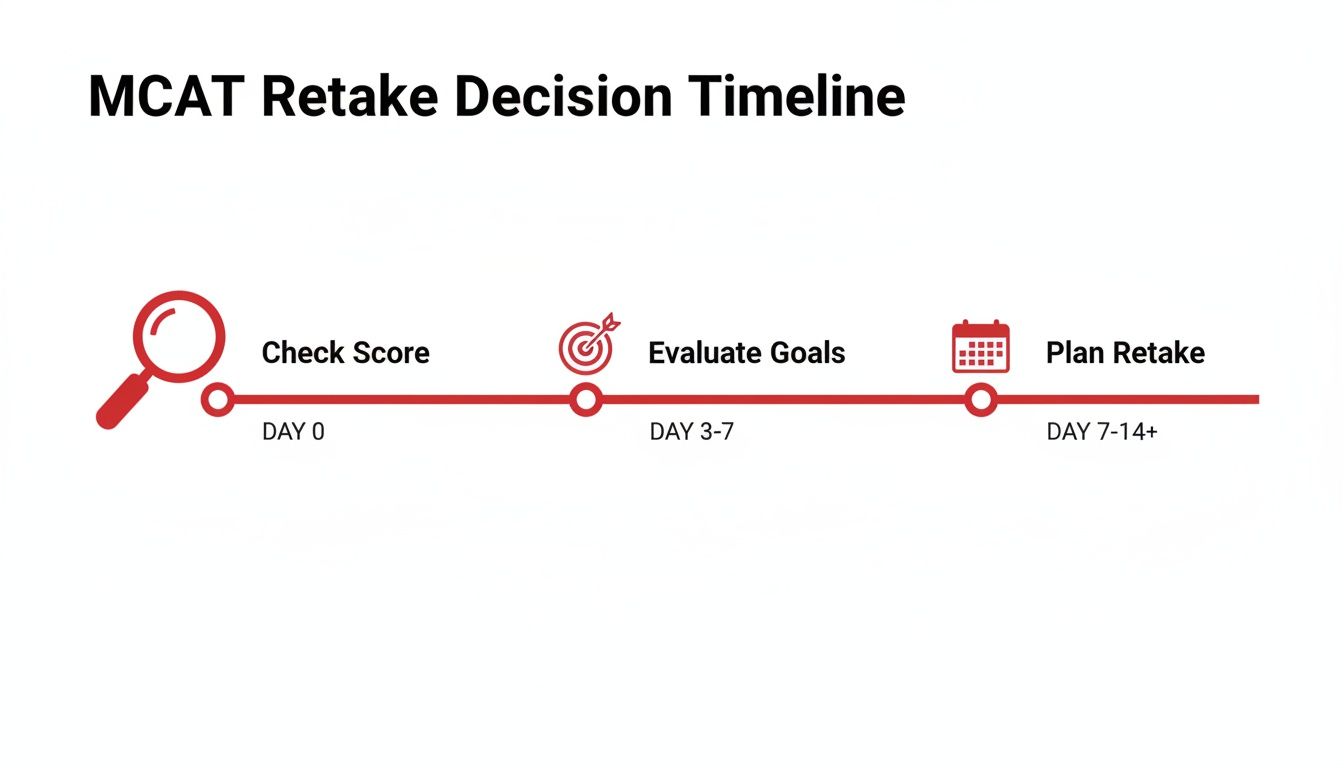
As you can see, the journey always starts with an honest look at your score. From there, you have to weigh it against the specific schools you're targeting before you even think about committing to another round of prep.
Your MCAT score is a powerful tool, but only when you use it correctly. A well-timed test gives you maximum leverage across multiple application cycles, providing both opportunity and peace of mind on your path to medical school.
Common Questions About MCAT Score Validity
You've got questions, and we've got answers. It's easy to get tangled up in the details of MCAT score validity, so let's walk through a few common situations pre-meds run into.
What If My Score Expires Mid-Cycle?
This is a classic timing trap. Here’s the deal: your MCAT score generally needs to be valid when you matriculate (that is, when you actually start med school), not just when you hit "submit" on your application.
If your score is set to expire before you'd be putting on that white coat, you'll almost certainly have to take the test again. The safest bet is to always double-check the specific policy for every single school on your list.
Do MD/PhD Programs Have Different Rules?
Thinking about a combined degree like an MD/PhD? You’ll want to pay close attention here. While most of these programs stick to the standard three-year rule, some of the most competitive ones might prefer scores that are no more than two years old.
Why? These research-heavy tracks are incredibly rigorous and put a huge premium on having the most current scientific knowledge. They want to know your biochem and physics are fresh.
The absolute best advice I can give is to check directly with the admissions office for any specialized program. Their requirements can be much stricter than the standard MD track, so never, ever assume.
How Does a Retake Look on My Application?
So, you're thinking about retaking the MCAT even though your old score is still valid. First, know this: schools will see all of your scores. There's no hiding an attempt.
A big jump in your score can be a fantastic story, showing grit and determination. On the flip side, a lower score could raise some uncomfortable questions. The bottom line is to only retake the exam if you are truly confident you can do better.