Getting a medical school waitlist notification is not a rejection. Far from it. It’s the admissions committee telling you you're a strong, competitive applicant who made the cut in an incredibly selective pool. Think of it as a holding pattern, not a final no. The committee sees your potential but has to juggle its class size after sending out initial acceptances.
What a Medical School Waitlist Really Means

Landing on a waitlist can feel like you're stuck in limbo. You're not in, but you're not out, either. That ambiguity is frustrating, but understanding what’s happening behind the scenes can give you the power to move forward with a real strategy.
Medical schools use waitlists for one simple reason: yield management. They always send out more acceptance letters than they have seats because they know not every accepted student will enroll. Many top-tier applicants get multiple offers and can only say "yes" to one. The waitlist is their go-to tool for filling the seats that inevitably open up as other students decline their offers.
The numbers alone show just how competitive this game is. In a recent cycle, 51,946 applicants were fighting for just 23,000 first-year spots. That works out to only about 44% of candidates getting an immediate acceptance. This leaves over half the pool—roughly 28,000 people—either rejected or waitlisted. You can dig into more data on the tough medical school acceptance rates to get the full picture.
This reality means that even exceptionally qualified applicants often find themselves waiting. It’s just part of the process.
To help you get organized fast, here’s a quick-reference table outlining the immediate steps you should take.
Your First Steps After a Waitlist Notification
| Action Item | Key Objective | Timeline |
|---|---|---|
| Accept Your Spot on the Waitlist | Formally confirm your continued interest. Schools won't consider you otherwise. | Within 24-48 hours |
| Read the School's Instructions | Understand their specific rules for communication and updates. | Immediately |
| Draft a Letter of Intent (LOI) | Articulate your strong, specific reasons for wanting to attend their program. | Within 1-2 weeks |
| Identify Significant Updates | Gather new grades, awards, publications, or experiences to share. | Ongoing |
| Notify Your Pre-Health Advisor | Seek expert guidance and keep them in the loop. | Within the first week |
Following this checklist ensures you cover all your bases without missing a critical step in the early days.
Ranked vs. Unranked Waitlists
One of the first things you need to figure out is what kind of waitlist you're on. This detail directly shapes your strategy.
- Ranked Waitlists: Some schools put applicants in a specific numerical order. If you're number 5 on a ranked list, you have a pretty good idea of where you stand. Movement is more predictable—when a spot opens up, the offer goes to the next person in line. The catch? Schools almost never tell you your actual rank.
- Unranked Waitlists: This is the much more common approach. Here, the admissions committee treats the entire waitlist as a pool of equally qualified candidates. When a seat becomes available, they dive back into that pool to find the applicant who best fits the class's needs at that moment. The decision could be based on diversity, a specific experience, or a powerful demonstration of interest.
Being on an unranked waitlist means the game isn't over. It's a direct invitation to keep advocating for yourself and show them exactly why you are the perfect person to fill an open spot.
The Unpredictability of Waitlist Movement
The toughest part of being on a medical school waitlist is how unpredictable it all is. Movement is driven by things you have zero control over, like how many accepted students decide to go somewhere else.
Some years, a school might pull dozens of students off the waitlist. In other years, it might only be a handful—or none at all.
This uncertainty is exactly why just sitting back and hoping is a losing strategy. You have to shift your mindset. See this as your opportunity to reinforce your commitment and give the admissions committee new, compelling reasons to pick you. This is your chance to prove you haven't given up and that your passion for their program has only gotten stronger. Proactive, professional engagement can make all the difference.
Writing a Standout Letter of Intent

After the initial shock of a waitlist decision wears off, your Letter of Intent (LOI) becomes your single most powerful tool. This isn't just a formality; it's a strategic move that can genuinely influence an admissions committee. A well-crafted LOI shows unwavering commitment and, more importantly, provides fresh, compelling evidence of your growth as a candidate.
This is no time for a generic template. To stand out, your letter needs to be specific, sincere, and perfectly tailored to that one school.
Letter of Intent vs. Letter of Interest
First, let's clear up a common point of confusion. People often use these terms interchangeably, but they serve very different purposes. Sending the right one is critical.
Letter of Interest: Think of this as a strong "like." You send this to a school that remains a top choice, but maybe not your only top choice. It expresses your continued enthusiasm and provides updates, but it stops short of a definitive commitment. You can send multiple letters of interest.
Letter of Intent (LOI): This is the heavyweight. An LOI is a formal declaration that if the school offers you a seat, you will unequivocally accept. You can only send one true LOI. Sending more than one is an ethical breach that can backfire badly if schools find out.
The power of a true Letter of Intent lies in its certainty. For an admissions committee trying to fill its final seats, a candidate who guarantees they will enroll is incredibly valuable. It removes all the guesswork from their yield management.
What Makes an Update Meaningful?
Your LOI has to be more than just a promise; it needs to contain substantial new information. The goal is to show the admissions committee that you’ve been actively strengthening your candidacy since you first applied. A generic "I'm still interested" won't move the needle.
So, what actually counts as a "meaningful" update?
- New Academic Achievements: This is one of the strongest updates you can send. We're talking about a recently completed semester with a high GPA, especially in tough upper-level science courses.
- An Improved MCAT Score: If you retook the MCAT and saw a significant jump—generally 3+ points—this is a major update you absolutely must highlight.
- Publications or Presentations: Have you co-authored a paper that was recently published or accepted? Did you present a poster or give a talk at a conference? This is huge.
- Expanded Roles and Responsibilities: Don't just list more hours. Detail new responsibilities. For instance, maybe you’ve gone from a volunteer to a trainer for new volunteers. Or perhaps you were given a leadership role in your research lab.
- New Certifications or Skills: Relevant certifications, like becoming an EMT, or gaining proficiency in a specific lab technique like CRISPR, add tangible value to your profile.
Avoid sending updates about minor activities that don't add a new dimension to your application. Every piece of new information should reinforce why you're a great fit for medicine and for that specific school. For a deeper dive, our detailed guide on the medical school letter of intent breaks down the structure and tone even further.
Structuring Your Letter for Maximum Impact
Your LOI should be professional, concise, and never more than one page. Structure it logically to guide the reader through your case.
1. A Clear and Direct Opening
Get straight to the point. Start by stating your name, AAMC ID, and the purpose of your letter. Explicitly state that this school is your number one choice and that you will matriculate if accepted. Leave absolutely no room for ambiguity.
2. The "Why This School" Paragraph
This is the heart of your letter. You have to go deeper than what you wrote in your secondary application. Connect your recent experiences directly to specific programs or values at the school. Did your new role at a free clinic solidify your passion for serving the underserved, which happens to be a key part of the school's mission? Does your recent research publication align perfectly with the work of a specific professor there? Name names and programs. Show you’ve done your homework.
3. The Updates Section
Here's where you detail your new achievements. Use a few clear, concise sentences or a bulleted list to present your updates. Frame each one in terms of the skills or insights you gained. For example, instead of just saying "Published a paper," say "Co-authored a publication in the Journal of Clinical Investigation, where I was responsible for analyzing the statistical data, which significantly strengthened my quantitative research skills."
4. A Professional Closing
End by reiterating your firm commitment one last time. Thank the admissions committee for their time and their continued consideration of your application.
The margins in medical school admissions are razor-thin. Acceptance rates at individual MD programs average a punishing 4.23%, with some ultra-selective schools like Tulane (1.41%) and Johns Hopkins (2.07%) dipping even lower. This fierce competition is exactly why so many amazing applicants land on a waitlist, where a powerful LOI can truly make all the difference. Your letter is your final, best shot to prove you belong in that accepted class.
Mastering Your Communication Timeline
Navigating your communication after being waitlisted is a delicate art. Sending too many emails will just annoy an already overworked admissions committee, but complete silence can make them forget you exist. The key is a professional, well-timed strategy that keeps you on their radar for all the right reasons.
This isn't about bombarding their inbox. It’s about making every single point of contact meaningful. Your goal is to show them you’re still growing as a candidate and that your interest is unwavering, all without crossing the line into becoming a nuisance.
The First 48 Hours: Acknowledgment is Key
Your first move should happen almost immediately. As soon as you get that waitlist notification, you need to formally accept your spot on the list. Most schools require this, and dropping the ball here could get you removed from consideration entirely.
Keep this first email short, professional, and straight to the point. Thank them for their continued consideration, state clearly that you accept your place on the waitlist, and briefly reiterate your strong interest in their specific program. This is not the time for a big update; it's just a simple, respectful acknowledgment.
The 4-6 Week Mark: The First Real Update
After that initial email, it’s time to go quiet for a bit. Give the admissions committee some breathing room. The ideal time to send your first significant update—usually in the form of a Letter of Intent (LOI) or a detailed update letter—is about four to six weeks after you were waitlisted.
This timing is strategic. First, it respects the committee’s insane schedule as they juggle initial acceptances and rejections. Second, it gives you enough time to actually accomplish something new and substantial to tell them about. Sending an update too soon can look desperate and likely won't contain any truly new information.
Before you hit "send" on any email, ask yourself this one question: "Does this new information provide a compelling reason for the adcom to pull up my file again?" If the answer isn't a firm "yes," it's better to wait.
Picking Your Communication Channel
When it comes to how you should reach out, there's a clear winner.
- Email: This is almost always the way to go. It’s professional, it creates a written record of your correspondence, and it lets the recipient respond on their own schedule. Always send your communications to the general admissions office email address unless they’ve told you to contact a specific person.
- Phone Calls: Just don’t. Avoid calling unless you have a critical, time-sensitive administrative question (like a major issue with your applicant portal). Phone calls interrupt their workflow and are absolutely not the right way to provide updates or express interest.
Above all, follow the school's specific instructions to the letter. If a program explicitly says "do not send additional materials," then you must respect that. Ignoring their rules is a massive red flag. It shows you can't follow directions—a fatal flaw for a future physician. Getting a handle on the entire application cycle can provide helpful context; for a broader view, check out our guide on the complete AMCAS application timeline.
What Actually Counts as a "Significant Update"?
Not every little thing you do is worth an email. To avoid spamming the committee with minor news, you have to be selective. A significant update is something that adds a new, impressive layer to your candidacy.
Here’s a quick rundown to help you figure out what’s worth sharing versus what you should probably hold onto.
| Worth Sharing (Significant Update) | Better to Hold Back (Minor News) |
|---|---|
| New MCAT score with a 3+ point increase | Shadowing a new doctor for a few hours |
| Final grades from a semester with a strong science GPA | Attending a general pre-med webinar |
| A co-authored research paper was accepted for publication | Continuing to volunteer at the same place |
| Promotion to a leadership role in a clinical or research setting | Receiving a generic certificate of participation |
Every interaction is a chance to strengthen your case. By mastering the timing and substance of your communication, you ensure every email you send makes a positive, professional, and memorable impact.
Juggling Multiple Offers and Waitlist Spots
Getting an acceptance from one medical school while you're still on the waitlist for your absolute dream program is a fantastic problem to have. It's also an incredibly stressful one. This is a high-stakes balancing act that demands careful planning, a ton of professionalism, and a solid grasp of the official rules of the road.
Your mission is to protect the seat you’ve already earned while keeping the door open at your top-choice school—all without burning any bridges. When things get this complex, borrowing some strategies for managing multiple projects can be surprisingly helpful for staying organized and sane.
Making Sense of the AAMC "Traffic Rules"
The Association of American Medical Colleges (AAMC) has a set of guidelines, known as the "Traffic Rules," designed to keep the application process fair for everyone. In the AMCAS portal, you'll encounter two key actions: "Plan to Enroll" and "Commit to Enroll." Understanding the difference is non-negotiable.
Plan to Enroll (PTE): Starting February 19, you can use this non-binding option. It tells one school, "I'm planning to come here," but it still lets you stay on other schools' waitlists or hold other acceptances. You can only select PTE for one school at a time, but you're free to change it if a better offer comes along.
Commit to Enroll (CTE): This is the final, binding move. Starting April 30, selecting CTE means you are officially done. You've made your decision. Once you click this, you have an ethical and professional duty to withdraw every other application, including all other acceptances and waitlist spots. Schools can see this status, and they expect you to withdraw from their applicant pools immediately.
At its core, this whole system is about transparency and courtesy. When you use these tools correctly, you help schools manage their class sizes, which in turn allows them to give good news to students on the waitlist. It’s about keeping the line moving for everyone.
Managing Seat Deposits and Critical Deadlines
Most medical schools will ask for a deposit to hold your place in the class. We're usually talking a few hundred dollars, and it's almost always non-refundable.
The big date you need to circle on your calendar is April 30. Before this date, you can hold multiple acceptances and pay multiple deposits. No problem.
After April 30, AAMC guidelines strongly push applicants to narrow it down to one school. Holding multiple seats beyond this date is considered poor form because it prevents other students from getting off the waitlist. While you can stay on waitlists after paying a deposit and selecting "Plan to Enroll" at one school, be prepared to forfeit that deposit if you get accepted somewhere else you'd rather go. Just think of it as the cost of keeping your options open.
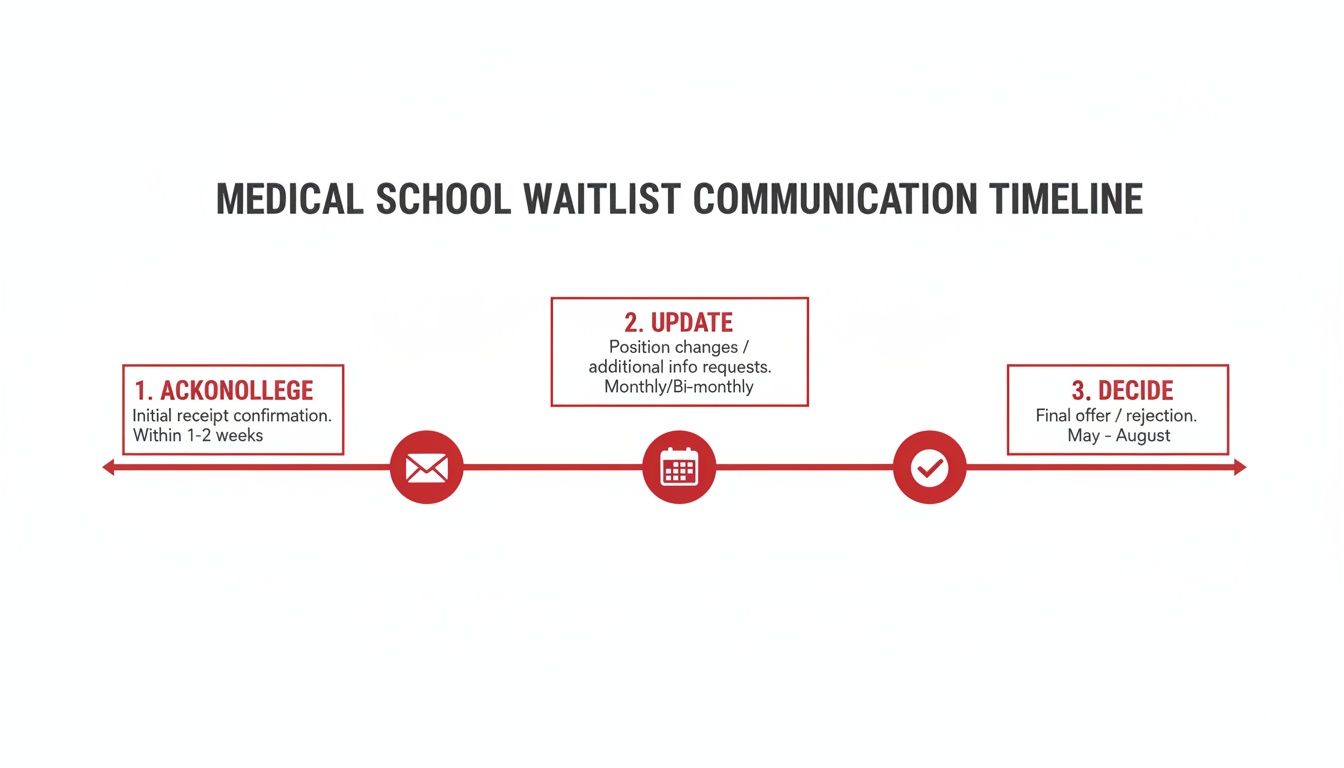
As you can see, the journey follows a clear path: you acknowledge your spot, keep the school updated with meaningful information, and then make a final, decisive choice when the time comes.
To help you navigate these tricky decisions, here's a quick decision-making framework.
Decision Matrix for Multiple Offers and Waitlists
This table breaks down common scenarios you might face when holding an acceptance while waiting on other schools. The goal is to make a professional and strategic choice that aligns with AAMC guidelines.
| Scenario | Recommended Action | Key Consideration | AAMC Guideline |
|---|---|---|---|
| Holding 1 Acceptance, on 1 Waitlist (Dream School) | Pay deposit for the accepted school. Select "Plan to Enroll." Send a Letter of Intent to the waitlist school. | Securing your spot is the priority. The deposit is the cost of keeping your top option alive. | Permitted. "Plan to Enroll" keeps your waitlist spot active. |
| Holding 2+ Acceptances (Pre-April 30) | Pay deposits to hold your top 2-3 choices. Do not select "Plan to Enroll" yet. | You can hold multiple seats, but be mindful of costs. This gives you time to visit schools or get more info. | Permitted. You have until April 30 to hold multiple acceptances. |
| Holding 2+ Acceptances (Post-April 30) | Choose ONE school, pay the deposit, and select "Plan to Enroll." Professionally withdraw from all other acceptances. | Holding multiple seats after this date blocks other applicants. It's a matter of professional courtesy. | Strongly discouraged. You must narrow down to one "Plan to Enroll" selection. |
| Get Off Waitlist for Dream School (After Paying Deposit Elsewhere) | Accept the new offer. Select "Commit to Enroll" immediately. Professionally withdraw from the first school. | Act quickly and decisively. You will likely lose your first deposit, but you're securing your top choice. | Required. You must withdraw other applications upon selecting "Commit to Enroll." |
Navigating this requires you to be organized, timely, and respectful. Following these steps ensures you act with integrity throughout the process.
A Real-World Waitlist Scenario
Let's walk through a situation I see every year. You got into School B—a great program—and you've already paid the deposit. But you're still on the waitlist for School A, your absolute top choice. What's the play?
- Lock In Your Spot. First things first, accept the offer from School B and pay their deposit before the deadline. This is your safety net. You now have a guaranteed seat in a medical school class. Don't risk it.
- Use "Plan to Enroll." Head over to the AMCAS portal and select "Plan to Enroll" for School B. This signals your good-faith intention while keeping all your other options on the table.
- Advocate for School A. Now, you pivot your focus. It's the perfect time to send that powerful Letter of Intent to School A. Make it crystal clear that they are your number one choice and you will attend without hesitation if you get in.
- Make the Call. The phone rings—it's School A with an offer! It's time to act fast. Formally accept their offer, and then go directly to the AMCAS portal and select "Commit to Enroll" for School A.
- Withdraw with Grace. Simultaneously, you must contact School B (and any other school where you have an active application) to professionally withdraw. A polite, concise email is all you need. Thank them for the opportunity and let them know you'll be matriculating elsewhere. Do this the same day you get the offer from School A. Another deserving applicant is anxiously waiting for that spot you're holding.
Thinking about how many medical schools to apply to from the start can sometimes help manage the complexity of this end-of-cycle juggling act. Ultimately, this process is a test of your organizational skills and professionalism. By following the rules and communicating with courtesy, you can navigate this period with integrity and land exactly where you're meant to be.
Staying Resilient and Planning Your Next Steps

Let's be honest: being waitlisted is tough. The emotional weight of the uncertainty can be draining, and managing that stress is just as critical as managing your application. This period tests your resilience, but it's also a chance to take back control by planning for every possible outcome.
Your first priority has to be your mental health. It’s tempting to refresh your email every five minutes or obsessively scroll through student forums for any sign of waitlist movement, but that's a direct path to anxiety.
Instead, create a structured routine. Limit yourself to checking your email and applicant portals once or twice a day at set times. This one small change can dramatically lower that constant feeling of high alert and give your mind the space it needs to focus on other things.
Building Your Proactive Plan B
True resilience isn't just about weathering the stress; it's about being prepared for whatever comes next. While you absolutely should remain hopeful for an acceptance, you need to simultaneously build a proactive 'Plan B' for a potential reapplication cycle. Having a concrete plan is empowering and ensures you aren’t left scrambling if you don't get off the waitlist.
This plan should be a strategic, honest assessment of your entire application. Think of it as a constructive self-audit to find and strengthen any potential weak spots.
Start by looking at your application with fresh eyes. Where could it be stronger?
- Academic Metrics: Was your MCAT score on the lower end for that particular school? Are there any dips in your GPA, especially in key science courses?
- Experiences: Did you have enough meaningful clinical exposure? Was your research experience substantial, or did it feel more like a brief stint?
- Personal Statement and Secondaries: Did your essays truly articulate your "why medicine" story and your specific fit with each school's mission?
This isn’t about dwelling on negatives. It's about finding clear opportunities for growth.
A well-structured 'Plan B' transforms waiting from a passive, stressful experience into an active, productive period of self-improvement. It ensures that no matter the outcome, you are moving forward on your journey to becoming a physician.
Seeking Feedback and Strengthening Your Profile
One of the most valuable things you can do right now is get an outside perspective. If you have a supportive pre-health advisor, schedule a meeting to go over your application with them. They’ve seen thousands of applications and can often spot weaknesses you might have missed.
Some schools—though not all—may offer feedback to waitlisted or rejected applicants after the cycle is over. Check the admissions website for their policy. If they offer it, take full advantage. Hearing directly from the source provides truly invaluable insight.
For some applicants, this period is also an opportunity to bolster their profiles for future cycles. This could involve anything from gaining new experiences to getting credentials in order, which for some may mean seeking reliable academic document translation services for international coursework or activities.
Finally, think about how a gap year could strategically enhance your profile. A productive gap year is a powerful asset for any re-applicant, allowing you to gain meaningful experiences that directly address any identified weaknesses. For a deep dive into your options, check out our guide on making the most of a gap year before medical school.
By preparing for all possibilities, you remain in command of your journey, turning a period of uncertainty into a chapter of deliberate growth.
Common Questions About the Medical School Waitlist
The waitlist is a black box, and the uncertainty can be maddening. It’s only natural to have a million questions running through your head. Let's cut through the noise and get you some straight answers so you can focus your energy where it actually counts.
Should I Retake the MCAT While on the Waitlist?
This is a high-stakes question. My advice? Only consider a retake if you are absolutely certain you can get a significant score bump—think 3 or more points. A flat score doesn't help you, and a lower one can actively torpedo your chances by planting new seeds of doubt.
You need to be brutally honest with yourself about the timeline. Can you realistically carve out enough quality prep time without your current grades, research, or job taking a nosedive? A better score is a powerful update to send a school. But if your current MCAT is already solid and near the school's median, your time is almost always better spent getting more clinical hours or wrapping up that research project.
How Can I Find Out My Rank on the Waitlist?
The short answer is: you can't. The vast majority of medical schools don’t rank their waitlists. They see it as a pool of equally qualified candidates they can draw from as needed. Even for the rare schools that do have a ranked list, they almost never share that information.
Don't waste your time and energy chasing a number you have zero control over. Instead, pour that energy into things you can control:
- Writing a powerful Letter of Intent that makes a compelling case.
- Sending meaningful updates that show your continued growth and commitment.
- Deepening your experiences so you have even more to talk about.
Asking about your rank can come across as unprofessional or suggest you haven't read their policies. It's much better to respect their process and focus on strengthening your own file.
Your energy is a finite resource. Spend it on actions that add demonstrable value to your application, not on trying to uncover information schools intentionally keep private.
Is It a Good Idea to Send Another Letter of Recommendation?
This one is simple: it depends entirely on the school's specific instructions. Many admissions committees are very clear that they will not accept additional, unsolicited materials. Ignoring a direct instruction like that is a huge red flag—it makes them question your ability to follow directions, which is a non-negotiable skill for a doctor.
Now, if a school is open to updates, a new LOR can be a game-changer, but only if it highlights a significant new achievement. A letter from your research PI because you were just named a co-author on a publication? That's gold. Another generic character reference from a professor who already wrote for you? Not so much. The new letter has to bring a fresh, impressive perspective that the committee hasn't already seen.
When Is the Latest I Might Hear Back from a Waitlist?
The prime time for waitlist movement is from May through July. Things really heat up after the April 30 "Plan to Enroll" deadline and subsequent "Commit to Enroll" dates, as schools finally get a solid count of who is actually coming.
But that's not a hard deadline. It’s not unheard of for applicants to get a call in August, sometimes just a few weeks or even days before orientation starts. While you should absolutely hold onto hope, you also need to be pragmatic. As summer rolls on, it’s wise to quietly start thinking about and preparing for a potential reapplication. This way, you’re in a position of strength, ready for whatever happens.
Navigating the complexities of the waitlist and preparing for high-stakes exams requires a solid strategy. The expert tutors at Ace Med Boards provide personalized guidance to help you strengthen your profile and ace your boards. Explore our services and schedule a free consultation today.