Your USMLE Step 1 score percentile tells you one simple, crucial thing: what percentage of other test-takers you scored higher than. For example, landing in the 75th percentile means you outperformed 75% of your peers. It’s a direct measure of your competitive standing in a huge crowd of aspiring doctors.
What Your Step 1 Percentile Really Means

Think of your medical school journey like a marathon. Your three-digit Step 1 score is your finish time, but your USMLE Step 1 score percentile is your official rank. It answers the one question that really matters: "How did I do compared to everyone else who ran the same race?"
This single number transforms a raw score into a powerful, context-rich ranking. It shows you exactly where you stand in the national pool of medical students—invaluable information for both your own assessment and, of course, for residency applications.
The Shift to Pass/Fail and Why Percentiles Still Matter
The USMLE Step 1 exam officially switched to a Pass/Fail system in January 2022. So, do old scores and percentiles even matter anymore? Absolutely.
Residency program directors are still sorting through thousands of applications from students who have three-digit scores on their transcripts. For these applicants, a strong percentile remains a major advantage that can directly influence who gets an interview.
Even if you're taking the new Pass/Fail version, this historical data provides an essential benchmark. It helps you understand the level of mastery needed not just to pass, but to pass comfortably and build a rock-solid foundation for the numerically scored Step 2 CK exam.
A percentile isn’t just a number; it’s a reflection of your relative command of the foundational sciences compared to a national standard set by your peers. It's a key piece of the puzzle in a competitive application.
Why This Metric Is Critical for Your Application
Ultimately, a percentile rank offers a clear, standardized way for you and programs to gauge your performance. It cuts through the noise of scaled scores and gives everyone an intuitive measure of your knowledge base.
Here’s how understanding your percentile helps:
- Benchmark Your Knowledge: Are you average, above average, or truly exceptional in your grasp of the material? The percentile tells you instantly.
- Guide Your Strategy: A percentile that's lower than you hoped for might be a signal to double down on other parts of your application, like research or Step 2 CK prep.
- Inform Residency Choices: Highly competitive specialties have historically filtered applicants based on top-tier scores and percentiles. Knowing where you stand helps you build a realistic school list.
By demystifying this number, you can better interpret your own performance and build a smarter, more strategic plan for the residency match.
For those still mapping out their study timeline, using tools that forecast performance can be a game-changer. You can get a better handle on your readiness with a USMLE Step 1 score predictor. This insight helps you focus your efforts where they'll have the biggest impact.
The Rising Bar of Step 1 Performance Trends
To really get what a Step 1 percentile means, you have to look at the exam's history. The hyper-competitive landscape we associate with the exam didn't just pop up overnight. It was built over decades as medical students, year after year, got better and better. This created what many of us called a "rising bar," where each new class of students slightly out-performed the last.
This steady climb meant that the definition of a "good" score was always a moving target. What was considered a rock-solid performance one year might have been viewed as just average a few years later. This context is crucial for understanding the intense pressure tied to the exam before it switched to Pass/Fail. For any applicant with a three-digit score, it paints a picture of the incredibly competitive world they navigated.
Why Did Scores Keep Climbing?
So, what was driving this constant upward trend? A few things. Medical education itself got more sophisticated, and at the same time, students got access to an explosion of high-quality, targeted study resources. Think about the rise of platforms like UWorld and Sketchy. This powerful combination allowed students to prepare more efficiently and master the material more deeply than ever before.
As the exam's role in residency applications became more and more important, the time and energy dedicated to prep skyrocketed. This fed a cycle of ever-increasing competition. The national average score crept higher, which in turn pushed the performance needed to land in a top-tier USMLE Step 1 score percentile even further out of reach.
The consistent upward trend in scores over two decades wasn't an accident. It was a clear signal of improved preparation and a more competitive applicant pool, fundamentally raising the standards for what it took to stand out.
The historical data tells a powerful story. Over the two decades between 1997 and 2017, the national mean score for U.S. and Canadian medical students jumped from 212 to 229. That steady climb represents an average gain of nearly a full point every single year, highlighting just how relentless the rise in performance was. For a closer look at the numbers, you can explore a detailed analysis of these encouraging trends in Step 1 performance.
The Legacy of a High Bar
Even with the exam now being Pass/Fail, this history of rising scores still casts a long shadow. The knowledge base required to simply pass today's exam was forged by this decades-long trend of academic improvement.
For current students, this means the 'Pass' threshold isn't some low bar to stumble over. It's a rigorous standard reflecting years of increasing mastery across the board. To clear it, you need a deep, thorough command of the foundational sciences—the very same knowledge that produced those ever-increasing scores. For more on what it takes, you might find our guide on the USMLE Step 1 pass rate insightful. This context is exactly why robust, dedicated preparation is still absolutely critical.
Translating Your Score into a Percentile
That three-digit score on your report feels pretty abstract, doesn't it? The number only starts to have real meaning when you translate it into a percentile. This is where you see exactly how your performance stacks up against thousands of other medical students.
Think of it like a massive bell curve for every test-taker in the country. Most students cluster around the average, with fewer and fewer landing at the extreme high and low ends. Your USMLE Step 1 score percentile pinpoints your exact location on that curve.
It’s not just about how many questions you got right; it’s about your relative position. Scoring in the 50th percentile means you performed better than half of all test-takers, putting you smack in the middle of the pack. It's the clearest, most immediate benchmark of your knowledge base.
Understanding the Bell Curve
The distribution of Step 1 scores has always followed this predictable bell curve pattern. The mean score represents the peak, and standard deviations show how spread out the scores are from that average.
- The 50th Percentile: This is the national average, the dead center of performance.
- The 75th Percentile: Landing here means you outperformed three out of every four of your peers—a strong signal of excellence to residency programs.
- The 90th Percentile: This is an exceptional performance. It places you in the top 10% of all examinees and makes you a highly competitive applicant for almost any specialty.
This chart shows how the average score steadily crept up over two decades. As the average increased, it pushed the entire bell curve higher, meaning you needed an even better score just to stay competitive.
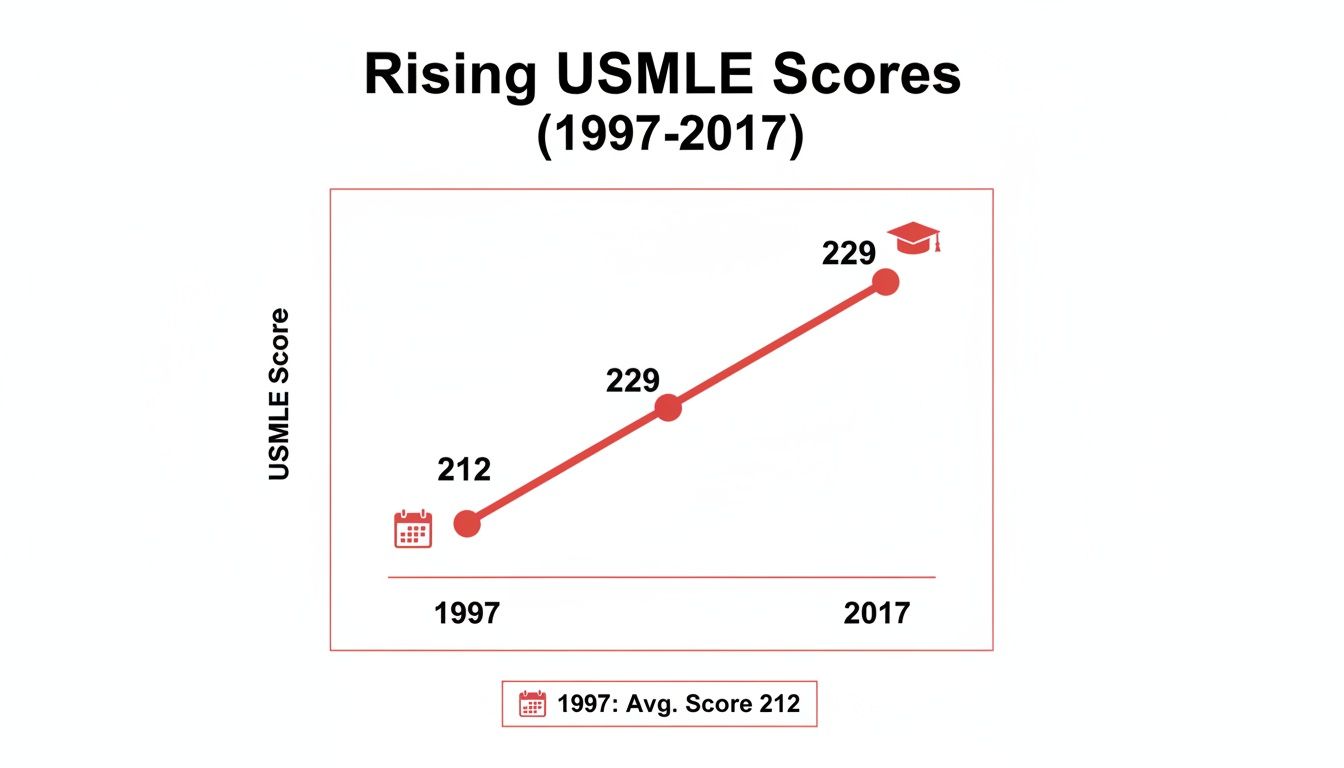
This trend meant that achieving a high percentile required a stronger and stronger performance each year. The bar was constantly being raised.
USMLE Step 1 Score to Percentile Conversion Chart (Pre-2022 Data)
Before the exam went pass/fail, residency programs relied heavily on these scores and their corresponding percentiles. This table gives you an idea of how scores historically translated into competitive rankings.
| Score Range | Approximate Percentile Rank | What This Means for Competitiveness |
|---|---|---|
| 260+ | 95th – 99th | Exceptional. A top-tier applicant for the most competitive specialties. |
| 250 – 259 | 85th – 94th | Very Strong. Competitive for nearly all specialties. |
| 240 – 249 | 70th – 84th | Strong. A competitive score for most specialties, including some competitive ones. |
| 230 – 239 | 55th – 69th | Solid. Above average and a good foundation for many residency programs. |
| 220 – 229 | 40th – 54th | Average. Meets the benchmark but may be less competitive for top fields. |
| 210 – 219 | 25th – 39th | Below Average. May limit options, especially for more competitive specialties. |
| Below 210 | Below 25th | Significantly Below Average. Would be a major hurdle for matching. |
Even though your score report will just say "Pass" or "Fail," understanding these historical benchmarks provides crucial context for the level of mastery expected on the exam.
What Different Percentiles Mean in Practice
The real-world implications of these percentiles were massive. Before 2022, a percentile was the clearest lens residency directors had to gauge an applicant's competitiveness.
For instance, a score of 245+ often put you around the 75th percentile. That meant you outscored 75% of your peers, immediately making you a standout applicant for elite fields like dermatology or orthopedic surgery.
Even in the pass/fail era, understanding this history is still incredibly useful. It shows the level of rigor the exam demands and helps you appreciate the depth of foundational knowledge needed just to get a passing mark.
If you're looking for more details on the current standards, check out our guide on the USMLE Step 1 passing score. Knowing where the bar was once set helps you prepare much more effectively for the exam as it exists today.
How Residency Programs View Your Percentile
Let's be blunt: your USMLE Step 1 percentile is more than just a number on a report. For applicants with a scored exam, it's one of the first things residency program directors see, and it can make or break your chances of getting a closer look. In a sea of thousands of applications, percentiles have always been a quick and easy way to sort the pile.
Think of it like trying to get into an exclusive club. The bouncer doesn't have time to chat with everyone in line. They scan the crowd for familiar faces or people on the VIP list. A high percentile is your VIP pass—it gets you past the velvet rope and ensures your application isn't just tossed aside.
Even with the switch to Pass/Fail, a strong numerical score and its corresponding high percentile are powerful assets. It doesn't just open doors; it can kick them wide open, especially for the most competitive specialties where it often functions as a gatekeeper for interviews.
Specialty-Specific Expectations
Not all specialties are created equal, and their expectations for Step 1 scores reflect that. A percentile that's considered fantastic for a primary care specialty might barely meet the screening cutoff for a surgical subspecialty. It's all about context.
Historically, the most competitive fields—think dermatology, neurosurgery, and orthopedic surgery—used high percentiles as a primary screening tool. Anything less than the 90th percentile might not even make the first cut.
- Highly Competitive Fields: For programs like plastic surgery or otolaryngology, you'd typically see matched applicants with percentiles in the 85th+ range.
- Moderately Competitive Fields: Specialties such as anesthesiology or radiology were often looking for applicants in the 60th-80th percentile range.
- Less Competitive Fields: While programs in family medicine or pediatrics have historically had a broader range, a percentile above the 50th still provided a significant advantage.
This tiered system means your percentile plays a huge role in shaping your application strategy and which career paths are most accessible. To get the full picture, you can learn more about what programs look at for ERAS and see how Step 1 fits into the bigger picture.
The Impact on IMGs and DO Students
For International Medical Graduates (IMGs) and osteopathic (DO) students, a standout percentile has been particularly crucial. It's one of the most direct ways to level the playing field and prove academic excellence on par with U.S. allopathic graduates.
A percentile in the top quartile (75th percentile and above) acted as a powerful equalizer, signaling to program directors that an applicant possessed the foundational knowledge to excel in any U.S. residency program, regardless of their medical school's reputation or location.
On the flip side, a lower percentile means you need to be much more strategic. You'll likely need to apply to more programs, consider less competitive specialties, or ensure that every other part of your application—research, letters of recommendation, and especially your Step 2 CK score—is absolutely stellar to make up for it.
Strategizing for the Pass/Fail Era
With the USMLE Step 1 now graded as Pass/Fail, the entire landscape of residency applications has shifted. The game has certainly changed, but the fundamental rules of excellence and preparation have not. The intense focus once placed on a single three-digit score has now been redistributed across your entire application.
This change elevates the importance of other key metrics that showcase your capabilities. Program directors need objective data to sort through thousands of applicants, and without a Step 1 score, they are absolutely looking elsewhere. This pivot makes your USMLE Step 2 CK score the new heavyweight champion of quantitative measures.
The New Center of Gravity: Step 2 CK
Your Step 2 CK score is now the single most critical numerical indicator of your clinical knowledge and reasoning skills. Think of it as a direct reflection of how well you can apply the foundational sciences you learned for Step 1 in a real clinical context. A stellar performance on this exam is no longer a nice bonus—it's essential for standing out.
Beyond Step 2 CK, other elements of your application now carry significantly more weight. Residency programs are placing a much heavier emphasis on:
- Clinical Clerkship Grades: Consistently earning Honors in your core rotations demonstrates high performance over time, not just on a single day.
- Letters of Recommendation (LORs): Strong, personalized letters from respected faculty provide crucial qualitative insight that a score never could.
- Research and Extracurriculars: Meaningful involvement shows your commitment and passion for the field, telling a story about who you are beyond the classroom.
A strong application in the Pass/Fail era is a holistic one. It tells a complete story of your competence, dedication, and potential as a future physician, not just your ability to ace one standardized test.
Reframing Your Step 1 Preparation
This new reality completely reframes how you should approach Step 1. Your goal is not just to scrape by with a pass. Instead, you need to view your Step 1 prep as building the unshakeable foundation required to excel on Step 2 CK and throughout your clinical years. A deep mastery of pharmacology, physiology, and pathology will pay dividends long after you receive that "Pass" notification.
While the exam shifted to pass/fail in 2022, the historical data still provides a vital benchmark for understanding the level of knowledge required. Before the change, the average score had climbed to around 232 by 2021, with a score of 245 marking the 75th percentile. You can explore more of this data on the official USMLE performance data site.
This context is critical. It shows that the "Pass" standard is built upon a legacy of high performance, making comprehensive preparation as important as ever for your future success.
Your Action Plan for USMLE Success

Alright, you understand the numbers. But knowing your Step 1 score percentile is only half the battle. What you do next is what truly shapes your residency match success. Whether you’re holding a three-digit score or a simple "Pass," your strategy from this point forward makes all the difference.
Think of this as your roadmap, connecting today’s preparation to a successful match tomorrow. Let's make sure you have a clear path forward.
Framing a Numerical Score
If you took the exam before it went Pass/Fail, that three-digit number is a permanent, prominent feature on your application. Your job is to build a narrative around it.
- High Scorers: If your score puts you in a high percentile, fantastic. That’s a major strength and a powerful validator of your academic horsepower. Lean into it. Apply confidently to competitive programs that value top-tier board scores.
- Average or Lower Scorers: If your score isn’t the star of your application, the mission is to make it a supporting character. You’ll need to build a compelling, well-rounded profile by crushing other areas. That means securing stellar clerkship grades, getting glowing letters of recommendation, and absolutely knocking Step 2 CK out of the park.
Your Step 1 score is one chapter in your story, not the entire book. A lower-than-desired percentile can be balanced by demonstrating excellence across the rest of your application.
Mastering the Pass/Fail Exam
For those of you facing the Pass/Fail exam, the game has changed. The goal isn't just to scrape by—it's to build a rock-solid foundation of knowledge. Why? Because your Step 1 prep is the launchpad for a stellar Step 2 CK score, which now carries much more weight in residency applications.
Pour your energy into truly mastering high-yield concepts and sharpening your clinical reasoning. This approach not only guarantees a confident pass but sets you up for success in your clinical years and on future exams. For a deep dive, a great place to start is our detailed guide on how to study for USMLE Step 1.
The Role of Personalized Tutoring
No matter your situation, test-taking is a skill—and like any skill, it can be sharpened. This is where personalized tutoring can be a game-changer. It’s the most efficient way to identify and fix your specific weaknesses, whether they're in content knowledge or test-taking strategy.
An expert tutor can help you:
- Master High-Yield Concepts: Stop wasting time on low-yield minutiae and focus your limited study hours on what actually matters.
- Develop Effective Strategies: Learn how to deconstruct complex question stems and sidestep the common traps that trip up so many students.
- Build Confidence: Get targeted, real-time feedback and support so you can walk into exam day feeling prepared, not panicked.
Ultimately, your best asset is a proactive plan. By strategically addressing your specific circumstances, you can build a competitive application that showcases your full potential as a future physician.
Frequently Asked Questions
Does My Old Numerical Step 1 Score Still Matter?
Yes, absolutely. If you took the exam before it switched to Pass/Fail, that three-digit score is a permanent fixture on your academic record. Residency programs will see it, and they'll use it to compare you with every other applicant who also has a numerical score. A high percentile remains a significant advantage.
What Was a Good USMLE Step 1 Score Percentile?
Historically, a score hovering around the 50th percentile—somewhere in the 230–232 range—was considered solid. Landing in the 75th percentile (around 245) or higher was excellent, making an applicant a strong contender for nearly any specialty. Of course, what defined a "good" score always came down to an applicant's specific residency aspirations.
How Does the Pass/Fail Change Affect IMGs?
For International Medical Graduates, the shift to Pass/Fail raises the stakes on every other part of the application. Without a stellar Step 1 score to make them stand out, IMGs now have to double down on achieving an excellent Step 2 CK score, locking down valuable US clinical experience (USCE), and securing powerful letters of recommendation.
Navigating your USMLE journey is complex, but you don't have to do it alone. At Ace Med Boards, we specialize in personalized tutoring to help you master the material, build unshakable confidence, and hit your goals.
Book a free consultation today and let's build your tailored action plan together.