Facing the USMLE Step 1 can feel like staring up at a mountain with no clear path. But what if you had a map? That's exactly what a well-used USMLE Step 1 sample exam is: your most powerful diagnostic tool. It acts as a detailed blueprint of your current strengths and weaknesses, making it the absolute cornerstone of any effective study plan.
Your Starting Point for USMLE Step 1 Success
Starting your Step 1 prep journey requires a real strategy, and nothing provides clarity like a baseline assessment. Think of your first sample exam not as a performance to be judged, but as an initial survey of the territory you need to conquer. It reveals which subjects are solid ground and which are treacherous terrain requiring a lot more attention.
With the exam's shift to a pass/fail format, the entire game has changed. The goal is no longer about chasing a sky-high three-digit score but about building the unshakable confidence and competence needed to pass securely. This guide is your roadmap to building that confidence.
Charting Your Course for Success
A structured approach is what transforms a simple practice test into a powerful engine for growth. Instead of just passively taking exams and looking at the score, you'll learn to use them actively to steer your studies. This strategic mindset is what separates students who feel prepared from those who feel like they're perpetually playing catch-up.
Your plan should focus on a few key areas:
- Strategic Selection: Learn to choose the right exams at the right time, balancing official NBME resources with top-tier third-party question banks.
- Authentic Simulation: Master the art of recreating real test-day conditions to build stamina and crush anxiety before it starts.
- Deep Analysis: Go way beyond the score report to figure out not just what you got wrong, but why you got it wrong.
- Targeted Improvement: Convert your performance data into a dynamic and efficient study schedule that actually works.
Building a Strong Foundation
Your success on Step 1 depends on more than just acing medical trivia; it requires smart resource management. A crucial, often overlooked, part of your prep is managing your budget and getting the necessary tools without breaking the bank. For tips on saving money on essential programs, it's worth exploring sources for reliable discount software for students.
By treating your first USMLE Step 1 sample exam as a diagnostic tool rather than a final judgment, you empower yourself to study smarter, not just harder. It’s the first step in moving from uncertainty to being fully in control of your preparation.
This guide will walk you through each piece of the puzzle, ensuring you know how to squeeze every drop of value out of every practice exam you take. If you're looking for a broader overview of the entire process, you can learn more about how to prepare for USMLE Step 1 in our detailed article. This comprehensive approach ensures you're not just studying content—you're mastering the exam itself.
Choosing Your Tools: NBME vs. Third-Party Exams
When you're gearing up for Step 1, it's easy to think all practice exams are the same. They're not. Knowing the difference between the official exams from the NBME and the question banks from third-party companies is one of the most important strategic decisions you'll make.
Think of it like this: the official NBME exams are your final dress rehearsal before opening night. They're made by the same people who write the real Step 1, using retired questions and the exact software you'll see on test day. This makes them the undisputed gold standard for predicting your score.
Third-party exams from companies like UWorld or Amboss, on the other hand, are your intensive training camps. They aren’t built to be predictive. Their mission is to teach. They throw a massive volume of questions at you—often tougher than the real thing—backed by incredibly detailed explanations designed to build your knowledge from the ground up.
The Gold Standard: The Official NBME Exams
The National Board of Medical Examiners (NBME) offers a set of practice tests called Comprehensive Basic Science Self-Assessments, or CBSSAs. These are your most honest and reliable benchmarks. Period.
Their power lies in their authenticity. The question style, length, and feel are designed to perfectly mirror the actual exam. Taking an NBME is the closest you can get to the real experience without sitting in a Prometric center.
But there's a catch: the answer explanations are often brief, and sometimes, they don't exist at all. The goal of an NBME isn't to teach you a concept from scratch; it's to assess whether you've already mastered it. That’s why they are best used as periodic, high-stakes check-ins to see where you truly stand.
An NBME score report is an unfiltered look at your readiness. It’s the most direct feedback you'll get, showing you exactly how you stack up against the passing standard. Use this data to make critical calls about your study plan and test date.
The Training Grounds: Third-Party Question Banks
Third-party question banks (Q-banks) are the workhorses of Step 1 prep. While the NBME gives you the final exam blueprint, companies like UWorld and Amboss provide the bricks and mortar to build your house of knowledge.
Their real value is educational. Every single question comes with an exhaustive explanation that not only breaks down the correct answer but meticulously explains why every other option is wrong. This transforms each question into a powerful mini-lesson, helping you connect concepts across different subjects.
Here’s a clear breakdown of how these resources differ:
NBME vs. Third-Party Sample Exam Comparison
Choosing the right tool at the right time is critical. This table breaks down the key differences between the official NBME self-assessments and the third-party Q-banks that will form the backbone of your daily study routine.
| Feature | Official NBME/USMLE Exams | Third-Party Q-Banks (e.g., UWorld, Amboss) |
|---|---|---|
| Primary Purpose | Assessment & Prediction | Learning & Content Mastery |
| Question Source | Retired official USMLE questions | Original questions written by the company |
| Predictive Accuracy | Very high. The best predictor of your final score. | Variable. More for tracking progress than predicting a score. |
| Answer Explanations | Minimal to none. | Extremely detailed with diagrams, charts, and summaries. |
| Software Interface | Identical to the real USMLE interface. | Similar, but proprietary to each company. |
| Question Difficulty | Mirrors the difficulty of the actual Step 1 exam. | Often designed to be harder to test deeper knowledge. |
| Best Use Case | Periodic milestone assessments (every 2-4 weeks). | Daily, high-volume practice for building knowledge. |
Ultimately, the smartest approach isn't about choosing one over the other—it's about integrating them. The most successful students use third-party Q-banks for daily, high-volume practice to build knowledge and stamina. They then strategically save the official NBME exams for milestone assessments every few weeks to get a true measure of their progress and simulate the real exam environment.
To find the right fit for your learning style, you can explore various USMLE practice tests and see which platforms click for you. This dual approach ensures you’re not just learning the material deeply but are also perfectly prepared for the unique format and pressure of test day.
How to Perfectly Simulate Test Day Conditions
Taking a USMLE Step 1 sample exam is so much more than just answering questions. Think of it as a full-scale dress rehearsal for one of the most important days of your medical career.
Real preparation means building the mental and physical stamina to perform at your peak for eight straight hours. To do that, you have to meticulously recreate the official test day environment, right down to the smallest detail.
Simply timing yourself in a quiet room won't cut it. The goal is to make the entire process—from waking up to finishing that last block—so familiar that the real exam feels like just another practice session. This eliminates surprises and frees up your mental energy to focus on the questions, not the logistics.
Setting the Stage for Success
Your environment plays a massive role in how you'll perform. Don't even think about taking a full-length exam on your couch or in a busy coffee shop. Instead, find a dedicated space that mimics the sterile, distraction-free setting of a Prometric testing center.
- Find a Quiet Zone: Choose a location where you know you will not be interrupted for 8 solid hours. This could be a library study carrel, a quiet corner of your school, or a home office with a strict "do not disturb" policy in effect.
- Eliminate All Distractions: This part is non-negotiable. Turn off your phone and put it in another room. Close every unnecessary tab on your computer and disable all notifications.
- Use Only Permitted Items: Have only water, your planned snacks, and any permitted comfort items (like earplugs) nearby. Treat it exactly as you would on test day.
The following infographic shows how this simulation is the final, crucial step in your prep.
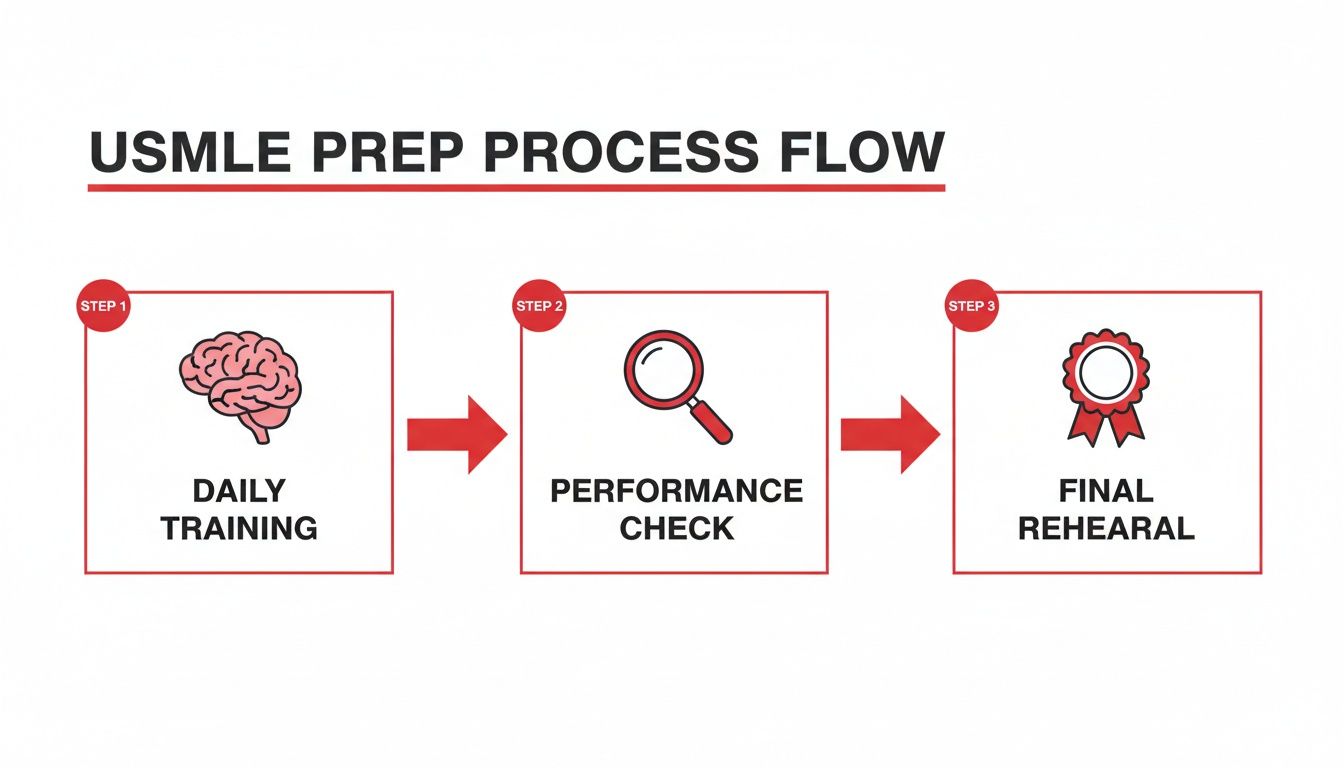
As you can see, daily training and periodic performance checks all build toward this final rehearsal. It's where you put everything together.
Mastering the Test Day Rhythm
The real USMLE Step 1 is a marathon, not a sprint. It's seven 60-minute blocks with a total of 60 minutes of break time you can use however you want. Your simulation must strictly adhere to this structure to build authentic endurance.
Start your exam at 8 AM, the typical start time for the real thing. This helps align your body clock, ensuring you're mentally sharp when it matters most. I even recommend planning and eating your exact test-day breakfast as part of the simulation—it makes a bigger difference than you'd think.
Replicating the exact timing and break structure is the single most effective way to combat test day fatigue. You train your brain to know when to focus intensely and when it can recover, preventing burnout in the final blocks.
Follow the official break schedule precisely. Here’s a common approach:
- Block 1 (60 mins)
- Optional Break (5-10 mins)
- Block 2 (60 mins)
- Optional Break (5-10 mins)
- Block 3 (60 mins)
- Lunch Break (20-30 mins)
- Block 4 (60 mins)
- And so on…
This rigid structure is what trains your mind and body for the grueling pace. Successfully managing this routine can also be a powerful tool in your arsenal; you can learn more about how to overcome test anxiety by building this kind of familiarity and control. Conquering the process is the first step to conquering the exam.
Turning Your Exam Results Into Actionable Insights
Finishing an eight-hour USMLE Step 1 sample exam feels like crossing a marathon finish line. It's so tempting to just glance at the score, breathe a sigh of relief (or frustration), and move on. But the real work—the work that actually boosts your score—starts right now.
That performance report isn't a final grade; it’s a diagnostic map, a treasure trove of data waiting to be decoded. Transforming that raw data into a powerful, personalized study plan is the single most important skill you can develop. It’s the difference between studying hard and studying smart.
This process goes way beyond just counting right and wrong answers. It's about getting into the weeds and figuring out why you made each mistake.
Decoding Your Performance Beyond the Score
First things first: take a breath and move past the emotional reaction to your score. Whether you’re thrilled or disappointed, the number itself is just one data point. The real gold is hidden in the patterns of your performance across all 280 questions.
Your next step is to create a system for categorizing every single question you got wrong. Think of yourself as a detective looking for clues. A simple spreadsheet or even a dedicated notebook works perfectly for this. Your mission is to spot the trends that reveal your unique weaknesses.
Start by sorting your mistakes into two big buckets:
- Subject-Based Errors: This is the most obvious analysis. Tally up which subjects (Cardiology, Renal, Biochemistry) and even which sub-topics (cardiac murmurs, glomerulonephritis) are tripping you up the most.
- Reason-Based Errors: This is where the magic happens. It’s the more critical, and often overlooked, category. Why did you actually miss the question? Was it a true knowledge deficit, or was something else at play?
Identifying Your Unique Error Patterns
Once you have a list of your incorrects, it's time to dig into the "why." Every mistake is a learning opportunity, but only if you diagnose its root cause correctly. This is how you turn a generic score report into a dynamic roadmap for targeted improvement.
Here are the most common error types I see students make:
- Pure Knowledge Gap: The most straightforward error. You just didn't know the fact, pathway, or mechanism being tested. These are the easiest to fix with focused content review.
- Question Misinterpretation: You knew the underlying concept but totally misread what the question was asking. This is a huge red flag for fatigue or rushing.
- Overthinking or Second-Guessing: The classic "I had it right and changed my answer" mistake. This almost always points to a lack of confidence.
- Timing and Fatigue Errors: You noticed your performance tanked in the last few blocks of the exam. This tells you that building mental stamina needs to be a priority.
Systematically categorizing every error forces you to confront the real reasons for your mistakes. Asking "Am I consistently missing pharmacology questions?" or "Do my scores always drop after the fourth block?" is how you find the highest-yield areas to fix.
This kind of deep analysis is more critical than ever. When Step 1 went pass/fail on January 26, 2022, it didn't get easier. In fact, the stakes for ensuring a comfortable pass got higher. Post-transition data shows that by 2024, US MD pass rates dropped to 89%, and repeater pass rates have been stuck at a brutal 60-61%. This highlights just how crucial it is to intervene effectively after any subpar performance.
Building Your Action Plan
With your error analysis in hand, you can now build a truly effective study plan. Instead of vaguely deciding to "review Cardiology," you can laser-focus on "arrhythmia pharmacology" because your spreadsheet showed a specific knowledge gap there.
If you spotted a pattern of changing correct answers, you know you need to work on test-taking strategies and confidence-building exercises. It's all about targeted, intelligent action.
If your analysis consistently points to certain score ranges, it might be helpful to see how that translates to your passing probability. You can learn more about using a USMLE Step 1 score predictor to gauge your readiness.
By turning your results into a concrete action plan, you ensure that every hour of studying is aimed directly at your weakest points. That's how you maximize efficiency and build the confidence you need to walk in on test day and succeed.
Common Pitfalls When Using Sample Exams
Even the best tools can be misused, and your USMLE Step 1 sample exam is no exception. Acing this prep isn't just about taking practice tests; it's about using them the right way. Falling into a few common traps can easily sabotage your progress, creating a cycle of anxiety and burnout instead of building real confidence.
Think of it this way: knowing the pitfalls is the first step to avoiding them. When you can spot an ineffective strategy, you can pivot quickly. This ensures every sample exam becomes a productive step forward, not just a frustrating setback.
Let's break down the most frequent mistakes students make and, more importantly, how you can steer clear of them.
Falling into the Burnout Trap
One of the most destructive habits is what I call "practice test burnout." This happens when you take too many full-length exams in a short time without leaving nearly enough room for a deep, meaningful review. The focus shifts from learning to just getting through the tests, and the actual learning gets completely lost.
Imagine training for a marathon by running a full 26.2 miles every single weekend. You wouldn't have any time to recover, analyze your performance, or strengthen your weak muscles. The same logic applies here. The review phase is where the real improvement happens.
The purpose of a USMLE Step 1 sample exam isn't just to get a score; it's to generate data. Taking another test before you've fully analyzed and acted upon the data from the last one is a wasted opportunity.
A much healthier schedule spaces out full-length exams by at least one to two weeks. This gives you plenty of time to dissect every single question, truly understand your errors, and patch up weak knowledge areas before your next assessment.
Suffering from Score Obsession
Another huge pitfall is "score obsession." This is when your entire focus narrows down to that single three-digit number, completely overshadowing the rich learning opportunities hidden inside each question. A lower-than-expected score can trigger panic, while a high score might create a false sense of security, causing you to gloss over crucial mistakes.
Remember, a practice score is not a judgment of your worth—it's a diagnostic snapshot in time. Its only value is in what it tells you about your current knowledge and test-taking skills.
To fight this, shift your mindset from evaluation to diagnosis. After each exam, pour your energy into understanding the why behind your errors, not just the what of your score. Ask yourself:
- Was this a pure knowledge gap I need to fill?
- Did I misunderstand what the question was actually asking?
- Did I flip my answer from right to wrong because I lost confidence?
This kind of detailed analysis is infinitely more valuable than any single number. If you find yourself struggling to move past the score, check out our guide on how to improve test-taking skills, which focuses on building a more resilient and strategic mindset.
Neglecting True Test Simulation
Finally, a critical error is failing to properly simulate real test-day conditions. Taking blocks untimed, constantly pausing the exam, or doing it in a noisy, distracting environment gives you a completely inaccurate picture of your preparedness. You might score well, but you haven't built the mental stamina required for the real eight-hour beast.
This creates a dangerous false sense of security. On test day, the rigid timing, limited breaks, and sterile environment can feel like a massive shock to your system if you haven't trained for it. You absolutely must practice like you'll play.
Commit to full, uninterrupted simulations for every single practice exam. This means starting at 8 AM, sticking strictly to the official break times, and getting rid of all potential distractions. This discipline is what builds the endurance and familiarity you need to walk into that testing center feeling calm, prepared, and in control.
Frequently Asked Questions About the USMLE Sample Exam
Jumping into USMLE prep brings up a ton of questions. We get it. This section cuts through the noise and gives you clear, straightforward answers to the most common things students worry about when using a USMLE Step 1 sample exam.
How Many Sample Exams Should I Take Before Step 1?
There's no single magic number, but a strategy that works time and time again is taking 4-6 full-length practice exams during your dedicated study block. This hits the sweet spot between getting enough assessment data and having time to actually review and learn, all without hitting burnout.
Think of it like a ramp-up. You’ll want to take a baseline exam early on to see where you stand. After that, space out the others—especially the official NBMEs—every one to two weeks. This gives you enough runway to dig deep into your review, hammer out your weak spots, and actually see your score climb.
Plan to take your final practice test about a week before the real deal. It’s the perfect way to lock in your confidence and get your test-day routine down cold.
What Is a Good Score on a Step 1 Sample Exam?
Since Step 1 is now pass/fail, the game has changed. Your goal is simple: consistently score in a range that makes passing a near certainty. Most advisors will tell you to aim for scores of 65% correct or higher on the UWorld Self-Assessments (UWSAs) and the newer NBME exams. Hitting this mark generally puts you in the 95%+ probability of passing zone.
But here’s the real pro-tip: Stop obsessing over a single score. What matters most is the trend. An upward climb across multiple exams is the best indicator that you're truly ready.
A rising trend shows your study methods are clicking and your knowledge base is getting stronger across the board. That's way more valuable than one fluke high score.
Should I Prioritize UWorld Self-Assessments or NBME Exams?
This is a classic question, but it's the wrong one to ask. It’s not an either/or situation—you absolutely need both. They serve completely different, yet equally vital, roles in your prep. Thinking you can skip one is a rookie mistake.
Here’s how to think about them strategically:
NBME Exams: These are your reality check. Written by the test makers with retired USMLE questions, they are the gold standard for predicting how you'll perform on exam day. Their score correlation is the most accurate you'll find.
UWorld Self-Assessments (UWSAs): Think of these as powerful learning tools. The UWSAs are notoriously tough, but their strength lies in their incredibly detailed explanations that teach you high-yield concepts you might have missed.
A battle-tested strategy is to use the UWSAs earlier in your dedicated period to build your knowledge and get into heavy-duty review mode. Then, save the newer NBME forms for the final few weeks to get the most accurate read on your readiness and simulate the real exam experience. It’s the perfect one-two punch to build and then validate your knowledge.
Feeling stuck or not sure what your practice exam scores really mean? The expert tutors at Ace Med Boards can help you dissect your performance data and build a personalized study plan that turns those weak areas into your biggest strengths. Find out how one-on-one guidance can unlock your score potential at https://acemedboards.com.