After pouring months into prep, the wait for your MCAT score can feel like the hardest part of the whole process. That final stretch is always the most nerve-wracking.
The good news? The timeline is incredibly predictable. MCAT score release dates are consistently set for 30 to 35 days after you sit for the exam. This means you can actually plan your next steps and application strategy without flying blind.
Understanding the MCAT Score Release Timeline
That one-month wait might feel agonizing, but there’s a solid reason for it. Think of it less as a delay and more as a crucial quality control phase.
The AAMC uses this time to meticulously double-check results, scale the scores from every test form, and make absolutely sure every single test-taker gets an accurate, fair assessment. It’s a complex system designed to maintain the integrity of the exam we all rely on.
This period isn't just dead time, though. It's the perfect opportunity to shift your focus. You can start polishing other parts of your medical school application, like your personal statement or lining up those letters of recommendation.
From Test Day to Score Day
Your journey from hitting "submit" on that exam to seeing your final score involves several key stages. The AAMC has a standardized process that keeps things consistent for everyone, no matter which MCAT test date you chose.
Let's break down exactly what's happening behind the scenes during that 30-35 day window.
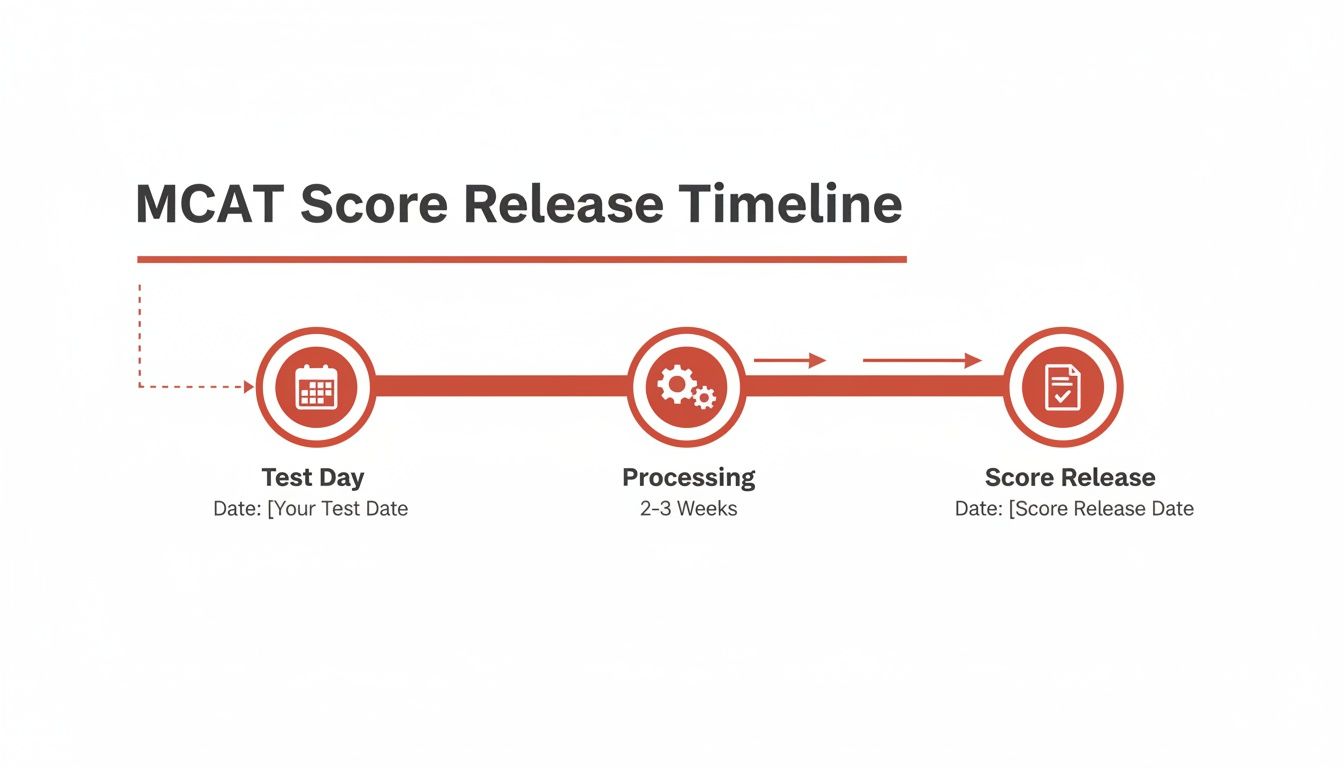
This visual shows the clear path from the moment you leave the testing center to the day your score finally lands in your account. It's a structured, reliable process.
Your MCAT Score Release Journey at a Glance
To make it even clearer, here’s a table that breaks down the key milestones from the day you take the MCAT to the moment you get that official score.
| Milestone | Typical Timeframe | What Happens During This Stage |
|---|---|---|
| Test Day | Day 0 | You take the MCAT. After nearly 7.5 hours, the raw data from your exam is securely transmitted to the AAMC. |
| Score Processing & Scaling | Day 1 to Day 29 | This is the "black box" phase. The AAMC performs quality checks, converts your raw answers into a scaled score, and ensures statistical fairness across all test versions. |
| Final Verification | Day 29 to Day 30 | A final round of verification ensures accuracy before scores are prepared for release. |
| Score Release Day | Day 30 to Day 35 | On the designated day, your official scores are posted to the AAMC Score Reporting System by 5:00 PM Eastern Time. |
This table helps you visualize why the wait is necessary and what's happening each step of the way.
Ultimately, this waiting period is a built-in part of the med school application marathon. Use this time wisely, and you’ll be ready to hit the ground running the moment your score arrives.
How to Use the AAMC Score Release Calendar
Think of the official AAMC calendar as your single source of truth for your entire application timeline. It works just like a train schedule: every departure (your test date) has a fixed, predictable arrival time (your MCAT score release date). Getting a handle on this schedule is absolutely essential for lining up your test day with your application goals.
You can find the calendar right on the AAMC website. The layout is refreshingly simple, listing every available test date for the year with its corresponding score release date right next to it. This predictable system takes all the guesswork out of your planning.
This lets you plan everything backward. If you know you need your score in hand by early July to be a competitive applicant, you can just scan the calendar and find the latest possible test date in May or early June that still hits your deadline. Simple as that.
Finding Your Perfect Test Date

The AAMC schedule is built to help you strategize. Each test date has a score release date that falls about 30-35 days later. For example, a test taken on May 31, 2026, will have its scores released on July 1, 2026. This consistent timeline is the key to timing your medical school submissions perfectly.
The real power of the AAMC calendar is its predictability. Knowing that scores are always released by 5:00 PM Eastern Time on a specific day lets you coordinate your entire application submission practically down to the hour.
To make this crystal clear, let's look at a few concrete examples of how test dates map to their release dates throughout the year.
Sample MCAT Test Dates and Corresponding Score Releases
This table illustrates the direct relationship between when you take the MCAT and when your score is released, based on the AAMC's typical schedule.
| If You Test On This Date | Your Score Is Released On This Date | Official Release Time (ET) |
|---|---|---|
| January 23, 2026 | February 24, 2026 | By 5:00 PM |
| April 24, 2026 | May 27, 2026 | By 5:00 PM |
| June 26, 2026 | July 28, 2026 | By 5:00 PM |
| September 11, 2026 | October 13, 2026 | By 5:00 PM |
By using this calendar effectively, you can choose from the various dates when MCATs are offered to build a timeline that gives you confidence and a strategic edge. This one simple step ensures your score arrives exactly when you need it for a strong, timely application.
A Step-by-Step Guide to Accessing Your Score
The day your MCAT score is released can feel like the longest day of your life. The anticipation is intense, so the last thing you want is to be fumbling around trying to figure out where to find your results. Knowing the exact process beforehand can make a nerve-wracking day just a little bit smoother.
Your score will be waiting for you in the AAMC’s MCAT Testing History (THx) system. Good news—this is the same portal you used to register for the exam, so you should already be familiar with it. When release day rolls around, just head over to the AAMC website and log in with your username and password.
Accessing the MCAT THx System
Once you're logged in, look for a link that says something like "Get Your MCAT Scores." That’s your ticket. Clicking it will take you right to your score report. The AAMC knows everyone is logging in at once, so their system is built for heavy traffic, but it’s still smart to expect a little slowness. Be patient.
Here’s a glimpse of what the score report itself looks like.

As you can see, it's a lot more than just one number. The report gives you a full breakdown of your performance, and understanding what each part means is crucial to making sense of your results.
Interpreting Your Score Report
Your official report gives medical schools a detailed picture of your performance. Getting comfortable with these components helps you understand that bigger picture, too.
- Total Score: This is the big one—your combined score from all four sections. It can range from a 472 to a 528.
- Section Scores: Each of the four MCAT sections gets its own score, from 118 to 132. This shows schools where you shined and where you might have struggled.
- Confidence Bands: These bands show the range where your "true score" likely falls. The AAMC includes them to acknowledge that a score can vary slightly on any given day.
- Percentile Ranks: This might be the most important metric of all. It’s not just about what you scored; it’s about how that score stacks up against everyone else who took the test. A 90th percentile rank means you performed better than 90% of other test-takers.
Why Your Score Release Date Is Critical for Applications
Your MCAT score release date isn't just another notification to wait for—it's a pivotal deadline that sets the entire pace of your medical school application. Think of it as the starting gun in a race. Getting a strong score early puts you in the first pack of runners, while a late score means you're starting from behind, trying to catch up.
The world of medical school admissions runs on a rolling basis. This simply means that admissions committees review applications as they come in. Submitting a complete application—and "complete" means your MC-AT score is included—puts you in that first wave of consideration when interview slots and seats are still plentiful. It's a massive advantage.
This makes your test date a huge strategic decision. A late spring or early summer score release lines you up perfectly to submit a finished application right when the primary services (AMCAS, AACOMAS, and TMDSAS) start sending them to schools. For a deep dive into how all these dates fit together, check out our complete AMCAS application timeline.
Submitting With or Without Your Score
A common question I hear is whether to submit the primary application before the MCAT score is back. You absolutely can do this, and it gets your application into the verification queue early. But there's a catch: no medical school will consider your application complete until that score arrives.
- Submitting Before Your Score: This gets the verification process out of the way, which is great. The downside is that schools won't actually review your file, and you're essentially applying blind, not knowing the final number that will define your application.
- Waiting for Your Score: This approach lets you apply with full confidence, knowing exactly what score you're working with. The risk here is a delayed submission if your score release falls late in the summer, potentially putting you behind other applicants.
The sweet spot for most applicants is to test no later than May. This timing typically ensures your score is back by late June, allowing your complete, verified application to be one of the first that admissions committees see.
For some applicants, navigating the process of academic accommodations is also a key part of this planning; understanding how to secure things like how to get extra time on SAT can offer relevant insights for structuring your MCAT prep and timeline. Ultimately, the goal is to sync your MCAT score release with the opening of the application floodgates. That alignment gives you the best possible shot at making a powerful first impression.
Planning Your Next Steps After Getting Your Score
Once your score is finally in hand, the path forward becomes much clearer. Think of your MCAT score release date as a fork in the road—one path leads directly to pushing your application forward, while the other involves a strategic plan to retake the exam.
If your score met or even beat your expectations, a huge congratulations is in order! Now it’s time to act fast. Your most immediate job is to get that score sent over to the medical schools on your list through AMCAS or whatever application service you're using. This is often the last piece of the puzzle that makes your application "complete" and ready for a serious review.
If Your Score Met Your Goal
With a strong score locked in, your attention should immediately shift to secondary applications. These school-specific essays will start flooding your inbox soon after your primary application is verified. Having that solid MCAT score lets you tackle these with confidence.
- Transmit Your Score: Head into your application portal (AMCAS, AACOMAS, etc.) and officially release your scores to your designated schools.
- Prepare for Secondaries: Start pre-writing essays for your top-choice schools. You can usually find the prompts online well ahead of time, so get a head start.
- Practice for Interviews: Begin preparing for the Multiple Mini Interview (MMI) or traditional interview formats. You don't want to be caught off guard.
If You Need to Re-Evaluate Your Score
Getting a score that’s lower than you hoped for is tough. It’s okay to be disappointed, but it is absolutely not the end of the road. This is your chance to analyze what happened, regroup, and build a much stronger plan for next time. Give yourself a day to process the news, then switch into an analytical mindset.
Don’t just stare at the total score; dig into your individual section scores. Pinpointing a specific area of weakness is the very first step toward building a more effective study plan for a potential retake.
If a retake is on the table, you need to be brutally honest about your preparation. Did you struggle with certain content areas? Maybe you ran out of time or test-day anxiety got the best of you. If your next steps involve rethinking your approach to tough subjects, a comprehensive organic chemistry study guide could be a game-changer. It's also a good idea to learn more about what is a good MCAT score to set a new, realistic target.
Frequently Asked Questions About MCAT Score Release
Even after you’ve mapped out the AAMC's timeline, a few nagging questions about your MCAT score release date can still create some anxiety. It's completely normal. Let’s tackle the most common concerns pre-meds have so you can navigate this final waiting period with a bit more peace of mind.

We'll clear up everything from what happens with holiday schedules to the real scoop on how long your score is good for.
Common Questions and Clear Answers
Here are some straightforward answers to the questions that tend to keep test-takers up at night.
What if my score release date falls on a holiday? Don't worry, the AAMC sets its calendar way in advance to sidestep major national holidays. In the extremely rare event a date landed on one, it would simply shift to the next business day. But in practice, this almost never happens.
Can my MCAT score be delayed? Delays are incredibly uncommon. They usually only happen if there’s a formal investigation into a testing irregularity at your center or a problem with your specific exam. If this were to happen, the AAMC would contact you directly.
The score release process is a well-oiled machine. Barring truly exceptional circumstances, you can confidently expect the AAMC to post your score by 5:00 PM ET on your scheduled date.
Score Validity and Potential Errors
Once that score is in your hands, two more questions often pop up: how long can you use it, and what if you think something is wrong?
How long is an MCAT score valid?
For most medical schools, your MCAT score is considered valid for three years. So, if you're applying during the 2026 application cycle, a score from 2023 would typically be the oldest one they'd accept. But—and this is important—you should always double-check the specific admissions policies for every single school on your list, as some might have slightly different rules.
For more perspective on what scores mean, check out our guide on the average MCAT score.
What if I suspect a scoring error?
The AAMC has a very strict, multi-step quality control process, which makes actual scoring errors almost unheard of. That said, if you have a strong reason to believe there was a mistake, you can pay a fee to request a rescore. Just know that this process has historically almost never resulted in a score change.
Getting through the MCAT is a huge milestone on your path to medicine. At Ace Med Boards, we're here to help you with every stage of the journey, from focused test prep to building a winning application strategy. Book a free consultation today and find out how our expert tutors can help you reach your goals.