So, you’ve hit the two-year home residency requirement on your J-1 visa. It can feel like a major roadblock, especially when your career plans are starting to take shape in the U.S. This rule is officially known as Section 212(e) of the Immigration and Nationality Act, and it’s a core part of the exchange visitor program.
Think of it as a "return ticket" that's automatically stapled to your visa. The whole point is to ensure the skills and experience you gained in the States are brought back to your home country, fulfilling the program's original mission of cultural and educational exchange. This requirement is a critical piece of U.S. Immigration Law and has a huge impact on exchange visitors.
To get around it, you'll need to demonstrate that compelling circumstances prevent you from leaving. Whether you secure a No Objection Statement from your home country, prove exceptional hardship to a U.S. citizen family member, or land a crucial role sponsored by a U.S. government agency, the goal is the same: to justify why you need to stay.
Who Is Subject to This Rule?
Not every J-1 visa holder has this two-year string attached. It typically applies if:
- Your program was funded by the U.S. government or your home country's government.
- Your specialized field of knowledge is on your home country's "Skills List," meaning your expertise is in high demand back home.
- You are an International Medical Graduate (IMG) participating in clinical training—this almost guarantees you're subject to the rule.
Trying to ignore this requirement simply won't work. If Section 212(e) applies to you, you are legally barred from changing your status to another nonimmigrant visa (like an H-1B), applying for a green card, or getting an L or K visa.
You're essentially locked out of most long-term immigration options in the United States until you either spend two years back home or get a waiver. For many, especially physicians who want to practice here, this is a massive hurdle. If you're an IMG, getting a handle on this rule is the very first step in planning your post-residency career. Our complete IMG guide dives deeper into the specific challenges and opportunities you'll face.
The two-year home residency requirement isn't just a suggestion; it's a legal barrier that prevents you from adjusting your status. The J-1 waiver is the key that unlocks the door to your future in the U.S., allowing you to bypass this rule entirely.
This is exactly where the J-1 visa waiver comes into play. A waiver isn't something you're automatically entitled to; it's a formal request to be forgiven from the two-year rule. The process is complex, but it's manageable, and a successful waiver officially cancels that "return ticket." It’s the essential bridge that lets you move from a J-1 to an H-1B or pursue permanent residency without ever having to leave the country.
The Five Pathways To Securing A J1 Waiver
Think of the J-1 waiver process not as a single door, but as a hallway with five different entry points. Each one opens with a unique key, and your first job is to figure out which one fits your specific situation. Choosing the wrong path means wasting precious time and money on an application that was never going to work for you.
That's why understanding all five pathways is the most critical first step in this entire journey.
The J-1 Exchange Visitor Program is a massive undertaking, bringing around 300,000 foreign visitors from 200 countries to the U.S. each year. With numbers that big, it's easy to see why the government has a very structured system for managing the two-year home-residency requirement.
To help you see the fork in the road every J-1 holder faces, here's a simple decision tree.
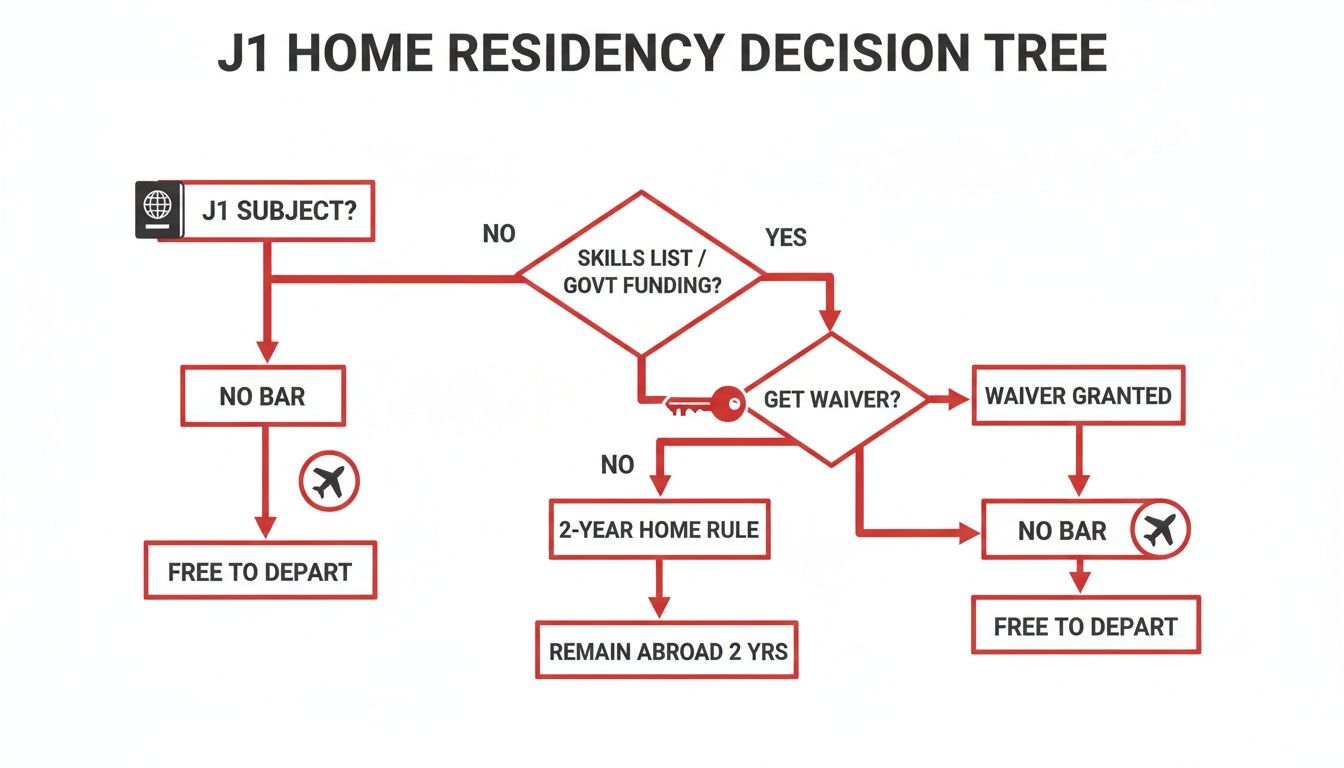
This chart boils it down: you either fulfill the two-year rule or you find a waiver that fits. Let's break down those waiver options in detail.
Comparison Of J1 Waiver Types
To get a high-level view of your options, this table quickly compares the five main waiver types. It’s a great starting point to see which path might align with your personal and professional circumstances before we dive deeper into each one.
| Waiver Type | Primary Purpose | Ideal Applicant Profile | Key Requirement |
|---|---|---|---|
| No Objection Statement | Your home country's government has no issue with you staying in the U.S. | J-1 holder without U.S. government funding whose home country is amenable. | A formal statement from your home country's government sent to the U.S. Department of State. |
| Interested Government Agency (IGA) | Your work is vital to a specific U.S. federal agency's mission. | Scientists, researchers, or specialists working on federally important projects. | Sponsorship and a formal request from a U.S. federal agency on your behalf. |
| Exceptional Hardship | To prevent severe, unusual suffering to a U.S. citizen/LPR family member. | J-1 holder with a U.S. citizen or permanent resident spouse or child. | Proving hardship that goes far beyond normal separation difficulties. |
| Persecution | To protect you from likely persecution in your home country. | J-1 holder with a credible fear of returning due to race, religion, or politics. | Substantial evidence of a well-founded fear of future persecution. |
| Conrad 30 (Physicians) | To place physicians in medically underserved communities in the U.S. | International Medical Graduates (IMGs) willing to work in a shortage area. | A 3-year employment contract in a designated underserved area. |
This table gives you the lay of the land. Now, let’s get into the specifics of what each of these really entails.
1. No Objection Statement Waiver
The "No Objection Statement," or NOS, is often seen as the most straightforward path. But don't be fooled—its success depends entirely on one thing: getting your home country's government to cooperate.
You're essentially asking your home country to officially tell the U.S. Department of State, "We don't mind if this person stays in the U.S. and doesn't come home for two years." If your J-1 program was funded by the U.S. government (like Fulbright), this door is almost always closed to you.
2. Interested Government Agency Waiver
The Interested Government Agency (IGA) waiver is for people whose work is considered critical to a U.S. federal agency's mission. Think of it as having a powerful sponsor in your corner. A U.S. agency has to step up and tell the government that your departure would actively harm their work.
This isn't something you can apply for on your own. You must first convince a federal agency that you are indispensable to one of their projects. It's a common route for high-level scientists and researchers working on projects of national importance.
Key Takeaway: An IGA waiver is a two-step process. First, you secure sponsorship from a federal agency. Only then can that agency petition for your waiver.
3. Exceptional Hardship Waiver
This waiver is purely humanitarian. To qualify, you have to prove that leaving the U.S. would cause exceptional hardship to your U.S. citizen or lawful permanent resident spouse or child. And trust me, they mean "exceptional."
This is a very high bar to clear. Simply being separated from family or facing financial strain isn't enough. The hardship has to be far more severe than what's normally expected in these situations, often involving serious, documented medical conditions that can't be managed in your home country.
4. Persecution Waiver
The Persecution waiver is another humanitarian option, but it's for your own safety. This path is for you if you can show a credible, well-founded fear that you will be persecuted if you return home.
The basis for this persecution must be tied to your race, religion, or political opinion. Proving this requires a mountain of evidence and a clear, compelling story that demonstrates the specific threats you would face. It’s a complex legal argument that should not be taken lightly.
5. The Conrad 30 Program For Physicians
For International Medical Graduates (IMGs), the Conrad 30 Program is the most well-known—and for good reason. It was designed specifically to address doctor shortages in medically underserved parts of the U.S.
Under this program, each state’s Department of Health can recommend up to 30 physicians for a J-1 waiver each year. The catch? You have to agree to work in an area that desperately needs doctors.
To get a Conrad 30 waiver, an IMG must:
- Have a full-time job offer from a healthcare facility in a designated Health Professional Shortage Area (HPSA) or Medically Underserved Area (MUA).
- Commit to working there for at least three years.
- Be ready to start work within 90 days of the waiver being approved.
This program is extremely competitive, and finding an eligible job is half the battle. If you're heading down this road, our guide on the best tools to find IMG-friendly residency programs can give you a much-needed edge in your search.
Mastering The Conrad 30 Waiver For Physicians
For countless International Medical Graduates (IMGs), the Conrad 30 waiver isn't just another option—it's the path to practicing medicine in the United States after residency. This program was ingeniously designed to funnel talented physicians into the very communities that need them the most, turning a major immigration hurdle into a win-win for public health.
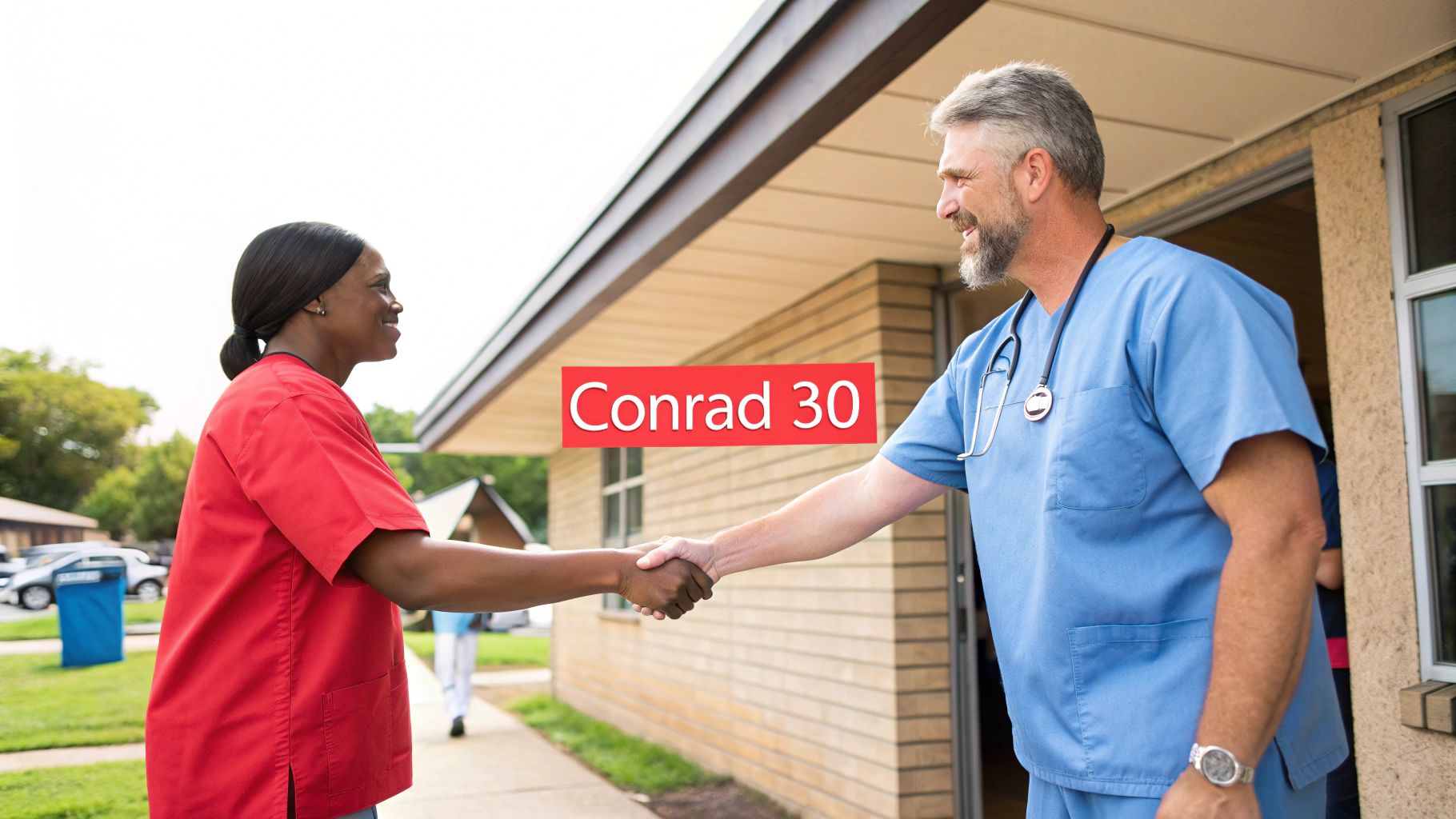
Think of it as a straightforward deal. The U.S. government agrees to waive your two-year home residency requirement. In exchange, you commit to practicing in a designated underserved area for at least three years. This is more than just getting a job; it’s about securing a specific role in a qualifying location and locking in a long-term service commitment.
The Core Conrad 30 Eligibility Criteria
To even be considered for a Conrad 30 waiver, you have to hit several non-negotiable benchmarks. Each one is there to ensure the program actually works as intended by improving healthcare access. Miss even one, and your application is dead on arrival.
Your application absolutely must include:
- A Full-Time Employment Contract: You need a signed, legally binding contract for a full-time job—that means at least 40 hours per week—at a healthcare facility in a federally designated Health Professional Shortage Area (HPSA), Medically Underserved Area (MUA), or Medically Underserved Population (MUP).
- A Three-Year Service Commitment: Your contract has to spell out, in no uncertain terms, that you agree to work at that specific facility for a minimum of three years. This is the heart of the Conrad 30 bargain, and they take it very seriously.
- A Timely Start Date: You must agree to start your new job within 90 days of getting your J-1 waiver officially approved by U.S. Citizenship and Immigration Services (USCIS).
These are the absolute fundamentals. Nailing down that qualifying job offer is the first—and most important—step you'll take. For IMGs, getting a handle on the application and Match Day is crucial; you can dive deeper in our complete guide to the residency match.
The Strategic Importance Of October 1st
The Conrad 30 program is a high-stakes sprint, and the starting gun goes off at exactly 12:01 AM on October 1st every year. That's the moment each state gets its fresh batch of 30 waiver slots for the new fiscal year. The competition is fierce, especially in states with large IMG populations.
In places like California, Texas, and New York, all 30 slots can be snapped up within a few hours—sometimes even minutes. This makes your timing and preparation everything. You can't just start thinking about this in September. Your entire application package needs to be polished, complete, and ready to send the second that window opens.
The Conrad 30 J-1 Visa Waiver Program is one of the most vital channels for international medical graduates to practice in underserved U.S. communities, with each state getting exactly 30 slots annually. While some states fill these slots within hours of the October 1st opening, others may not use their full allocation. Demonstrating the program's impact, the Delta Regional Authority alone sponsored 440 physicians through J-1 waivers between 2019 and 2021, with 47% of these doctors being placed in rural areas. Learn more about how California manages its J-1 visa waiver program and its impact on community health.
Understanding Flex Slots And State Nuances
While the core J1 visa waiver requirements are set at the federal level, states get a bit of wiggle room. One of the most critical variations is the use of "flex slots." The original Conrad program was all about primary care, but Congress later allowed states to use up to 10 of their 30 slots for specialists practicing in underserved communities, even if their facility isn't in a designated HPSA or MUA.
This can be a game-changer for specialists in fields like cardiology, oncology, or neurology. The catch? Not all states use their flex slots, and the ones that do often have very specific priorities. One state might use them to bring psychiatrists to city mental health clinics, while another might be desperate for a cardiologist at a regional hospital that serves a huge rural area.
This is why your success boils down to deep research into your target state's Department of Health. They're the ones who set the precise application rules, document checklists, and—most importantly—their own healthcare priorities. If you can tailor your application to what they're looking for, you go from just another applicant to the exact candidate they need.
Navigating State-Specific Conrad 30 Program Rules
When it comes to the Conrad 30 program, success hinges on one critical fact: every state plays by its own rules. While the federal government lays the foundation for J-1 visa waiver requirements, each state's Department of Health builds its own unique house on top. If you try to use a single blueprint for every state, you're setting yourself up for failure.
Think of the Conrad 30 program like a national coffee shop franchise. They all sell the same basic product—a J-1 waiver—but each location is an independent store. Their opening times, what's in stock, and how they serve customers can be wildly different. One state might open its application window on October 1st and be "sold out" of waivers by noon; another might have spots available for months.
This is why your first, non-negotiable step is to dive deep into your target state's Department of Health website. Those sites are the official rulebooks. They dictate everything from application deadlines and required documents to the specific healthcare priorities that drive their selection process.
Decoding State Priorities and Timelines
The differences from one state to the next can be staggering. A large, rural state like Texas, for instance, might heavily prioritize primary care physicians—think Family Medicine, Internal Medicine, and Pediatrics—who are willing to work in remote clinics. Their entire selection process could be laser-focused on plugging those specific gaps.
Meanwhile, a state like California might use its "flex slots" to recruit specialists for urban public health clinics that are battling unique challenges. One year they might desperately need psychiatrists; the next, it could be infectious disease experts. Your specialty and where you plan to practice must align with their immediate needs.
This isn't just anecdotal—it's a pattern we've seen for years. Data from the Conrad 30 program between 2000 and 2023 shows that while some states consistently use all 30 of their waiver slots, others struggle to recruit enough qualified physicians. This highlights just how diverse the demand and administrative styles are across the country. You can explore detailed insights from a survey of over 280 physicians with J-1 waivers to get a better handle on these trends.
Tailoring Your Application for Maximum Impact
Once you understand these state-level nuances, you can stop submitting a generic application and start crafting a highly targeted one. Your goal is to present yourself not just as another qualified doctor, but as the perfect solution to that state's specific healthcare problem.
Here’s how to make that happen:
- Create a State-Specific Checklist: Don't even think about using a general document list. Go to your target state’s website and find their unique forms, letter templates, and evidence requirements.
- Identify Their Priorities: Read their program guidelines until you know them by heart. Do they mention specific specialties, facility types like Critical Access Hospitals, or certain geographic regions? Your application needs to scream, "I am exactly who you're looking for."
- Respect Their Timelines: Note their exact submission window and how they want it (is it an online portal or old-school physical mail?). Missing a deadline, even by a minute, is an automatic disqualification.
By tailoring your approach this precisely, you show a serious commitment to serving that state's community. That level of detail and care can be the deciding factor that gets you one of those coveted 30 spots. For IMGs, this kind of strategic planning is just as crucial as acing your exams or navigating the Match. For more on that, check out our residency match landing page.
Your Step-By-Step J1 Waiver Application Checklist
Trying to figure out the J1 waiver requirements can feel like you're trying to assemble a puzzle with pieces scattered across a dozen different government websites. It's confusing. Let's walk through it together with a clear, step-by-step checklist.
This plan will take you from that first online form all the way to the final USCIS approval, breaking down a massive process into simple, manageable tasks.

The whole thing kicks off online. Your very first move is to head over to the Department of State's J Visa Waiver Online portal. This is where you'll fill out Form DS-3035, the document that officially starts your case.
Phase 1: Initial Case Setup
Think of this first phase as getting your foot in the door. You’re essentially raising your hand and telling the Department of State (DOS) that you’re starting the waiver process. Getting every detail right here is critical—a simple mistake can cause major delays later.
- Complete Form DS-3035 Online: This is your official waiver request. You’ll enter your personal details, list your J-1 programs, and choose the waiver type you're applying for (like Conrad 30 or IGA).
- Pay the Application Fee: Once the form is submitted, you’ll be prompted to pay the processing fee, which is currently $120. It's non-refundable, so make sure you keep the receipt.
- Generate Your Case Number and Barcode Sheet: The system will then spit out a unique case number and a cover sheet with a bunch of barcodes. This sheet is your golden ticket. It has to go on top of every single document you mail to the DOS. It’s how they connect your physical paperwork to your electronic file.
With your case number and barcode sheet in hand, it's time to tackle the most time-consuming part: putting together your document package.
Phase 2: Assembling Your Document Package
This is where you build your case. Every single document you gather is a piece of evidence proving you’re eligible for the waiver. For physicians going for a Conrad 30 or IGA waiver, this part is especially intense and needs to be perfectly organized.
Your core documents will pretty much always include:
- A Signed Employment Contract: This needs to be for a full-time job—at least 40 hours per week—for a minimum of three years in an eligible underserved area.
- Facility Letter of Need: A formal letter from your future employer that explains exactly why they need to hire you and how it will help the local community.
- Evidence of Recruitment Efforts: Your employer has to show they tried to hire a U.S. physician first. This usually means providing copies of job ads and a summary of their recruitment efforts.
- Copies of All DS-2019/IAP-66 Forms: These forms track every J-1 program you've ever been a part of.
- Personal Statement: This is a letter from you, in your own words, explaining why you need the waiver.
When you're pulling everything together, remember that a strong support letter can make a huge difference, particularly for hardship or interested government agency cases. Using a solid Immigration Support Letter template can give you a great starting point for these crucial communications.
Phase 3: The Two-Pronged Submission
Here’s a detail that trips up a lot of people. You’re not just sending one package to one agency. For Conrad 30 and IGA waivers, you’re actually managing two submissions at the same time.
You have to send one complete application to the sponsoring agency (like a state's Department of Health for a Conrad 30 waiver) and a separate, but very similar, package to the U.S. Department of State's Waiver Review Division. These are two distinct tracks that eventually meet up.
The state or IGA looks at your file first. If they give you the green light, they’ll send a support letter directly to the DOS on your behalf. Once the DOS gets that letter and has all your documents, they start their own review.
If the DOS agrees and gives a favorable recommendation, they pass your case to the final stop: U.S. Citizenship and Immigration Services (USCIS). USCIS has the last word and will issue the official I-612 approval notice, which means your waiver journey is finally over. The whole process, from start to finish, can take anywhere from four to eight months—sometimes even longer, depending on how busy the agencies are.
Common Questions About J1 Visa Waivers
Navigating the J1 waiver process always brings up a flood of "what if" scenarios. These are the tricky, specific questions that can cause sleepless nights, but getting clear answers is the key to moving forward with confidence.
Let's tackle some of the most common questions that pop up once you get into the nitty-gritty.
Can I Change Employers While On A J1 Waiver?
Thinking about switching jobs after your waiver comes through? You need to proceed with extreme caution. This is one of the biggest pitfalls for J-1 physicians. Your waiver isn't a general permission slip to work anywhere; it's a binding contract tied to a three-year service commitment with a specific employer in a specific underserved area.
The entire reason your waiver was approved, especially if it was a Conrad 30, was because you promised to solve a critical healthcare shortage in a particular community. Backing out of that commitment undermines the whole point of the program.
A transfer is only possible under incredibly narrow "extenuating circumstances," like the hospital you work for suddenly shutting down. Even then, it’s not automatic. You'd have to find another qualifying job in an underserved area and get brand new approval from USCIS—a process that is both rare and highly uncertain.
Crucial Takeaway: Vet your employer and your contract like your career depends on it—because it does. Once that waiver is approved, you are locked in with that employer for the full three years. USCIS takes this commitment very, very seriously.
What Happens If I Fail To Complete The Three-Year Service?
Failing to complete your three-year service obligation comes with severe immigration consequences. This isn't a contract you can just walk away from. If you break your commitment, the waiver that forgave your two-year home residency requirement becomes instantly void, as if it never existed.
This means you immediately snap back to being subject to the original two-year home residency rule. The fallout is huge: you’ll become ineligible to change to an H-1B visa, apply for a green card, or adjust your status in any other way.
To get your immigration status back on track, you would have no choice but to return to your home country for two full years. This isn't just a penalty; it's the enforcement of the original J-1 visa terms you agreed to. USCIS actively monitors compliance, and there's very little recourse once you're found in breach of your contract.
How Does A J1 Waiver Affect My Family On J2 Visas?
This is a common and important question, and thankfully, the answer is good news. Your dependents—your spouse and unmarried children under 21 who are here on J-2 visas—are directly tied to your J-1 status. That means they are also subject to the two-year home residency requirement.
When you successfully get a J-1 waiver, your J-2 family members are automatically included. You do not need to file separate waiver applications for them. That one approval covers your entire immediate family, allowing them to stay in the U.S. with you.
Once your status changes (for instance, from J-1 to H-1B), they will then need to apply to change their status to the corresponding dependent visa, like an H-4.
Can I Apply For More Than One Type Of J1 Waiver At Once?
No, you can't hedge your bets by submitting multiple waiver applications at the same time. The U.S. Department of State's system is built to handle only one active waiver case per person.
This means you have to do your homework upfront and choose the single best strategy for your situation. Whether you go for a Conrad 30, Exceptional Hardship, or another path, you have to commit to that application and see it through to a final decision.
If your application is denied, you might be able to try again with a different type of waiver, but only if you meet its specific eligibility rules. For more answers to your questions, you can explore our comprehensive FAQ page.
At Ace Med Boards, we know the J1 visa waiver is just one of many hurdles on the long road to practicing medicine in the U.S. From USMLE prep to residency match strategy, our expert tutors offer the personalized guidance you need to succeed at every stage. Visit us at https://acemedboards.com to schedule a free consultation and see how we can help you reach your career goals.