So, what exactly is the USMLE Step 1? Think of it as the first major hurdle every medical student in the United States must clear to eventually practice medicine. It’s a comprehensive, one-day exam designed to see if you can take all those foundational concepts from your basic science courses and apply them in a clinical context.
Essentially, it's the foundational checkpoint that proves you've mastered the core language of medicine before you dive into the hands-on world of clinical rotations.
Your First Milestone in Medicine
The USMLE Step 1 is a massive milestone in any medical student's journey. It's co-sponsored by the National Board of Medical Examiners (NBME) and the Federation of State Medical Boards (FSMB), which ensures there's a single, high standard of knowledge for all future doctors, no matter where they went to med school. This exam isn’t about just spitting back isolated facts; it's about showing you can connect and apply them.
Imagine a mechanic who can name every single tool in the shop but has no clue how they work together to actually fix an engine. Step 1 is designed to make sure you're not that mechanic. It throws complex clinical scenarios at you to test your integrated understanding of subjects like:
- Anatomy and Physiology
- Biochemistry and Genetics
- Pathology and Pharmacology
- Microbiology and Immunology
To give you a clearer picture, here's a quick breakdown of the exam's structure.
USMLE Step 1 Exam Snapshot
The table below summarizes the key details you need to know about the Step 1 exam format.
| Attribute | Description |
|---|---|
| Exam Length | 8 hours (one day) |
| Question Format | Multiple-choice questions (MCQs), single-best-answer format |
| Total Questions | Up to 280 questions |
| Structure | Divided into 7 blocks of 60 minutes each |
| Questions Per Block | Up to 40 questions per block |
| Total Break Time | 45 minutes (plus a 15-minute tutorial you can skip for more break time) |
| Scoring | Pass/Fail (as of January 2022) |
This structure is built to test not just your knowledge but your endurance and ability to manage time under pressure.
The Shift to Pass/Fail and Its Impact
One of the biggest changes to this exam was its move to a pass/fail scoring system back in January 2022. This was a deliberate choice aimed at dialing down the intense stress students faced and shifting the focus from chasing a sky-high three-digit score to achieving genuine, deep comprehension.
While it might sound like this lowers the stakes, it actually puts more weight on truly understanding the material. This knowledge is what you'll directly rely on during your clinical clerkships and when you sit for the numerically scored Step 2 CK exam later on.
The goal is no longer about outperforming your classmates on one test day. It's about building a solid, unshakable foundation of medical science that will carry you through your entire clinical career. This makes mastering the concepts, not just barely passing, more critical than ever.
Successfully passing Step 1 confirms you have the scientific knowledge needed to start participating in supervised patient care. Getting a feel for the current USMLE Step 1 pass rate can give you some valuable context as you start mapping out your preparation.
Navigating The Pass/Fail Scoring System
The day USMLE Step 1 switched from a three-digit score to a simple pass/fail outcome was a seismic shift in the world of medical education. That date—January 26, 2022—marked the end of an era defined by a relentless, and often unhealthy, chase for the highest possible score.
This change wasn't just administrative; it was philosophical. The old system was notorious for fueling student burnout, pushing an obsession with a single number that sometimes came at the expense of actually learning medicine. By removing the score, the exam's creators hoped to pull the focus back to where it belongs: building a genuine, lasting understanding of the foundational sciences.
Why This Change Matters For Your Strategy
So, what does this mean for you? It completely changes the game for your prep and, ultimately, your residency application. A "pass" on Step 1 is now a fundamental requirement—a box you have to check to move forward—but it's no longer a metric that sets you apart from other applicants.
This shift puts a ton more weight on other parts of your profile.
Think of it this way: your application is no longer defined by a single number from your preclinical years. Instead, residency programs now look more closely at your performance in clinical settings, your research experience, and, crucially, your score on the still-numerically-graded USMLE Step 2 CK exam.
The exam itself is still a beast. This breakdown shows you just what you're up against—it's a marathon, not a sprint, and requires serious endurance.
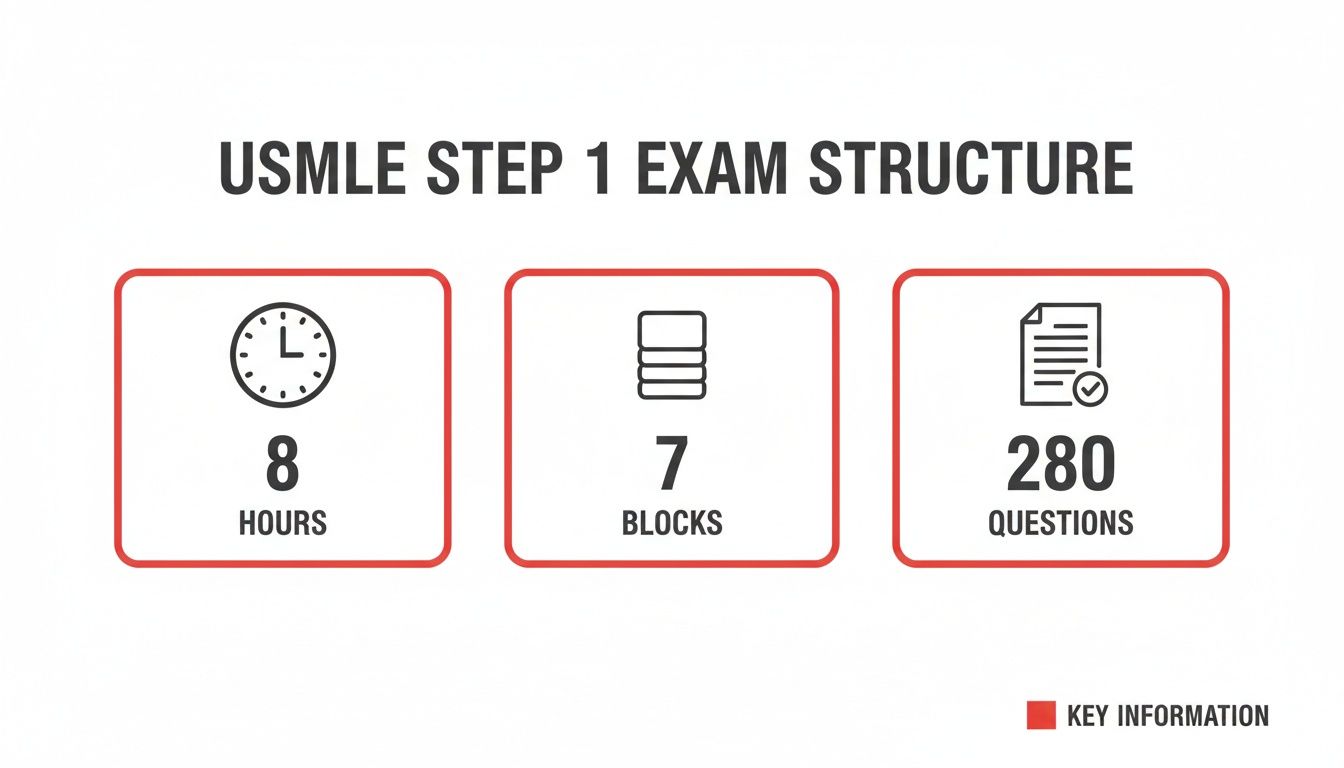
As you can see, this isn't just about knowing the material. Success demands strategic pacing and solid time management across a full eight-hour day.
Understanding The New Passing Standard
It’s a common myth that a pass/fail system automatically makes an exam easier. That’s definitely not the case here. When the change happened, the passing threshold was actually bumped up from an internal equivalent score of 194 to 196. It's a small change on paper, but it's had a real impact on pass rates.
Since the switch in 2022, first-time pass rates for US MD students have dipped from around 95% down to 89%. DO students saw a similar drop, going from 94% to 86%. The change hit International Medical Graduates (IMGs) even harder, with pass rates falling from 77% into the 70-73% range. If you want to dig into the numbers, you can find the official USMLE performance data published for everyone to see.
At the end of the day, getting a handle on the nuances of the USMLE Step 1 passing score is a critical part of your prep. You aren't just studying to pass; you're aiming to comfortably clear a higher bar, building a rock-solid foundation that will support you through your clinicals and beyond.
Mapping Out the Exam Content and Structure
To really get a handle on USMLE Step 1, you have to look under the hood. This isn't your typical final exam where you can get by on pure memorization. Think of it more like a marathon designed to see if you can think like a doctor, connecting the dots between different scientific fields to figure out complex problems.
The exam itself is a one-day, eight-hour ordeal taken on a computer. It's broken down into seven 60-minute blocks, and each block contains up to 40 multiple-choice questions. All told, you're looking at a maximum of 280 questions. You also get a grand total of 45 minutes of break time you can use however you want between blocks.

Core Scientific Disciplines
The content covers all the foundational sciences you’ve been drowning in for the first two years of med school. But here’s the catch: the questions are rarely straightforward. They’re designed to be interdisciplinary, meaning they’ll weave concepts from several subjects into a single clinical puzzle.
The main subjects on the chopping block include:
- Anatomy and Embryology
- Behavioral Sciences
- Biochemistry and Genetics
- Microbiology and Immunology
- Pathology
- Pharmacology
- Physiology
But these subjects aren't tested in neat little sections. A single question about a patient with chest pain might demand that you pull from your knowledge of cardiac anatomy, the physiology of a heart attack, the pathology behind clogged arteries, and the pharmacology of blood thinners—all at once.
The whole point of the exam is to push you past rote memorization. It forces you to apply what you know in a practical, clinical way, which is the single most important skill for any future physician. True mastery isn't just knowing the facts; it's understanding how all these systems talk to each other.
The Power of Clinical Vignettes
Just about every question you'll see on Step 1 is wrapped in a clinical vignette—a short story about a patient. You'll get their age, symptoms, history, and maybe some lab results or an X-ray. It's your job to piece it all together and pick the one best answer.
For instance, the exam won't just ask, "What does metformin do?" Instead, it might describe a 55-year-old patient just diagnosed with type 2 diabetes and ask which drug is the best first choice, based on how it works inside the body's cells. This approach is a direct test of your clinical reasoning.
This integrated style is precisely why digging into the official USMLE content outline is an absolute game-changer for your prep. It’s the blueprint. It doesn’t just list subjects; it shows you how physician skills and different disciplines are woven together. Knowing this structure helps you prepare for the real marathon, not just a series of sprints through different topics.
How to Register and Schedule Your Exam Day
Conquering Step 1 isn't just about mastering the science; it also involves clearing a few administrative hurdles first. Getting your registration and test date locked in early is a huge win—it removes a major source of stress and frees you up to focus completely on your prep.
The process is pretty straightforward, but there are slight differences depending on where your medical school is located.
First things first, you have to confirm you’re eligible. For most students in U.S. or Canadian MD and DO programs, this just means being officially enrolled in a medical school accredited by the LCME or COCA. If you're an international medical graduate (IMG), you’ll need to meet the requirements laid out by the ECFMG, which includes being enrolled in a school listed in the World Directory of Medical Schools.
The Registration and Scheduling Process
Once you've confirmed you're good to go, it's time to apply. This is your official entry into the USMLE system.
- Submit Your Application: If you’re a student at a U.S. or Canadian school, you'll register through the National Board of Medical Examiners (NBME) website. IMGs will use the ECFMG's online portal instead.
- Receive Your Scheduling Permit: After your application is processed and approved, you'll get a scheduling permit. Think of this as your golden ticket—you literally cannot book your exam without it.
- Choose Your Eligibility Period: This is a key step. You'll select a three-month window during which you plan to take the exam. Be realistic about your study timeline here; don't pick a period you can't realistically prepare for.
With your permit in hand, you're ready for the final step: booking your actual test day. You’ll do this through the Prometric test center website. It's a smart move to book your date as soon as you get your permit, as popular dates and locations fill up fast, especially during peak seasons like May and June.
Pro Tip: Try scheduling your exam for a Tuesday or Wednesday. This gives you Monday for a light, final review and helps you avoid the weekend rush, so you can walk into the test center feeling fresh and focused.
For a much deeper dive into how to time your exam perfectly with your school's curriculum, check out this complete scheduling guide for medical students. Seriously, planning ahead is one of the best ways to keep that test-day anxiety in check.
Building Your High-Yield Study Plan
Knowing what's on the exam is one thing; knowing how to prepare is another beast entirely. A winning approach to Step 1 isn't just about cramming information. It's about building an efficient, high-yield system that turns years of preclinical knowledge into a passing score.
The foundation of this whole process is your dedicated study period. This is a sacred block of time—usually 6 to 8 weeks—where your only job is to live and breathe Step 1 prep. Most students carve this out right after finishing their second-year coursework, giving them a clear runway with minimal distractions.

Weaving Together Key Resources
You don't need a library of resources. You just need the right ones, used the right way. Most successful students build their entire plan around a core trio of tools that work together perfectly. Think of them as a three-legged stool—take one away, and the whole thing gets wobbly.
- UWorld (QBank): This is your primary engine for active learning. Its question bank is legendary for a reason—it mirrors the style, tone, and difficulty of the real Step 1 exam better than anything else out there. The goal isn't just to get questions right; it's to meticulously dissect the explanations for every single option, correct or not.
- First Aid for the USMLE Step 1: This is the high-yield bible for the exam, plain and simple. It’s not a textbook you read cover-to-cover to learn things for the first time. Instead, it's a dense framework for organizing and reviewing the mountain of information you already have in your head.
- Pathoma: This resource is your key to mastering pathology, a subject that makes up a massive chunk of the exam. The video lectures and accompanying text have an incredible way of breaking down ridiculously complex diseases into concepts that just click.
Your daily routine should be a constant cycle through these three. Maybe you start the day watching Pathoma videos on cardiology, then you annotate your First Aid book with key takeaways, and finally, you hammer home the concepts with a block of UWorld questions on the cardiovascular system.
The Critical Role of Active Learning and Assessments
Passive studying—like re-reading your notes for the tenth time or watching lectures on 2x speed—is the biggest trap you can fall into during Step 1 prep. Real learning, the kind that sticks, only happens when you are actively retrieving and applying information. This is precisely why question banks are so powerful.
The most effective study plans are built around active recall, not passive review. Every practice question you do is a miniature test of your ability to diagnose a problem, just like you will on the real exam and in your future clinical practice.
This is also where self-assessments come in. The NBME Self-Assessments are practice exams made by the very same people who create the real Step 1. Taking one every 1-2 weeks during your dedicated period is non-negotiable.
These practice tests give you two pieces of invaluable data: they estimate how ready you are for the real deal, and they give you a brutally honest breakdown of your weak areas. This feedback allows you to adjust your focus, turning those weaknesses into strengths before you walk into the testing center. Crafting a detailed and adaptable USMLE study plan is truly the single best investment you can make in your success.
Life After Step 1 and What Comes Next
Passing the USMLE Step 1 is a massive milestone—a true rite of passage in your medical journey. It’s the finish line for years of intense preclinical study, but it's much better to think of it as the starting line for what comes next. Clearing this hurdle is your ticket to the most exciting phase of your training: clinical rotations.
Making the leap from textbooks to patient care requires a major mental shift. You're no longer just memorizing biochemical pathways and drug mechanisms; you're applying that knowledge to real people with real, complex problems. This is where all that hard work for Step 1 really begins to pay off.
The New Landscape for Residency Applications
With Step 1 now scored as pass/fail, the whole game of residency applications has changed. The pressure to chase a specific three-digit score is gone. In its place, there's a much bigger focus on the other parts of your profile. Residency program directors are now looking much more closely at how you perform in your clinical clerkships and your score on the next big exam.
Your Step 1 pass proves you have the necessary scientific foundation. Your clinical grades, letters of recommendation, and Step 2 CK score will now tell the story of how well you can apply it.
This means your performance on rotations like Internal Medicine, Surgery, and Pediatrics is more critical than ever before. Excelling in the clinic and on the wards shows your work ethic, clinical reasoning, and ability to be part of a healthcare team—qualities that a multiple-choice exam can never fully capture.
The Spotlight Shifts to Step 2 CK
The most direct result of the pass/fail change is the new, elevated importance of the USMLE Step 2 CK exam. Since the scoring changed in 2022, every student's focus has had to pivot to Step 2 CK, which still gives you a numerical score.
In the past, mean Step 1 scores for matched applicants often fell in the 230-244 range. Now, that pressure to prove excellence falls squarely on this next test. For a deeper dive into the numbers, you can always explore the official USMLE scoring data to see the trends for yourself.
Your journey is really just beginning. And as you look further down the road, you might even start thinking about the business side of medicine. Understanding things like digital marketing, such as this guide to local SEO for medical practices, can be surprisingly useful later in your career. But for now, celebrate your achievement. Step 1 is the key that unlocks the door to your future as a physician.
Answering Your Top Questions About USMLE Step 1
Let's be honest, figuring out the logistics of Step 1 can feel like a whole separate course. You’ve probably heard a dozen different opinions from upperclassmen. We've compiled the most common questions we get from students to give you some straight answers.
How Long Should I Really Study for Step 1?
This is the big one, isn't it? While you've technically been studying since day one of med school, the real, heads-down, dedicated study period is what matters most. For most students, a solid 6 to 8 weeks of full-time, focused work does the trick.
Think of it as your job for those two months—we're talking 8-10 hours a day. But remember, this is deeply personal. Your ideal timeline hinges entirely on your foundation from your preclinical years and how quickly you can spot and patch up your weak spots.
What Happens If I Fail Step 1?
First, take a deep breath. Failing Step 1 is a tough setback, but it is absolutely not the end of the road for your medical career. The USMLE program allows for a limited number of retakes, though you will have to re-register and pay the fee for each attempt.
The most important thing is to see a failed attempt not as a failure, but as a diagnostic tool. Your score report is a roadmap pointing directly to your areas of weakness. Use that data to build an entirely new study plan, ideally with guidance from an academic advisor or a tutor who can help you see what you were missing.
A retake demands a fundamental shift in strategy, not just more hours using the same methods. It's your chance to rebuild your approach from the ground up, aiming for deep understanding instead of surface-level memorization.
Are UWorld and First Aid Actually Necessary?
While the NBME doesn't officially endorse any third-party resources, let's be real: tools like UWorld, First Aid, and Pathoma are considered indispensable by nearly every student who successfully passes Step 1. They've become the unofficial core curriculum for a reason.
These resources are engineered to match the exam's unique question style and focus on the highest-yield information.
- UWorld: This is the undisputed gold standard for practice questions. The clinical vignettes are as close as you'll get to the real exam.
- First Aid: Think of this book as the bible for your study plan. It’s the framework that holds everything else together.
- Pathoma: An absolute lifesaver for mastering pathology, which is a massive component of the exam.
When used together, they create a powerful, interconnected system for active learning that just works.
If you're building your study plan or need help overcoming a tough exam, Ace Med Boards offers expert one-on-one tutoring designed for your specific challenges. Start with a free consultation to see how we can help you ace your boards.