So, how long is the MCAT, really? Let's get straight to it: from the moment you sit down to the moment you walk out, you’re looking at a 7.5-hour commitment.
That number often catches aspiring medical students by surprise. While the actual time you spend answering questions is 6 hours and 15 minutes, the full test day experience is a marathon. Think of it less like a single exam and more like a full day on the job.
Your MCAT Test Day Timeline At A Glance
Getting a handle on the day's structure is your first step toward building the mental endurance you'll need. The MCAT isn't just one long test; it's a series of sections, breaks, and administrative steps that all add up. Knowing the flow helps you prepare for the reality of test day, not just the science content.
The pure testing time adds up to 6 hours and 15 minutes. But once you add in the optional tutorial, the two 10-minute breaks, a crucial 30-minute lunch break, and the final survey, your total seated time swells to about 7.5 hours. As you can see, understanding this schedule is just as vital as knowing the available MCAT test dates.
This timeline gives you a great visual for how the day breaks down, from arrival to departure.
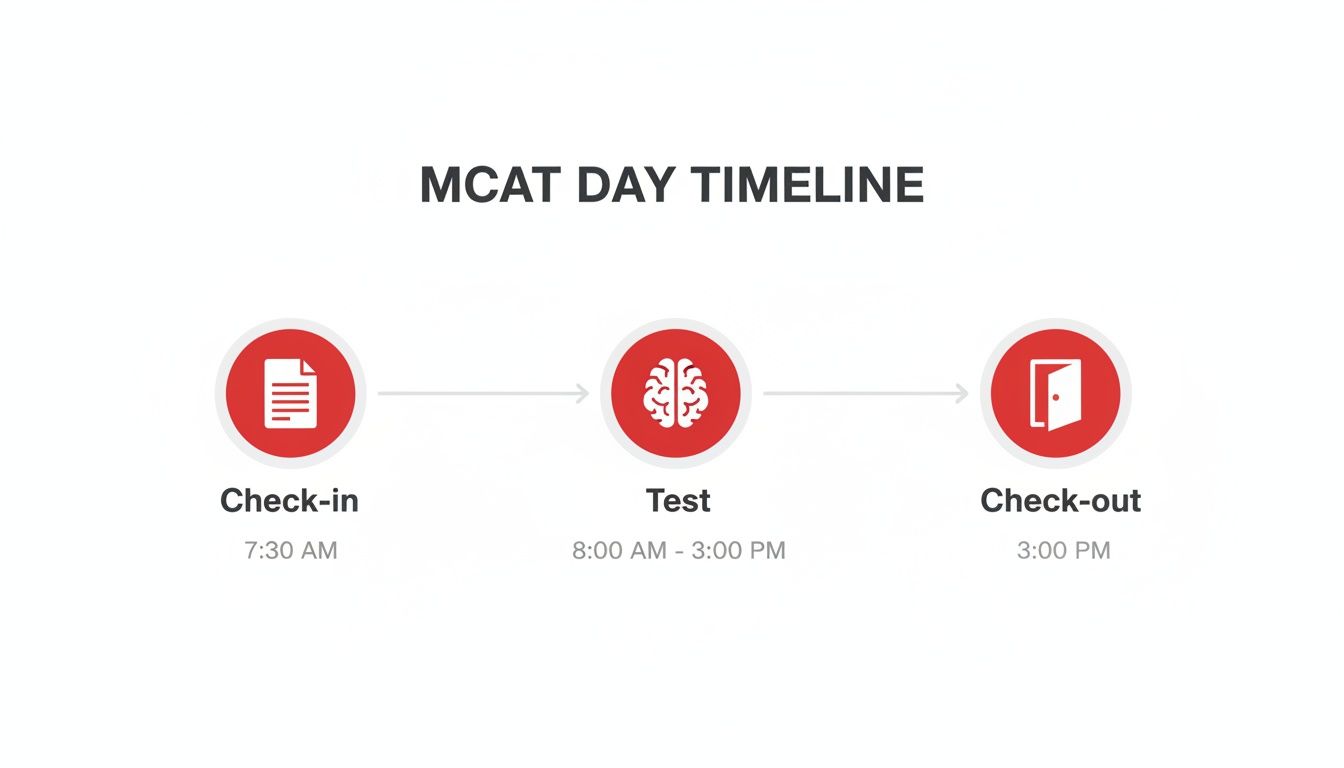
It’s clear that the actual exam is just one piece of a much larger logistical puzzle.
The Complete Schedule
To give you a clear, minute-by-minute guide, here’s a detailed breakdown of how your time will be spent on exam day.
MCAT Test Day Schedule Breakdown
This table maps out every segment of your test day, from the initial check-in to the final survey, so you know exactly what to expect.
| Event | Duration |
|---|---|
| Check-in & Tutorial (Optional) | 10 Minutes |
| Chemical & Physical Foundations | 95 Minutes |
| Optional Break | 10 Minutes |
| Critical Analysis & Reasoning (CARS) | 90 Minutes |
| Optional Lunch Break | 30 Minutes |
| Biological & Biochemical Foundations | 95 Minutes |
| Optional Break | 10 Minutes |
| Psychological, Social & Biological Foundations | 95 Minutes |
| Void Question & Survey | 12 Minutes |
| Total Seated Time | 7 Hours 27 Minutes |
Keep in mind, this schedule is just the time you're seated at the computer. Your day starts earlier and ends later.
A critical piece of advice: The clock starts long before the exam begins. You’re required to arrive 30 minutes early for check-in. Factoring in travel, check-in, the full exam, and checking out, most test-takers will tell you it feels like a full 8- to 9-hour day. Plan accordingly
Breaking Down Each MCAT Section By The Minute
Knowing the total test day is long is one thing, but truly mastering the MC-AT means understanding the rhythm of its individual parts. Think of it like a triathlon; it's a single, grueling event, but each leg—the swim, the bike, the run—demands a completely different strategy and pace. You can't sprint through the marathon-like science sections the same way you navigate the nuanced CARS section.

The exam is meticulously engineered to test your knowledge and critical thinking under intense, sustained pressure. It kicks off with a 95-minute block for the 59 questions in the Chemical and Physical Foundations of Biological Systems section.
After a quick 10-minute breather, you’ll face the beast that is the Critical Analysis and Reasoning Skills (CARS) section, which gives you 90 minutes for its 53 questions. Following a much-needed 30-minute lunch break, you dive back in for another 95 minutes with the 59 questions of the Biological and Biochemical Foundations of Living Systems section.
Finally, after one last 10-minute break, you’ll finish the day with 95 minutes dedicated to the 59 questions in the Psychological, Social, and Biological Foundations of Behavior section. It's a marathon of the mind.
A Pacing Perspective
When you do the math, the timing for the three science sections works out to roughly 1 minute and 36 seconds per question. But here’s the kicker: the CARS section is tighter, giving you only about 1 minute and 42 seconds per question—and these questions require you to read and digest dense passages first.
It’s not just about knowing the science; it's about shifting cognitive gears. The science sections demand quick recall and application, while CARS requires methodical reading and deep inference. Your pacing has to adapt on the fly.
This is why just knowing the material isn't enough. Success comes from building the mental stamina and strategic flexibility to handle these shifts. The only way to get there is by taking the best MCAT practice tests under real, timed conditions.
- Chem/Phys & Bio/Biochem: These are a mix of passage-based questions and standalone, discrete problems. A key skill is quickly identifying which type you're dealing with so you can allocate your time effectively.
- CARS: This section is 100% passage-based. The real challenge is maintaining razor-sharp focus through walls of text without getting bogged down, all while that clock is ticking.
- Psych/Soc: This section often feels like a hybrid. It blends scientific knowledge with passage interpretation that feels a bit like CARS, just with a different subject matter.
Ultimately, mastering how long the MCAT is means mastering the unique rhythm of each and every segment.
Navigating The Time Between Sections
When you're thinking about how long the MCAT is, it's easy to focus only on the timed sections. But the real test of endurance often comes down to mastering the moments in between. The breaks and administrative hurdles aren't just filler—they're a critical part of the day that can either drain your energy or recharge you for the next push.

Here's something many students don't realize until it's too late: every time you leave the testing room for a break, you have to go through a full security check-out procedure. When you come back, you repeat a similar check-in, complete with a finger/palm scan and inspection. This process can easily eat into your break, turning a 10-minute break into maybe seven or eight minutes of actual downtime.
Making Every Second Count
This logistical friction means you absolutely must have a plan for your breaks before test day. Don't waste precious mental energy deciding what to do in the moment.
- 10-Minute Breaks: Treat these like a quick pit stop. Your priorities are using the restroom, stretching your legs, and grabbing a quick sip of water. Avoid the temptation to check your phone or review notes; the goal is to clear your mind, not clutter it.
- 30-Minute Lunch: This is your main refueling stop. Pack a light, easily digestible meal with a good mix of protein and complex carbs to sidestep that dreaded post-lunch energy crash. Use the full time to eat, hydrate, and mentally detach from the exam for a few minutes.
Your ability to transition smoothly and efficiently between sections is a skill in itself. The MCAT is designed to test your resilience, and how you manage the time outside the exam is a major factor in your overall performance.
To build this kind of structured discipline, many students find that adapting timed study methods can be a game-changer. For instance, you can learn more about how the Pomodoro technique can prepare you for MCAT pacing and break management by reading our guide at https://acemedboards.com/pomodoro-mcat/.
Perfecting these small intervals is key to conquering the long haul of test day. By practicing your break routine during full-length practice exams, you ensure that nothing feels new or stressful. This allows you to conserve your mental energy for the questions that truly matter.
Why The MCAT's Length Is A Feature, Not A Flaw
Let’s be honest, the grueling length of the MCAT can feel like a major design flaw. But what if I told you it's actually one of its most important features? The exam is far more than a simple test of your science knowledge; it’s a full-blown simulation. Its marathon format is intentionally built to mirror the high-stakes, high-stamina world of medical school and a physician's career.
Think about it for a second. Long hospital shifts, complex board exams, and critical life-or-death decisions all demand immense mental endurance. You have to be able to think clearly and critically under sustained pressure, often when you're exhausted. The MCAT is your very first taste of this professional reality.
It’s assessing your resilience and focus just as much as your recall of organic chemistry. The exam's length is a direct test of your ability to manage fatigue, stay sharp, and execute complex problem-solving for hours on end. Those are non-negotiable skills in medicine.
A Deliberate Design
This structure isn't an accident; it's the result of careful evolution. The current format, with its 6 hours and 15 minutes of active testing plus breaks, was rolled out in April 2015. This wasn't just a random change—it was part of a larger, deliberate initiative to better align the exam with the real-world demands of medical education and clinical practice.
By pushing you to your cognitive limits, the AAMC is getting a pretty good idea of your readiness for the marathon that lies ahead.
Viewing the MCAT's duration as a training ground rather than a hurdle can fundamentally shift your mindset. You're not just studying for a test; you're preparing for a career that demands this exact type of mental fortitude.
This perspective is crucial. It transforms your prep from a grind of content review into a genuine professional development exercise. You can find more strategies for this holistic approach in our complete guide on how to prepare for the MCAT.
Building The Stamina To Conquer Test Day
Realizing the MCAT is a 7.5-hour marathon is one thing. Actually training your mind and body to not just survive but thrive for that entire time is another challenge altogether. The exam's length isn't an accident; it's designed to test your mental resilience under pressure. Conquering it requires a smart, targeted approach.
This isn't just about memorizing facts. It's about conditioning yourself for peak performance when you're hours deep into the test and fatigue starts to set in.
Think of it like training for an actual marathon. You wouldn't just read books about running—you’d run. A lot. Your MCAT prep needs that same hands-on approach, which means taking full-length, timed practice exams. These simulations are absolutely essential for spotting pacing issues, learning when your focus starts to fade, and perfecting your break strategies.
Personalizing Your Endurance Training
A generic study plan is a recipe for frustration because it doesn't account for your unique sticking points. This is where a personalized strategy makes all the difference. One-on-one tutoring, for instance, can quickly identify exactly where you're losing time—whether you're getting stuck on certain organic chemistry reactions or getting bogged down in dense CARS passages. An expert can help you build a plan that focuses your energy on high-yield areas, making your prep far more efficient.
The goal isn't just to learn the material. It's to train your mind and body to perform at peak capacity for over seven hours. That’s a skill that will pay dividends long after test day, throughout med school and your entire career.
A well-structured schedule is your roadmap. To see how you can pace your studies over a longer period, check out this detailed 6-month MCAT study schedule, which really emphasizes that gradual build-up of endurance.
Fueling Your Focus
Your physical state has a massive impact on your mental performance. Proper nutrition, hydration, and sleep are non-negotiable parts of building MCAT stamina. Some students even explore options to improve endurance for those long focus periods, like the GOAT Stamina supplement, to gain an edge. Just as you carefully map out your study sessions, you need a plan to fuel your brain and body for this demanding test.
Ultimately, mastering the MCAT's length comes down to transforming your preparation. At Ace Med Boards, we focus on creating that personalized strategy, helping you build both the academic knowledge and the mental fortitude you need to walk into the testing center with confidence, ready to excel from the first minute to the last.
Frequently Asked Questions About MCAT Timing

We've broken down the sections, the breaks, and the sheer stamina this test demands. But from our experience tutoring students, we know there are always a few lingering questions about the nuts and bolts of test day timing.
Let’s clear those up now. Think of this as your final pre-flight check, making sure you know the rules of the road so you can pour all your mental energy into the questions, not the procedures.
Can I Finish A Section Early And Move On?
The short answer is no. Each MCAT section is locked into its own time block, and that clock is non-negotiable. If you happen to finish with time to spare, your only option is to review your answers within that same section.
The timer has to run its full course before you can move on to a break or the next part of the exam. This setup makes managing your time within each 90- or 95-minute window a make-or-break skill, because any leftover time simply disappears—it doesn’t carry over.
What Happens If I Take Too Long On My Break?
This is a critical one: going over your allotted break time eats directly into your next section. The clock for the following part of the test starts ticking the second your break officially ends, whether you’re back in your seat or still in the hallway.
Every extra minute you take is a minute you lose for answering questions. It's absolutely essential to keep an eye on the break timer and give yourself enough time to get through the security check-in process and settle back at your desk.
The AAMC is incredibly strict about test day procedures. Sticking to the timed breaks isn't just a friendly suggestion; it’s a hard rule designed to keep the environment standardized, and it directly impacts your ability to perform on the next section.
Are Accommodations For Extra Time Available?
Yes, they are. The AAMC provides testing accommodations for students with documented disabilities, as outlined by the Americans with Disabilities Act (ADA). These can include things like extended time on sections, longer breaks, or other adjustments.
The key thing to know is that you have to apply for these accommodations far in advance of your test date. The approval process is thorough, requires extensive documentation, and can easily take several months to complete. Proactive planning is a must.
How Should I Use The 30-Minute Lunch Break?
Your 30-minute lunch break is the most important reset of the day. You have to use it strategically to refuel your brain and body without triggering that dreaded post-meal energy crash.
- Plan Your Fuel: Pack a light meal that’s rich in protein and complex carbs. Steer clear of heavy, greasy, or sugary foods that will just make you feel sluggish and sleepy.
- Get Away From The Test: Use the full time to eat, use the restroom, and stretch your legs. The goal is to mentally detach from the exam. Don't even think about discussing questions or doing any last-minute cramming. This break is for recovery, not for review.
Mastering the MCAT's length and pacing is about more than just knowing the science—it demands a personalized strategy and rock-solid stamina. At Ace Med Boards, our expert tutors provide one-on-one guidance to help you build the skills and confidence to conquer test day. Find out how we can help you at https://acemedboards.com.