Defining a good MCAT score can feel like trying to hit a moving target, but the real data points to a pretty clear benchmark. If you're aiming for a competitive allopathic (MD) medical school program, a score of 511.7 or higher is what typically separates strong applicants from the rest of the pack.
What Is a Good MCAT Score Today?

The Medical College Admission Test (MCAT) isn't just another standardized test. Think of it as the great equalizer in medical school admissions—a universal translator that lets committees compare your academic readiness against applicants from completely different universities and backgrounds.
A strong score signals that you’ve got the scientific knowledge and critical thinking skills to handle the intense curriculum that awaits you. But what is a strong score? It really comes down to context, specifically percentiles.
A higher percentile means you performed better than a larger chunk of other test-takers. Scoring a 500 might feel like a decent achievement, but it only puts you at the 50th percentile—smack dab in the middle. It's not a bad score, but in an applicant pool this competitive, it won’t help you stand out. To dig deeper into how these scores are calculated, check out our guide on the average MCAT score.
The Real Competitive Benchmark
To figure out what score you really need, you have to look at the scores of students who actually get accepted. The benchmark for a "good" MCAT score is often pegged at 511.7 or higher. This number comes from the average score for accepted medical students in recent years, placing you in the 81st to 83rd percentile range.
This isn’t just a random number; it’s the score that distinguishes competitive applicants for MD programs. This is a massive leap from the overall average score of 500.5, which is only the 49th percentile.
Key Takeaway: Your goal isn't just to beat the average person taking the test. It's to score in the same ballpark as the average accepted medical student. That's a critical distinction to make when setting your target.
MCAT Score Tiers at a Glance
To really wrap your head around the 472 to 528 score range, it helps to break it down into tiers. Each tier paints a different picture of how competitive your application will be.
Here's a quick look at what different scores generally mean for your chances.
| Score Tier | Total Score Range | Approximate Percentile | General Applicant Outlook |
|---|---|---|---|
| Exceptional | 520+ | 97th – 100th | Highly competitive for top-tier research programs and elite medical schools. |
| Competitive | 512 – 519 | 83rd – 96th | A strong score that makes you a competitive candidate for most MD programs. |
| Solid | 506 – 511 | 66th – 82nd | A good score for many MD programs and very competitive for DO programs. |
| Average | 500 – 505 | 49th – 65th | Considered average; may require a very strong GPA and extracurriculars to be competitive for MD programs. |
| Below Average | < 500 | Below 49th | Generally not competitive for most MD programs without significant strengths elsewhere in the application. |
This table helps put the numbers into perspective. At the end of the day, a "good" MCAT score is one that opens the doors to the medical schools you dream of attending.
While 511.7 is a powerful benchmark to aim for, your personal target score will ultimately depend on your GPA, the schools on your list, and the story your overall application tells.
Analyzing Your Performance Section by Section
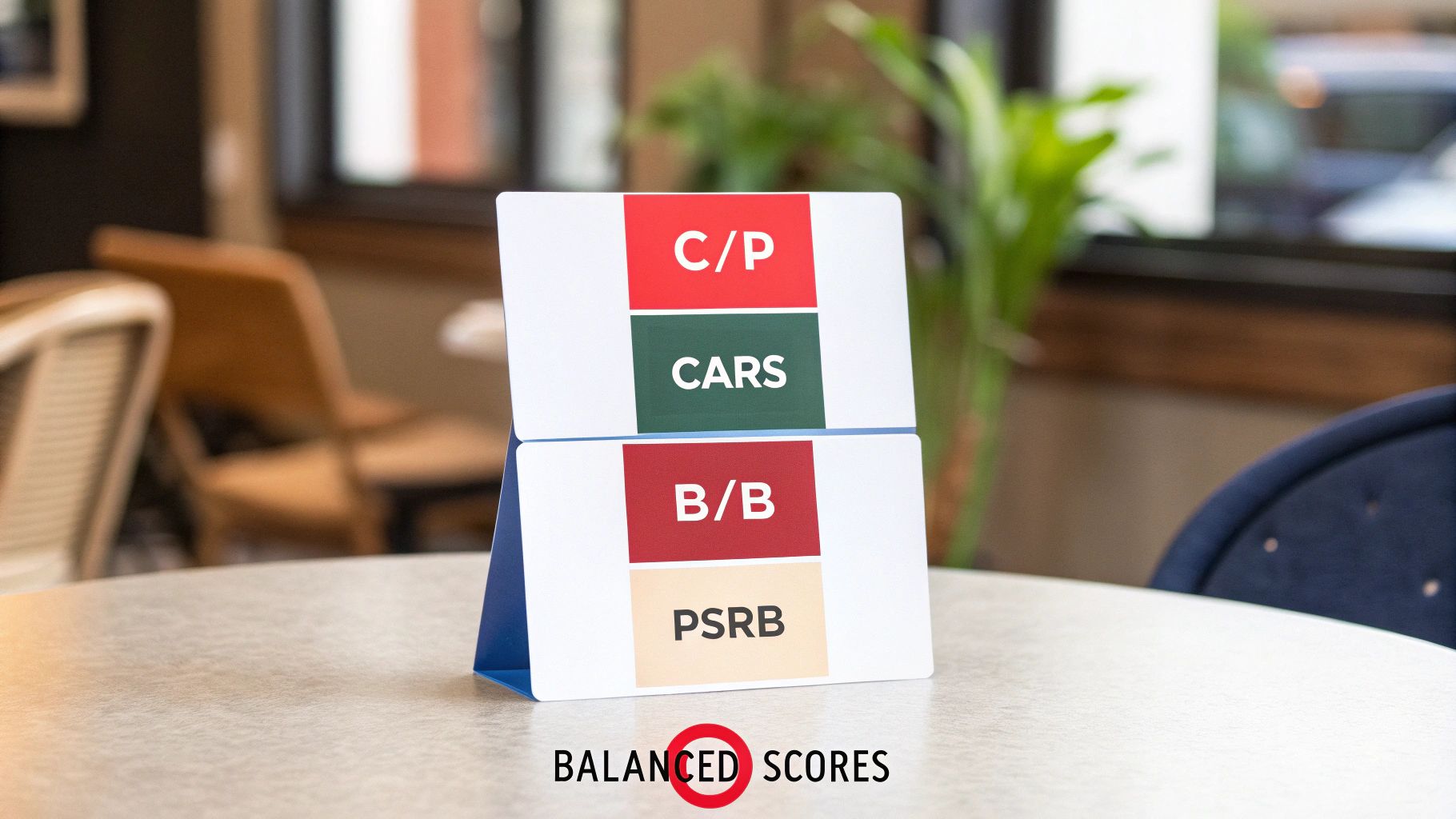
While your total MCAT score is the headline number, admissions committees always read the fine print. They don't just glance at a single three-digit score; they break it down, looking closely at the four individual section scores that build that total. A huge total score is great, but a balanced performance often tells a much more compelling story.
Think of it like this: your total score is the final sale price of a house, but the section scores are the inspection report. A high price is impressive, but adcoms want to see that the foundation is solid, the plumbing works, and the electrical is up to code. They're looking for proof that you're strong across the board, not just a science whiz who struggles with critical reading.
A lopsided score—say, incredible science scores paired with a rock-bottom verbal reasoning score—can be a major red flag. It might suggest a weakness that could become a real problem in the reading-heavy, fast-paced environment of medical school.
The Four Pillars of Your MCAT Score
Your total score is built on four distinct pillars, each testing a different skillset that's absolutely essential for a future doctor. Getting a feel for what each one represents is the first step to understanding where you stand.
- Chemical and Physical Foundations of Biological Systems (C/P): This is the hard science that underpins everything else. It tests your grasp of fundamental chemistry and physics concepts and your ability to apply them to living systems.
- Critical Analysis and Reasoning Skills (CARS): This is the curveball. With no prior science knowledge needed, CARS is all about your ability to dissect dense, complex passages from the humanities and social sciences. It's a direct measure of the critical thinking skills you'll need to interpret medical literature and patient histories.
- Biological and Biochemical Foundations of Living Systems (B/B): This is where your biology, biochemistry, and organic chemistry knowledge gets put to the test. It's the core science that forms the basis for subjects like physiology and pharmacology.
- Psychological, Social, and Biological Foundations of Behavior (PSBB): The newest section, PSBB, looks at your understanding of the psychological and social factors that influence health and human behavior.
Why a Balanced Score Matters So Much
A balanced score, where each section is 127 or higher, is a powerful signal of consistent academic strength. It tells adcoms you can handle a wide range of cognitive challenges, from memorizing scientific pathways to analyzing dense philosophical arguments. An unbalanced score, especially one with a low CARS score, can be a deal-breaker for many programs.
The CARS section is often seen as a proxy for how a student will handle the sheer volume of reading in medical school. A significantly lower score here can be interpreted as a potential risk, even if your science scores are in the 90th percentile.
It's also interesting to see how trends have shifted. Since its introduction, test-takers have really figured out the PSBB section. The data shows the Psychological, Social, and Biological Foundations (PSBB) section average is now up to 125.9, as students have zeroed in on the high-yield topics. In contrast, the Critical Analysis and Reasoning Skills (CARS) average remains lower at 124.6. You need a score of 128 or higher just to break into the 90th percentile, which really underscores its difficulty. You can find more insights on this at magoosh.com.
This is why a comprehensive approach to your MCAT content review is non-negotiable. It's a classic mistake to just drill your strongest subjects while ignoring your weaknesses. That's a surefire way to end up with an imbalanced score. Each section tells a piece of your story—make sure they all say you're ready for what's next.
Matching Your Score to Your Medical School Goals
Let's clear up a common misconception right away: there is no single, universal "good" MCAT score. The right score for you is entirely dependent on your personal ambitions and the specific path you want to take in medicine.
Think of it like applying for a job; the qualifications needed for a fast-paced startup are completely different from those for a Fortune 500 company. In the same way, the score that makes you a top-tier candidate for an osteopathic (DO) program might just be average for a competitive allopathic (MD) program.
Defining a strategic, personalized target score is what turns an abstract goal into a concrete, actionable plan. This means looking beyond a generic number and mapping out the distinct score expectations for the different medical pathways you're considering.
Your individual goals should be the engine driving your MCAT prep. Are you dreaming of attending a top-tier research institution? Or are you passionate about the holistic, patient-centered philosophy of osteopathic medicine? Your answer will dramatically shift what a good MCAT score really means for your application.
Allopathic MD Versus Osteopathic DO Programs
One of the biggest distinctions you'll encounter in admissions is between MD and DO programs. While both paths lead to becoming a licensed physician, their admissions benchmarks can differ quite a bit, especially when it comes to the MCAT.
This is where understanding the applicant pool is critical. MD programs generally attract a larger number of applicants with exceptionally high stats, which naturally drives the average accepted MCAT score higher.
For instance, a total score in the 506-510 range can make you a star applicant for many excellent DO programs, placing you well above their average matriculant. For most MD programs, however, a score in that range would be considered solid but probably not exceptional. The data shows that while 506-510 gives you solid odds for DO schools, most MD hopefuls need to aim for 511+ to truly stand out.
Strategic Insight: Your MCAT score is a tool. A 508 can be used to build a compelling application for great DO schools, while a 514 could be the key that unlocks interviews at competitive MD programs. The effectiveness of the tool depends entirely on where and how you use it.
Targeting Top-Tier Research Institutions
If your ambition is to land a spot at a top-20, research-heavy medical school, the goalposts move significantly higher. These institutions aren’t just looking for students who can handle the coursework; they are actively searching for the next generation of leaders in academic medicine and biomedical research.
For these elite programs, a "good" MCAT score is often in the 518-522+ range.
Why is the bar set so high? These schools receive tens of thousands of applications for just a few hundred spots. A top-percentile MCAT score becomes a necessary screening tool to identify candidates who have demonstrated exceptional mastery of the foundational sciences and superior critical thinking. Frankly, a score below 515 might get your application screened out before a human even reads your personal statement.
Planning for Competitive Specialties
It might feel a little premature, but thinking about your potential future specialty can also help shape your MCAT goal. Highly competitive specialties like dermatology, neurosurgery, or orthopedic surgery often see a strong correlation with high USMLE Step scores later in medical school. Admissions committees are well aware of this pattern.
A stellar MCAT score can serve as an early indicator of your potential to crush future board exams, making you a more attractive candidate for schools known for strong residency match lists in these competitive fields. While it’s not a direct one-to-one relationship, a high MCAT score signals the kind of test-taking stamina and deep knowledge base that predicts success down the line. To better understand how scores are broken down, explore our detailed guide on the MCAT score range.
Ultimately, matching your score to your goals is about being both realistic and strategic. It empowers you to build a focused study plan that aligns directly with the doors you want to open in your medical career.
How Admissions Committees Actually Use Your Score
Once you hit submit on your AMCAS or AACOMAS application, that MCAT score you worked so hard for starts its new life. It’s no longer just a number on a screen; it becomes a critical data point in the complex puzzle that is your medical school application. Admissions committees (ad-coms) use it as a standardized tool, but its role is far more nuanced than just being a simple cutoff. It’s the first step in a process designed to build a complete picture of you as a future physician.
Think of the MCAT as a universal yardstick. Medical schools get flooded with applications from students at hundreds of different undergrad institutions, each with its own grading quirks and curricular rigor. A 3.8 GPA from a small liberal arts college might not be directly comparable to a 3.8 GPA from a massive state university known for grade deflation. The MCAT cuts through that ambiguity. It provides a single, objective metric to compare every applicant's foundational scientific knowledge and critical reasoning skills on a level playing field.
This is especially important when considering different application pathways, like allopathic (MD) versus osteopathic (DO) programs, which often have different score expectations.
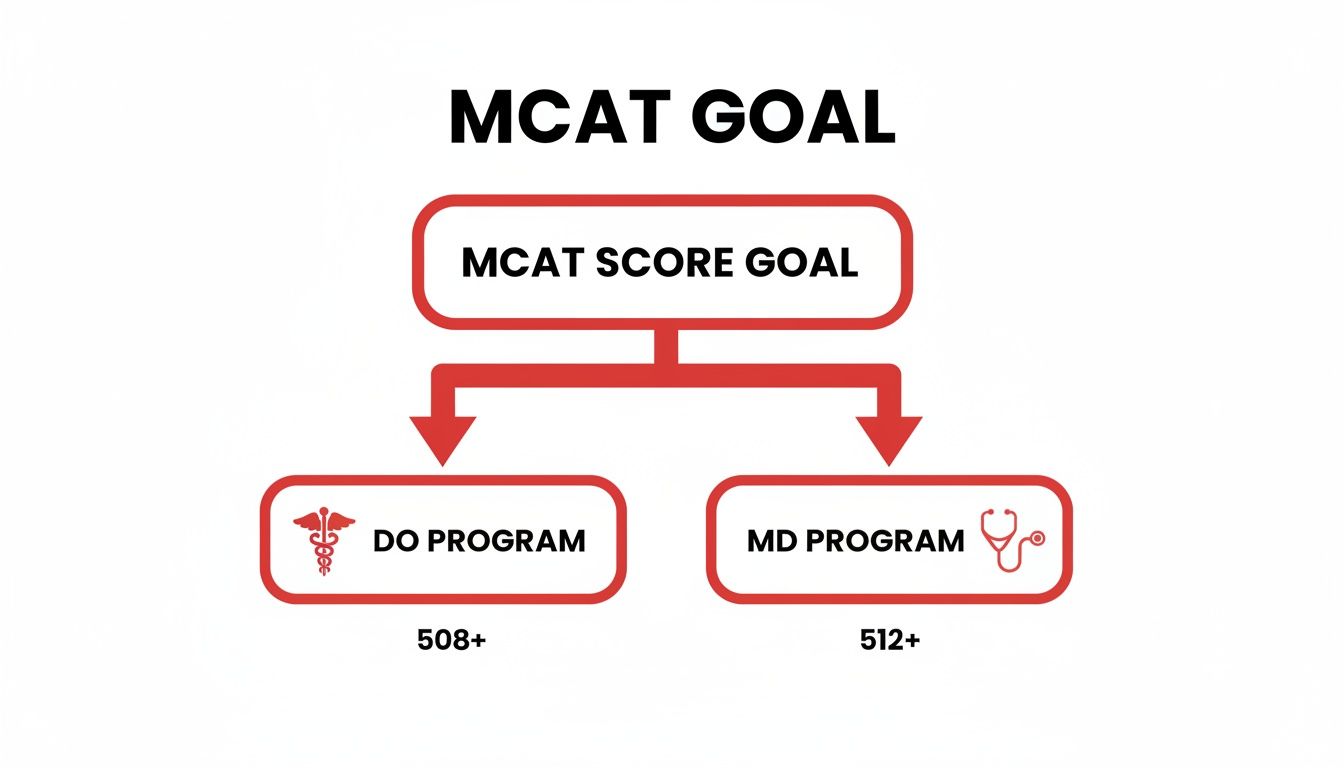
As the chart shows, a score that’s highly competitive for a DO program might be closer to the median for many MD programs. This is why aligning your target score with your specific goals is so crucial from the very beginning.
Beyond the Numbers: The Reality of Holistic Review
Despite its importance, your MCAT score is almost never viewed in a vacuum. The vast majority of U.S. medical schools practice holistic review, a philosophy where they consider every single component of your application to gauge your potential. Your MCAT score is weighed alongside your GPA, research publications, hours spent shadowing, clinical volunteering, personal statement, and letters of recommendation.
This approach creates a system of checks and balances. A stellar GPA can help soften the blow of a slightly lower-than-average MCAT score by demonstrating your academic diligence and work ethic over four years. On the other hand, a fantastic MCAT score can provide powerful reassurance if your GPA had a rocky start, proving you’ve mastered the material and have the academic horsepower to succeed in medical school.
Your application tells a story. The MCAT score is a major plot point, but it's not the entire narrative. A compelling personal journey, significant research contributions, or unique life experiences can make your story unforgettable, even if one plot point is less than perfect.
For instance, an applicant with a 509 MCAT who also founded a non-profit health clinic in an underserved community presents an incredibly powerful case. Their experiences demonstrate maturity, leadership, and a deep commitment to medicine that raw numbers alone could never capture.
The Truth About Score Bands
It’s also crucial to understand that ad-coms often think in terms of score bands rather than obsessing over single-point differences. An applicant with a 513 and another with a 514 are, for all practical purposes, viewed as being in the same competitive tier. Both have clearly demonstrated a high level of proficiency.
Schools frequently group applicants into ranges (e.g., 510-514, 515-519). Falling within your target school's preferred band is what gets your foot in the door, allowing the more personal, qualitative parts of your application to shine. This means you absolutely shouldn't panic over a one-point difference. Instead, focus on landing your score firmly within the competitive range for the schools on your list.
Context is King
Finally, committees always consider context. They look at your background, the resources you had available, and any obstacles you might have overcome. A first-generation college student who worked two jobs to support their family while maintaining a solid GPA and achieving a good MCAT score might be viewed more favorably than a candidate with a slightly higher score but far fewer challenges.
Ultimately, a good MCAT score serves one primary function: it ensures your application gets a thorough, serious review. It acts as a gatekeeper, and a strong score guarantees that an admissions officer will spend real time reading your essays, analyzing your activity descriptions, and considering your story.
From there, it's the strength of your entire profile that will carry you to an interview invitation. The score opens the door, but it’s your experiences, character, and passion for medicine that will convince them to let you walk through it.
Building Your Strategic MCAT Game Plan
Knowing the theory behind a good MCAT score is one thing, but figuring out what a good score means for you is the game-changer. It's time to shift from abstract percentiles to a concrete, personal target score. This number will become the anchor for your entire study plan.
This isn't just about wishing for a 528. It's about building a smart, strategic plan based on your unique academic profile and where you want to go.
The first move? Figure out your starting point. You can't chart a course without knowing where you are on the map, which means taking a full-length, high-quality diagnostic test is non-negotiable. Get it done under realistic, timed conditions.
This baseline score is just data. It’s not a judgment of your potential. Think of it as raw intel that reveals your current strengths and, more importantly, pinpoints exactly where you need to improve.
Factor in Your GPA and School Competitiveness
Your MCAT score doesn't exist in a vacuum. It works hand-in-hand with your GPA to tell admissions committees a story about your academic readiness.
A high GPA might give you a little breathing room for a slightly lower MCAT, while a fantastic MCAT can help balance out a GPA that isn't perfect. You have to be realistic about this dynamic. An applicant with a 3.9 GPA has a lot more flexibility than someone with a 3.4 GPA, who will need a much higher score to stay competitive.
Next, get real about the schools on your list. Your target score changes drastically depending on your aim:
- Osteopathic (DO) Programs: These schools generally have a slightly lower average matriculant MCAT, often landing in the 504-506 range.
- In-State Public MD Programs: Many public schools favor in-state applicants, which can sometimes mean slightly more forgiving score expectations.
- Out-of-State or Private MD Programs: These schools pull from a national applicant pool, which naturally drives up the competition and the average MCAT scores.
- Top-Tier Research Institutions: The most selective programs out there. You'll need a score deep into the top percentiles to be a serious contender.
The goal is to align your study efforts with the actual benchmarks of the programs you genuinely want to attend.
Create Your "Dream" and "Realistic" School Lists
Now, let's turn these ideas into something tangible. This exercise is how you transform a vague goal into a precise number.
- Build a "Dream School" List: Pick 5-7 top-tier programs you'd love to attend. Go find the median MCAT score for their latest incoming class. This number sets your aspirational, reach-for-the-stars target.
- Build a "Realistic School" List: Now, identify 10-15 programs where your GPA and a reasonably improved MCAT would make you a strong candidate. Mix it up with MD and DO schools, both in-state and out-of-state. Finding their median MCAT scores will establish your solid, achievable target.
This dual-list strategy gives you a score range to work with. Your ultimate goal is to land comfortably within the zone for your "realistic" schools while stretching toward your "dream" school benchmarks.
And remember, scores are always trending up. For a top-tier spot like NYU School of Medicine, the average is a staggering 523—that's the 99th percentile. More broadly, a 512 has become the unofficial target for many competitive MD programs, putting you in the 85th percentile.
A well-defined target score is your North Star. It clarifies every single decision you make, from choosing the best MCAT study materials to how you spend your time each week. Without it, you're just studying without a purpose.
As you map out your strategy, exploring the best tutoring platforms for standardized test preparation can offer excellent support. Once you have your baseline score and your target score, the path forward becomes crystal clear. The gap between those two numbers dictates the intensity, duration, and focus of your MCAT prep, turning a mountain of content into a series of manageable steps.
Turning Your Target Score into Test Day Success

Alright, so you’ve got your target score. That’s a huge first step, but let’s be real—a number on a sticky note won’t get you into medical school. The real work starts now. It's time to shift from planning to doing and turn that goal into daily, focused action.
This is where you build a structured study schedule around your baseline score and your ultimate goal. Forget trying to cover everything. Your mission is to strategically attack your weakest areas with surgical precision. High-quality practice materials are your best friend here, giving you a taste of the real exam and critical data on where you stand.
Bridging the Gap with Expert Guidance
For a lot of students, the gap between their first practice test and their target score feels like a massive canyon. It can be overwhelming, and that’s precisely where personalized support can make all the difference in landing a good MCAT score. Think of an expert tutor as a seasoned guide helping you find the most efficient path across that canyon.
A great tutor does more than just explain concepts. They become your strategist.
- Develop Customized Strategies: They’ll dig into your practice tests, find the sneaky error patterns you keep making, and build a tailored plan to fix them for good.
- Focus on High-Yield Topics: Tutors live and breathe the MCAT. They know what gets tested most, ensuring you spend your limited time on concepts that will actually boost your score.
- Teach Advanced Techniques: They can show you how to break down those monster multi-step questions and manage the clock when the pressure is on.
This is all about working smarter, not just logging more hours. The data doesn't lie: while over 52,000 applicants had a 506.3 MCAT and a 3.64 GPA, it was the students hitting 511.7 or higher who were consistently getting into MD programs. A targeted 10-20 point jump with expert help isn't a pipe dream; it’s a proven way to become the kind of applicant admissions committees notice.
Your target score is more than a number—it’s a key that unlocks access to your dream medical programs. Investing in the right support system is an investment in that future.
Taking Control of Your Medical School Journey
At the end of the day, your MCAT score is one of the most significant factors you can control in this whole process. Now that you have a target in mind and a game plan forming, it’s time to take decisive action. A great starting point is exploring some of the best MCAT practice tests to get an honest look at where you are and track your progress.
Build a study plan that pushes you but doesn't break you. Don't be afraid to ask for help when you hit a wall. Taking these steps won't just get you ready for the exam; it will build the confidence you need to walk into that testing center knowing you’ve done everything possible to succeed. Your medical school journey is in your hands—go take control.
Common Questions (and Straight Answers) About Your MCAT Score
Once you get your score back, a whole new set of questions pops up. Let's tackle some of the most common ones we hear from pre-meds every day.
Should I Retake the MCAT for a Higher Score?
This is a big decision, and it’s not one to take lightly. The simple rule of thumb? Only consider a retake if you are genuinely confident you can boost your score by at least 3-4 points.
A jump like that shows adcoms you have grit and can improve. But scoring the same—or worse—sends a really negative signal. Before you even think about re-registering, you need to do a serious post-mortem on your first attempt. Was it a specific content gap? Did test-day anxiety get the best of you? Did you run out of time?
A retake only makes sense if you have a concrete, actionable plan to fix exactly what went wrong the first time.
How Do Medical Schools Look at Multiple MCAT Scores?
Medical schools see all of your attempts, so there's no hiding a previous score. But how they interpret them can differ from school to school.
- Highest Score: This is the most common approach. Most schools will simply look at your best total score and focus on that.
- Most Recent Score: A smaller number of schools might give more weight to your latest attempt, whether it’s better or worse.
- Superscoring: This is pretty rare, but a few schools might create a "superscore" by taking your best section scores from different test dates. Don't count on this.
Ultimately, your highest score is what matters most. That said, a clear upward trend is always a good look. It tells a story of resilience. Stagnant or declining scores, on the other hand, can raise red flags about your preparation or ability to handle pressure.
Key Insight: The narrative of your scores matters. An improvement from a 505 to a 512 tells a powerful story of resilience and dedication that admissions committees appreciate.
How Long Is My MCAT Score Valid?
Your MCAT score has an expiration date. Most medical schools will only accept scores that are two to three years old, but this isn't a universal rule. Each school sets its own policy.
The general guideline is that your score must be valid at the time you plan to matriculate (start school). For instance, if you’re aiming to start medical school in the fall of 2026, you'll probably need an MCAT score from 2023 or later.
It is absolutely critical to check the specific requirements for every single program you're applying to. Go directly to their admissions website and confirm the dates. You don't want a technicality like an expired score to derail your application after all that hard work.
Ready to turn your target score into reality? At Ace Med Boards, our expert tutors create personalized study plans to help you master the MCAT and secure your spot in medical school. Get started with a free consultation today at https://acemedboards.com.