If you’re a high-achieving high school student with your heart set on becoming a doctor, you’ve probably heard whispers about a special pathway that seems almost too good to be true: BS/MD programs. So, what exactly are they?
Think of a BS/MD program as an express train to your medical career. It's a combined educational track that offers exceptional high school students provisional acceptance into medical school at the same time they're accepted into an undergraduate program.
What Are BS MD Programs An Accelerated Path to Medicine

The traditional path to becoming a doctor is a long and winding road. You spend four years as a pre-med, juggling brutal science classes, MCAT prep, and a mountain of extracurriculars, all while battling the intense stress of the medical school application cycle.
BS/MD programs, also known as direct medical or combined medical programs, let you bypass a huge chunk of that uncertainty. They are designed for students who are absolutely certain, even in high school, that medicine is their calling. Instead of two separate application processes, you’re on a single, continuous journey from your Bachelor of Science (BS) or Bachelor of Arts (BA) straight into your Doctor of Medicine (MD) degree.
The Fundamental Structure Of Combined Programs
While the core idea is the same, these programs come in a few different flavors, usually condensing the standard eight-year journey into a more focused timeline.
- Eight-Year Programs: These follow a traditional 4+4 model—four years of undergrad, four years of med school—but with the incredible security of knowing your med school spot is already waiting for you.
- Seven-Year Programs: A more accelerated 3+4 model. You’ll complete all your undergraduate requirements in just three years before transitioning to medical school.
- Six-Year Programs: This is the most intense option, following a 2+4 model. It requires a year-round, pedal-to-the-metal commitment to finish your undergraduate coursework in only two years.
This direct path isn't just a shortcut; it's a huge vote of confidence from a medical school in a high school student’s potential, maturity, and unwavering commitment.
The primary value of these programs lies in securing a coveted seat in medical school years before your peers. This significantly reduces the pressure associated with the traditional pre-med track, allowing students to focus more deeply on their studies and clinical experiences.
But make no mistake, this security comes at the price of extreme competition. A 2025 survey from Kaplan showed a major spike in how competitive admissions officers view these programs. A full 16% deemed it 'much more competitive' and another 25% called it 'somewhat more.' It's not uncommon for top-tier programs to have acceptance rates well below 5%.
To give you a clearer picture, let's break down the key differences between the BS/MD and traditional pre-med routes.
BS/MD Programs At a Glance
| Feature | BS/MD Program Pathway | Traditional Pre-Med Pathway |
|---|---|---|
| Application Point | Senior year of high school | Senior year of college |
| Med School Acceptance | Conditional acceptance upon high school graduation | Acceptance received after college graduation |
| Typical Timeline | 6 to 8 years total | 8+ years total (not including gap years) |
| Primary Stressor | Extremely competitive high school application | MCAT performance and college application process |
| Flexibility | Less flexibility to change major or career path | More flexibility to explore other interests |
| MCAT Requirement | Often waived or requires a lower threshold score | A high, competitive score is mandatory |
This table really highlights how the BS/MD path front-loads the stress into high school but offers incredible peace of mind during the undergraduate years.
Beyond just understanding the structure, getting into one of these programs requires years of dedicated work. Arming yourself with essential tips for university preparation is a critical first step. This journey demands meticulous planning and a deep understanding of what lies ahead, a topic we explore further in our guide on https://acemedboards.com/how-to-get-into-medical-school/.
Navigating the Different Types of Combined Medical Programs
The term "BS/MD program" gets tossed around a lot, but it’s really an umbrella covering a few very different paths to a medical degree. Figuring out these variations is a huge deal because the commitment, flexibility, and day-to-day pressure can change dramatically from one type to another. It’s not just about getting into a program; it's about finding the right one for you.
Think of it like booking a trip. One option is a non-stop, high-speed bullet train—intense but efficient. Another is a reserved seat on a more scenic route that still guarantees you’ll get to your destination. Both end with you becoming a doctor, but the journey couldn't be more different.
Let's break down the main categories so you can see which one aligns with your goals and personality.
True Combined and Accelerated Programs
This is the classic "bullet train" most people picture when they hear about bs md programs. These are genuinely integrated pathways that compress the journey, often into just six or seven years instead of the traditional eight.
- Structure: You’re admitted straight out of high school into a continuous curriculum. This usually means finishing your bachelor’s degree in two or three years before immediately starting medical school at the same institution.
- Commitment Level: This is as high as it gets. You are locked into a fast-paced, predetermined track with very little wiggle room to explore other majors or consider a gap year.
- Example: A great example is the Penn State/Sidney Kimmel Medical College (Jefferson) program, a well-known seven-year track. Students do three years at Penn State and four at Jefferson, but only if they maintain a high GPA and hit a certain MCAT score.
These programs are built for the student who is 100% certain they want to be a doctor and has the discipline for a relentless academic pace.
Early Assurance Programs (EAPs)
If the accelerated program is a bullet train, an Early Assurance Program is like having a reserved first-class ticket for a later train. You don’t get on right after high school; you apply once you're already in college.
EAPs offer a fantastic middle ground. They let you get a feel for a traditional college experience for a couple of years before you lock in your spot in medical school, often without the stress of taking the MCAT.
Students typically apply for these programs during their sophomore year. Getting in means you have a guaranteed seat waiting for you at that university’s medical school after you graduate, as long as you keep up your grades and meet a few other requirements.
This route offers way more flexibility than a 6- or 7-year program. It gives you the chance to confirm that medicine is truly your passion through college-level classes and activities before you fully commit. The University of Rochester's REMS (Rochester Early Medical Scholars) program is a prime example, admitting students from high school but giving them the security and flexibility of an EAP.
Conditional Acceptance Programs
These are the most common types of programs, usually set up as an eight-year (4+4) plan. They operate on a "guaranteed interview" or "guaranteed acceptance" basis, but it all hinges on you meeting specific benchmarks during your undergrad years.
The "condition" is everything here. The medical school is essentially saying, "We see your potential. If you prove us right by keeping up a stellar GPA and (sometimes) hitting a target MCAT score, the spot is yours."
This model gives you the most traditional college experience while still handing you a major leg up in the admissions game. For instance, the Pre-Professional Scholars Program at Case Western Reserve University is an eight-year path that gives students conditional acceptance to the CWRU School of Medicine without an MCAT requirement, provided they maintain a 3.65 GPA. These bs md programs take away the anxiety of the hyper-competitive application cycle, but they don't remove the need to consistently perform at a high level.
Decoding the Intense BS/MD Admissions Process

Let's be clear: applying to a BS/MD program isn't just a slightly harder version of a normal college application. It's a whole different ballgame. You're essentially going through a preliminary, high-stakes medical school interview while you're still a teenager.
Admissions committees aren't just looking for academic superstars. They're on the hunt for a rare blend of intellectual horsepower, proven resilience, and a level of maturity that’s years ahead of the typical high school senior.
The entire process is built to find students who can handle an intense, accelerated curriculum and have truly thought through their decision to become a doctor. The goal is to separate the high achievers from the future physicians.
The Unwavering Academic Foundation
The first hurdle is academics, and the bar is sky-high. A competitive application for a BS/MD program starts with a transcript that screams consistent excellence and a genuine love for learning.
This goes way beyond just getting straight A's. Committees need to see that you've actively challenged yourself with the toughest courses your school has to offer.
- Near-Perfect GPA: You'll need a GPA of 3.9 or higher (unweighted) just to be in the running.
- Top-Tier Test Scores: While some schools have gone test-optional, the most competitive programs are looking for an SAT score of 1500+ or an ACT score of 34+.
- Rigorous Curriculum: Your schedule should be loaded with Advanced Placement (AP) or International Baccalaureate (IB) courses, especially in core sciences like biology, chemistry, physics, and calculus.
Think of these numbers as the non-negotiable filters. If you don't meet these standards, your application probably won't even get a serious look.
Proving Your Commitment Beyond the Classroom
Exceptional grades and test scores are just the price of admission. What truly sets you apart are the experiences that paint a vivid picture of your long-term, demonstrated commitment to medicine.
Admissions committees have to see that your interest in medicine isn't just a whim but a passion you've actively pursued. This is where you prove you're serious.
"A student with a 4.0 GPA but no clinical or research experience is a far weaker candidate than a student with a 3.9 GPA who has spent hundreds of hours in a hospital setting and contributed to a research project. Experience demonstrates maturity and an informed desire to enter the field."
Here’s what they’re looking for:
- Clinical Volunteering: Consistent, long-term volunteering in a hospital or clinic is a must. It shows you understand the realities of patient care.
- Physician Shadowing: Observing doctors in different specialties proves you've done your homework and understand what the day-to-day life of a physician actually looks like.
- Research Experience: Getting involved in scientific research, whether at a university or through a school program, shows your engagement with the science behind medicine.
- Leadership Roles: Holding meaningful leadership positions in clubs, sports, or community groups demonstrates the maturity and people skills essential for a future doctor.
Your Personal Story: The Narrative and the Interview
After you’ve cleared the academic and experiential hurdles, it all comes down to your personal statement, supplemental essays, and the interview. This is your chance to connect all the dots and tell a compelling story about why you want to be a doctor.
Your personal statement needs to be incredibly mature and reflective. It should explain not just what you did, but why it mattered and how it solidified your choice to pursue medicine. The interview, often using the tough Multiple Mini Interview (MMI) format, will test your ethical reasoning, critical thinking, and communication skills under pressure. You can learn more about what medical schools are looking for in our detailed guide.
The selectivity of these programs can't be overstated. While general medical school matriculation rates were 44.58% for MD applicants in the 2024-25 cycle, acceptance into BS/MD programs is far more brutal. Many top programs accept fewer than 1% of applicants. This reality highlights the need for a truly exceptional application that leaves no doubt about your readiness for this accelerated path.
The Pros and Cons Is a BS MD Program Right for You
Deciding on a BS/MD program is a huge commitment, one that locks in your career path far earlier than the traditional route. Think of it like this: at seventeen, you're choosing to hop on a high-speed, non-stop train to your final destination. It's fast and direct. The alternative is a local train with plenty of scenic stops, giving you the chance to explore or even change your destination entirely.
Both paths can get you to a successful career as a doctor, but the journey itself couldn't be more different. To make the right call, you have to honestly weigh the incredible benefits against some very real drawbacks. This isn't just about grades and timelines; it's about your personal growth, lifestyle, and what will ultimately make you happy.
The Allure Advantages of a Guaranteed Path
One of the biggest draws of a BS/MD program is the profound sense of relief that comes with knowing you have a spot in medical school. The traditional pre-med track is a pressure cooker, where every single grade, extracurricular, and MCAT score feels like a make-or-break moment.
Here's where BS/MD programs really shine:
- Reduced Stress and Anxiety: With a conditional acceptance in hand, you get to bypass the notoriously grueling medical school application gauntlet during college. This frees you up to actually focus on learning and exploring your interests, rather than just endlessly building a resume.
- A Shorter Timeline: Many of these programs, especially the 6- or 7-year tracks, get you to your MD degree much faster. That means you're starting residency—and earning a physician's salary—years before your peers on the traditional 8+ year path.
- Cohesive and Focused Curriculum: The undergraduate and medical school curricula are often designed to flow together seamlessly. This integration creates a more logical learning experience, cutting out the repetitive coursework that can sometimes happen when pre-med and med school are separate.
- Potential Cost Savings: A shorter program can mean one or two fewer years of tuition. While medical school is a massive financial commitment no matter what, chopping off a year of undergraduate costs can save you a significant amount of money.
The Reality Check The Downsides of Early Commitment
While the pros are tempting, the cons are just as important and require some serious soul-searching. Committing to a demanding, decade-long career before you can even vote is a massive decision. The very structure that offers security can also feel incredibly restrictive.
The immense pressure to maintain a high GPA and the lack of flexibility are the most cited challenges for students in combined medical programs. The safety net of acceptance is conditional, and the fear of losing it can be a constant source of stress, sometimes leading to burnout before medical school even begins.
The potential for a watered-down college experience is another huge factor. A traditional four-year university path is a time for discovery—to fall in love with a random elective, study abroad, or even realize medicine isn't for you after all. Many students find that taking a little extra time is a good thing. In fact, exploring the pros and cons of a gap year before medical school can offer a great perspective on why a less frantic pace can be beneficial.
The accelerated pace can feel relentless, with jam-packed schedules and almost no room for error. This high-pressure environment can be isolating, potentially keeping you from the clubs, sports, and social events that are so central to the traditional college experience.
As you juggle these big questions, using effective decision-making strategies can help you navigate the process and choose the path that feels right for you.
Weighing Your Options BS/MD Program vs Traditional Pre-Med
To lay it all out clearly, let's put the two pathways head-to-head. This table breaks down the core trade-offs you'll need to think about.
Weighing Your Options BS/MD Program vs Traditional Pre-Med
| Factor | BS/MD Program | Traditional Pre-Med Path |
|---|---|---|
| Primary Advantage | Security of early med school acceptance | Flexibility to explore and mature |
| Major Stressor | Maintaining high performance to keep your spot | The competitive med school application process |
| College Experience | Focused, structured, and often limited socially | More room for exploration and diverse activities |
| Career Flexibility | Very low; locked into medicine early on | High; can change majors or career goals |
| Timeline | Accelerated (6-8 years to MD) | Longer (8+ years, often with gap years) |
| Best For | Highly mature students 100% certain about medicine | Students who want to confirm their passion for medicine |
In the end, this decision comes down to self-awareness. Are you disciplined, mature beyond your years, and absolutely positive that medicine is your calling? If that’s a resounding yes, the structure and security of a BS/MD program could be a fantastic fit. But if you value flexibility and want the time to truly explore who you are before making a lifelong commitment, the traditional route offers an invaluable journey of discovery.
Crafting Your Application: A Step-By-Step Timeline
The journey to a BS/MD program is a marathon, not a sprint. While some students only start thinking about college applications in their junior year, getting into one of these elite programs demands a strategic game plan that starts the moment you walk into high school.
Breaking this multi-year process down into manageable steps makes the goal far less intimidating and a whole lot more achievable. Think of it like building a house. You can't just start with the roof; you have to pour a strong, unshakeable foundation first. Freshman year is all about pouring that concrete.
The timeline below shows just how different the accelerated BS/MD path is compared to the traditional one, highlighting why that early start is so critical.
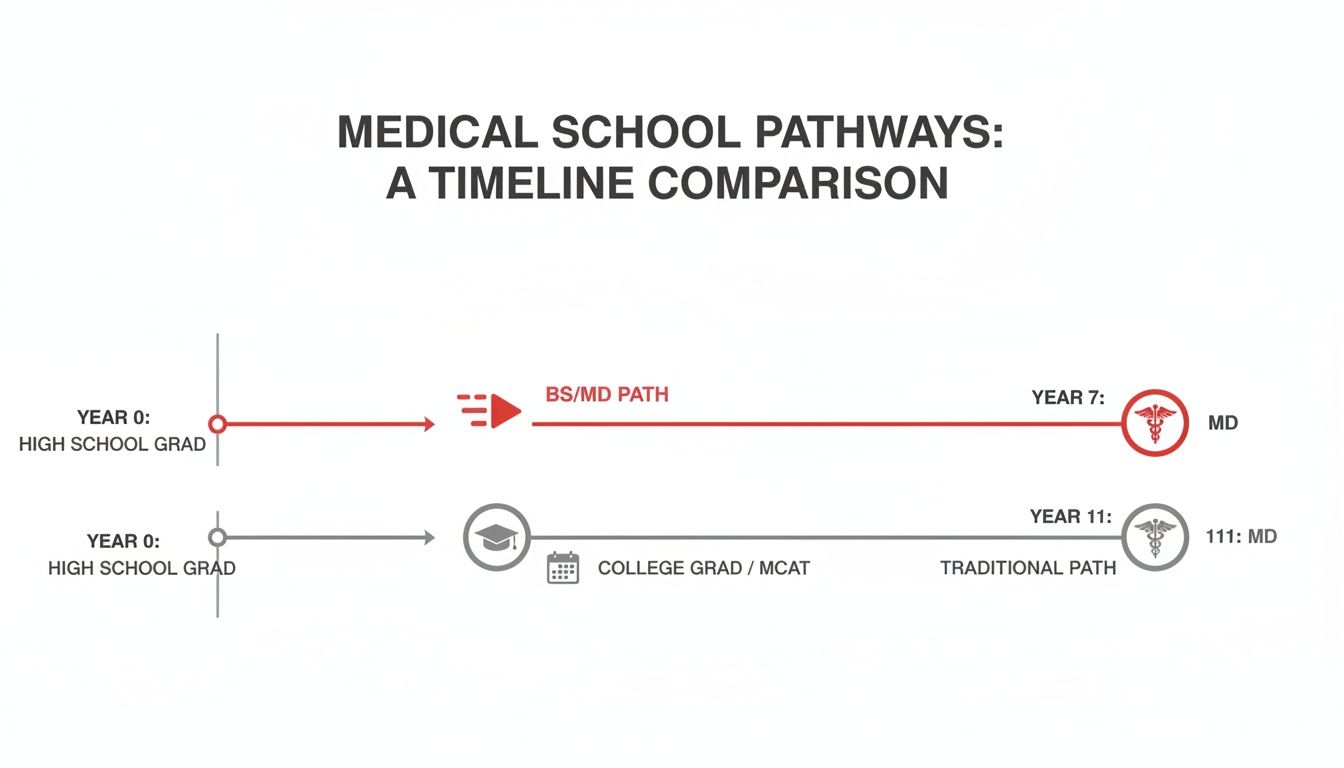
As you can see, the BS/MD track seriously compresses the journey, which means you need to be doing application-level prep work much, much earlier.
Your Ninth Grade Action Plan
The main goal of freshman year is simple: build stellar academic habits and start exploring what you're genuinely passionate about. This isn't the year to have your entire medical career mapped out, but it is the year to prove you have the discipline and intellectual drive for a seriously challenging path.
- Focus on Grades: Aim for the highest possible GPA you can get, especially in your science and math classes. This sets the tone for your entire high school transcript.
- Explore Interests Broadly: Join clubs that actually excite you, whether it’s the debate team, robotics club, or a sport. Admissions committees want to see a real person, not just a pre-med robot.
- Begin Reading Widely: Start reading about medicine, healthcare policy, and new scientific discoveries. This builds a knowledge base that will be invaluable later on.
Your Tenth Grade Action Plan
Sophomore year is where you start adding depth and showing some initiative. You've got your academic footing; now it's time to prove you can apply your skills and passions in more meaningful ways. This is when you shift from just exploring interests to pursuing them with real purpose.
This is the perfect time to seek out your first leadership opportunities. It could be as simple as becoming the treasurer of a club or organizing a small volunteer event. These early experiences show maturity and a willingness to take on responsibility.
Start looking for volunteer opportunities, especially in a healthcare setting. Consistency is what really matters here—a long-term commitment to one or two activities is far more impressive than a scattered list of one-off events.
Your Eleventh Grade Action Plan
Junior year is, without a doubt, the most critical period for your application. This is when you deepen your commitments, kick off standardized test prep, and start the serious research that will shape your application list. The work you do this year will form the very core of your BS/MD application.
- Deepen Extracurriculars: It's time to move from being a member to a leader. If you've been volunteering, ask for more responsibility. If you're involved in research, try to contribute to a specific project.
- SAT/ACT Preparation: This is the year for dedicated, structured test prep. Plan to take the SAT or ACT in the spring, which leaves you time for a retake in the summer or fall if you need one.
- Research Programs: Start building a list of BS/MD programs. Pay close attention to their mission, curriculum, and specific requirements like GPA cutoffs or MCAT policies.
Your Twelfth Grade Action Plan
Senior year is all about execution. All the foundational work from the past three years comes together as you craft and submit your applications. Your most important skills now are organization and time management.
You'll be writing powerful, reflective essays and securing strong recommendation letters from teachers who know you well. You also need to start preparing for interviews, as they are a crucial part of the admissions process for BS/MD programs.
To stay on track, a detailed resource like a complete medical school application checklist can be a lifesaver for managing all the deadlines and requirements. This multi-year journey takes immense dedication, but with careful planning, you can present a compelling and competitive application.
How Ace Med Boards Can Give You a Competitive Edge
Trying to navigate the intense BS/MD application process can feel like finding your way through a dense fog. The competition is fierce, and even the most qualified high school students can struggle to stand out from the crowd. This is where getting expert guidance shifts from being merely helpful to absolutely essential.
Let's be clear: the landscape is incredibly challenging. In the 2025-26 academic year, U.S. medical schools hit a new record, enrolling 100,723 students. While that's great news for the future of medicine, it signals even tougher competition for the handful of spots in elite combined programs. You can discover more about these enrollment trends and what they mean for applicants on medicaleconomics.com. Only the absolute top performers get in.
At Ace Med Boards, we get this pressure because our tutors have walked this exact path and succeeded. We help transform what feels like a daunting, chaotic journey into a structured, manageable process that's designed to make your unique strengths shine.
Personalized Strategies for a Unique Path
A BS/MD application isn't just a standard college application with a few extra essays. It requires a completely specialized approach. Our services are built from the ground up to address the specific hurdles you'll face, providing one-on-one support that’s shaped around your individual story and goals.
We help you build a narrative that admissions committees can't ignore:
- Admissions Consulting: We work with you to craft standout essays and a cohesive application that tells a powerful story about your unwavering commitment to medicine.
- Interview Coaching: The interview is often the final gatekeeper. We provide specialized coaching, including critical MMI preparation, to help you communicate your maturity, passion, and readiness with confidence.
- MCAT & Academic Tutoring: For those programs that require the MCAT or for simply maintaining that sky-high GPA, our expert tutors offer personalized strategies to ensure you meet—and exceed—every academic benchmark.
Our mission is simple: we demystify the admissions process. We give you the insider knowledge and strategic support that admissions committees look for but that most applicants just don't have. We turn your potential into a powerful, undeniable application.
When you partner with an expert who has been through it all, you get more than just advice. You get a mentor who is personally invested in your success. Our tutors help you build the precise academic and extracurricular profile that makes admissions committees sit up and take notice.
If you're ready to build an application that truly shows what you're capable of, learn more about how our medical school admissions consulting services can provide the critical advantage you need to succeed.
Your Top Questions About BS/MD Programs, Answered
Even after getting the lay of the land, most families I talk to still have a ton of questions about what life in a BS/MD program is really like. It's a huge commitment, and you absolutely should get into the weeds on the details before diving in.
Let's tackle some of the most common questions that pop up when students and parents are weighing their options.
Can I Still Apply to Other Medical Schools if I’m in a BS/MD Program?
This is a big one, and the answer is… it depends entirely on the program's fine print. Some BS/MD programs are what we call 'binding.' Once you're in, you're committed. They expect you to matriculate into their affiliated medical school, and applying elsewhere is strictly off-limits.
On the other hand, plenty of programs are more flexible. They let you take the MCAT and even apply to other medical schools. In this scenario, your BS/MD spot acts like the ultimate 'safety net.' It's critical to read the rules for every single program you're considering, because breaking a binding agreement can have some pretty serious consequences for your future in medicine.
What Happens If My GPA Drops?
There’s no getting around it: maintaining top grades is a non-negotiable part of the deal. These programs have strict academic standards, usually requiring a minimum GPA of 3.5 or higher throughout your undergraduate years.
If your GPA dips below that magic number, you’ll likely be placed on academic probation. You’ll have a set amount of time to bring your grades back up. If you can’t, you risk being dismissed from the combined program. The good news? It’s not the end of the world. You can almost always finish your undergraduate major and apply to medical school the traditional way—you’ve just lost the guaranteed seat.
The security of a BS/MD program is its biggest draw, but remember that this security is conditional. Consistent high performance is the key to holding onto your spot and making that smooth transition into medical school.
Do All BS/MD Programs Let You Skip the MCAT?
The dream of bypassing the MCAT is what attracts many students to BS/MD programs, but it’s definitely not a universal perk. The policy varies widely, so never assume the exam is waived.
Here’s how it usually breaks down:
- Some programs waive the MCAT completely. This is a massive weight off your shoulders.
- Others require you to take it and hit a certain minimum score to finalize your acceptance into the med school portion.
- A few might require a practice exam just to make sure you have the foundational knowledge to succeed.
Always, always double-check the specific requirements for every single program on your list.
What Are My Alternatives if I Don't Get In?
Not getting into a BS/MD program is far from a failure—in fact, it’s the route most doctors take! The traditional pre-med path is still the most common way to get into medical school. You'll complete a four-year undergraduate degree, crush the MCAT, and then go through the application cycle.
There are other great options, too. You could look into Early Assurance Programs (EAPs), which allow you to apply during your sophomore year of college. Post-baccalaureate programs are another fantastic choice if you need to strengthen your academic profile after you graduate. The dream of becoming a physician is still very much alive and well.
Navigating the maze of BS/MD applications takes a sharp strategy and an insider's perspective. At Ace Med Boards, our experienced admissions consultants can help you craft an application that truly stands out from the crowd. Visit https://acemedboards.com to schedule your free consultation today.