
Taking a gap year before medical school used to be a rare choice. Now, it’s a common—and often strategic—decision for aspiring doctors. It’s a chance to get your hands dirty with real-world experience, mature on a personal level, and truly prepare for the marathon that is medical education.
Why a Gap Year Is the New Normal for Pre-Meds

If you're staring at your four-year plan and feeling a little panicked about fitting everything in, you're not alone. The path to medical school has definitely changed. What was once an exception has now become a clear trend, and the traditional sprint from undergrad straight into med school is becoming less and less common.
And this isn't just a feeling; the data backs it up. The reality is that medical school admissions have become intensely competitive. Trying to cram in all the necessary clinical hours, research experience, and volunteer work while acing a full course load is a monumental task. A gap year gives you the breathing room to build a profile that truly stands out.
The Data Behind the Trend
In the last few years, taking time off before medical school has become the overwhelming norm. According to the AAMC's 2023 Matriculating Student Questionnaire, a staggering 73.2% of U.S. medical students who started in the 2023-24 academic year took at least one gap year. That’s a huge jump from a decade earlier when the number was just 57.9%. For more on this, check out the data from the Emory Wheel.
This trend signals a fundamental shift in what admissions committees are looking for. They're increasingly seeking applicants who bring maturity, resilience, and a tested commitment to medicine—qualities that are best forged through real-world experiences outside the classroom.
Think of your undergraduate application as a compelling snapshot of your potential. A gap year allows you to create a documentary, showcasing your dedication, growth, and readiness for a career in medicine through sustained, meaningful action.
Traditional Path vs. Gap Year Path
So, what does this actually mean for your application? A well-planned gap year transforms your candidacy from a list of academic achievements into a compelling story of purposeful growth. This is a huge part of what we cover in our guide on how to get into medical school.
Let’s break down how the two paths compare.
Application Snapshot Traditional Path vs Gap Year Path
The table below contrasts the traditional, direct-entry path with the now-common gap year path, highlighting key differences in experience, application strength, and personal readiness.
| Metric | Traditional Path (Direct from Undergrad) | Modern Path (With Gap Year) |
|---|---|---|
| Experience Depth | Often limited to summer gigs and school-year opportunities, which can feel surface-level. | Allows for immersive, long-term roles like full-time research or clinical work, showing a much deeper commitment. |
| Application Strength | Relies heavily on GPA and MCAT scores, with experiences that can sometimes feel rushed or generic. | Balances strong academics with a rich narrative of personal and professional development, adding unique character. |
| Personal Readiness | Higher risk of burnout without a break; less time for self-reflection to confirm if this is the right career. | Provides time to recharge, solidify your motivation for medicine, and develop maturity before starting training. |
Ultimately, the rise of the gap year before medical school shows a broader understanding that the best future doctors aren't just academically brilliant—they are also well-rounded, experienced, and resilient individuals.
Weighing the Pros and Cons of a Gap Year
Deciding to take a gap year before medical school is a huge choice, not just a simple pause in your education. Think of it as an intentional detour, one that has the power to completely reshape your path to becoming a doctor. Let's get real and have an honest conversation about the actual advantages and potential downsides of this increasingly common route.
It helps to think of this time as "recharging your battery." The pre-med track is a brutal marathon, and a gap year can be that critical moment to step off the treadmill, prevent burnout, and gain some much-needed perspective. This is your chance to build the mental resilience you’ll definitely need for the rigors of medical training.
But it’s not just about rest; it's about strategic growth. A gap year gives you the time and space to build a much stronger, more compelling application—one that tells a story of genuine, tested commitment.
The Clear Advantages of Taking a Gap Year
One of the most powerful benefits is having dedicated time for MCAT preparation. Without the constant pressure of a full college course load, you can focus entirely on studying. This laser focus often leads to a higher score, which can dramatically improve your odds of getting into your top-choice schools.
On top of that, a gap year opens the door to deep, meaningful experiences that are almost impossible to squeeze into a packed undergraduate schedule.
- Immersive Clinical Experience: Working full-time as a medical scribe, EMT, or clinical research coordinator provides the kind of hands-on patient interaction that admissions committees absolutely love to see.
- Substantive Research: You can finally commit to a long-term research project. This could lead to publications or presentations that prove you have a serious academic curiosity beyond just getting good grades.
- Personal and Professional Maturity: Simply living on your own, managing your own money, and navigating a real job all contribute to the kind of maturity medical schools are actively looking for in applicants.
A well-planned gap year transforms your application from a simple list of activities into a powerful narrative of purpose. It shows you’ve tested your commitment to medicine in the real world and come out more focused and prepared than ever before.
Acknowledging the Potential Downsides
Of course, the decision isn't a slam dunk for everyone. It’s crucial to look at the challenges head-on to make sure this is the right move for your specific situation. The first and most obvious hurdle for many is money.
Let's be honest: many common gap year jobs, like being a research assistant or a scribe, don't pay very well. This can create real financial pressure, especially if your undergraduate loans are about to enter repayment. You'll need to be smart with your budget and might have to put off other big life milestones.
Beyond the bank account, there are some personal and academic things you need to think about, too.
Navigating Momentum and Peer Pressure
A big worry for a lot of students is the fear of losing academic momentum. After taking a year or two away from intense coursework, the idea of jumping back into a demanding study routine can feel pretty intimidating. This "academic rust" is a real thing, but you can absolutely manage it with some discipline once you start school.
Finally, there’s the social side of things. It can be tough watching your friends and classmates move on to the next chapter—starting medical school, other grad programs, or kicking off their careers. It's easy to feel "left behind." It takes real confidence in your own path to stay focused on your timeline and trust that you're making the right choice for you. This decision really boils down to your personal goals, your financial reality, and what you truly need to become the strongest medical school candidate you can be.
Designing Your High-Impact Gap Year
A successful gap year before medical school isn’t about just passing time—it's about intentional action. Think of it as building a bridge between your undergrad degree and your future as a doctor. Each activity you choose is another solid plank making that bridge stronger and your path forward clearer.
This is your playbook for picking experiences that do more than just check a box. We're talking about choices that genuinely deepen your commitment to medicine and make your application impossible to ignore.
The real key is moving beyond simply racking up hours. Admissions committees are looking for a story of growth, not just a list of tasks. They want to see the core competencies of a physician in action: resilience, empathy, teamwork, and a real-world understanding of patient care.
Choosing Your Path: One Year or Two?
One of the first big decisions is how long your gap year (or years) will be. This isn't a one-size-fits-all choice. The right timeline depends entirely on your goals and what your application might be missing.
Most aspiring doctors opt for one to two years to build a more compelling profile. The data backs this up: 43.9% of 2023-24 matriculants took one to two gap years, while another 13.4% extended their plans to three or four years.
Why the extra time? It allows for more substantial pursuits, like seeing a research project through to publication or completing a post-baccalaureate program. It gives you room to make a real impact.
Here’s a simple way to visualize the path many students take.
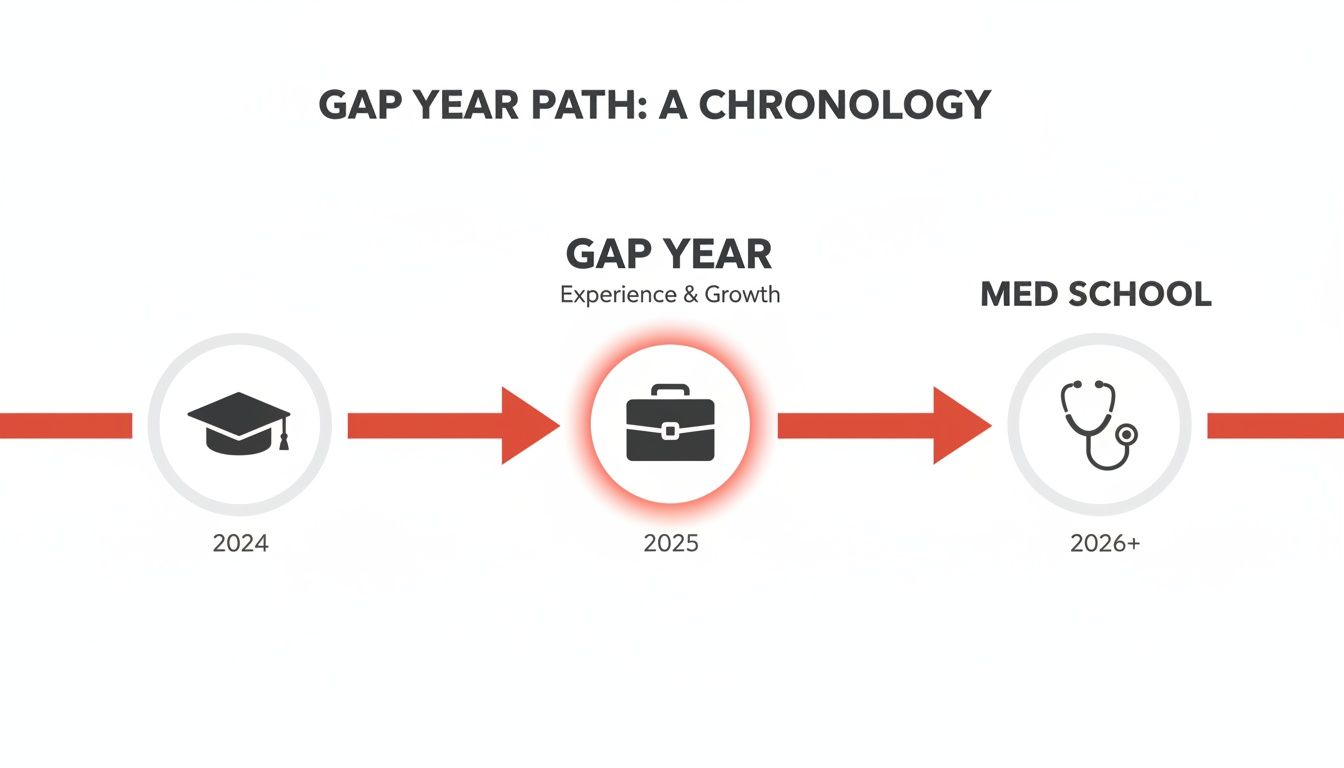
This shows that a gap year is a structured, intentional step in the journey—not just hitting the pause button.
The Most Valuable Gap Year Activities
While your options are endless, certain experiences are consistently valued by medical school admissions committees. Why? Because they directly prove you have the makings of a great future doctor. Let's break down the heavy hitters.
1. Clinical Experience: The Foundation of Your Application
Direct patient interaction is completely non-negotiable. It proves you understand the realities of healthcare—the good, the bad, and the emotionally draining. This is your chance to confirm, without a doubt, that a life in medicine is truly for you.
- Medical Scribe: You'll work shoulder-to-shoulder with physicians, picking up medical terminology, learning the art of patient charting, and seeing how clinical reasoning unfolds in real-time. It’s an unparalleled behind-the-scenes look at a doctor’s daily workflow.
- Emergency Medical Technician (EMT): As an EMT, you’re on the front lines. You'll sharpen your decision-making skills under pressure, learn to stay calm in chaotic situations, and provide direct, hands-on care when it matters most.
- Certified Nursing Assistant (CNA): This role offers deeply personal patient interactions. You’ll assist with daily living activities, providing the kind of comfort and care that builds profound empathy and strengthens your communication skills.
These roles are about so much more than logging hours. To get a better sense of what admissions committees are really looking for, check out our guide on getting meaningful clinical experience for pre-med students.
2. Immersive Research: Demonstrating Academic Curiosity
Getting involved in research shows that you're intellectually curious and grasp the scientific principles that underpin modern medicine. A gap year gives you the time to go way beyond a brief summer project and do something truly substantial.
A year-long research position can lead to tangible outcomes like a publication or a poster presentation. More importantly, it demonstrates your ability to think critically, analyze data, and contribute to the advancement of medical knowledge—all skills vital for a physician-scientist.
Look for paid, full-time positions as a research assistant or lab technician at a university or medical center. This signals a serious commitment and allows you to become a valued part of a research team.
3. Meaningful Volunteer Work: Showing Your Altruism
Volunteering is your chance to show your commitment to service, a core value of the medical profession. The key here isn't variety; it's consistency and passion. Adcoms would much rather see a long-term commitment to a single cause you care about than a scattered list of one-off events.
Think about opportunities that align with your interests and let you see the social determinants of health firsthand.
- Working at a hospice or respite house offers a nuanced understanding of end-of-life care and the incredible importance of compassion.
- Volunteering at a free clinic exposes you to underserved populations and the systemic challenges baked into our healthcare system.
- Serving at a soup kitchen or homeless shelter builds deep empathy and gives you a broader perspective on the community you hope to one day serve.
Ultimately, your gap year before medical school is your opportunity to build a compelling story. By choosing your activities with intention, you can craft a narrative that shows not only that you are qualified for medical school, but that you are truly ready to become a compassionate and dedicated physician.
Managing Your Finances and Well-Being
Taking a gap year before medical school is about more than just beefing up your application. It’s a huge life transition that hits your wallet and your mental health hard. Let’s be honest about the two things no one really prepares you for. This time is an investment in building the resilience you'll need to thrive later, but you have to start on solid ground.
First, you have to get real about the money. Many of the best gap year roles—the ones that give you incredible experience—don't pay well. For pre-meds on a gap year, figuring out how to manage money better is non-negotiable if you want any peace of mind. A detailed budget isn't just a good idea; it's a necessity, especially when you start adding up the insane costs of med school applications.
The numbers don't lie. A full 50% of gap-year matriculants either volunteered or worked in research. The problem? The average salary for a research assistant was only $41,414. That's barely enough to get by in most major cities, which puts applicants without family support in a tough spot. You can dig into more of the data on how money shapes pre-med decisions in this detailed study of gap year trends.
Building Your Financial Plan
To get through this, you need a game plan. The goal is to create enough stability so you can actually focus on your application without stressing about rent every month.
- Prioritize Paid Roles: Actively hunt for paid clinical jobs. Think EMT, medical assistant, or scribe. The pay varies, but these gigs provide both a paycheck and the hands-on experience you need.
- Address Student Loans: The minute you graduate, look into student loan deferment or forbearance. Make sure you understand the terms, because interest might keep piling up even if your payments are paused.
- Budget for Applications: The cost of applying to med school is a shock to the system. You need to start saving early for primary and secondary application fees, interview travel, and even a decent suit. Our guide on how many med schools you should apply to can help you build a realistic budget for this.
Protecting Your Mental Well-Being
Just as critical as your bank account is your mental health. A gap year can feel surprisingly lonely. You’ll watch your friends start their careers or move on to other graduate programs, and it's easy to feel like your own life is on pause. This feeling of "falling behind" is completely normal, but you can manage it with the right strategies.
Staying connected is everything. Schedule regular check-ins with friends, family, and mentors who get what you're going through. Find online pre-med communities or local volunteer groups to build a network of people who share your same goals and struggles.
A gap year isn't a detour; it's an essential part of your training. It’s where you develop the emotional maturity and resilience that textbooks can't teach, preparing you for the immense pressures of being a physician.
Finally, treat self-care like a required course, not an elective you can skip. Stick to a routine, get some exercise, and make time for hobbies that have nothing to do with medicine. This is your chance to build the healthy habits that will carry you through the brutal years of med school and residency. Your well-being is the foundation your entire medical career will be built on.
Telling Your Gap Year Story to Admissions Committees

You’ve poured a year or more into some incredible, demanding experiences. Now it’s time to make them count. A successful gap year before medical school doesn’t just end when you hit "submit" on your application—it all comes down to how you tell the story.
Admissions committees aren't looking for a simple list of jobs or activities. They want a compelling narrative of purpose, maturity, and an unshakable commitment to medicine. This is your chance to connect the dots for them and show not just what you did, but why it was so important for your journey.
Think of yourself as a storyteller. Your personal statement, activity descriptions, and interview answers are all chapters in the same book—the story of your growth.
Crafting a Compelling Personal Statement
Your personal statement is the heart and soul of your application, and your gap year experiences should be woven directly into its fabric. This isn't a separate report; it's the powerful evidence that backs up your argument for why you want to become a doctor. The trick is to shift from merely describing what you did to reflecting on its impact.
Instead of just stating you worked as an EMT, tell them about a specific patient encounter that completely shifted your perspective and hardened your resolve. This approach turns a job title into a powerful story of personal and professional growth. For some great examples of how this is done, checking out sample personal statements for medical school can show you how to build a truly memorable narrative.
Your gap year gives you a unique “before and after” story. Articulate who you were before the experience and who you’ve become because of it. This arc of growth is exactly what admissions committees are looking for.
Writing Impactful Activity Descriptions
The AMCAS Work & Activities section is prime real estate. Don't waste it with dry, resume-style bullet points. Each entry is a mini-story just waiting to be told. A great way to frame these is with the STAR method (Situation, Task, Action, Result), focusing on what you learned and how it changed you.
Before (Weak Description):
"Worked as a medical scribe in a busy emergency department. Responsible for documenting patient encounters in the EMR."
This tells the committee the "what," but it’s flat. It has no sense of impact or learning and is a huge missed opportunity.
After (Strong Description):
"Documented patient histories for a diverse population in a high-acuity emergency setting. Working alongside physicians, I learned to synthesize complex clinical information under pressure and gained firsthand insight into the diagnostic reasoning process, which affirmed my desire to pursue a career in medicine."
This version shows initiative, reflection, and a crystal-clear connection to your future goals. It paints a much more vivid and compelling picture.
Mastering the Interview Question
Sooner or later, you're going to get the direct question: “Why did you take a gap year?” Your answer needs to be confident, concise, and completely authentic. Avoid making it sound like you were just trying to fix a weak application. Instead, frame it as a deliberate, strategic choice to become a better future physician.
Try structuring your response around three key points:
- The Goal: Start with your objective. "I chose to take a gap year to gain a deeper, real-world understanding of patient care that I couldn't get in a classroom."
- The Experience: Give them a specific, powerful example. "Working as a CNA in a long-term care facility, I learned how to build trust with patients facing chronic illness, which taught me just how vital empathy is in daily medical practice."
- The Transformation: Bring it all back to your future in medicine. "That experience didn’t just strengthen my application; it fundamentally shaped the kind of compassionate, patient-centered doctor I aspire to become."
This structure lets you tell a powerful story of intentional growth, turning a standard question into one of the strongest moments of your interview. At the end of the day, every applicant has stats, but your gap year story is uniquely yours. Tell it well, and you'll stand out for all the right reasons.
Your Gap Year Questions Answered
Even after doing all the research, you probably still have a few nagging questions bouncing around in your head. That's completely normal. Deciding to take a gap year before medical school is a huge decision, and it’s smart to want all the facts.
Think of this section as a final check-in to clear up any lingering doubts. We're going to tackle the biggest worries we hear from pre-meds—from admissions impact to interview strategies—so you can move forward with confidence.
Will Taking a Gap Year Hurt My Chances of Getting In?
This is the number one fear, but let’s set the record straight: the data tells a completely different story. Taking a gap year isn't just accepted anymore; it’s become the expected path for most successful med school applicants.
With over 73% of matriculating students taking at least one year off, admissions committees see a well-planned gap year as a sign of maturity. It’s an asset, not a liability. A productive year shows a deeper, more tested commitment to medicine that someone fresh out of undergrad often can't demonstrate.
A gap year doesn’t hurt your application; a wasted gap year does. The focus is on purposeful action and growth. As long as you use the time to gain meaningful experience, you are actively strengthening your candidacy.
Should I Take One Gap Year or Two?
There's no magic number here. The right amount of time depends entirely on your goals and where your application currently stands.
- One Year: This is often the sweet spot for a focused plan. It gives you enough runway for dedicated MCAT prep, racking up significant clinical hours, and submitting a polished application without losing momentum.
- Two or More Years: A longer timeframe can open the door to more profound achievements. This could mean finishing a master's degree, seeing a research project through to publication, or stepping into a major leadership role at a non-profit.
The key is an honest self-assessment. Where are the holes in your profile? How much time do you realistically need to turn those weaknesses into compelling strengths?
Can I Do Something Non-Medical During My Gap Year?
Absolutely—but with one critical condition. You must maintain a clear, consistent connection to healthcare. Pursuing a non-medical interest, like teaching abroad or working in a different industry, can show off valuable life skills and make you a more interesting, well-rounded applicant.
However, adcoms need to see that your dedication to medicine never wavered. This means you have to supplement that non-medical work with ongoing clinical volunteering, shadowing, or another healthcare-related activity. It proves your focus is still locked on your ultimate goal. Before you commit, it’s also smart to ensure you've covered all your academic bases by reviewing the common prerequisites for medical school.
How Should I Explain My Gap Year in an Interview?
Your interview is where your story comes to life. When the gap year question comes up, you need to frame it as a deliberate, thoughtful choice—not a backup plan.
Start by clearly stating what you set out to do. For example, "I chose to take a gap year specifically to gain direct, hands-on patient care experience that would prepare me for the realities of clinical medicine." Then, follow up with a concrete example of what you did and, most importantly, reflect on what you learned from it.
You want to connect those lessons directly back to why you’ll be a more compassionate, resilient, and prepared medical student. If you build your narrative around intentional growth, you'll turn a standard interview question into a powerful statement about your readiness for a career in medicine.
At Ace Med Boards, we know the journey to medical school is a marathon, not a sprint. Whether you're using your gap year to crush the MCAT, need guidance on your application, or are already planning for your board exams, our expert tutors are here with the personalized support you need to succeed. Get started with a free consultation today at https://acemedboards.com.