A great medical residency letter of recommendation does more than just list your accomplishments. It tells a compelling story about your clinical skills and character, showing program directors who you are beyond your test scores. Coming from a respected physician, a powerful LoR can absolutely elevate your application and often becomes the deciding factor in a super competitive match.
Why Your LoRs Matter More Than You Think

Think of your Letters of Recommendation (LoRs) as more than just a checkbox on your ERAS application. They're the human element that can make or break your residency candidacy. While your USMLE scores and MSPE prove you can handle the academics, your LoRs offer something different: an expert, third-party validation of how you actually perform in a real-world clinical setting.
Program directors are swimming in applications, often from hundreds of candidates who look identical on paper. A standout LoR is what cuts through that noise. It gives them a window into your work ethic, your bedside manner, and your potential as a future colleague—the stuff that really brings an application to life.
The True Weight of a Recommender's Words
This isn't just a hunch; the data backs it up. Program directors consistently rank application components, and their feedback tells a clear story about what they truly value.
Here's a breakdown of how program directors rank the most critical parts of your application, based on data from the NRMP Program Director Survey. Notice where your LoRs fall.
Application Factors Program Directors Actually Care About
| Rank | Application Component | Why It Matters to Them |
|---|---|---|
| 1 | USMLE Scores | The primary filter for academic capability and standardized knowledge base. |
| 2 | Letters of Recommendation | Provides crucial insight into clinical performance, professionalism, and specialty fit from a trusted source. |
| 3 | MSPE | Offers a comprehensive, standardized overview of your medical school performance and evaluations. |
| 4 | Personal Statement | Shows your communication skills, personality, and genuine interest in their specific program and specialty. |
| 5 | Clerkship Grades | Demonstrates consistent clinical performance and your ability to apply knowledge in a hands-on setting. |
As you can see, your LoRs are the second most important factor in the entire application. Program directors lean on them to gauge the qualities that raw scores can't capture, like professionalism, teamwork, and whether you're a good fit for their specialty. For students using resources like Ace Med Boards to nail their USMLE Steps and Shelf exams, it's crucial to understand that top scores are only part of a winning strategy.
Let’s put this in perspective. Imagine two applicants vying for a competitive surgery spot. Both have identical Step 2 scores. One has three generic, lukewarm letters. The other has a letter from an attending who vividly describes how they skillfully managed a complex post-op patient, calmed a distressed family, and proactively jumped in to help the team during a crisis.
That specific, story-driven endorsement is what lands the interview.
The Unique Hurdle for IMGs
For International Medical Graduates (IMGs), the weight of these letters is even heavier. A strong LoR from a U.S. physician, based on recent hands-on clinical experience, is an essential bridge. It demonstrates your ability to thrive within the American healthcare system and reassures program directors that you have the clinical acumen and cultural competency to hit the ground running on day one.
A great LoR doesn't just say you're competent; it shows your competence through specific examples. It's the difference between being told a student is "hardworking" and reading a story about them staying late to follow up on a patient's lab results without anyone asking.
Choosing the Right Recommenders for Your Application
Deciding who writes your residency letters of recommendation is probably the most strategic move you'll make in this entire process. Seriously. It’s not about just snagging a letter from the most famous attending you can find. It’s about assembling a team of advocates who, together, will paint a complete and powerful picture of you as a future resident.
Think of your letter writers as storytellers. Each one is responsible for a different chapter of your clinical journey. One might focus on your sharp diagnostic skills, another on your compassion at the bedside, and a third on your dedication in the lab.
Building Your Letter of Recommendation Portfolio
One of the biggest mistakes I see applicants make is chasing after the biggest names. Sure, a letter from a department chair can add some serious weight, but a detailed, personal letter from a senior resident or junior attending who actually worked with you day-in and day-out often packs a much bigger punch than a generic endorsement from someone who barely knows your name.
Program directors are pros at spotting form letters. They want to see genuine enthusiasm. They’re looking for specific, story-driven praise that could only come from someone who directly observed you in action.
Let's break down the key roles your letter writers can play:
- The Clinical Attending: This is your MVP. This recommender should be a physician in your chosen specialty who saw you work extensively during a core rotation or, even better, a sub-internship. They’re the ones who can speak directly to your clinical reasoning, procedural skills, and how you interact with patients.
- The Specialty Expert: This is often a well-respected figure in your field, like a division chief or a program director. Their letter signals to other programs that you’re a serious candidate within the specialty and lends a huge amount of credibility to your application.
- The Research Mentor (PI): If you have your sights set on an academic or research-heavy program, a letter from your Principal Investigator is non-negotiable. This person can detail your analytical skills, your dedication, and your actual contributions to scholarly work, highlighting your potential as a future academic physician.
- The Department Chair: For many specialties, a chair's letter is either required or very strongly recommended. A great example is the SLOE in Emergency Medicine. This letter provides a high-level, comparative assessment of you against your peers at your institution.
By strategically mixing and matching these types of recommenders, you create a multi-faceted application that checks all the right boxes for different program priorities.
At the end of the day, your collection of letters should answer three critical questions for a program director: Can this person actually do the job? Are they genuinely passionate about our specialty? And are they someone we’d want to work a long shift with?
Aligning Recommenders with Your Career Goals
The ideal mix of recommenders you choose should be a direct reflection of your career goals and the types of programs you’re targeting.
Let's look at two different applicants gunning for internal medicine.
Scenario 1: The Academic Researcher
This applicant wants a top-tier university program with a heavy research focus. Their letter portfolio might look something like this:
- PI from a year-long research project to showcase their scientific curiosity and productivity.
- Attending from a cardiology sub-internship to highlight advanced clinical skills in a competitive subspecialty.
- Department Chair of Medicine to provide that formal, high-level institutional endorsement.
- Clerkship director who can speak to their consistent excellence across all third-year rotations. Honing your skills during your medical student clerkships is what makes getting these key letters possible in the first place.
This combination practically screams "future academic leader." Every letter has a specific job, underscoring both clinical chops and scholarly potential.
Scenario 2: The Community Clinician
Now, contrast that with an applicant aiming for community-based programs that prioritize hands-on clinical skills and patient connection. Their strategy would be completely different:
- Attending from a primary care rotation who saw their fantastic bedside manner and ability to build rapport with patients.
- Hospitalist they worked closely with during their medicine sub-I, who can vouch for their efficiency and teamwork on the floor.
- Senior resident who directly supervised them, giving a ground-level view of their work ethic and how teachable they are.
- Program director from an away rotation, proving they can adapt and shine in a totally new clinical setting.
This portfolio is all about practical skills, being a good colleague, and a real commitment to patient care—precisely what community programs are searching for. Your job is to figure out what your target programs value most and then select the writers who can best champion those specific qualities.
How to Ask for a Letter That Gets You Noticed
The quality of your residency letter of recommendation is directly tied to how you ask for it. A rushed, disorganized request almost always results in a generic, uninspired letter. But a thoughtful, well-prepared approach? That’s how you empower your attendings to become your strongest advocates.
This whole process starts long before you ever hit "send" on an email. The sweet spot for making your request is four to six weeks before you need the letter uploaded to ERAS. This timeframe shows respect for an attending's packed schedule and gives them enough breathing room to reflect on your performance and write something truly detailed.
Making the Initial Request
Whenever you can, ask for the letter in person. It’s far more personal and shows that you’re taking this seriously. Find a quiet moment at the end of a rotation, maybe after morning rounds, to briefly state your intentions and pop the question.
If an in-person meeting just isn't in the cards, a professional email is your next best bet. When you're reaching out to potential recommenders, knowing how to write professional emails that get replies is a skill that pays off big time.
No matter how you ask, the words you use are critical. Don't just ask, "Will you write me a letter?" You need to be more direct. Try this instead:
"Based on our time working together, would you feel comfortable writing a strong letter of recommendation for my residency application?"
This phrasing is strategic. It gives the physician an easy, respectable "out" if they feel they don't know you well enough to provide a glowing endorsement. Trust me, a lukewarm letter can do more damage than no letter at all. Getting an enthusiastic "yes" is the real first step.
Assembling Your Recommender Packet
Once an attending agrees, your next job is to make their task as easy as possible. You’ll do this by giving them a comprehensive "LoR Packet" that has everything they need to write a personalized, impactful letter. A well-organized packet screams professionalism and keeps your best qualities front and center.
Giving your writer a complete packet makes their job easier and results in a much stronger, more specific letter for you. Here’s exactly what to include.
Your Recommender Packet Checklist
| Item | Why It's Included | Expert Tip |
|---|---|---|
| Your Current CV | Provides a complete overview of your academic achievements, research, and other experiences. | Highlight 2-3 experiences you're most proud of so they can easily reference them. |
| Your Personal Statement Draft | Offers deep insight into your motivations, career goals, and personal journey. | Even an early draft is better than nothing. It helps them align their letter with your narrative. Check out our guide on how to write a personal statement for residency. |
| ERAS Letter Request Form | Contains the unique Letter ID they need to upload the letter directly to the AAMC portal. | Download the PDF directly from your ERAS account for each recommender to avoid any confusion. |
| Summary of Shared Experiences | Reminds them of specific cases, a memorable patient interaction, or a presentation you gave. | Be specific! Instead of "the patient with pneumonia," say "the complex case of Mr. Jones with multifocal pneumonia in the ICU." |
| The Deadline | Clearly states the date you need the letter uploaded by. | Make the date bold and easy to find in your email. Give them a deadline that is a few days before your actual ERAS submission date for a safety buffer. |
The whole point is to arm your writer with specific, concrete details. Think about it: program directors are sifting through hundreds of applications. A letter from a clinical attending that says you "managed 50 complex cases autonomously" has high credibility and blows vague praise out of the water. Especially for IMGs, who saw match rates of 60.8% according to the NRMP, every specific detail counts.
This visual breaks down the common types of recommenders—Chair, Clinical, and Research—and shows the unique value each brings to your application.
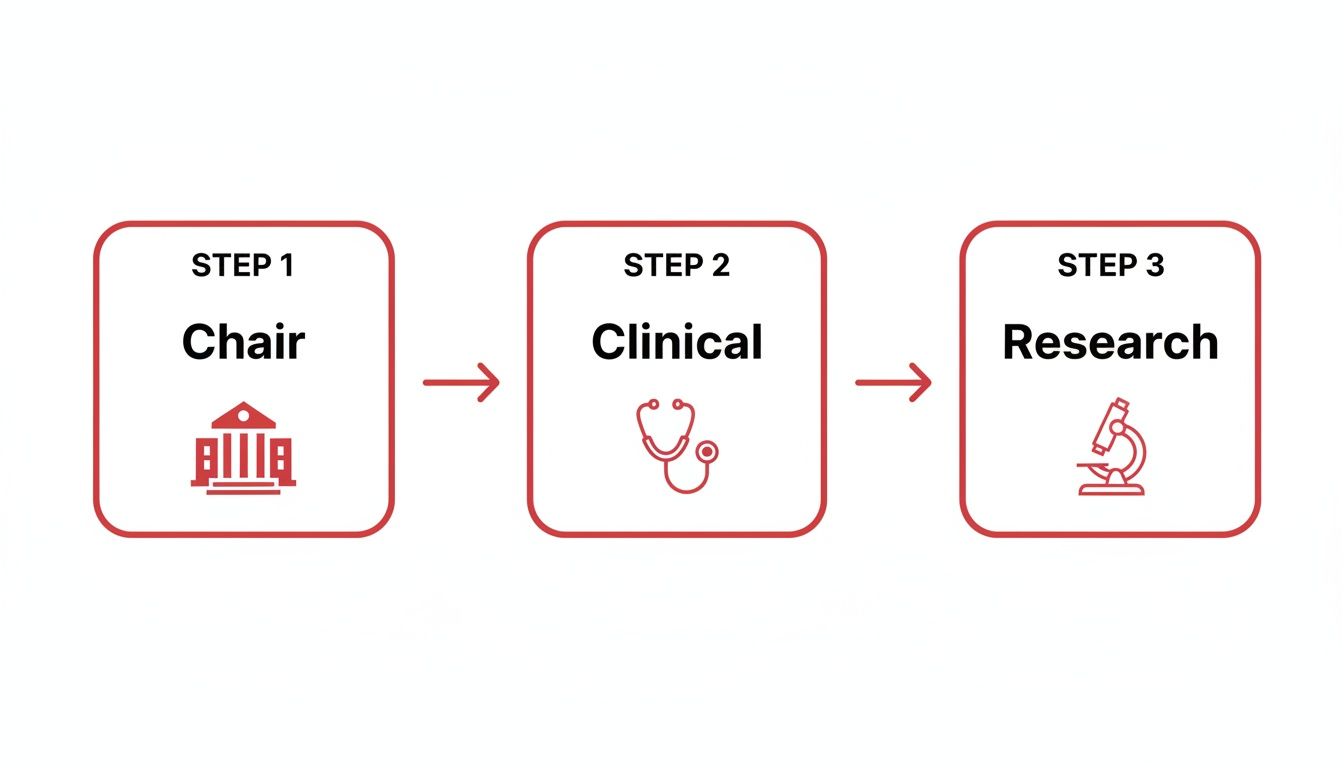
A strategic mix of these letters gives programs a 360-degree view of your candidacy, from a high-level institutional endorsement to your actual performance on the wards.
By providing these materials, you're not writing the letter for them. You’re giving them the high-quality source material they need to advocate for you effectively. This prep work is often what separates a good letter from a truly great one.
Managing Your Letters Within the ERAS System
Once your recommenders have enthusiastically agreed to write for you, the next step is navigating the technical side of things in the Electronic Residency Application Service (ERAS). This is where your careful organization pays off, ensuring every letter gets to the right program without a single hiccup. Honestly, getting these details right is just as critical as the content of the letters themselves.
First, you’ll log into your MyERAS portal and find the "Letters of Recommendation" section. For each person writing you a letter, you need to create a new LoR entry. This involves entering their name, title, department, and institution. It seems simple, but this step is what generates the unique Letter ID number for that specific letter writer.
After you finalize an entry, ERAS will let you generate the official LoR Request Form. This is the PDF you need to get to your recommender. It contains their unique Letter ID and gives them clear, step-by-step instructions for uploading the letter directly to the AAMC's Letter of Recommendation Portal (LoRP).
Always Waive Your Right to View
During this process, you’ll be asked a critical question: do you want to waive your right to see the letter? The answer is always, unequivocally, yes.
You must waive your right. Checking this box tells program directors that you have complete confidence in your recommender and that the letter is a candid, unbiased assessment. Failing to waive this right is a huge red flag. It implies you don't trust your recommender or, even worse, that you might have influenced the letter's content.
In the residency application world, perception is reality. A confidential medical residency letter of recommendation carries significantly more weight because program directors assume it's more honest. Don't give them any reason to doubt the authenticity of your letters.
Tracking and Assigning Your Letters
Sending the request form to your writer doesn't mean your job is done. Now, you play the waiting game, but you need to do it actively by monitoring the status of your letters in the ERAS portal. You'll see the status change from "Confirmed for Upload" (meaning you created the entry) to "Uploaded" (success!).
Don't panic if a letter isn't uploaded the next day. Attendings are incredibly busy people. However, as your deadlines get closer, sending a polite and gentle follow-up email is perfectly acceptable and often necessary.
The final piece of the puzzle is assigning your letters to specific programs. ERAS lets you upload more letters than the typical three or four required, and this flexibility is a powerful strategic tool if you use it wisely.
- Your Core Letters: You should have three strong, versatile letters (maybe from your medicine sub-I and a key clerkship) that you can assign to the vast majority of your applications.
- Specialty-Specific Letters: Did you do a pediatric surgery rotation? Assign that fantastic, highly specific letter only to pediatric surgery programs where it will actually resonate.
- Program-Specific Letters: If one of your letter writers has a personal connection to a specific program or is an alum, assign that letter exclusively to that one institution. It’s a way to leverage their network on your behalf.
This kind of targeted approach shows programs you’ve put real thought into your application. It demonstrates a level of detail that’s a key part of an overall effective ERAS application strategy. Mastering the logistics of the ERAS system is what ensures your powerful letters actually land in the right hands.
An IMG's Guide to Securing Powerful US Letters
If you're an International Medical Graduate, your application journey comes with a unique set of hurdles. Your letter of recommendation strategy needs to be smart, targeted, and designed to overcome them. While every applicant needs great letters, for IMGs, they do more than just recommend—they serve as a critical bridge, directly answering the questions program directors have about your readiness for the U.S. healthcare system.
The single most important factor? Recent, hands-on U.S. clinical experience (USCE). Letters from back home, even from the most distinguished professors, just don't carry the same weight. A program director in Ohio simply has no frame of reference for a hospital in another country. But they absolutely understand and trust the evaluation from a U.S. attending they might know or whose institution they respect.
The Power of US-Based Letters
Your primary mission should be to get at least three powerful letters from physicians based on your clinical work in the United States. These letters are your golden ticket because they provide an apples-to-apples comparison. They prove you can navigate an EMR, present patients like a local intern, and work seamlessly within a U.S. clinical team.
This isn't just a feeling; the data backs it up. A recent analysis of neurology applications revealed a stark difference: LoRs for U.S. grads mentioned specific clinical skills 88.86% of the time, while IMG letters only hit that mark 70.28% of the time. This gap is exactly what strong letters from your USCE are meant to close. With 60.8% of active IMG applicants matching in 2025, every single competitive advantage is crucial.
This is precisely why seeking out hands-on rotations, sub-internships, and externships is non-negotiable for any serious IMG applicant.
Addressing Bias by Highlighting Core Competencies
It's an unfortunate truth that unconscious bias can creep into the selection process. A strong, detailed letter of recommendation is your best defense. The trick is to have your U.S. attendings highlight concrete, observable skills that map directly to the ACGME Core Competencies.
Instead of a generic letter saying you're "hardworking," you want one that describes how you:
- Demonstrated excellent patient care by staying late to personally follow up on a critical lab value for a patient on your service.
- Showcased strong medical knowledge by suggesting a differential diagnosis during rounds that others had overlooked.
- Exhibited impressive interpersonal and communication skills by effectively de-escalating a tense family meeting.
- Showed professionalism by always being prepared, punctual, and respectful to every single person on the healthcare team, from the nurses to the janitorial staff.
When your letter writers use this kind of specific, competency-based language, they're not just giving an opinion. They are providing objective proof of your abilities.
An IMG's letters must do more than just recommend; they must validate. They need to prove to a skeptical program director that you are not a risk, but a capable and well-prepared candidate ready to contribute from day one.
Balancing Home Country and US Letters
So, what should you do with that glowing letter from the head of medicine at your medical school? While it shouldn't be the cornerstone of your application, it can still have a role. A smart approach might involve submitting three strong letters from your U.S. rotations and one from a highly respected mentor from your home country.
This fourth letter can add a different kind of value, speaking to your growth, character, and dedication over several years. Think of it as a supplement, not a substitute, for letters based on recent USCE. As you piece together your application strategy, our complete IMG guide to the USMLE and match process can help you navigate these kinds of decisions.
Ultimately, your portfolio of letters should tell a clear and compelling story: you have a rock-solid foundation from your home institution, and you have successfully proven those skills within the demanding U.S. clinical environment. This dual validation can dramatically elevate your application, helping you stand out and land your spot in a U.S. residency program.
Common LoR Mistakes and How to Avoid Them

Even the sharpest, most qualified applicants can torpedo their own residency applications with simple, avoidable errors. A phenomenal letter of recommendation can make you a top contender, but a single careless mistake can wave a huge red flag to program directors.
Knowing what not to do is just as important as knowing what to do.
One of the most common blunders I see is a student asking a physician who barely knows them. It's tempting to chase a "big name," but this almost always backfires. You end up with a lukewarm, generic letter that says nothing specific about your skills or work ethic. Program directors can spot these form letters from a mile away, and they do far more harm than good.
Another critical error is bad timing. Asking for a letter just two weeks before the ERAS deadline is a non-starter. It’s unprofessional, signals poor planning, and puts a ton of pressure on your attending. That’s not the impression you want to leave with someone who is about to vouch for your professional future.
Forgetting Key Supporting Documents
Just as damaging is failing to give your recommender everything they need to write a stellar letter. When an attending has to chase you down for your CV, personal statement, or rotation evaluations, you’re making their job harder.
This friction often results in a weaker, less detailed letter. They simply don't have the specific examples and data points needed to make your application truly shine.
The goal of your letter of recommendation packet is to make it incredibly easy for your recommender to write a strong, detailed, and enthusiastic endorsement. A great letter doesn't just happen; you help create the conditions for it.
Remember, the specific details in these letters carry immense weight. Research has even shown a link between the content of LoRs and future performance as a resident. One study found that residents in the "highest group" had letters with more mentions of core ACGME competencies. Strong letters aren't just fluff—they're predictive.
Common Pitfalls to Sidestep
To make sure your LoRs are a genuine asset, be absolutely certain to avoid these classic mistakes:
- Failing to waive your right to see the letter. This is a major red flag for program directors. Not waiving your right suggests you don’t fully trust your writer, which undermines the letter's credibility from the start.
- Not following up professionally. It’s okay to check in, but do it right. A single, polite reminder email a week or two before the deadline is perfect if the letter hasn't been uploaded yet. Anything more is pestering.
- Neglecting to send a thank-you note. This is non-negotiable. A brief, sincere thank-you email or handwritten note shows gratitude and maintains a professional relationship. It's just good form.
By steering clear of these common missteps, you ensure all your hard work isn't undone by a simple oversight. To see what a powerful, well-executed letter looks like, take a look at this sample residency letter of recommendation.
Common Questions About Residency Letters of Recommendation
Getting your LoRs in order brings up a ton of questions. Let’s cut right to the chase and tackle the ones that pop up most often for applicants.
How Many Letters Do I Actually Need?
Most residency programs are looking for three to four letters. The non-negotiable rule here is to meticulously check the specific requirements for every single program you apply to, because it absolutely varies.
Here’s a smart play: get four strong letters uploaded into ERAS. This setup gives you incredible flexibility. You can send a core group of three letters everywhere and reserve that fourth one as a specialty-specific powerhouse for relevant programs. It’s the perfect way to tailor your application without burying programs in paperwork.
Is a Chair Letter Absolutely Required?
Not always, but this is highly specialty-dependent. For some fields, a letter from the department chair is more than just a good idea—it's a requirement. Emergency Medicine, for instance, lives and dies by the Standardized Letter of Evaluation (SLOE), which comes from the chair or their designee. It’s not optional.
For many other specialties, a chair's letter is a huge bonus. It provides a high-level, comparative look at how you stack up against your peers. But let's be real: a glowing, detailed letter from an attending who worked with you day in and day out is almost always more powerful than a form letter from a chair you met once.
If your chosen field values it, you should definitely make the effort to get one.
What if My Recommender Misses the Deadline?
First off, don't panic. It happens more than you'd think. Attendings are juggling a thousand things, and deadlines can slip through the cracks. If a letter hasn't been uploaded a week or two before your first application deadline, it’s time to send a gentle nudge.
A brief, polite follow-up email is your best tool here. Simply remind them of the upcoming deadline and offer to provide any extra information they might need. A professional note like this works wonders:
- Subject: Following Up – Letter of Recommendation for [Your Name]
- Body: Dear Dr. [Name], I hope this week is treating you well. I'm just writing to gently follow up on my letter of recommendation for residency. With the application deadline on [Date] getting closer, I wanted to make sure you had everything you needed from me. Thank you again for your incredible support!
This approach shows you're on top of things while still being completely respectful of their time.
Juggling every piece of the residency match, from securing the perfect letters to crushing your board exams, is a massive undertaking. Ace Med Boards provides one-on-one, personalized tutoring for the USMLE, COMLEX, and Shelf exams to help you build the strongest application possible. Start with a free consultation and let's work together to help you reach your match goals.