Think of your pre med pre requisites as the foundational language of medicine. These aren't just boxes to check off; they're the core courses that prove you can handle the intense scientific curriculum of medical school and give every accepted student a shared starting point.
Building Your Academic Foundation with Core Pre Med Courses

Before you can learn to diagnose a patient, you have to understand the basic science that makes a body tick. That’s the whole point of these prerequisite courses. They aren’t random hurdles—they're the bedrock upon which every single medical concept you'll learn later will be built.
Could you imagine trying to understand pharmacology without a solid grasp of organic chemistry? It would be a nightmare. A deep understanding of these sciences is absolutely non-negotiable for med school, and using in-depth chemistry resources can make all the difference. These classes give you the vocabulary and the principles you need to start thinking like a doctor.
The Universal Science Curriculum
While you'll find slight variations from school to school, a standard set of science courses forms the backbone of just about every pre-med path in the country. You should plan on completing the full sequence in several key subjects.
Here's what that almost always looks like:
- Biology: Two semesters with lab work, taking you from the inner workings of a cell all the way to genetics.
- General Chemistry: Two semesters with labs, which lay down the fundamental rules of matter and chemical reactions.
- Organic Chemistry: One or two semesters with labs, focused on the carbon-based molecules that are the essence of life.
- Physics: Two semesters with labs, explaining the physical laws that govern biological systems from blood flow to nerve impulses.
- Biochemistry: At least one semester, which perfectly bridges the gap between the worlds of chemistry and biology.
These subjects are the most critical pieces of your academic puzzle. If you want to see how this all fits into a four-year plan, check out our detailed guide to the essential pre-med courses to help map out your schedule.
The core science prerequisites do more than test your ability to memorize facts. They’re designed to see if you can apply complex scientific principles—a skill you’ll rely on every single day as a physician.
This standardized curriculum ensures that when you and your classmates walk into medical school on day one, you all share the same essential knowledge base, no matter what you majored in. This allows your professors to hit the ground running with an advanced, fast-paced curriculum.
To help you visualize it, here's a quick summary of what most U.S. medical schools expect.
Standard Pre-Med Course Requirements at a Glance
| Core Subject | Typical Coursework | Required Semesters | Lab Component |
|---|---|---|---|
| Biology | General Biology I & II | 2 Semesters | Yes, required |
| General Chemistry | General Chemistry I & II | 2 Semesters | Yes, required |
| Organic Chemistry | Organic Chemistry I & II | 1-2 Semesters | Yes, required |
| Physics | General Physics I & II | 2 Semesters | Yes, required |
| Biochemistry | Biochemistry I | 1 Semester | Often recommended |
| English/Writing | Composition, Literature | 2 Semesters | No |
| Mathematics | Calculus and/or Statistics | 1-2 Semesters | No |
This table covers the basics, but always remember to double-check the specific requirements for every single school you plan on applying to, as some have unique prerequisites you won't want to miss.
Why Your GPA Is More Than Just a Number
In your medical school application, your Grade Point Average (GPA) is one of the first things an admissions committee sees. It’s their initial, standardized snapshot of your academic discipline, your intellectual curiosity, and whether you have what it takes to handle the relentless pace of a medical curriculum.
While it certainly doesn't define you, your GPA is a critical metric that sets the tone for your entire application. Think of it as the foundation of a house. A strong foundation can support an impressive, complex structure. A shaky one, however, makes adcoms question the integrity of everything else, no matter how great your other accomplishments are.
The Two GPAs That Matter Most
Admissions committees don't just glance at a single number. They dig into your academic performance from a few different angles, but two specific calculations carry the most weight when they review your pre med pre requisites.
- Overall GPA: This is the big picture—the average of every single grade from every college course you've ever taken for credit. It speaks volumes about your consistency, work ethic, and ability to manage a diverse academic load.
- BCPM GPA: This is your science GPA, calculated from courses in Biology, Chemistry, Physics, and Math. Honestly, this one is often the more critical of the two. It’s a direct signal of your aptitude for the core sciences you'll live and breathe in med school. A high BCPM GPA shows you’ve already mastered the foundational language of medicine.
Hitting it out of the park in both is the dream scenario. But a standout BCPM GPA can be a powerful statement, proving you excel where it counts most for a future doctor.
An upward trend in your GPA can be just as impactful as a high cumulative average. It tells a story of growth, resilience, and an increasing commitment to your academic goals—qualities every medical school values.
What Is a Competitive GPA for Medical School?
There’s no magic number that guarantees you an acceptance letter, but the data gives us a very clear idea of what it takes to be competitive. The standards are high, and for good reason—the profession demands academic excellence.
Looking at recent data provides a solid benchmark. For the 2025-2026 application cycle, the average GPA for all applicants to U.S. med schools was 3.67. But the students who actually got in and matriculated? They boasted an average GPA of 3.81.
Breaking it down further, matriculants at allopathic (MD) schools in 2025 had an overall GPA of 3.79 and a science (BCPM) GPA of 3.73. For osteopathic (DO) schools, matriculants averaged a 3.71 overall GPA and a 3.53 BCPM GPA. You can find more details in this breakdown of medical school requirements from Kaplan.
The takeaway is clear: strategically aiming for a GPA well above 3.7 puts you in a strong position. But remember, these are averages, not hard cutoffs.
Strategies to Protect and Elevate Your Grades
Building and maintaining a high GPA requires a proactive game plan from your very first semester. One bad grade early on can be a real pain to recover from, so discipline from day one is essential.
- Create a Balanced Schedule: Don't try to be a hero by cramming four lab-heavy science courses into one semester. Mix in some humanities or other less intense classes to manage your workload and avoid burnout.
- Use Your Resources: From day one, get comfortable with office hours, tutoring centers, and study groups. Asking for help isn't a sign of weakness; it's a core strategy for success.
- Attack Weaknesses Immediately: If you're struggling in a class, don't wait until the final to get help. A single "C" can do serious damage to your BCPM, so getting support early is non-negotiable. If you're worried about a dip in your grades, check out our guide on how a low GPA can affect medical school acceptance and what you can do about it.
Your GPA is more than just a number—it’s a story about your hard work, dedication, and potential. By understanding how it's judged and taking smart steps to protect it, you can build an academic record that opens the doors to your future in medicine.
How to Align Your Coursework with the MCAT
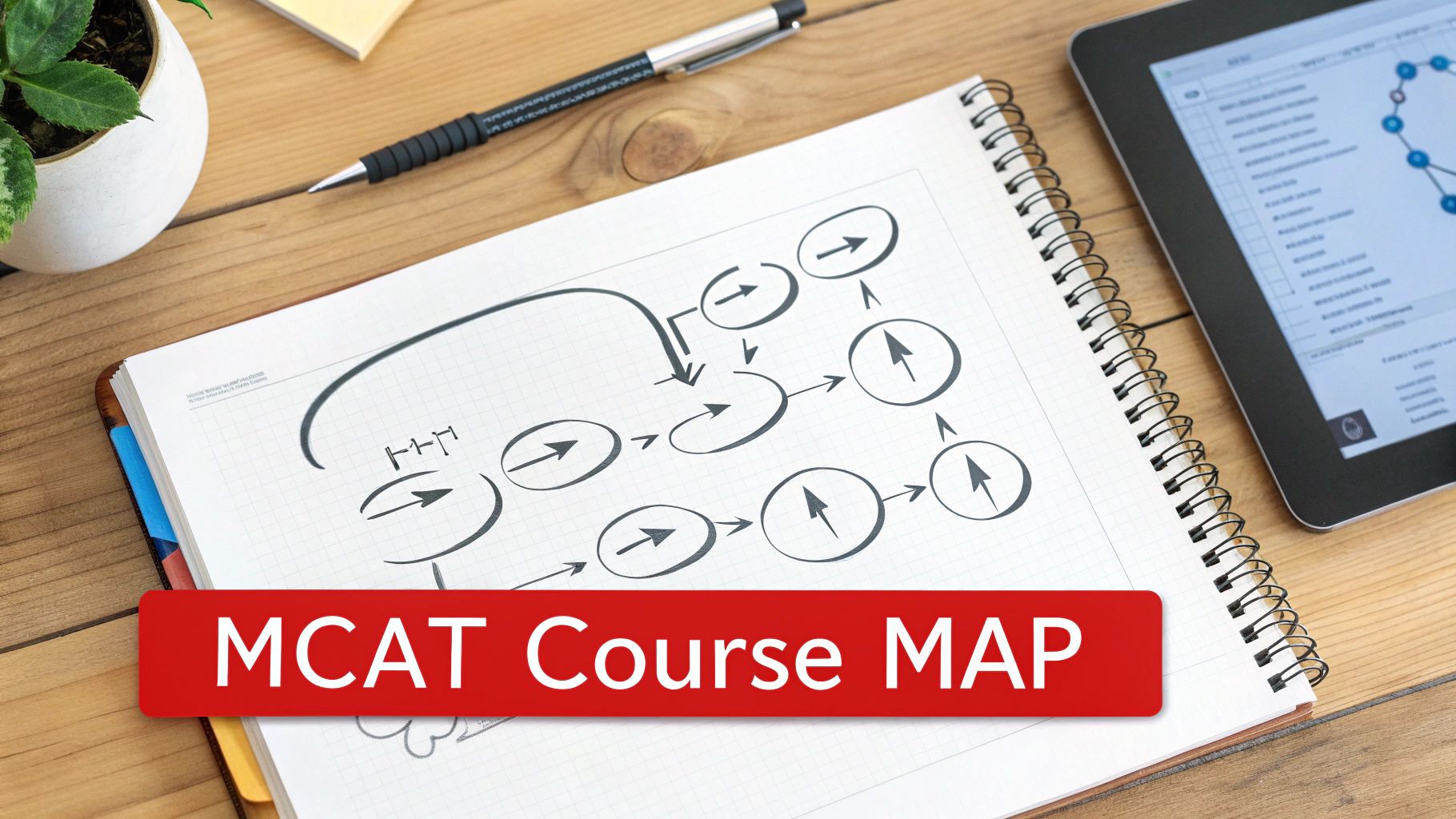
So many students see the MCAT as this monster waiting at the end of their prerequisite journey. It's a final, intimidating hurdle to clear after years of hard work. But what if you stopped thinking of it that way?
It’s far better to view your coursework and the MCAT as two sides of the same coin. The exam isn’t just a glorified flashcard test; it’s designed to see how well you can apply the foundational concepts from your classes to solve complex, unfamiliar problems.
Adopting this mindset from day one is a game-changer. Instead of just grinding for an 'A' in Organic Chemistry, you start asking, "How could this reaction mechanism pop up in a passage about metabolic pathways?" Suddenly, every lecture becomes a long-term MCAT prep session.
Mapping Courses to MCAT Sections
The MCAT isn't some random collection of science trivia. Its structure is a direct reflection of the core science curriculum you'll be taking anyway. Once you understand this alignment, you can see the why behind each prerequisite and really zero in on the most critical concepts.
It's not just about passing a class; it's about mastering the material so deeply that it becomes second nature on exam day.
The link between your classes and the test is incredibly direct. For example, the Biological and Biochemical Foundations of Living Systems section is built almost entirely on introductory biology (65%) and biochemistry (25%). Meanwhile, the Chemical and Physical Foundations of Biological Systems section pulls heavily from general chemistry (30%), organic chemistry (15%), physics (25%), and biochem again (25%).
This is exactly why cramming fails. The test is built to reward students who have methodically constructed a solid, interconnected web of scientific knowledge over several semesters. For a full breakdown, check out the official AAMC guide to the MCAT exam.
Planning your coursework with the MCAT in mind is one of the smartest things a pre-med can do. The table below shows exactly how your required classes feed into each section of the exam, helping you connect the dots between your syllabus and your future score.
MCAT Section and Prerequisite Course Alignment
| MCAT Section | Primary Prerequisite Courses | Key Concepts Tested |
|---|---|---|
| Chem/Phys | General Chemistry, Physics, Organic Chemistry, Biochemistry | Thermodynamics, kinetics, fluid dynamics, circuits, acid-base chemistry, molecular structure, enzyme function, metabolic pathways. |
| CARS | Humanities, Social Sciences (e.g., Philosophy, History) | Reading comprehension, argument analysis, identifying author's tone and intent, drawing inferences from complex texts. |
| Bio/Biochem | Introductory Biology, Biochemistry, General Chemistry, Organic Chemistry | Cell biology, genetics, molecular biology, organ systems, hormonal regulation, DNA/RNA structure, protein synthesis, metabolism. |
| Psych/Soc | Introductory Psychology, Introductory Sociology | Behavior, cognition, social interaction, cultural differences, sociological theories, sensation and perception, mental health. |
This table makes it clear: your undergraduate courses aren't just hoops to jump through. They are the fundamental building blocks for every single question you'll face on test day.
The Most Impactful Courses for Your MCAT Score
While all your science prerequisites matter, a few carry an outsized weight on the MCAT because of how heavily they're tested. If you want to strategically plan your curriculum for maximum impact, give these subjects some extra attention.
- Biochemistry: This is, without a doubt, the single most high-yield subject for the MCAT. It's tested in two different sections and acts as the crucial bridge connecting your knowledge of biology, gen chem, and o-chem. A strong biochem foundation is non-negotiable.
- Introductory Biology: This forms the absolute backbone of the B/B section. You need a rock-solid grasp of genetics, cellular processes, and how organ systems function and interact.
- General Chemistry & Physics: These two are the heart of the C/P section. Your ability to apply principles like thermodynamics, kinetics, and electromagnetism to biological systems will be tested over and over.
But don't just focus on the hard sciences. You need to train your brain to think critically, too.
The CARS (Critical Analysis and Reasoning Skills) section is the great equalizer. It doesn’t test what you know; it tests how you think. Courses in philosophy, literature, and sociology can be surprisingly effective for building the mental muscles needed to deconstruct dense passages and analyze arguments.
Adopting an MCAT Mindset in Class
Your goal isn't just to learn the material for your final exam. It's to learn how the MCAT will test it. This means making a mental shift from rote memorization to active application, starting from your very first semester.
Here's a great way to do this: use MCAT-style practice questions while you're studying for your course exams.
For instance, when you cover acid-base chemistry in gen chem, don't stop at memorizing the Henderson-Hasselbalch equation. Go find a few MCAT passages that apply that very equation to the blood buffering system. This approach not only cements the concept for your class but also gets you comfortable with the test's format. A well-structured MCAT content review plan is essential for bridging that gap between classroom theory and test-day application.
By seeing your coursework through an MCAT lens, you turn your entire undergraduate education into one long, integrated, and highly effective prep course.
Building a Compelling Profile Beyond the Classroom
Exceptional grades and a killer MCAT score are non-negotiable, but they only tell half the story. Admissions committees aren't just looking for walking textbooks; they want to see the human qualities that make a great physician. This means proving your commitment, empathy, and resilience through meaningful experiences outside of lectures and labs.
Think of your application as a story. Your transcript and MCAT score are the prologue, proving you have the academic horsepower. But the experiences you rack up beyond the classroom are the compelling chapters that reveal your character, your motivations, and your genuine passion for medicine. These are the pre med pre requisites that truly bring your application to life.
The Three Pillars of Experience
To build a well-rounded and convincing profile, you need to plant your feet firmly in three core areas. Each one serves a distinct purpose, collectively showing adcoms that you understand the realities of a medical career and are ready for its challenges.
These pillars are:
- Clinical Experience: Direct exposure to patient care.
- Research: Involvement in scientific inquiry.
- Volunteering and Community Service: A demonstrated commitment to serving others.
Each of these adds a unique flavor to your application, transforming you from a set of numbers into a candidate with a proven dedication to health and humanity. A balanced approach is absolutely key.
Gaining Meaningful Clinical Exposure
Clinical experience is, without a doubt, the most critical non-academic requirement. It's your chance to prove to admissions committees—and more importantly, to yourself—that you have a realistic grasp of what it means to work in healthcare. Shadowing a physician is a great start, but hands-on roles offer much deeper, more valuable insight.
To show you're serious about healthcare, consider getting your hands dirty. Completing one of the many phlebotomy certification programs is a fantastic way to do this. Other high-impact roles include working as a medical scribe, a certified nursing assistant (CNA), or an emergency medical technician (EMT). These jobs throw you right into the clinical environment, letting you see the physician-patient dynamic up close and contribute directly to the care team.
You can't overstate the importance of clinical experience. It's the ultimate test of your desire to become a doctor, confirming that you're comfortable and effective in a patient-facing world.
A survey from the Association of American Medical Colleges (AAMC) found that 95% of admissions officers rate clinical experience as a highly important factor. The data also shows that the average matriculant has logged around 150 hours of clinical experience, making it a standard expectation for any serious applicant. You can dig into the AAMC's data on their website for a closer look.
The Role of Research and Volunteering
While clinical hours are the bedrock, research and volunteering round out your profile by showcasing different, but equally important, attributes.
Research Experience
Getting involved in research demonstrates your curiosity, your analytical skills, and your understanding of the scientific process that drives evidence-based medicine. Whether you're in a wet lab pipetting solutions or assisting with clinical research, this experience shows you can think critically and contribute to advancing medical knowledge. You don’t need a Nobel Prize-winning publication; the goal is to show engagement and intellectual horsepower.
Volunteering and Community Service
Medical schools want to accept students who are compassionate and dedicated to helping others. Consistent volunteering—whether it’s in a hospital or at a local soup kitchen—showcases your altruism and commitment to your community. Tutoring underserved kids or spending time at a hospice demonstrates a service-oriented mindset that is central to being a good doctor. The average matriculant has about 100 hours of volunteer work, so sustained involvement is what counts.
Ultimately, your goal is to weave a narrative of purpose. Instead of just checking boxes, seek out opportunities that genuinely light a fire in you and allow you to make a real impact. By thoughtfully choosing your experiences, you can craft a compelling story that highlights your unique strengths and unwavering dedication to a career in medicine. To help get the ideas flowing, check out our guide on finding the right extracurricular activities for medical school.
Charting Your Course: The Four-Year Pre-Med Roadmap
Getting through your pre-med prerequisites isn't about frantically checking off boxes on a list. It's about building a thoughtful, strategic plan that unfolds over several years. A well-designed roadmap keeps you from feeling overwhelmed and ensures you're building a competitive application, piece by piece, without any last-minute panic.
Think of it like building a house. Each semester lays a new floor, complete with the essential wiring (your coursework) and plumbing (your experiences), before you start on the next level.
This timeline gives you a great visual for how the key parts of your pre-med profile—clinical experience, research, and volunteering—should fit together over time.
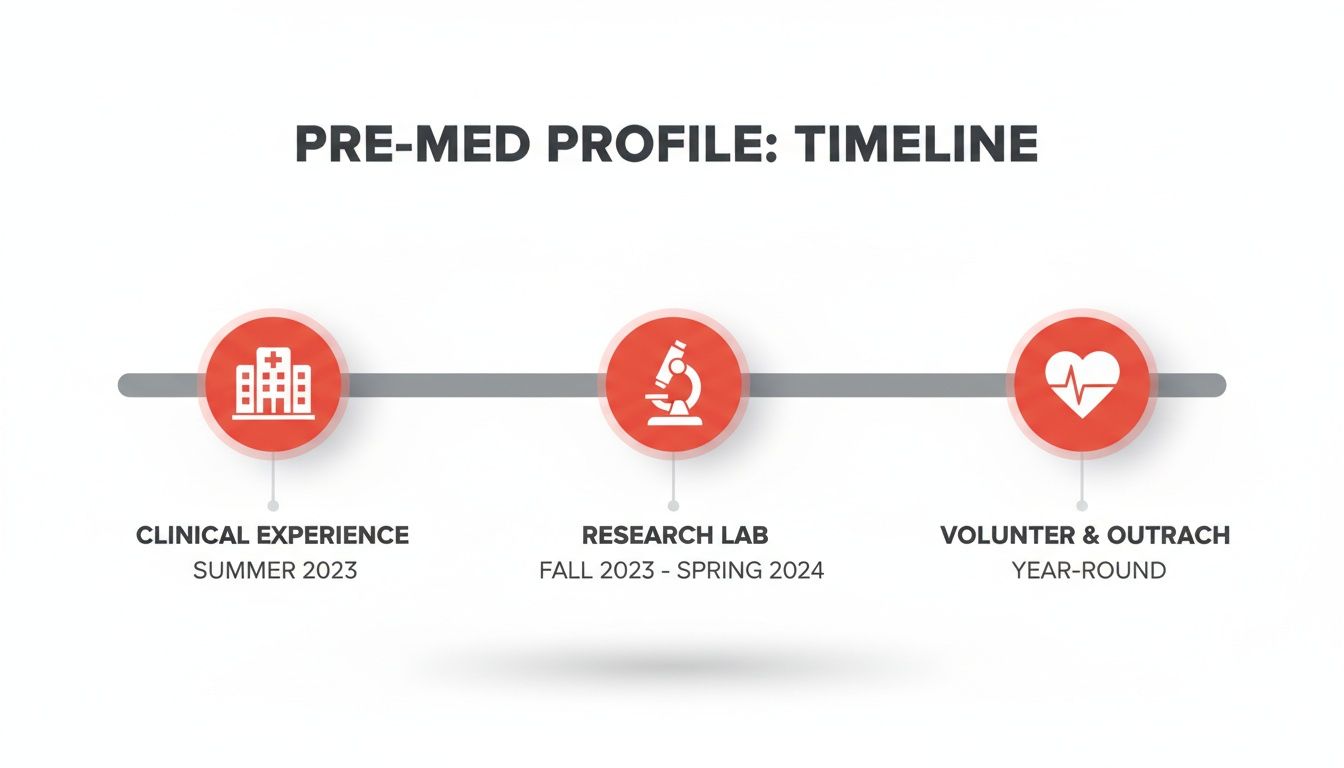
As you can see, these activities aren't things you can just cram into a single summer. Admissions committees want to see genuine, long-term commitment.
The Traditional Four-Year Path
For most students heading straight to college with medical school on the brain, a structured four-year plan is the clearest route. This timeline weaves everything together—from foundational science classes to MCAT prep and finally, submitting your application—at a steady, manageable pace.
Year 1: Freshman Year
- Academics: Your main goal is to crush your introductory science courses. This means General Biology I & II and General Chemistry I & II, both with their labs. It's absolutely crucial to build strong study habits now to protect that GPA from day one.
- Extracurriculars: Start exploring. Find a cause you care about and begin volunteering. Check out the pre-med clubs on campus. This is your low-pressure year to find activities you actually enjoy.
Year 2: Sophomore Year
- Academics: Time to tackle the big ones: Organic Chemistry I & II and Physics I & II. These classes have a reputation for a reason, so be smart about balancing your schedule.
- Extracurriculars: Now you start looking for more substantial experiences. See if you can find a research opportunity in a professor's lab and begin shadowing physicians. It's also a great time to lock down a consistent clinical volunteering gig.
Year 3: Junior Year
- Academics: Dive into your upper-level science courses. The most important one? Biochemistry. This course is a massive part of the MCAT, so don't skip it.
- MCAT Prep: This is go-time for the MCAT. You should dedicate your fall semester and winter break to serious, intensive prep. The goal is to take the exam in the spring.
- Application Prep: Begin brainstorming your personal statement. You'll also want to start asking for letters of recommendation from professors and mentors who know you and your work well.
Year 4: Senior Year
- Application Submission: Your primary AMCAS application gets submitted in June, right after junior year wraps up. You’ll spend the summer grinding out those secondary applications.
- Interviews: If everything goes to plan, you’ll spend the fall and winter of your senior year traveling for medical school interviews.
- Academics: Finish your degree on a high note. Medical schools will see your final grades, so now is not the time for "senioritis."
Adapting the Plan for Different Journeys
Don't worry, the traditional path isn't the only way to get into medical school. Plenty of successful applicants are non-traditional students, career changers, or transfers who need a timeline that's a bit more flexible.
Your path to medicine is your own. Admissions committees value the diverse life experiences and maturity that non-traditional applicants bring. Don't see a different timeline as a weakness—frame it as a strength.
If you’re changing careers, a formal post-baccalaureate (post-bacc) program is usually the most direct route. These programs are designed specifically to help you knock out all the science prerequisites in one or two years.
For transfer students, the first step is to meet with an advisor immediately. You need to map out how your existing credits fit into your new school's pre-med track and pinpoint any courses you still need to take. A solid medical school application checklist can be a lifesaver for staying organized.
It's also becoming more and more common for students to take one or more gap years after graduation. According to AAMC data, the average age of a first-year medical student is 24, which really shows this trend. Gap years are a golden opportunity to strengthen an application by getting more clinical or research experience, finishing a post-bacc, or just studying for the MCAT without the pressure of a full college course load.
Don't Assume All Pre-Med Requirements Are the Same
It's a huge mistake to think there's a universal checklist for pre med pre requisites. While the core science courses are pretty standard, assuming every medical school wants the exact same thing is one of the fastest ways to get your application tossed aside.
Every institution has its own academic vibe and priorities, and you can see it in the courses they require or recommend. For example, one school might be big on genetics, while another wants to see a semester of statistics or public health. These aren't just random suggestions—they're clues about what that school values in its students. If you miss these details, your application looks generic, like you didn't bother to figure out why you're a good fit for their specific program.
The Game is Changing: It's About Competencies, Not Just Courses
On top of that, the old model of just ticking off course boxes is starting to fade. A growing number of medical schools are moving toward a competency-based framework. This means they're less focused on the specific classes you took and more interested in what you can actually do.
Instead of just checking if you passed Organic Chemistry, they want to see proof of your scientific inquiry and critical thinking skills. Big names like Stanford and the University of Pennsylvania are already on board with this approach. It’s a more holistic view that also values skills like communication and cultural competence. You can get a feel for this modern take by checking out Stanford's admissions recommendations.
Your Secret Weapon: The MSAR Database
So, how in the world do you keep all these different requirements straight? Your single most important tool is the Medical School Admission Requirements (MSAR) database from the AAMC. This is the official playbook for what every single MD-granting medical school in the U.S. and Canada is looking for.
Don't think of the MSAR as just a list of schools. It's a strategic intelligence tool. It lets you slice and dice data, filtering schools by their specific prerequisites, average GPA/MCAT scores, and even their mission. It’s how you build a smart, targeted school list.
Seriously, using the MSAR isn't optional. It’s a critical step that helps you:
- Dodge Costly Mistakes: Before you spend a dime or a minute on an application, you can confirm you actually meet the non-negotiable requirements for every single school on your list.
- Find Your "Best-Fit" Schools: The MSAR helps you uncover programs that will actually appreciate your unique background, whether that's in research, a passion for rural medicine, or coming from a non-science major.
- Customize Your Applications: When you understand a school's mission and specific requirements, you can write secondary essays that scream, "I belong here," instead of just sending another generic response.
By putting in the research time upfront, you shift from a scattergun approach to a precision strategy. This ensures every application you send is perfectly aligned with what that specific admissions committee is dying to see.
Got Questions About Pre-Med Prerequisites? We've Got Answers.
The path to medical school is rarely a straight line, and it's completely normal to have questions about the prerequisites. Let's tackle some of the most common hurdles and concerns that pop up for aspiring doctors.
I Got a 'C' in a Prerequisite. Is My Dream Over?
First, take a deep breath. A single 'C' on your transcript is not an automatic deal-breaker, but you do need to be strategic about it. Admissions committees are looking at your entire academic story, not just one grade.
If that 'C' is an outlier—a lone blip surrounded by strong A's and B's, especially with a clear upward trend in your GPA—it's much easier for them to overlook. However, if that course drags down your overall science GPA (BCPM) or if your dream schools have a hard cutoff (like a B-), you should seriously consider retaking it.
Another powerful way to offset a lower grade? Absolutely crush your advanced-level science courses. Earning an 'A' in Biochemistry or Genetics shows adcoms that you’ve mastered the foundational concepts, effectively proving that the 'C' was just a fluke.
Can I Use My AP or IB Credits to Skip Classes?
This is a classic question, and the answer is a firm "it depends." Every medical school has its own policy, making this a tricky area to navigate.
Some schools will happily accept AP or IB credits for introductory courses like General Chemistry or Biology. But there's almost always a catch: they'll expect you to prove your mettle by taking higher-level science courses in those same subjects. So, if you use AP Bio credit, they’ll want to see stellar grades in courses like Cell Biology, Genetics, or Molecular Biology on your university transcript.
The safest move is to check the admissions website for every single school you plan to apply to. Many top programs do not accept AP/IB credits for science prerequisites at all. When in doubt, taking the course in college is the most reliable path forward.
How Do I Handle Prerequisites as a Non-Science Major?
Good news: medical schools love non-science majors! Students from the humanities, arts, and social sciences bring incredibly valuable and diverse perspectives to medicine. The key is simply to prove you can handle the scientific rigor.
You have two main options for getting your science courses done:
- Weave Them In: With some savvy planning alongside your academic advisor, you can fit the required science courses into your undergraduate schedule. This takes foresight from day one but is totally doable.
- Do a Post-Bacc: A post-baccalaureate program is a fantastic, well-trodden path for non-science majors and career changers. These programs allow you to focus entirely on completing your prerequisites after you graduate, helping you earn top grades without juggling other requirements.
Is Taking a Gap Year a Good Idea?
Once seen as a detour, the gap year is now a mainstream and often strategic choice. With the average age of a first-year medical student now at 24, taking time off is more common than not.
A gap year gives you dedicated time to finish up any missing prerequisites without the stress of a full-time undergraduate schedule. It's also a golden opportunity to strengthen the rest of your application in meaningful ways. You can get significant clinical experience, dive into a research project you're passionate about, or dedicate serious time to volunteering.
Admissions committees often view a well-spent gap year as a sign of maturity, focus, and genuine commitment to the field.
Navigating all these moving parts can be a lot to handle on your own. Ace Med Boards provides personalized admissions consulting to help you build the perfect strategy for your unique journey, from course planning all the way to your final application. Learn more about how we can help at https://acemedboards.com.