For any pre-med, shadowing a physician is a non-negotiable step. It’s your chance to see the real, unvarnished life of a doctor—moving beyond textbooks to witness their daily work firsthand. The whole point is to find physicians who will let you observe, prepare yourself to be professional, and then soak up everything you can to strengthen both your conviction and your medical school application.
Why Shadowing Is More Than Just a Box to Check
Let's be real—getting into med school often feels like a mad dash to collect experiences. It's so easy to see shadowing as just another task to complete, but its real value is so much bigger than that. This experience is your most honest preview of the life you're signing up for.
A Critical Reality Check
Your science classes teach you the what, but they can't possibly teach you the how and why of daily medical practice. Shadowing pulls back the curtain on what it truly means to be a doctor.
You'll see more than just clinical decisions. You’ll witness the mountain of administrative work, feel the emotional weight of a tough conversation with a patient’s family, and see the intricate teamwork it takes just to keep a practice running. It’s an unfiltered look at the incredible highs and the seriously demanding lows.
This is all designed to help you answer one crucial question: Is this life really for me?
Answering that question with a confident "yes" based on real experience gives you a powerful, authentic story for your applications and interviews. It also counts as a crucial form of clinical experience, something admissions committees look at very closely. To see how shadowing fits in with other activities, it’s worth understanding what is clinical experience and why it carries so much weight.
Shadowing turns a generic desire to "help people" into a concrete, compelling story. Instead of a cliché, you can talk about the time you watched a pediatrician build trust with a terrified child, solidifying your own commitment to compassionate care.
The Statistical Edge
Beyond just confirming your own passion, shadowing gives you a measurable boost. One study analyzing over 17,000 medical school applications revealed a telling pattern: accepted students averaged 130 shadowing hours, while rejected students averaged just 119.
The data also suggested that having more than 50 hours was linked to a higher chance of getting in, which really highlights the impact this experience can have. When you dig into the importance of structured clinical experiences, you see just how much weight admissions committees place on them.
Finding and Landing Your Ideal Shadowing Role
Securing a shadowing opportunity can feel like the toughest part of the entire pre-med journey. But trust me, a smart, multi-pronged strategy is far more effective than just sending a few random emails and hoping for the best. Knowing how to shadow a physician really starts with knowing who to ask.
Start With Your "Warm" Network
Your first move should always be to tap into the connections you already have, no matter how distant they might seem. This "warm" network is your most valuable asset because a personal connection, even a small one, cuts through the noise.
- Personal and Family Connections: Who’s your family doctor? Your pediatrician? Any specialists you or your family members have seen? These physicians already know you, which makes them far more likely to say yes.
- University Resources: Your pre-med advisor is an absolute goldmine. They often keep lists of alumni or local doctors who are friendly to student shadowers. And don't forget your science professors—many have colleagues in the local medical community.
Mastering the Art of Cold Outreach
When your immediate network comes up dry, it’s time to move on to cold outreach. I know it can feel intimidating, but it’s a standard rite of passage for pre-meds. The key is to be professional, personal, and respectful of the physician's insanely busy schedule.
Your first email is your first impression, so make it count. Keep it short, professional, and to the point. Since many hospitals or larger clinics require a formal application, knowing how to craft a compelling resume for your shadowing application is a skill that will put you a step ahead right from the start.
Pro Tip: Your email's subject line is everything. A generic "Shadowing Request" is easily ignored. Try something more specific and professional like "Pre-Med Student Seeking Cardiology Shadowing Opportunity." This tells the physician or their office manager exactly what the email is about in a single glance.
In your message, clearly state who you are, your school and year, and—most importantly—why you are interested in their specific specialty. This small bit of personalization shows you've done your homework and aren't just spamming every doctor in a 50-mile radius. It's what separates an email that gets a reply from one that goes straight to the trash.
Choosing the right outreach method depends on your connections and comfort level. Let’s break down the common approaches.
Shadowing Outreach Method Comparison
| Method | Success Rate | Pros | Cons |
|---|---|---|---|
| Warm Network | High | Higher response rate; builds on existing trust; less formal process. | Limited by the size of your personal and academic network. |
| Cold Email | Moderate | Scalable; allows for thoughtful, personalized messages; professional. | Emails can be easily ignored or lost; requires strong writing skills. |
| Phone Calls | Low-Moderate | Can be more direct and personal if you reach the right person. | Often screened by staff; can be seen as intrusive if not handled well. |
| In-Person | Low | Highly personal; shows initiative (if appropriate for the setting). | Very difficult in most clinical settings; can be perceived as unprofessional. |
Ultimately, a mix of leveraging your warm network and sending targeted, professional cold emails will give you the best shot at landing a great opportunity.
The entire shadowing process is designed to help you grow. It confirms whether a specialty is right for you, demystifies what a physician's day really looks like, and gives you compelling experiences to talk about in your applications.
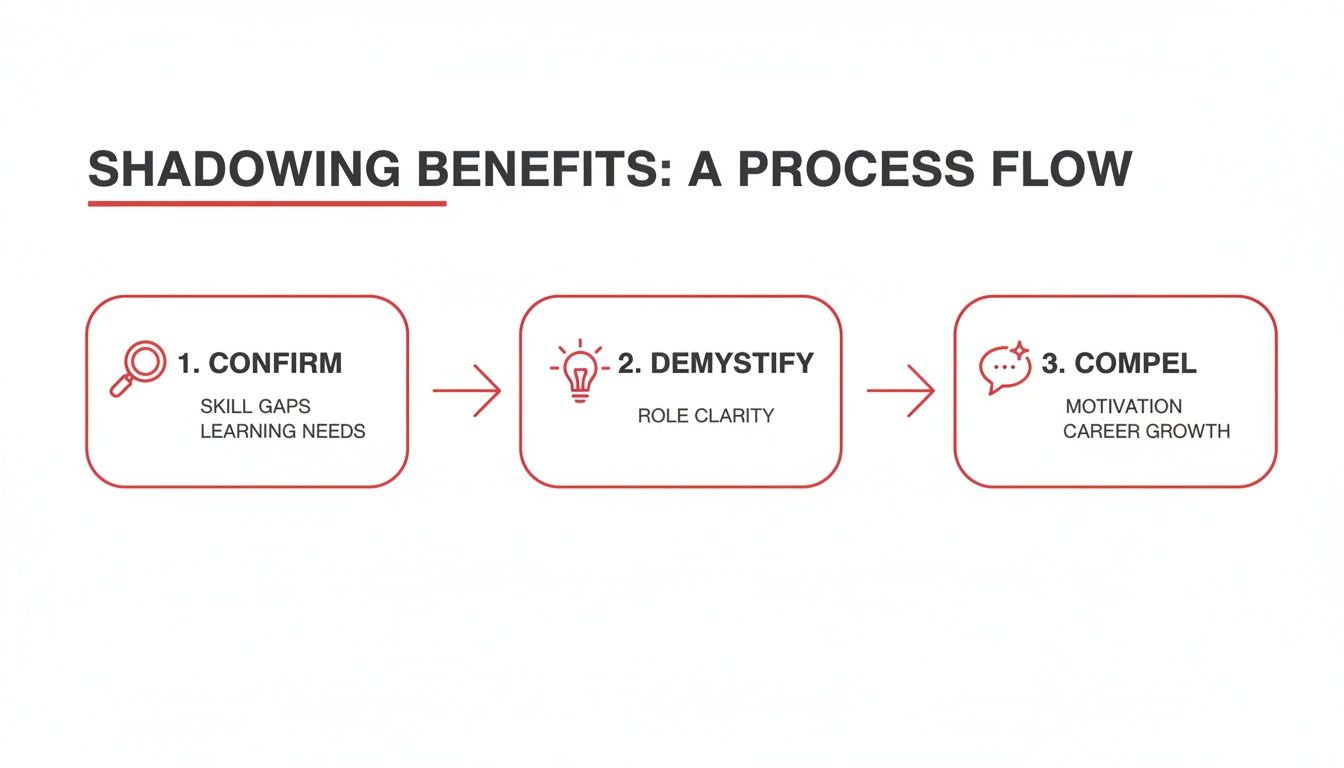
As you can see, each stage builds on the last, turning simple observation into a powerful tool for your personal and professional development.
Following Up Without Being a Nuisance
Doctors are incredibly busy. Their inboxes are overflowing. If you don't hear back within a week or two, sending a polite follow-up is perfectly fine and shows you're genuinely interested.
A simple, brief message is all you need. Something like this works well:
"Dear Dr. Smith, I hope you are having a good week. I am just following up on my previous email regarding a potential shadowing opportunity. I have attached my resume again for your convenience. Thank you for your time and consideration."
If a second email goes unanswered, it's probably time to move on. Persistence is great; pestering is not.
Remember, shadowing is a critical piece of the puzzle, but it's just one piece. To see how it fits into the bigger picture of your pre-med preparations, check out our detailed guide on how to get clinical experience to ensure your application is as strong and well-rounded as possible.
How to Prepare Before Your First Day
You landed the shadowing opportunity—congratulations! Now the real work begins. Showing up prepared isn’t just about being on time; it's about demonstrating respect and initiative from the moment you arrive.
Thoughtful preparation sets the stage for a much richer learning experience. It signals to the physician and their staff that you value their time and are serious about your future in medicine.
Understand HIPAA and Patient Privacy
Before you even think about what to wear, you need to grasp the absolute importance of the Health Insurance Portability and Accountability Act (HIPAA). This federal law is the bedrock of patient privacy, protecting all sensitive health information.
As a shadower, you are legally and ethically bound to keep everything you see and hear confidential. This isn't a suggestion—it's a strict rule.
You cannot discuss patient cases, names, or any identifying details with anyone outside the clinical team. Not your partner, not your parents, and definitely not on social media. Even a seemingly innocent, accidental breach is a serious offense.
Key Takeaway: Think of yourself as a vault. Everything you observe about a patient—their diagnosis, personal stories, even their presence in the clinic—is confidential information. Your commitment to privacy is non-negotiable.
Handle Your Paperwork Proactively
Most hospitals or clinics will have some paperwork for you to complete. Don’t wait until the day before to ask about it. Being proactive shows you're organized and take this seriously.
Expect to handle a few common documents:
- Confidentiality Agreement: This is where you formally agree to abide by HIPAA and the facility's privacy policies.
- Immunization Records: You'll almost certainly need to show proof of vaccinations like the flu shot, MMR, and a recent TB test.
- Liability Waiver: A standard form that simply clarifies the observational nature of your role.
Reach out to the clinic manager or your contact person at least a week ahead to see what they need. Getting everything squared away early prevents last-minute scrambling and makes a fantastic first impression.
Dress the Part and Do Your Homework
Your attire speaks volumes before you even say a word. The default is business casual unless you’ve been specifically told to wear scrubs. For most, this means slacks or a professional skirt, a button-down shirt or blouse, and closed-toe shoes.
And on that note, make sure your shoes are comfortable. You will be on your feet for hours.
Beyond your appearance, invest a little time researching the physician you’ll be shadowing. What’s their specialty? Do they have any published research or specific clinical interests? A quick search can provide great context.
It’s also incredibly helpful to brush up on common conditions and terminology in their field. You don’t need to be an expert, but having a basic vocabulary will turn passive observation into active learning. This medical terminology study guide is a great place to start familiarizing yourself with the language of the clinic.
Turning Observation Into Active Learning

Simply standing in the corner of an exam room isn't going to cut it. To get the most out of shadowing, you have to shift from being a passive spectator to an active observer. This is your front-row seat to the real, unscripted world of healthcare, and every single interaction is a lesson waiting to be learned.
Your goal is to absorb more than just the clinical facts—it's to understand the subtle art of medicine. That means watching how the physician builds trust, how they deliver bad news, and how they navigate tough conversations. You need a solid game plan to turn these fleeting moments into lasting knowledge.
Develop a Smart Note-Taking System
Don't even try to jot down every medical term you hear. You'll drive yourself crazy. Instead, focus on capturing the context behind the care. A smart, structured note-taking system helps you organize your thoughts on the fly and spot the things that truly matter.
Try using a three-column method in your notebook:
- Clinical Observations: Keep it brief and HIPAA-compliant. Note the patient's main issue, key symptoms, and the doctor's plan. Think shorthand, like "60s M w/ chest pain" instead of using any personal details.
- The Art of Medicine: This is where the gold is. How did the doctor make a nervous patient feel at ease? How did they simplify a complicated diagnosis? Did you witness a tough ethical choice or a powerful moment of empathy? Write it down.
- Questions for Later: Anything you don't understand or want to know more about goes here. This list becomes your secret weapon for asking great questions when you get a quiet moment with the physician.
This approach forces you to look past the science and see the human side of medicine—exactly what medical schools want to hear about in your interviews.
Your notes are more than a diary of your day. They are the raw material for your personal statement and interview answers, helping you connect a specific moment you witnessed to the bigger reasons why you want to be a doctor.
Look Beyond the Physician
Doctors don't work in a silo. A huge piece of modern medicine is interprofessional collaboration, and shadowing is your chance to see it in action. Pay close attention to how the physician interacts with everyone on the team—nurses, MAs, PAs, and front-desk staff.
An NIH-backed study found that observing these team dynamics gives students a 'global perspective on patient care.' Watching how a team communicates (or fails to) shows you that patient outcomes hinge on far more than just a correct diagnosis. You can read more about these insights in the full research on interprofessional shadowing.
Ask Insightful Questions at the Right Time
Timing is everything. Never interrupt a patient consultation or a critical discussion. Hold your questions for the right moments, like when the physician is charting between patients, walking down the hall, or during a lunch break.
And please, don't ask basic questions you could easily Google. Focus on the "why" to show you're thinking critically.
Here are a few examples of questions that make a great impression:
- "I noticed you chose medication X over medication Y for that patient. Could you walk me through your thought process?"
- "How do you approach situations where a patient seems hesitant to follow your medical advice?"
- "What do you find is the most challenging non-clinical part of your job?"
These types of questions show genuine engagement and a deep curiosity about the profession. They're the kind of questions that make a physician remember you for all the right reasons.
How To Document and Leverage Your Experience

So you've wrapped up your shadowing experience. Great! But the work doesn't stop there. The real value comes from turning those hours into a compelling narrative for your medical school applications.
This isn’t just about tallying hours in a log. It’s about building a story that shows an admissions committee why this experience mattered and how it solidified your decision to pursue medicine. It all starts with meticulous documentation.
Systematically Tracking Your Hours
The first thing you should do is get organized with a simple spreadsheet. Trust me, this will save you a massive headache when you're filling out AMCAS or AACOMAS applications later. You need a clear, comprehensive log of every single shadowing session.
For each entry, make sure you capture:
- Physician’s Name and Specialty: e.g., Dr. Jane Smith, Pediatrics
- Location: e.g., City General Hospital, Inpatient Ward
- Date(s) and Total Hours: Log each day separately. Accuracy is key.
- Key Observations: A quick, HIPAA-compliant note about what you saw. Think "observed patient consultations for chronic asthma management" or "witnessed rounds for post-op recovery."
This system isn't just for organization; it's a strategic tool. Medical schools have wildly different expectations for shadowing hours. The AAMC notes an average of around 80 shadowing hours, but some top-tier programs might look for closer to 200 hours, while others are fine with 40. Keeping a precise log helps you know exactly where you stand.
If you want to improve your note-taking skills, there are great resources out there that can help you capture more meaningful observations.
The Power of Reflective Journaling
Okay, tracking hours is the "what." The "why" comes from your reflective journal. This is where the magic happens. After every single shadowing day, set aside 15 minutes to just write. Go beyond the clinical details and dig into how the experience made you feel and what it made you think.
Your journal is your personal statement goldmine. These reflections will help you articulate exactly how shadowing confirmed your commitment to medicine, providing specific, powerful anecdotes for essays and interviews.
Don't just summarize the day. Ask yourself some tough questions:
- What was the most difficult patient case I saw today, and why did it stick with me?
- How did the physician show empathy when delivering bad news?
- Did anything about the daily grind of being a doctor surprise me?
These are the insights that build a powerful narrative for your application. When you're ready to put it all together, these reflections will be invaluable for crafting a standout medical school CV.
Closing the Loop with Professionalism
Your experience isn't truly over until you've said thank you. This is more than just good manners; it's about solidifying a professional relationship that could lead to mentorship or a stellar letter of recommendation down the road.
Within a week of your last day, send a personalized, handwritten thank-you note to the physician. Don't just send a generic card. Mention a specific moment from your time there or a piece of advice that really resonated with you. It’s a small gesture that shows genuine appreciation and leaves a lasting positive impression.
Common Questions About Physician Shadowing
As you start planning your shadowing experiences, a lot of specific questions are bound to come up. It can be tricky trying to figure out what medical schools actually expect versus what’s just rumor, all while navigating professional etiquette.
Let’s clear up some of the most common queries pre-meds have. Getting these details right will help you build a shadowing experience that really strengthens your application.
How Many Shadowing Hours Do I Actually Need?
There’s no single magic number here, but a solid target is 50-100 hours spread across two or three different specialties. Honestly, admissions committees care far more about the quality of your experience and your reflections on it than the sheer quantity of hours.
A meaningful 50-hour experience that you can talk about in depth is way more valuable than 200 hours you spent passively standing in a corner.
Always do a little digging on the informal recommendations of your target schools, since some have higher expectations than others. The main goal is to get enough exposure to clearly explain why you're committed to medicine. It’s a huge part of showing admissions committees what medical schools look for in an applicant.
Shadowing is a story, not a statistic. An admissions officer will be more impressed by your detailed reflection on a complex patient case you witnessed over 40 hours than by a vague mention of 150 hours spent in a clinic.
What's the Difference Between Shadowing and Clinical Volunteering?
This is a critical distinction for your application, and it's one a lot of students mix up. The two roles serve very different, but equally important, purposes.
- Shadowing is purely observational. You are a fly on the wall, following a physician to understand their day-to-day professional life without any hands-on patient contact. The purpose is to prove you understand what a physician's career actually entails.
- Clinical Volunteering is an active role. Here, you're contributing to a healthcare setting, often with direct (though non-medical) patient interaction. Think transporting patients, stocking supplies, or talking with families. This demonstrates your commitment to service and your comfort in patient care environments.
Both are vital for a well-rounded application. One shows you know what doctors do; the other shows you want to be in that environment of care.
Should I Shadow a Physician I'm Related To?
The short answer is no, not if you can help it. Admissions committees tend to view shadowing a family member as an experience of convenience, not one you proactively sought out on your own. It can also raise doubts about whether you observed a truly objective, typical professional day.
If it's your only option to get started, it's better than nothing. But you should make it a priority to secure opportunities with physicians you aren't related to. This adds much more credibility to your application and proves you took the initiative to create your own path.
Do Medical Schools Take Virtual Shadowing Seriously?
Virtual shadowing definitely got a boost during the pandemic and is still seen as a legitimate way to explore specialties. It's particularly useful for getting a peek into fields that are tough to access in person, like highly specialized surgical fields.
Medical schools generally view it as a valuable supplement that shows your initiative, but they don't see it as a full replacement for in-person experience.
If you do virtual shadowing, be ready to discuss what you learned and why you chose that specific program. But whenever possible, make hands-on, in-person shadowing your top priority.
At Ace Med Boards, we understand that a strong application is built on more than just grades and hours—it's about turning your experiences into a compelling narrative. Our expert tutors and admissions consultants can help you articulate the value of your shadowing and position you for success. Learn more about our personalized guidance.