Everyone knows you need to take them, but the difference between a good score and a great score is how you use them. Treating NBME Step 2 CK practice exams as diagnostic super-tools—not just expensive question banks—is the key to unlocking your full potential. This is the approach that reveals hidden weaknesses and builds the mental endurance required to truly succeed.
Why Practice Exams Are More Than Just Practice
Let's get past the obvious. Just grinding through a practice exam isn’t enough. The real value comes from strategically using these assessments to guide your daily study, predict your performance, and turn that raw data into a higher final score.
Think of each practice test as a significant leap forward in your preparation, not just another item to check off your to-do list.
These exams are designed to do more than just simulate test day; they are your most powerful diagnostic instrument. They reveal the specific, subtle patterns in your reasoning that need correction and pinpoint your exact knowledge gaps by system and physician task.
Pinpointing Your Weakest Links
A practice exam doesn’t just tell you that you’re “weak in cardiology.” That’s not helpful. It can show you that you consistently miss management questions related to acute coronary syndrome but excel at diagnosing congenital heart defects. That level of detail is invaluable.
For example, seeing a low performance bar in "Communication and Interpersonal Skills" under the Psychiatry section is a direct signal to focus on ethics and patient counseling questions. This granular feedback allows for hyper-targeted studying. Instead of re-reading an entire chapter, you can focus your energy on the precise concepts holding you back, making your study sessions far more efficient.
Building Essential Test-Day Stamina
The Step 2 CK exam is a nine-hour marathon. Academic knowledge alone won't get you through it; you also need mental endurance. Regularly taking full-length NBME Step 2 CK practice exams under timed, simulated conditions builds the stamina required to stay focused and sharp all the way through that final block.
The goal is to make the real exam feel like just another practice session. By conditioning your mind and body for the length and intensity of the test, you reduce anxiety and minimize the risk of making careless errors due to fatigue.
This conditioning process is critical. You’ll learn how to manage your time, when to take breaks, and how to maintain concentration when mental exhaustion inevitably sets in. This is practical, real-world experience that question banks alone simply cannot provide. For more insights on maximizing test performance, you can check out our detailed guide on USMLE practice exams.
Predicting Performance with Accuracy
While no predictor is perfect, NBME self-assessments are widely considered the gold standard for estimating your final Step 2 CK score. They offer a realistic benchmark that helps you do a few key things:
- Set Realistic Goals: You need to know where you currently stand in relation to your target score for a specific residency.
- Track Your Progress: See tangible, data-driven evidence of your improvement over your dedicated study period.
- Make Informed Decisions: This data helps you decide if you need to postpone your exam or seek extra help to close a significant score gap.
Ultimately, these exams provide the objective data needed to transform your study plan from a guessing game into a targeted, evidence-based strategy for success.
How to Create Your Practice Exam Schedule
Figuring out when to take your NBME Step 2 CK practice exams can feel like a high-stakes puzzle. If you stack them too close together, you risk burnout. But if you space them too far apart, you're flying blind without enough data to guide your studying.
The sweet spot is a structured timeline that gives you regular diagnostic snapshots without overwhelming you. Think of it as building a few key milestones into your dedicated period: a baseline assessment to see where you stand, a few mid-prep check-ins to track progress, and a final exam to build confidence. This approach ensures you can see your progress clearly and make smart, data-driven adjustments along the way.
Each practice exam serves a unique purpose, moving you from one stage of prep to the next.
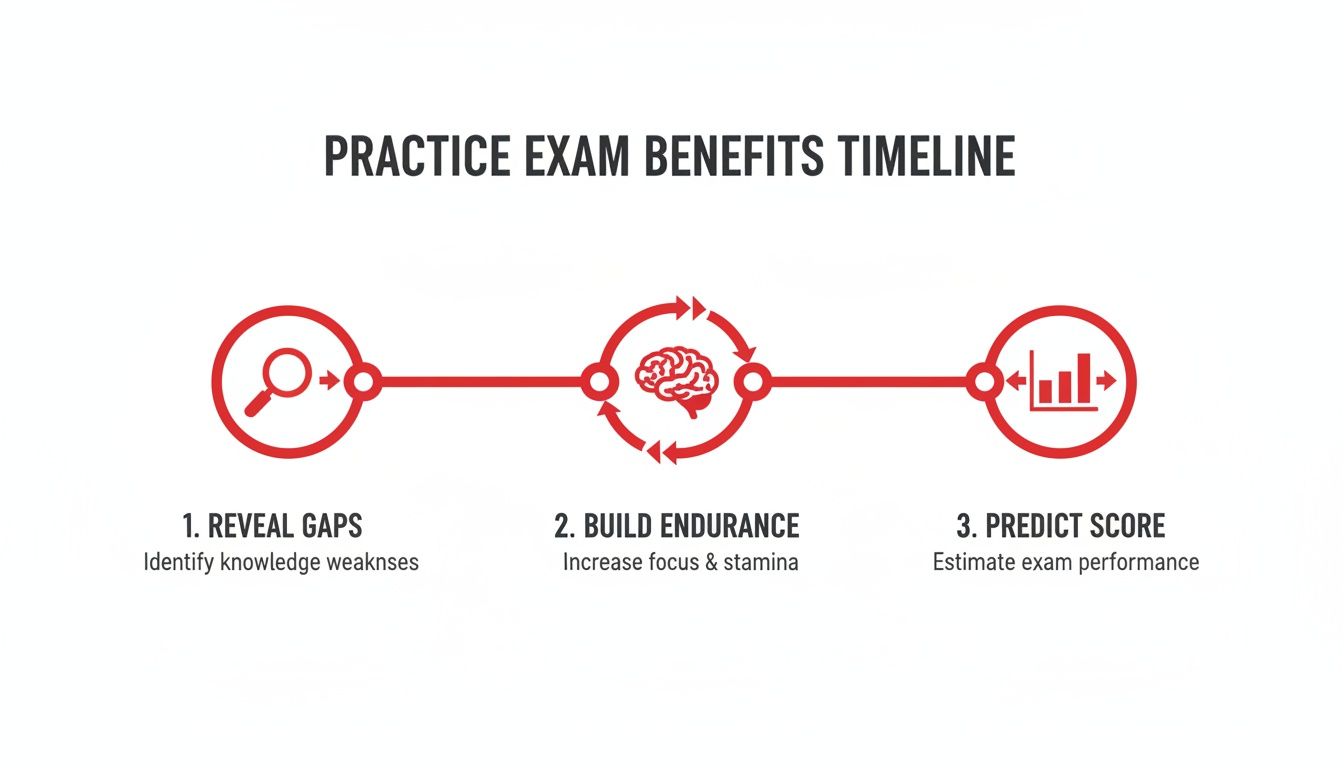
As you can see, these tests aren't just about getting a score; they're strategic tools you can use to sharpen your entire study plan.
Building Your Timeline Around Your Dedicated Period
The length of your dedicated study period is the single most important variable in designing your practice exam schedule. Whether you have a tight four weeks or a more spread-out eight weeks, the goal is the same: test yourself roughly once every 1-2 weeks.
This cadence is the key. It strikes the perfect balance between collecting fresh performance data and giving yourself enough time to actually review it, learn from your mistakes, and target your weaknesses. Taking an exam without thoroughly reviewing it is a massive wasted opportunity.
The time you spend reviewing your practice exam is just as valuable—if not more so—than the time you spend taking it. Block out at least one full day after each NBME to dissect every single question: the ones you got right, the ones you got wrong, and the ones you flagged.
Imagine you have a four-week dedicated period. You might take a practice exam every Sunday and use all of Monday for an in-depth review. That leaves Tuesday through Saturday to crush targeted UWorld blocks based on the weak spots you just uncovered. This cycle of test, review, remediate is the engine that drives real score improvement. For a deeper dive into structuring your days and weeks, check out our complete guide to building a Step 2 CK study schedule.
Sample NBME Step 2 CK Practice Exam Schedules
To make this more concrete, let's map out what this could look like. These are just templates, of course—you should absolutely tweak them to fit your own pace, energy levels, and needs. The schedules below include a mix of the NBME Comprehensive Clinical Science Self-Assessments (CCSSAs) and the UWorld Self-Assessments (UWSAs).
Here are a couple of sample schedules for the most common dedicated study timelines.
| Study Week | 4-Week Dedicated Plan | 8-Week Dedicated Plan |
|---|---|---|
| Week 1 | Baseline Exam (e.g., NBME 9) | Baseline Exam (e.g., NBME 9) |
| Week 2 | Focus on UWorld & review | Focus on UWorld & review |
| Week 3 | Mid-Prep Exam (e.g., NBME 10) | Mid-Prep Exam 1 (e.g., NBME 10) |
| Week 4 | Final Predictor (e.g., UWSA 2) | Focus on UWorld & review |
| Week 5 | N/A | Mid-Prep Exam 2 (e.g., NBME 11) |
| Week 6 | N/A | Focus on UWorld & review |
| Week 7 | N/A | Final Predictor (e.g., UWSA 2) |
| Week 8 | N/A | Free 120 (3 days before exam) |
These plans provide a solid framework, ensuring you have regular checkpoints without sacrificing the critical time needed for review and targeted practice.
Fine-Tuning Your Schedule and When to Adjust
No battle plan survives contact with the enemy, and your study schedule is no different. You have to be flexible. So, what do you do if your score plateaus or—worse—drops on a mid-prep exam?
First, don't panic. This isn't a sign of failure. It's an incredibly valuable data point telling you that your current strategy needs a tune-up.
If you see a score drop, pump the brakes. Push your next practice exam back by a week and spend that extra time hammering your identified weak areas. Instead of forging ahead with new material, circle back to the systems or physician tasks where you struggled. This might mean your four-week plan becomes a five-week plan, and that's perfectly okay.
The ultimate goal is to peak on test day, not a week before. I always advise students to take their final, most predictive practice exam about 5-7 days before their actual test date. This gives you enough time to review it thoroughly and do some light, last-minute content consolidation without burning yourself out right before the real deal. Use those last few days for rest, light review of high-yield facts, and building confidence—not frantic cramming.
Decoding Your NBME Score Report
Getting your score report for one of the NBME Step 2 CK practice exams can feel like opening a black box. Your eyes immediately jump to that three-digit number, but that single data point is only the beginning of the story. The real value is buried in the performance graphs and content breakdowns that follow.
Learning to analyze this report like a seasoned tutor transforms it from a simple grade into a personalized roadmap for your remaining study period. It’s the key to making targeted, efficient improvements.
Looking Beyond the Three-Digit Score
Your overall score is a vital benchmark, but it doesn't tell you why you're scoring at that level. That's where the performance analysis comes in. The report breaks down your performance by physician task (e.g., Diagnosis, Management) and by system (e.g., Cardiovascular, Renal). These breakdowns are where your focus should be.
Don't just glance at these graphs. A bar labeled 'lower performance' in 'Management' within the 'Cardiovascular System' is a direct, actionable instruction. It’s telling you to immediately shift your UWorld focus to cardiology questions that end with "What is the next best step in management?"

This level of detailed analysis allows you to stop wasting time on broad, inefficient reviews and start making surgical strikes on your specific weaknesses.
Translating Performance Bars into an Action Plan
The performance bars on your score report compare your knowledge in a specific area to that of other test-takers. A 'borderline' or 'lower' performance isn't a judgment; it's a diagnostic signal. Here’s how to translate those signals into a concrete study plan:
- Lower Performance in a System: If you see a dip in 'Musculoskeletal & Skin,' it's time to dedicate your next few study blocks to that system. Do a set of UWorld questions on tutor mode focused solely on MSK topics to reinforce the foundations.
- Lower Performance in a Physician Task: A low score in 'Diagnosis' across multiple systems points to a potential weakness in forming differential diagnoses. This might mean you need to practice creating illness scripts or reviewing clinical reasoning frameworks.
Let’s consider a real-world scenario. A student scores a 245, but their report shows a significant weakness in 'Systems-Based Practice/Patient Safety.' This is a huge opportunity. They can now dedicate a few hours to reviewing quality improvement principles, medical error types, and patient handoff protocols—topics that are high-yield but often overlooked.
Understanding Score Plateaus and Underprediction
It's common to see your score stall on one or two practice exams. A score plateau isn't a sign that you've stopped learning; it often means you're consolidating knowledge before your next big jump. Don't let it discourage you. Instead, use it as a prompt to dig deeper into your review and change up your study methods.
Another key factor to consider is that NBME Step 2 CK practice exams are known to be conservative predictors. Many students find their actual Step 2 CK score is several points higher than their final NBME practice test. This isn't a guarantee, but it should give you confidence that you're likely in a slightly better position than the report suggests.
Your NBME report is a tool for improvement, not a final verdict. Use the data to identify patterns, address specific weaknesses, and refine your approach. The goal is to learn from every single assessment.
For a more in-depth breakdown of how scores and percentiles work, you can explore our complete guide to Step 2 CK scoring.
The Bigger Picture Context and Pass Rates
Understanding your score also means placing it in the context of national performance data. These practice exams are a cornerstone for a reason—they help you gauge your standing against a huge cohort of your peers.
For instance, the USMLE performance data for the testing year ending in June 2024 revealed that first-time takers had an 88% pass rate, while the rate for repeaters was 60%, showing just how critical a strong initial preparation is. These statistics highlight the competitive nature of the exam and the importance of using every tool, like practice tests, to your advantage. You can discover more insights from the official USMLE performance data report.
Ultimately, decoding your report is about moving from "what" to "why" and "how." What was my score? Why did I miss those specific questions? And how will I adjust my study plan to fix those gaps before the next exam? This analytical process is what separates top scorers from the rest.
A Better Way to Review Your Practice Exams
Grinding through an eight-hour practice exam is the easy part. Seriously. The real, high-yield work starts the second you hit that final "End Block" button. How you break down your performance on NBME Step 2 CK practice exams is what separates someone who just takes tests from a student who actively learns from them.
Simply glancing at your score and re-reading explanations for the questions you missed is a recipe for stagnation. A top-tier review turns that raw performance data into a concrete, personalized study plan. The goal here is to wring every last drop of value out of each question, fix broken reasoning, and convert old mistakes into future points on the board.

This whole process comes down to one simple but incredibly powerful tool: the error log.
Creating Your High-Yield Error Log
Think of an error log as a diagnostic tool for your study habits, not just a list of your screw-ups. For every single question you review—and I mean the ones you got wrong and the ones you flagged but got right—you're going to dig into the root cause. This is how you spot the patterns that are holding you back.
You don’t need anything fancy. A basic spreadsheet will do the trick. Set it up with these columns:
- Question ID: Just the number so you can find it again.
- Topic/System: e.g., Cardiology, Pulmonology, Ethics.
- My Answer: What you chose.
- Correct Answer: What the right answer was.
- Error Category: This is the money column. We’ll break this down next.
- Key Takeaway: Boil down the main learning point into a single, punchy sentence.
This forces you to go beyond just seeing what you got wrong and analyze why.
Categorizing Your Mistakes for Targeted Improvement
The real magic happens in that "Error Category" column. Every mistake you make boils down to one of three issues. Tagging each one helps you see if you have a knowledge problem or a test-taking problem.
- Knowledge Gap: This is the most straightforward mistake. You just didn't know the information cold. Maybe you blanked on the first-line treatment for acute gout or couldn't recall the classic triad for Kartagener syndrome. It happens.
- Question Misinterpretation: This one is subtle and dangerous. You knew the material but completely misread the question. You might have missed a critical word like "except" or "not," or you failed to grasp what the vignette was really asking. A classic example is picking the definitive diagnostic test when the question asked for the "next best step."
- Flawed Reasoning/Overthinking: You had the facts, you understood the question, but you talked yourself out of the right answer. Maybe you got hung up on a tiny, irrelevant detail or fell for a juicy-looking distractor designed to prey on a common misconception.
After one full exam review, you might find that 70% of your errors aren't knowledge gaps at all—they're from misreading the question. That’s a game-changer. It tells you to stop re-reading Harrison's and start slowing down your reading pace.
Your error log's job is to diagnose the "disease" behind your wrong answers. Is it a "knowledge infection" that needs a dose of content review? Or is it a "reasoning fracture" that requires targeted practice in how you interpret questions?
Why You Must Review Questions You Got Right
This is the step everyone skips, and it's a massive missed opportunity. You have to review every single question you flagged, even if you guessed correctly. Getting a question right with shaky logic is a liability, not a win.
It exposes a fragile understanding that will likely crumble under the pressure of the real deal. When you're looking at a flagged-but-correct question, ask yourself two things:
- Can I confidently explain why the right answer is right?
- Even more importantly, can I explain why the other four answer choices are definitively wrong?
If the answer to either is "no," treat it like you got it wrong. Add it to your error log. This process transforms lucky guesses into reliable knowledge. When you combine this kind of deep review with a smart question bank strategy, like the one we outline in our guide to the UWorld Step 2 question bank, you start building real mastery.
By adopting this systematic review, you guarantee that every minute you sink into an NBME Step 2 CK practice exam pays off. You'll stop making the same dumb mistakes over and over, and you'll build a rock-solid foundation of both knowledge and test-taking skill.
Aligning Your Score with Your Residency Goals
With Step 1 now pass/fail, your Step 2 CK score has transformed into one of the single most critical numbers in your residency application. Program directors lean on it heavily as a primary sorting tool, which means your NBME Step 2 CK practice exams are no longer just about self-assessment—they’re about strategic career planning.
Think of these practice tests as your clearest window into where you actually stand in the hyper-competitive landscape of the Match. This isn’t about fueling anxiety; it’s about empowerment. When you view your scores through the lens of real residency matching data, you can set a concrete, data-driven target score that aligns directly with your career ambitions.
From Practice Score to Target Specialty
The first move is to ground your performance in real-world outcomes. Every specialty plays by different rules, and Step 2 CK scores are a massive differentiator. You absolutely need to know the numbers for the field you're targeting.
Knowing the benchmarks transforms a score like "250" from an abstract number into a tangible measure of your competitiveness. For instance, if you're aiming for a top-tier specialty like dermatology or plastic surgery, you need to be consistently hitting the upper echelons on your practice exams. On the other hand, if your passion is family medicine or pediatrics, the target looks a bit different. This knowledge turns your NBME practice exams into a powerful progress tracker for a very specific goal.
Your practice exam score isn't just a number; it's a key that can unlock the door to your dream residency. Every point you gain is a tangible step toward matching in the specialty and program you want.
Adopting this mindset is crucial. It reframes your review sessions from a tedious chore into a mission-critical part of your career strategy. Every concept you master after missing a question is a direct investment in your future.
Using NRMP Data to Set Your Target
So, where do you find these all-important numbers? Your new best friend is the National Resident Matching Program (NRMP) and its "Charting Outcomes in the Match" report. This data is pure gold, detailing the stats of applicants who successfully matched into various specialties. It shows the average Step 2 CK scores, giving you a clear, evidence-based target to aim for.
Here’s a simple, effective way to use it:
- Identify Your Target Specialties: Nail down the top one to three specialties you're seriously considering.
- Find the Average Matched Score: Dig into the latest NRMP data and pinpoint the mean Step 2 CK score for U.S. MD seniors who successfully matched into those fields.
- Set Your Goal: Your target score on practice exams should be at or, ideally, slightly above that average. This builds in a buffer and makes your application profile that much stronger.
This data-driven approach strips away the guesswork. You’re no longer just "studying hard"—you're strategically working toward a specific number that is directly tied to your residency dreams.
The Score Thresholds You Need to Know
The score gaps between specialties can be surprisingly wide, and your performance on NBME Step 2 CK practice exams is your best predictor of where you'll land. Historical data from the NRMP and AAMC paints a clear picture of how high the bar is set for certain fields.
For example, the most competitive specialties like Plastic Surgery, Dermatology, and ENT typically see matched U.S. MDs averaging around a 257. Fields like Orthopedics and Neurosurgery aren't far behind, with averages hovering in the 252-256 range. Understanding these benchmarks early in your dedicated study period is vital for setting goals that are both realistic and ambitious. To see a more granular breakdown, you can explore the Step 2 scores needed by specialty.
For International Medical Graduates (IMGs), these numbers are just as crucial, if not more so. U.S. IMGs who match into internal medicine average around 238, but those aiming for more competitive fields like surgery or anesthesia need scores closer to 248. The data tells a clear story: your practice exam performance must align with the statistical realities of the Match. Use this information to guide your study plan, gauge if you're on track, and recognize when it might be time to get some expert help to close a score gap and secure your spot in a U.S. residency program.
Answering Your Top NBME Practice Exam Questions
Even with the best-laid plans, the nitty-gritty details of NBME Step 2 CK practice exams can be a headache. I get these questions all the time from students in their dedicated study period, so let's clear up the confusion with some straight, practical answers.
Think of this as your go-to FAQ for those logistical hurdles that always seem to pop up.
Which NBME Exams Should I Take?
The NBME is always updating its Comprehensive Clinical Science Self-Assessments (CCSSAs), so the specific forms available can shift. Right now, the newest exams—Forms 12, 13, and 14—are widely seen as the most predictive and true-to-life for the current Step 2 CK style.
Here's a battle-tested strategy: start with the older forms (like 9, 10, or 11) for your baseline and mid-prep checks. You want to save the newest, most accurate forms for the last few weeks. That’s when you need the clearest possible picture of where you stand before the real deal.
How Do the UWorld Self-Assessments Fit In?
You absolutely cannot skip the UWorld Self-Assessments (UWSA 1 and UWSA 2). They are a critical piece of the puzzle. Students consistently find that the UWSAs, especially UWSA 2, are scarily accurate predictors of their final score. Be warned, though—they're tough and sometimes known to slightly overpredict scores.
Here’s how to slot them into your schedule:
- UWSA 1: A perfect mid-prep gut check. It’s known for being difficult, and it will expose weaknesses you didn't even know you had, giving you enough time to work on them.
- UWSA 2: Save this one for the home stretch. Take it 1-2 weeks before your test date. Its detailed score report is the perfect final diagnostic tool to fine-tune your last days of studying.
The NBMEs are the official benchmark, but think of the UWSAs as your toughest sparring partner. Using both gives you a much more robust and well-rounded view of your readiness.
How Should I Handle a Score Plateau?
First off, don't panic. Hitting a score plateau is incredibly common. It’s also incredibly frustrating. It doesn't mean you've stopped learning; it usually means you've mastered the easy points and now need a more refined strategy for the complex, multi-step questions.
When your score stalls, the answer isn't just to study harder—it's to study smarter. This is a signal to get surgical with your review process. Dive back into your error log and hunt for deeper patterns. Are you constantly fumbling questions that blend two different systems? Do patient safety or ethics questions trip you up every time? A plateau is just an opportunity to diagnose these subtle weak spots and build a targeted plan to fix them.
A score plateau isn't a wall; it's a diagnostic sign. It's your brain telling you that your old study methods have done their job, and it's time to shift to a more targeted, analytical strategy to reach the next level.
Should I Take the Free 120?
Yes. 100%. No question about it. The Free 120 is a set of 120 questions released by the USMLE itself. These are retired questions from actual Step 2 CK exams, making them the most authentic preview you can possibly get. The interface, question length, and style are identical to what you’ll see on test day.
The sweet spot for taking the Free 120 is in the last 3-5 days before your exam. It's less of a predictive tool and more of a final dress rehearsal. It builds confidence, gets you comfortable with the software, and ensures there are zero surprises when you sit down for the real thing.
Feeling stuck on a plateau or just not sure what your practice scores are telling you? The expert tutors at Ace Med Boards live for this stuff. We specialize in digging into your practice data to create a personalized study plan that translates into real score jumps. Book a free consultation today and see how a targeted approach can help you lock in that residency spot you've been working for.