Building a killer schedule for USMLE Step 1 is about more than just slotting study hours into a calendar. It’s about creating a personalized blueprint—one that’s built on an honest look at where you are, a realistic timeline, and a deep understanding of how you actually learn.
The best plans don’t start with UWorld blocks. They start with you.
Building Your Foundational Study Blueprint
Forget about downloading some generic schedule you found online. It won’t know you have a secret strength in pathology or that pharmacology makes your head spin. Before you map out a single day, you need to lay a solid foundation. That starts with a serious, honest audit of your current knowledge.
Assess Your Starting Point
First thing's first: take a baseline NBME practice exam. And no, the score itself isn't the point. The real gold is in the performance feedback. This data is your treasure map, showing you exactly where your weakest areas are and where to focus your energy right from the get-go.
But don’t just stop at what subjects are weak. Dig deeper. Ask yourself why. Is it a recall issue? Trouble applying concepts? Or did test-day jitters get the best of you?
Once you have that intel, think about how you learn best. Are you a…
- Visual Learner? Do diagrams, charts, and videos from resources like Sketchy or Boards and Beyond make things click?
- Repetitive Learner? Is the spaced repetition of Anki the only way facts seem to stick in your long-term memory?
- Active Learner? Do you learn best by just diving headfirst into practice questions and reverse-engineering the concepts from the explanations?
Figuring this out now saves you from wasting weeks on resources that just don’t vibe with your brain. For a deeper dive, our guide on how to study for USMLE Step 1 can help you pair the right tools with your learning style.
Choosing Your USMLE Step 1 Study Timeline
Picking an exam date isn't just about circling a day on the calendar; it's a strategic decision that sets the pace for your entire dedicated period. The length of your study timeline depends heavily on your baseline knowledge, how many hours you can realistically commit each day, and your personal life commitments. Trying to cram a 12-week plan into 6 weeks is a recipe for burnout.
The table below breaks down common study durations to help you find the right fit.
| Study Duration | Ideal Candidate Profile | Average Daily Study Hours | Primary Focus |
|---|---|---|---|
| 4–6 Weeks | Strong foundational knowledge, few weak areas, full-time study capacity. | 8–10+ Hours | High-intensity Qbank completion, practice exams, and targeted weak area review. |
| 8–12 Weeks | Average baseline score, several content gaps to fill, can commit to full-time study. | 6–8 Hours | Balanced content review (e.g., First Aid, Pathoma) and consistent Qbank integration. |
| 16–24 Weeks | Significant knowledge gaps, studying alongside coursework, or has major life commitments. | 3–5 Hours | Gradual, in-depth content mastery, followed by a dedicated Qbank and testing phase. |
Be honest with yourself here. A shorter, more intense schedule requires an iron will and zero distractions. Longer timelines offer flexibility and deeper learning but demand incredible discipline to stay on track. Choose the path that aligns with your reality, not your aspirations.
Set a Realistic Exam Date
With a clearer picture of your academic needs and learning style, now you can set that target exam date. Be brutally realistic. You have to account for your current classes, family obligations, and the mental energy you can truly sustain day in and day out. Rushing is a classic mistake that can completely undermine months of solid effort.
The goal isn't to create the most intense, hardcore schedule imaginable. It’s to build one you can actually stick to. Consistency born from a well-paced, sustainable plan will always crush sporadic, high-intensity cramming.
This foundational work is everything. It ensures your entire schedule is built on the reality of your situation, not just wishful thinking. As you build this routine, it’s also helpful to understand effective strategies for forming habits that stick, making your study plan feel less like a chore and more like second nature.
Designing Your Dedicated Study Period
Your "dedicated" period is when the real work begins. It’s that focused, all-in stretch of time where your only job is mastering the material to pass Step 1. But here's a secret that experienced students learn the hard way: a successful dedicated period isn't about a rigid, minute-by-minute schedule. It’s about building a flexible, repeatable framework that balances intense study with crucial recovery.
Whether you have six weeks or sixteen, the core principles don't change. You need a structure you can lean on, but one that bends when you hit a wall. This is how you avoid the burnout that sidelines so many great students.
The Anatomy of a Perfect Study Day
A productive day during dedicated should feel like a well-rounded workout—targeting different mental muscles. Ditching the eight-hour passive reading marathon for a dynamic mix of active recall, content review, and consolidation is the key.
A typical day might look something like this:
- Morning (Prime Focus Time): Kick things off with one or two 40-question UWorld blocks. Put them on timed mode. This isn't just about answering questions; it's about simulating exam conditions and firing up your brain right from the start.
- Late Morning/Early Afternoon (Review & Consolidate): This is where the magic happens. Meticulously review every single question from your morning blocks—yes, even the ones you got right. Use this time to annotate First Aid or create Anki cards for the concepts that tripped you up.
- Afternoon (Content Deep Dive): Now, zoom in on a weak area you identified from your practice questions. Maybe that means pulling up Pathoma videos for a tricky pathology chapter or using Sketchy to finally make those microbiology facts stick.
- Evening (Spaced Repetition & Wind Down): Knock out your daily Anki reviews. This is non-negotiable for locking in long-term memory. Then, spend the last hour on some light, passive review… or better yet, just shut the books and step away.
This structure ensures you’re actively applying and reinforcing information all day long. And just as importantly, you have to protect your break times with the same discipline you apply to studying. A real, 60-minute lunch break away from your desk or a quick 15-minute walk between blocks can make a world of difference for your focus.
Structuring Your Weeks with Thematic Focus
Staring at the mountain of information you need to cover can be paralyzing. The best way to tackle it is by organizing your weeks around organ systems. This thematic approach lets you integrate physiology, pathology, pharmacology, and anatomy for a single system, making the connections stick.
For instance, a "Cardiology Week" would mean:
- Crushing all the UWorld questions tagged for the cardiovascular system.
- Reading the matching cardiology chapter in First Aid.
- Watching the relevant Pathoma and Boards and Beyond videos.
- Hitting the associated Anki decks every single day.
This turns your study plan from a scattered checklist into a cohesive web of knowledge. You start seeing the big picture of how everything connects within an organ system—which is exactly how the exam will test you.
This flowchart breaks down the essential steps for mapping out your dedicated period.
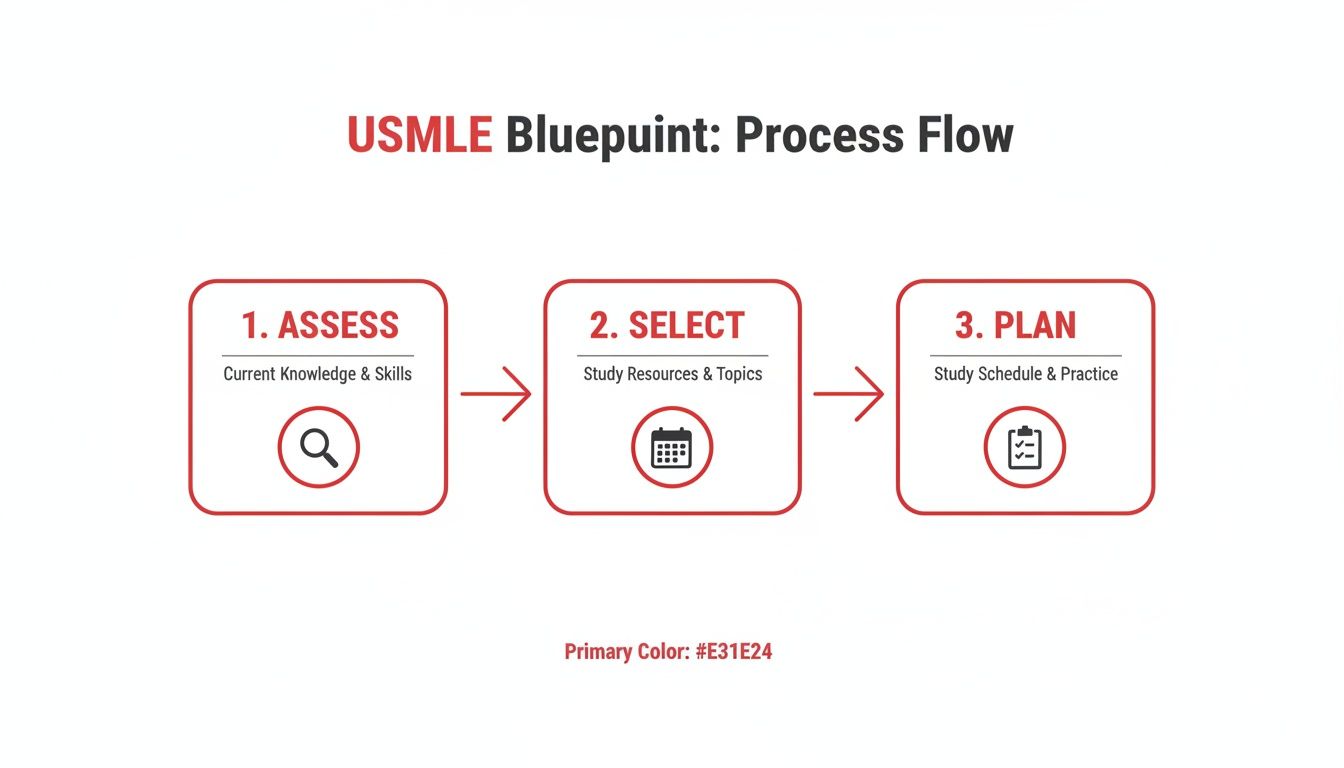
It’s a simple but powerful workflow: start with an honest look at where you stand, choose the right timeline for your needs, and then plan out your days and weeks with intention.
Integrating Practice Exams to Track Progress
Think of practice exams as the mile markers on your USMLE journey. They give you invaluable data on your progress, shine a spotlight on lingering weaknesses, and build your test-taking endurance. Strategically building them into your schedule for USMLE Step 1 is absolutely non-negotiable.
Your first move should be to take a baseline NBME exam before your dedicated period even starts. That initial score gives you a starting point and helps you prioritize your early study topics.
Don't fixate on your baseline score. Its purpose isn't to validate your knowledge but to illuminate your weaknesses. A low baseline is a roadmap, not a verdict.
From there, plan on taking a practice exam every one to two weeks. This regular check-in keeps you honest and lets you make data-driven tweaks to your plan. Are your cardiology scores still lagging? Maybe it’s time to schedule a second pass through those UWorld questions. If you want a deeper dive, you can learn more about the different types of USMLE practice exams and the best way to use each one.
As you get closer to your test date, your final practice tests—including the official Free 120—should be treated like full-dress rehearsals. Take them at the same time your actual exam is scheduled, mimic the break structure, and review them like your life depends on it. This is how you build the confidence and stamina to walk in on test day and perform at your best.
Integrating High-Yield Resources Into Your Schedule
Having a stack of high-yield resources is one thing; making them all work together in your schedule is a completely different beast. A truly effective schedule for usmle step 1 doesn’t just list books and question banks—it creates a workflow where each tool builds on the others. The real goal here is to create a closed-loop system where practice questions expose your weak spots, content review fills those gaps, and the whole process reinforces what you need to know long-term.
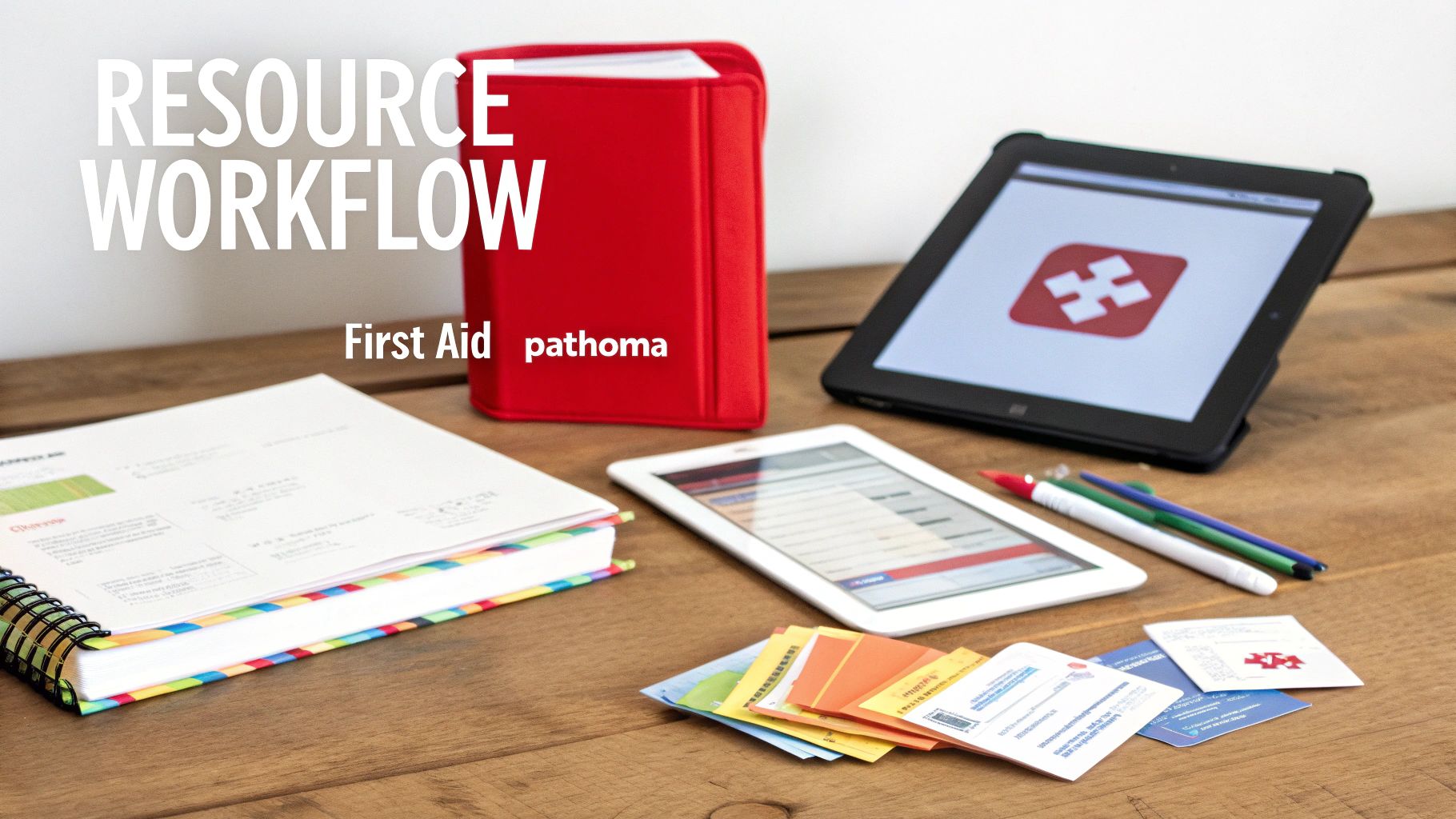
This whole process revolves around the "big three": UWorld, First Aid, and Pathoma. When you use them right, they become an interconnected powerhouse that gives your daily study sessions real purpose and direction.
Mastering Your UWorld Workflow
Your question bank, which for most people is UWorld, is the engine of your entire study plan. It’s where you actually apply what you’ve learned, figure out what you don't know, and get a feel for how the exam asks questions. But just cranking out questions isn't enough. How you approach your blocks and, more importantly, how you review them, is what separates a passing score from a great one.
The whole timed mode vs. tutor mode debate comes up a lot. Early in your dedicated period, using tutor mode can be useful to understand the "why" behind each answer without the pressure of a ticking clock. But you need to switch to exclusively timed, random blocks as soon as you can. Building your pacing and endurance is a skill in itself. The real exam has a clock, so your training has to have one, too.
Your post-block review should take two to three times longer than it took to do the questions. I know that sounds like a lot, but this is where the real learning happens. You have to go over every single question, even the ones you got right.
- For incorrect answers: Figure out exactly why you missed it. Was it a pure knowledge gap? Did you misread the question stem? Or was it just a silly mistake?
- For correct answers: Make sure you know why you got it right. Solid reasoning is one thing; a lucky guess is another. Reviewing correct answers locks in that knowledge so you're not just guessing on a similar question down the road.
This deep-dive review is your single most valuable learning activity. It’s how you actively plug your knowledge gaps in real-time.
Transforming First Aid Into Your Personal Bible
First Aid should absolutely not be a book you just read from cover to cover. Think of it as a living document—your personal encyclopedia of high-yield facts that you'll fill with notes and insights from your daily Qbank grind. This is how you turn it into an active learning tool.
As you review your UWorld blocks, have First Aid open to the right section. When you come across a concept, pathway, or drug that UWorld seems to love, find it in First Aid and add a quick note.
Pro Tip: Keep your annotations short and to the point. Scribble down a specific detail from a UWorld explanation, draw a quick diagram connecting two ideas, or write down a mnemonic that finally made something click. Over time, your First Aid will become a perfect reflection of your unique learning journey.
This constant back-and-forth between UWorld and First Aid turns passive reading into active learning. You’re not just memorizing facts from a book; you’re connecting them directly to the clinical vignettes you’ll face on exam day. For a full rundown of the best resources out there, check out our detailed guide to essential study material for USMLE Step 1.
Strategically Using Supplemental Resources
While UWorld and First Aid are your foundation, think of supplemental resources as specialists you call in to clarify tricky or memorization-heavy topics. They need to be used with a purpose, not just randomly.
- Pathoma: The first three chapters are basically required reading for mastering general pathology. For systems, I always recommend watching the relevant Pathoma videos before you dive into a new organ system in First Aid or UWorld. It just sets the stage perfectly.
- Sketchy: This is your go-to for brute-force memorization topics like microbiology and pharmacology. Seriously, schedule time to watch these videos before you start hitting those questions in UWorld. It builds a strong visual framework that makes everything stick. Trying to memorize antimicrobial spectra without it is a nightmare.
- Boards and Beyond: Dr. Ryan’s videos are a lifesaver for clearing up complex physiology and pathophysiology. If a UWorld explanation just isn't clicking, find the corresponding Boards and Beyond video for a clear, foundational lecture.
By creating a system where UWorld finds your weaknesses and your other resources fix them, you build a powerful and efficient learning loop. This integration is what leads to steady, measurable progress during your dedicated study period.
Scheduling in the Pass Fail Era
The seismic shift to a pass/fail Step 1 has completely rewired how you should approach your study schedule. It’s tempting to think this change lowers the stakes. In reality, it just raises them in different, more complex ways.
While the crushing pressure for a specific three-digit score is gone, the need for a deep and durable foundation of medical knowledge is more critical than ever.
Some students make the dangerous assumption that "pass/fail" means "easy to pass." This is a huge mistake. After the change in January 2022, the opposite proved true. A rigorous, well-structured schedule for usmle step 1 is arguably more important now because your margin for error is smaller. You have to build a knowledge base that not only gets you a pass but also truly prepares you for clinical rotations and Step 2 CK.
Shifting Focus From Score to Mastery
Without a Step 1 score, program directors are putting much more weight on other metrics—especially your Step 2 CK score and third-year Shelf exam performance. This means your Step 1 prep is no longer a sprint to a single numerical finish line. It’s now the foundational leg of a marathon.
Your study schedule needs to reflect this new reality. The goal isn't short-term pattern recognition or cramming high-yield facts anymore. It's about achieving true conceptual mastery.
- Prioritize Understanding "Why": Don't just memorize that a drug causes a side effect. Your schedule needs to carve out time to understand the physiological or pharmacological reason why it happens.
- Build Connections Between Systems: Instead of studying cardiology in a vacuum, connect its pathophysiology to the renal and endocrine systems. This integrated thinking builds the kind of durable knowledge you'll need for complex clinical reasoning later.
- Emphasize Long-Term Retention: Tools like Anki aren't just for cramming facts. They're essential for building a long-term knowledge repository that will serve you well into your clinical years.
This mindset shift is everything. You aren't just studying to pass one test; you're studying to become a competent physician.
The New Residency Application Timeline
The pass/fail change also scrambled the strategic timing of the exam for the residency match. With the Step 1 score gone, Step 2 CK is now the primary standardized metric for residency programs. This has massive implications for your schedule.
Recent NRMP data shows a dramatic shift. In the Main Residency Match, only 24.9% of applicants even had a numeric Step 1 score. This scarcity makes your Step 2 CK score a potential make-or-break number, with match averages floating in the 230s for primary care and soaring past 250 for competitive specialties.
Passing Step 1 isn't just about clearing a hurdle; it's about building the strongest possible launchpad for Step 2 CK success. A weak foundation here will make excelling on Step 2 exponentially harder.
Your schedule has to be built with this long game in mind. Don't underestimate this exam. Data on the USMLE Step 1 pass rate shows that passing is far from guaranteed and requires smart, dedicated preparation.
Treat your Step 1 study period with the same intensity as before, but with a renewed focus on building knowledge that lasts. This approach won't just ensure you pass confidently—it will set you up for a much stronger performance when it really counts.
Adapting Your Schedule and Avoiding Burnout
Let’s be honest: no study plan ever survives first contact with reality. Your perfectly crafted schedule for usmle step 1 is an amazing guide, but it has to be a living document, not a rigid prison. The biggest threat to your success isn’t a brutal biochemistry pathway; it’s burnout.
Staying healthy, sane, and flexible is how you’ll cross the finish line at peak performance.

The secret is to build a sustainable routine right from the start. This means scheduling mandatory breaks, exercise, and sleep directly into your calendar with the same priority as a UWorld block. Protecting this time isn't a luxury—it’s a core part of an effective study strategy.
Recognizing the Early Signs of Burnout
Burnout doesn't just show up one day. It’s a slow creep of exhaustion and cynicism that can completely derail your prep if you ignore the red flags. To fight it, you have to know what you’re looking for.
Catching these symptoms early lets you course-correct before they become a real problem:
- Persistent Fatigue: You feel wiped out even after a full night of sleep.
- Decreased Motivation: You start dreading study sessions you used to feel good about.
- Irritability and Cynicism: Small frustrations feel huge, and you feel disconnected from your goal.
- Stagnant Performance: Your Qbank and practice exam scores have flatlined, no matter how many hours you put in.
If this sounds familiar, it’s not a sign to grind harder. It’s your brain telling you to step back and adjust your approach. For a deeper dive, our guide on https://acemedboards.com/usmle-exam-burnout/ offers targeted strategies specifically for medical students.
Making Intelligent Adjustments to Your Plan
Your practice exam scores are more than just numbers—they're diagnostic tools. When you analyze them, you can make smart, data-driven tweaks to your weekly plan instead of panicking.
If your scores plateau, it might mean your current study method has stopped being effective for where you are now. This is a time to pivot. For instance, if you've just been passively reading First Aid, switch to actively making Anki cards based on your incorrect UWorld questions.
The real value of your schedule is in its adaptability. A plan that can bend without breaking is the one that will carry you all the way through dedicated. Falling behind one day doesn't mean you've failed; it means it's time to recalibrate.
When you do fall behind, fight the urge to sacrifice sleep or skip your day off to "catch up." That’s a short-term fix that leads to long-term exhaustion. Instead, look at the next few weeks and find lower-priority tasks to consolidate or topics you can review more briefly. Learning the art of maintaining work-life balance during your intense study is absolutely critical here.
Prioritizing Wellness as a Study Tool
Self-compassion and wellness aren't distractions from your Step 1 journey; they are essential tools for succeeding in it. The goal is to finish this marathon strong, not crawl across the finish line totally depleted.
Build these non-negotiables directly into your schedule:
- Schedule a Full Day Off: Protect at least one day each week where you do absolutely nothing related to Step 1. Your brain needs it.
- Incorporate Daily Movement: Even a 20-minute walk can boost focus and retention.
- Maintain a Consistent Sleep Schedule: Aim for 7-8 hours every night. Sleep is when your brain actually consolidates memories and does its learning.
Ultimately, flexibility and self-care are what turn a good schedule into a great one. They give you the resilience to handle whatever this exam throws at you, ensuring you show up on test day feeling confident, rested, and ready to dominate.
Your USMLE Schedule Questions Answered
Building a personalized schedule for USMLE Step 1 is a huge task, and it's totally normal for a flood of questions to pop up. Doubts about how many hours to study, when to actually take the test, and how to approach that final week are things every student grapples with. Let's tackle some of the most common questions with real, actionable answers to give you some clarity.
How Many Hours a Day Should I Study for Step 1?
Most students in their dedicated period aim for 8-10 hours of focused work daily, but that number isn't a magic bullet. Quality will always beat quantity. A solid 8-hour day filled with active learning—like grinding through practice questions and doing a thoughtful review—is miles better than a 12-hour slog of passively re-reading First Aid.
The key is sustainability. Try breaking your day into two- or three-hour blocks, each with a specific, achievable goal. For example, one block is for 40 UWorld questions, the next is for reviewing those questions, and a third is for hitting content you realized you were weak on.
And this is non-negotiable: you absolutely must schedule at least one half-day or full day off each week. This isn't laziness; it's a strategic move to prevent burnout and let your brain actually consolidate all that information. If you find yourself re-reading the same paragraph five times, that’s your brain telling you it’s time for a break, not more hours.
When Is the Best Time to Take the USMLE Step 1 Exam?
There's no single "best" time, but there's a sweet spot for most students: typically within two to four months after you've wrapped up your main pre-clinical coursework. This timing is ideal because your foundational knowledge is still relatively fresh as you head into your dedicated study period.
Many U.S. med students target the spring or early summer right after their second year. Since the exam is now pass/fail, the main goal is to pick a date that allows you to have a chunk of uninterrupted, high-quality prep time.
Try to avoid scheduling your exam right before a major life event or the start of a notoriously tough clinical rotation. You want to walk into that Prometric center feeling as rested and confident as possible, not completely depleted.
What Should I Do in the Final Week Before My Exam?
The final week is all about consolidation and building confidence, not cramming new material. Your goal is to shift gears from intense learning to light, high-yield review. You want to arrive on test day calm and prepared, not panicked and exhausted.
Your focus should be on rapid-review activities that pack a punch.
- Hit Your Incorrects: Spend some quality time going back over your marked or incorrect UWorld questions. The goal here is to finally understand the core concepts you kept tripping over.
- High-Yield Pass: Do a quick skim of First Aid, focusing on the pure memorization stuff. Think biochemistry pathways, microbiology charts, and pharmacology tables.
- Simulate the Real Thing: Most students take the Free 120 questions from the official USMLE website two or three days before their test. It’s a great way to get comfortable with the exam interface and the timing.
And I'm serious about this next one: do not study the day before your exam. Use that day to relax. Get some light exercise, eat a good meal, and get a full night's sleep. Your top priority is walking in with a clear mind.
How Did the Pass/Fail Change Affect Study Schedules?
The switch to pass/fail—along with a slightly higher passing standard—really shook up study strategies. The initial data was surprising, showing a drop in pass rates from 88% in 2021 to 82% in 2022. It seems some test-takers underestimated the exam's difficulty after the scoring change.
For instance, U.S. MD senior pass rates fell from 95% to 91%, while first-time international medical graduates (IMGs) saw a drop from 82% to 74%. This data really hammers home the need for a rigorous, well-structured study plan.
This means you can't afford to take your schedule for USMLE Step 1 lightly. I advise my students to prepare with the same intensity they would have for a scored exam. The focus, however, has shifted from chasing a three-digit number to achieving true mastery of the material. This approach not only gets you that "pass" but also builds a critical foundation for acing your clinical rotations and the increasingly important Step 2 CK.
Feeling overwhelmed or just not sure where to start with your USMLE prep? Ace Med Boards offers personalized, one-on-one tutoring to help you build a winning study schedule, master high-yield concepts, and walk into your exam with total confidence. Get the expert guidance you need by booking a free consultation.