To really move the needle on your test-taking skills, you have to stop thinking like a student and start thinking like a data scientist. High-stakes medical exams aren't just about memorizing facts; they're about active, data-driven practice. This means using your own performance metrics to diagnose weaknesses, setting specific score goals, and building a study plan around constant question-based learning from day one. It's a strategic shift that makes every single hour you study count.
Build a Data-Driven Foundation for Exam Success

Top scores on exams like the USMLE or COMLEX are built on a solid foundation of smart preparation, not just the sheer volume of information you can cram. The first real step is to ditch the endless, aimless rereading of textbooks and embrace a methodical, data-informed approach.
Think of yourself as a clinical investigator, but the case you're solving is your own academic performance. Your first goal? Diagnose your specific strengths and weaknesses with absolute precision.
Pinpoint Your Knowledge Gaps
Kick things off by taking a full-length, timed diagnostic exam, like an NBME self-assessment. The point here isn't to get a stellar score; it's to collect baseline data. Once you're done, resist the urge to just glance at the final three-digit number. Instead, you need to dive deep into the performance breakdown.
Start analyzing the data to find the patterns:
- Subject-Specific Weaknesses: Are you consistently bombing cardiology questions but crushing renal?
- Question Type Challenges: Do you freeze up on questions asking for the "next best step in management" but nail the pure diagnosis ones?
- Time-Related Errors: Did your accuracy take a nosedive in the last block of the exam when fatigue set in?
This initial analysis is your roadmap. It shows you exactly where to focus your energy for the biggest return on your study time.
A classic mistake is giving all subjects equal attention. If your diagnostic shows a 75% in endocrinology but a dismal 45% in neurology, spending the same amount of time on both is a massive waste. Your data is screaming at you to prioritize neurology.
Set Realistic and Measurable Goals
With your baseline data in hand, you can now set a realistic target score. This goal should be ambitious enough to push you but still achievable, and it will guide the intensity of your studying. From there, break that big goal into smaller, weekly benchmarks. For example, maybe you aim to boost your percentage correct on a 40-question UWorld block by 5% over the next two weeks.
A structured schedule is what makes these targets achievable. To get started, you can find a comprehensive and free tool in our exam preparation planner that helps organize your study blocks and track your progress effectively. This principle of structured preparation applies broadly; to set yourself up for success across various medical certifications, you can find invaluable guidance with these top tips for passing your medical certification exams the first time. Building this data-driven foundation is the first critical step toward mastering exam day.
Deconstruct Questions Like an Expert
Every single question on a high-stakes medical exam is a clinical puzzle, meticulously designed by the test writers. To beat them at their own game, you have to stop being a passive reader and start acting like a detective. You need to break down the vignette, find the signal in the noise, and isolate the critical data points.
Mastering this skill will completely change how you see the exam. Those long, intimidating question stems? They'll stop looking like walls of text and start looking like a series of clues leading you right to the answer.
So, how do you do it? First, fight the urge to read the question from top to bottom. Instead, read the last line first. It’s a simple trick, but it’s a game-changer. It immediately frames the entire problem by telling you exactly what you’re solving for—is it the diagnosis? The next best step? The mechanism of action?
Knowing your objective upfront gives you a massive advantage. You’re no longer just passively absorbing information; you're actively hunting for the specific clues that will solve the puzzle.
Spotting Illness Scripts and Key Clues
With the final question in mind, you can now read the full vignette with purpose. Your primary goal is to identify the classic illness script—that textbook presentation of a disease that examiners absolutely love to test.
For example, when you see a question describing a young woman with a butterfly rash, joint pain, and proteinuria, your brain should immediately scream "lupus!" Highlighting or mentally flagging these buzzwords as you go is a great way to start building a powerful differential diagnosis right from the get-go.
But don't just stop at the obvious clues. The real masters pay close attention to the subtle details that can make or break a diagnosis:
- Demographics: Age, sex, and ethnicity are never just filler. A 65-year-old smoker with hemoptysis is a completely different clinical picture than a 25-year-old with the same symptom.
- Lab Values: Don’t just glance over the labs. Dig in and interpret them. Is the anion gap elevated? Is the anemia microcytic? These numbers aren't just there for decoration; they are core pieces of the puzzle.
- Negative Pertinents: What isn't there is often just as important as what is. If a patient comes in with chest pain but has a normal ECG and clean troponins, you can confidently start moving away from acute coronary syndrome.
The One-Sentence Summary Technique
Okay, you've read the entire stem. Now, pause. Before you even peek at the answer choices, force yourself to synthesize all that information into a single, concise summary sentence.
This technique is your ultimate gut check.
If you can’t distill the vignette into one coherent thought, you’ve probably missed something important. It’s a sign to go back and re-read the stem before you let the answer choices influence your thinking.
Think about it. A long, convoluted paragraph about a patient's diet, social history, and a bunch of vague symptoms can almost always be boiled down. Something like: "A middle-aged man with a history of alcohol abuse presents with acute epigastric pain radiating to his back and an elevated lipase." Boom. That points you straight toward acute pancreatitis and cuts through all the fluff the question writers threw in to distract you.
Identifying and Avoiding Distractors
Once you have your one-sentence summary and a primary diagnosis in mind, it's time to tackle the answer choices. Exam writers are masters of crafting plausible but incorrect options known as distractors. They’re designed to trap the unwary, but they often fall into predictable patterns.
A common distractor might be the perfect treatment for a slightly different diagnosis that shares a few symptoms with the one in the vignette. Another classic is a diagnostic test that seems reasonable but isn't the most appropriate next step.
By having a crystal-clear picture of the clinical scenario before you ever look at the options, you can spot these traps from a mile away. You'll be able to confidently pick the best answer, not just one that looks "good enough."
This deconstruction method is a skill, and like any skill, it requires practice. As you work through more and more question banks, you’ll start to see these patterns everywhere. To get a feel for how these complex vignettes are built, check out these sample USMLE Step 3 questions. Making this expert approach your own will dramatically boost your accuracy and efficiency when it really counts.
Turn Practice Questions Into Your Strongest Learning Tool
Most med students fall into the trap of grinding through thousands of practice questions from UWorld or Amboss, thinking volume is the key. It’s a common strategy, but it’s painfully inefficient. The real secret to a massive score jump is a simple mindset shift: stop seeing Qbanks as just a way to test yourself and start treating them as your primary learning engine.
This approach is called deliberate practice. It transforms passive question-answering into an active, systematic hunt for your knowledge gaps—and a plan to close them. It's all about quality over sheer quantity.
The data backs this up. Focused, deliberate practice with board-style questions is one of the strongest predictors of high scores. Think about it: the NBME reports that first-time US/Canadian MDs taking Step 1 have a 91% pass rate, while first-timers from non-US/Canadian schools sit at 73%. A big part of that difference is access to and intensive use of these high-quality resources. In fact, many Qbanks report average score gains of 15–25 points after a student completes 2,000–3,000 questions with rigorous review.
Simulate Real Exam Conditions
First things first, you have to mimic the real deal. That means doing questions in timed, random blocks of 40. This isn't just about getting answers right; it’s about building the mental stamina and pacing you'll need to survive an eight-hour exam day.
Whatever you do, resist the urge to use "tutor mode." Seeing the answer immediately after each question creates a false sense of security. It doesn't train you to handle the pressure and uncertainty of a real block where you have to commit to your answers and manage the clock.
The infographic below breaks down a simple but powerful three-step process for dissecting questions under timed pressure.
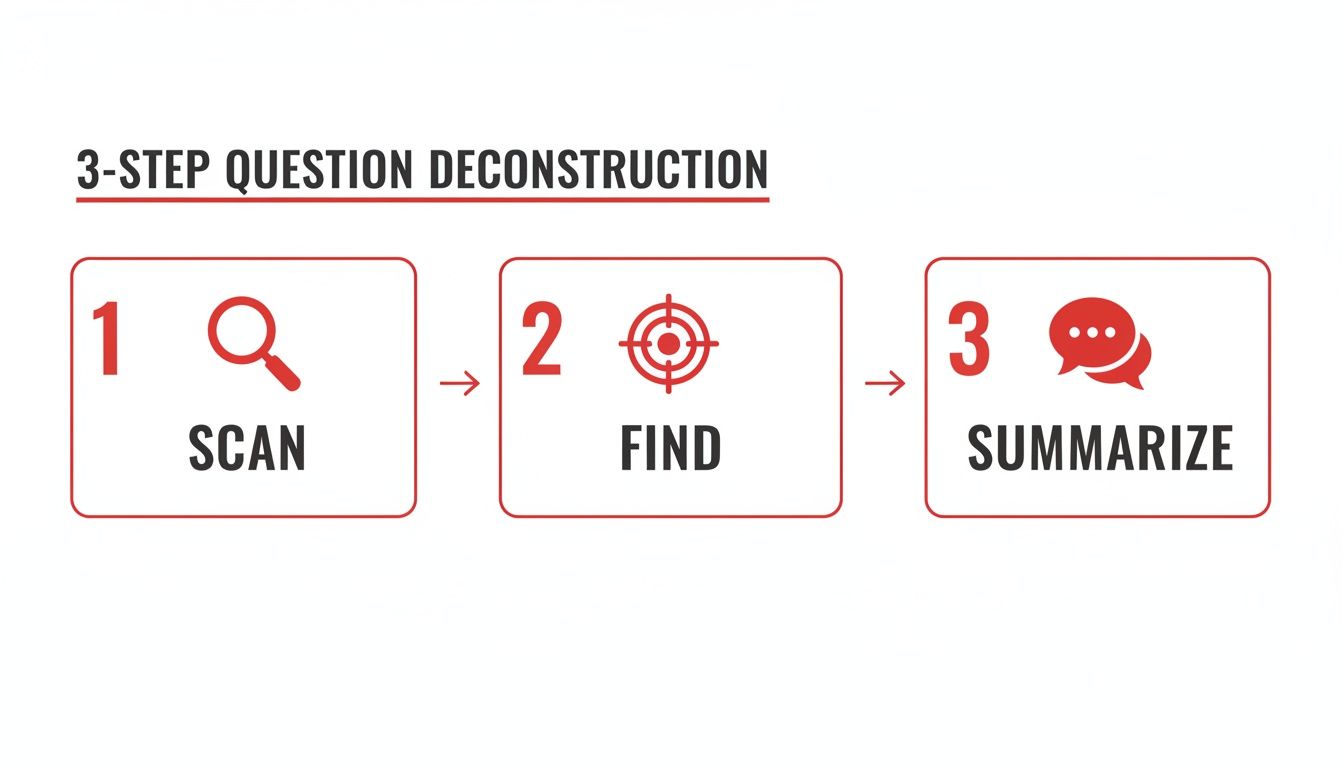
This Scan-Find-Summarize method trains your brain to zero in on the core clinical puzzle, pull out the essential data, and form a hypothesis before the answer choices can bias you.
The Art of Rigorous Review
This is where the magic happens. Answering the questions is the easy part. The brutal, time-consuming review process is what actually makes you smarter. You absolutely must review every single question, not just the ones you got wrong.
For every single question, you need to be able to answer these four things:
- Why was the right answer the best choice?
- Why were the other four answer choices definitively wrong?
- What critical piece of information did I miss or misinterpret in the vignette?
- How can I recognize this clinical pattern faster next time?
Getting a question right for the wrong reason is just as dangerous as getting it wrong. A lucky guess teaches you nothing. To make real progress, your review has to be brutally honest.
Block off at least as much time for review as you spent answering the questions. If you spent 60 minutes on a 40-question block, you need to budget a minimum of 60-90 minutes for a deep-dive review. This is non-negotiable.
Integrate Spaced Repetition With Your Qbank
During your review, you'll uncover tons of high-yield facts, classic presentations, and clinical pearls that you need to lock into long-term memory. This is the perfect time to bring in a spaced repetition system (SRS) like Anki.
Don't just highlight the text in the Qbank explanation. That's passive. Instead, create your own high-quality flashcards that force you to think. A good card doesn't just ask for a random fact; it frames it in a clinical context.
Here’s what a great Anki card looks like:
- Front: A 45 y/o patient on warfarin for A-fib presents with a painful, necrotic skin lesion on her thigh. What's the diagnosis and underlying mechanism?
- Back: Warfarin-induced skin necrosis. Caused by a transient hypercoagulable state. Warfarin inhibits vitamin K-dependent anticoagulants Protein C and S (short half-lives) faster than procoagulant factors II, VII, IX, and X (longer half-lives).
This method directly connects your Qbank review to a powerful memory tool, making sure the lessons you learn from your mistakes actually stick. By consistently practicing under timed conditions and performing meticulous reviews, you transform your Qbank from a simple practice tool into a dynamic learning system. As you build this skill, exploring different types of USMLE practice tests can further refine your ability to adapt to various question styles and formats, making you a more versatile and confident test taker.
Master Your Pacing and Manage Exam Day Anxiety

Your mental game on test day is just as critical as your knowledge base. After all those hours spent mastering content, the two things that most often sabotage a great score are poor timing and runaway test anxiety.
It’s a vicious cycle. You start falling behind on the clock, panic sets in, and that panic clouds the very clinical judgment you’ve worked so hard to build.
Breaking this cycle means walking into the testing center with a game plan. You need a clear strategy for managing your pace through each block and a toolkit of techniques to keep your nerves from taking over. This isn't about hoping you feel calm; it's about building a system to maintain peak performance from the first question to the last.
The Art of Strategic Pacing
On a marathon exam day like the USMLE or COMLEX, time is your most valuable resource. The goal isn't just to finish, but to spend your time intelligently to rack up as many points as possible. A classic mistake is getting stuck for five minutes on one obscure question while easier points are just sitting there, waiting for you.
To avoid this trap, I always teach students to use a "three-pass" approach for every single block:
- First Pass: Rip through the questions you can answer immediately and with confidence. If you know it, answer it and move on. Quick points are the goal here.
- Second Pass: Circle back to the questions you flagged—the ones you know you can solve but need a bit more thought. This is where you should spend the bulk of your time.
- Third Pass: With whatever time is left, go back to the questions you marked as total guesses. This ensures you never leave easy points on the table by getting bogged down too early.
This triage system is a fundamental skill. It turns you from a passive victim of the clock into an active manager of your time, guaranteeing you secure every single point you've rightfully earned.
Never let one killer question derail an entire block. A single question is worth the same as any other. Flag it, make your best guess, and move on. Your job is to accumulate points, not to prove you can solve every puzzle.
Taming the Anxiety Beast
Test anxiety is more than just feeling nervous. It’s a real physiological response that can cripple your cognitive function. Your heart races, your palms get sweaty, and your working memory—the very tool you need to dissect complex vignettes—takes a massive hit.
Managing this requires both mental and physical tactics.
Visualization is an incredibly powerful tool to use in the days leading up to your exam. Close your eyes and vividly imagine yourself sitting at the Prometric center, feeling calm, focused, and in complete control. Picture yourself moving efficiently through questions, confidently flagging the tough ones, and feeling a sense of accomplishment as you finish each block. This is like a mental rehearsal that primes your brain for success.
But what do you do when anxiety spikes mid-exam? You need an immediate reset button.
Controlled breathing is one of the fastest and most effective ways to do this. A simple "box breathing" technique—inhale for four seconds, hold for four, exhale for four, and hold for four—can physically slow your heart rate and bring your focus back to the question in front of you.
If you want to build a bigger toolkit, there are many excellent breathing exercises for anxiety you can practice beforehand so they feel automatic on test day.
Mastering these skills is non-negotiable. For a deeper dive, our guide on how to overcome test anxiety offers even more strategies tailored specifically for med students.
Finally, a quick look at how to structure your whole day can make a huge difference in managing your energy and focus.
Exam Day Pacing and Break Strategy
This sample schedule breaks down how to use your allotted 60 minutes of break time throughout an 8-hour USMLE/COMLEX exam day. The key is to disengage completely during your breaks to mentally reset for the next block.
| Block | Allotted Time (Minutes) | Recommended Break | Focus of Break |
|---|---|---|---|
| 1 | 60 | 5 minutes | Stand up, stretch, quick restroom trip. |
| 2 | 60 | 10 minutes | Hydrate, have a small protein-rich snack. |
| 3 | 60 | 5 minutes | Close eyes, deep breathing, quick mental reset. |
| 4 | 60 | 20 minutes (Lunch) | Eat a light lunch, walk around, avoid screens. |
| 5 | 60 | 5 minutes | Quick stretch, splash water on your face. |
| 6 | 60 | 10 minutes | Final snack/drink, positive self-talk. |
| 7 | 60 | 5 minutes | Use remaining time for a final mental break. |
| 8 | 60 | N/A | Finish strong. |
Remember, this is a template. You can adjust the break times based on how you feel, but never skip them. Using your breaks strategically is just as important as knowing the material.
When to Consider Personalized Tutoring for a Breakthrough
Hitting a plateau is one of the most maddening parts of board prep. You can spend weeks grinding through thousands of questions, meticulously reviewing every single answer, and still watch your practice scores flatline.
When all that hard work stops translating into better results, it’s usually a sign that you have a blind spot—a weakness in your test-taking skills that you just can’t see on your own.
This is exactly when personalized, one-on-one coaching becomes a game-changer. A skilled tutor does way more than just re-teach you cardiology. Their real value is in diagnosing the root cause of why you’re stuck. They essentially act as a data analyst for your study habits, pinpointing the specific error patterns holding you back.
Identifying Hidden Weaknesses
An expert coach can spot problems that are nearly impossible to diagnose by yourself. Are you consistently misinterpreting question stems that have multiple steps? Do you have a chronic timing issue, always rushing through the last ten questions of every block?
Maybe you have subtle knowledge gaps in a few high-yield areas that are costing you easy points across different organ systems.
For instance, a tutor might notice you correctly identify a disease but consistently choose the wrong "next best step." That’s not a content gap—it's a weakness in your clinical management reasoning. These are the kinds of insights that unlock real progress.
Personalized feedback is all about making the invisible visible. It’s having an expert look over your shoulder and say, "I see why you picked B, but here's the subtle clue in the patient's history you missed that makes C the only right answer."
Accelerating Your Improvement Curve
This targeted feedback loop is incredibly efficient. Instead of burning weeks trying to figure out why your scores won’t budge, you get immediate, actionable advice that addresses your unique challenges. This is especially true when it comes to strategy.
Test-taking skills improve dramatically when students get structured coaching on strategy, not just another content review. Data from certifying boards show that programs embedding formal feedback and practice tests consistently see higher pass rates, proving how coaching can lead to significant score improvements.
For students aiming for a highly competitive score, trying to overcome a previous failure, or simply wanting to study smarter, not harder, professional guidance is one of the most effective investments you can make.
It helps you break through those frustrating plateaus and fine-tune your approach in a way that self-study alone rarely can. To see how this works, exploring options like getting a tutor for USMLE Step 1 can give you a clearer picture of the benefits.
Answering Your Top Questions About Test Taking Skills
When you're deep in the trenches of board prep, the big-picture study plan is one thing, but it's the nagging, specific questions that keep you up at night. Let's tackle some of the most common anxieties and questions that pop up during those intense months with some direct, no-nonsense advice.
How Many Practice Questions Should I Really Do?
This is the big one, isn't it? The honest answer is that the number of questions you do is far less important than the quality of your review.
Yes, most students who score well will get through a major question bank like UWorld at least once, which is 2,000-3,000+ questions. But just clicking through answers to hit a target number is a total waste of time.
Think of it this way: a student who completes 1,500 questions but meticulously reviews every single answer choice—why each right answer is right and each wrong answer is wrong—will absolutely crush a student who passively blasts through 4,000 questions. The goal isn't just exposure; it's deep, lasting understanding of the clinical reasoning.
A better metric to track isn't the number of questions but the hours you spend on quality review. If you're not spending at least as much time reviewing a block as you did answering it, you're leaving a massive number of points on the table.
What Is the Best Way to Use NBME Practice Exams?
NBME (National Board of Medical Examiners) self-assessments are gold. They're the closest you'll get to the real deal and are fantastic for predicting your score, but their real power is as a diagnostic tool.
- Use them as milestones. Take one at the very beginning of your dedicated study period to get a baseline. Do another in the middle to see what's working and what's not. Save one or two for the end to build confidence and simulate the real exam day.
- Drill down into the data. Don't just glance at the three-digit score and move on. Dig into the content breakdown. If you're tanking immunology questions on three different NBMEs, that's not bad luck—it's a bright red flag telling you exactly where to focus your energy.
- Don't burn yourself out. Taking an NBME every weekend is a recipe for exhaustion. You'll start memorizing questions instead of learning concepts. Space them out by at least a week, preferably two.
Treat every NBME like a full dress rehearsal. That means strict timing, scheduled breaks, and no distractions. You're testing your stamina and pacing just as much as your knowledge.
How Do I Improve My Score When I Feel Stuck?
Hitting a plateau is one of the most frustrating parts of board prep, but almost everyone goes through it. It’s usually a sign that your passive study habits have reached their limit. To break through, you need to get more active and targeted.
Start by doing a deep dive into the last few practice blocks you completed. Categorize every single mistake. Are they knowledge gaps? Did you misread the question stem? Were you rushing and made a silly error?
Once you see a pattern, attack it head-on. For instance, if you realize pharmacology is a consistent weak point, don't just re-read the first chapter of your review book. Instead, make a specific set of Anki cards for drug mechanisms you keep forgetting. Do short, 10-question blocks focused only on pharma. Sometimes, just shaking up your routine is all it takes to get unstuck.
Is It Better to Study by Subject or in Random Mode?
The right answer changes depending on where you are in your study timeline.
- Early On (Building Your Foundation): In the beginning, studying in subject-specific, tutored mode is incredibly helpful. It lets you build a solid base in one area, like cardiology, by seeing dozens of related concepts back-to-back. You start to see the patterns.
- Later On (Dedicated Prep): As you get closer to your test date, you must switch to timed, random blocks. The real exam isn't going to serve you up 40 cardiology questions in a neat little row. You have to train your brain to jump from microbiology to ethics to biostats in a split second. This skill, called cognitive flexibility, is absolutely critical.
For the vast majority of your dedicated study period, you should be living in timed, random mode. It's the only way to truly simulate the mental gymnastics of exam day.
How Important Is a High-Quality Study Plan?
It’s everything. A well-designed plan is the difference between working hard and working smart. We see this in the data—small differences in preparation lead to huge differences in outcomes.
For example, USMLE Step 1 performance data shows that among US/Canadian MD students, first-time takers pass at a 91% rate. But for students from non-US/Canadian schools, that rate plummets to 72–73%. That means more than one in four fail on their first attempt. This gap often comes down to having a robust, data-driven plan. You can explore detailed USMLE performance data here to see more.
A great plan doesn’t just tell you what to study; it dictates how you study, weaving in active learning, spaced repetition, and constant performance analysis. It’s the framework that turns all that effort into points on the board.
Navigating the maze of board prep is tough, and you don’t have to figure it all out alone. If you've hit a wall or just want to make sure your strategy is rock-solid, the expert tutors at Ace Med Boards offer personalized, one-on-one guidance to find your weaknesses and make them your strengths. Visit acemedboards.com to schedule a free consultation and see how a tailored approach can transform your performance.