Think of an NBME USMLE Step 2 practice test as less of a quiz and more of a high-powered diagnostic tool. These self-assessments are the gold standard for a reason—they give you the clearest picture of where you stand and, more importantly, where you need to focus your energy. Mastering them isn't just about taking tests; it's a strategy that can unlock a higher score.
Your Blueprint for Acing NBME Practice Tests
Let’s be honest: with Step 1 now pass/fail, the heat is on for Step 2 CK. The score you get here carries a lot more weight, which means your practice test strategy has to be deliberate and smart. This isn't just about grinding through questions. It’s about building a repeatable framework you can use for every single practice exam to get the score you're aiming for.
Forget the generic advice you've heard a dozen times. We're going to walk through a real-world process for squeezing every drop of value out of each NBME USMLE Step 2 practice test.
This means getting intentional about:
- Strategic Selection: Picking the right test forms at the right moments in your study calendar.
- Deep Analysis: Learning to read your score report like a treasure map, uncovering actionable, high-yield insights.
- Active Learning: Turning every mistake into a concrete learning opportunity that actually closes knowledge gaps for good.
Why This Matters So Much
The stakes are high, and the data backs this up. The NBME designs both the practice tests and the real deal, so the correlation between them is incredibly strong. First-time takers from U.S. and Canadian medical schools consistently hit a 96% pass rate. But for repeat test-takers? That rate often drops to around 50–60%.
That massive gap shows just how costly it is to walk into the exam underprepared. You can dig into the detailed USMLE performance data yourself to see these trends.
By the time you finish this guide, you won't just be taking practice tests. You'll be using them as the cornerstone of a focused, efficient study plan that gets results.
Turning Strategy into Execution
This blueprint is designed to build both your knowledge and your confidence, step-by-step. To truly crush these NBME practice tests, you have to pair them with effective exam study strategies that force you to actively learn, not just passively review.
When you combine a solid content foundation with the diagnostic power of these self-assessments, you create a powerful feedback loop that speeds up your progress. For a broader look at how different resources fit together, our comprehensive overview of USMLE practice tests can provide extra context. Following this kind of structured approach is what ensures you walk into test day feeling ready for anything they can throw at you.
Choosing the Right NBME Forms and Timing Your Assessments
When you use your NBME USMLE Step 2 practice tests is just as critical as what you study between them. Think of your prep time in phases—a beginning, a middle, and an end. Each phase needs a specific kind of assessment to tell you where to focus your energy. If you use the right Comprehensive Clinical Science Self-Assessment (CCSSA) at the right time, you can turn your study plan from a guessing game into a targeted, data-backed strategy.
A huge mistake I see students make is burning through the newest, most predictive exams way too early. That’s like playing your ace in the first hand. A more tactical approach gets the maximum value out of every single form.
Laying the Foundation with a Baseline Assessment
Your first practice test is all about getting an honest, unfiltered baseline. Its only job is to be diagnostic—to show you where you're starting from and expose your big-picture weaknesses without the pressure of hitting a specific score.
For this, an older form like NBME Form 9 is perfect.
Using an older form for your baseline helps you:
- Get a feel for the NBME question style and the software interface.
- Pinpoint broad weak areas across different organ systems.
- Save the newer, more predictive forms for when you’re much closer to test day.
Take this baseline test about 4-6 weeks before your dedicated study period kicks off, or right as it begins. This gives you a clear roadmap from day one. The score itself doesn't matter much here; what matters is the performance data that will shape your first few weeks of studying.
The timeline below shows how you can use practice tests to guide each phase of your prep.
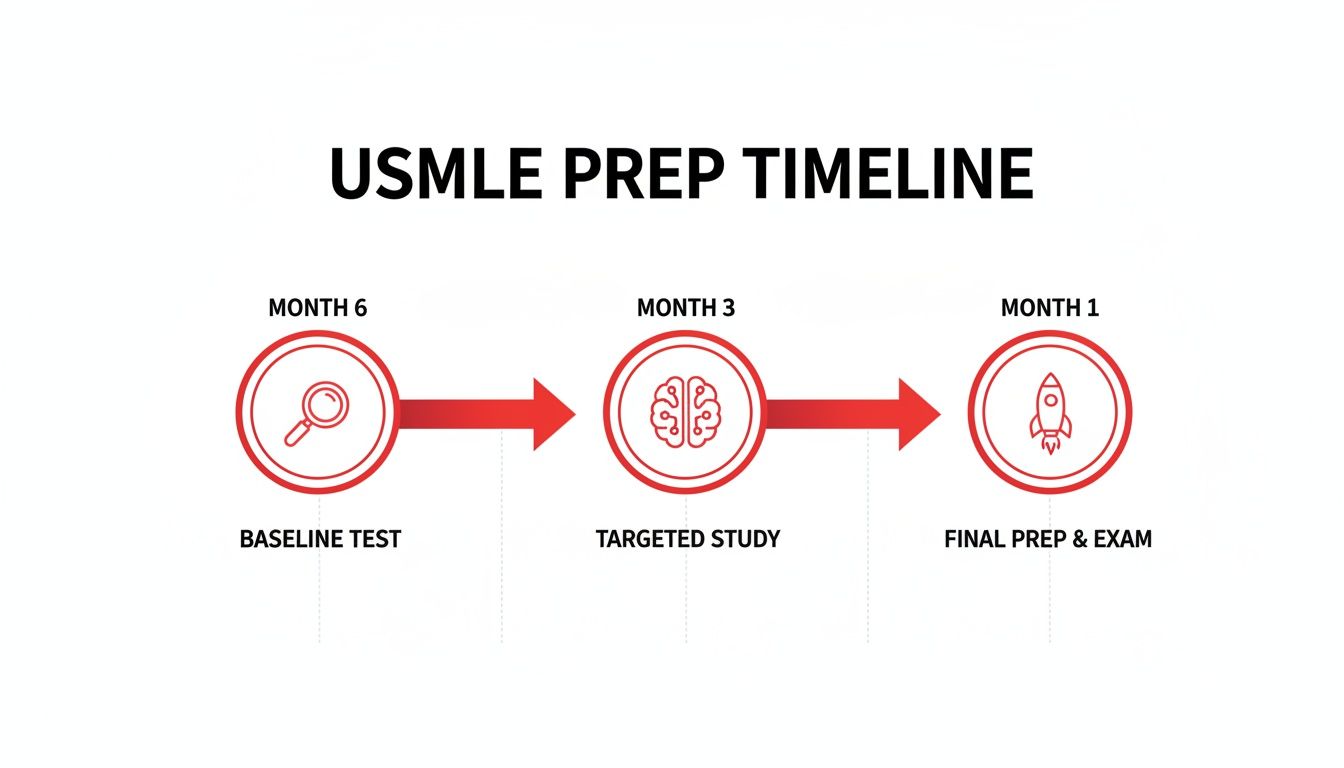
As you can see, each phase builds on the last, with practice exams acting as crucial checkpoints along the way.
Mid-Prep Checkpoints for Progress Tracking
After you've put in several weeks of focused work, it’s time to see if it's actually paying off. This is when you bring in the middle-tier forms, like NBME Forms 10 and 11. Think of these as crucial checkpoints to validate whether your study methods are working.
Taking one of these exams every 2-3 weeks during your dedicated study period will help you confirm your progress and adjust your focus. If you spent the last two weeks grinding cardiology, did your score in that section actually go up? If not, that’s a clear sign your approach isn't cutting it and something needs to change.
These mid-prep exams are your reality checks. They stop you from wasting time on an ineffective strategy, giving you a chance to course-correct while you still have plenty of time left.
The table below outlines a strategic approach to selecting and timing the most recent NBME forms for Step 2 CK.
Strategic Guide to NBME Step 2 Practice Test Forms
| NBME Form (CCSSA) | Recommended Timing | Primary Strategic Purpose |
|---|---|---|
| Form 9 | 4-6 weeks before dedicated study | Baseline Assessment: Get comfortable with the format and identify major knowledge gaps without using a highly predictive exam. |
| Form 10 or 11 | Every 2-3 weeks during dedicated study | Mid-Prep Checkpoint: Track progress, validate study methods, and recalibrate focus on persistent weak areas. |
| Form 12, 13, & 14 | Final 2-3 weeks before exam day | Predictive Assessment & Stamina Building: Get the most accurate score prediction and simulate real exam conditions to build endurance. |
Using this structured approach ensures you leverage each form for its intended purpose, moving from broad diagnostics to fine-tuned prediction as your exam date approaches.
The Final Stretch: Predictive Power and Stamina Building
In the last 2-3 weeks before your exam, your priorities shift. Now it’s all about score prediction and building the mental endurance to handle a full-length test. This is the time to unleash the newest and most accurate NBME forms, currently Forms 12, 13, and 14. These exams give you the closest look at the question difficulty and content spread you’ll face on the real Step 2 CK.
Try to schedule these final tests about one week apart. This gives you just enough time to do a deep review of each exam and patch up any last-minute weaknesses without getting completely burned out. Your average score across your last two NBMEs is often a very reliable predictor of how you'll perform on the actual exam.
But it’s not just about the score. These final run-throughs are your dress rehearsals for the real thing.
- Time Management: Be ruthless with the clock. Stick to the allotted time for every single block, no exceptions.
- Break Strategy: Figure out exactly how you'll use your break time. Will you grab a snack, take a short walk, or just close your eyes for a mental reset? Practice it.
- Environment: Find a quiet spot that feels like a real testing center to minimize distractions and get used to the silence.
Getting this rhythm down is non-negotiable. The real Step 2 CK is a marathon, and building up your test-taking stamina is what prevents decision fatigue and keeps you performing at your best from the first block to the last. For a deeper look at building the perfect schedule, our guide on when to take USMLE Step 2 offers more detailed timelines and strategies.
Unpacking Your Score Report to Pinpoint Weaknesses
Finishing an eight-hour NBME USMLE Step 2 practice test feels like crossing a finish line, but in reality, it's the starting gun for your most important work. That three-digit number is just a single data point. The real gold is buried in the performance breakdown, ready to show you why you landed on that score and exactly how to raise it.
The biggest leap forward comes when you shift your mindset from "What did I get?" to "Why did I get it?"

First things first, you need to translate that raw score into a projected Step 2 CK score. While the NBME provides its own score, many students turn to online converters or Reddit-based formulas for a more current, crowd-sourced prediction. These can be useful guides, but always treat the output as a range, not a rock-solid guarantee. From my experience, your average score across your last two NBMEs tends to be the most reliable predictor of where you stand.
A Framework for Analyzing Every Mistake
With a projected score in hand, it’s time to get your hands dirty and dig into your incorrects. Just passively reading the right answer explanation is a classic low-yield trap. What you need is a system to categorize every single mistake you made. This simple process turns a frustrating wall of red Xs into a highly specific, actionable study plan.
For every single question you got wrong, figure out which of these three buckets it falls into:
- Knowledge Gap: You just didn't know the information cold. Maybe you blanked on the first-line treatment for a certain condition or couldn’t recall a key diagnostic criterion.
- Question Misinterpretation: You knew the content but completely misread the question stem or missed a critical detail. This is when you overlook the word "except" or a subtle clue in the patient's history that changes everything.
- Judgment Error: You understood the question and knew the material, but you got lured in by a clever distractor, second-guessed your gut instinct, or made a simple reasoning mistake under pressure.
This categorization is the whole game. A knowledge gap calls for focused content review and flashcards. A misinterpretation problem means you need to slow down and practice a more deliberate question-dissection strategy. Judgment errors often signal test-taking anxiety or a need to build more confidence in your initial clinical reasoning.
Finding the Patterns in Your Performance Data
Once you’ve categorized your incorrects, zoom out and look for the patterns. Don't just see a random spray of mistakes; see a roadmap pointing directly to your weaknesses. This is where the performance breakdown by subject and system in your score report becomes invaluable.
Are you consistently fumbling questions in a specific organ system, like cardiology or renal? Or is your weakness more skill-based, like interpreting diagnostic imaging or tackling biostats?
Key Insight: Your NBME score report isn't a report card—it's a diagnostic tool. Treat it like a patient's chart. The patterns are your symptoms, and your job is to diagnose the underlying cause of your errors so you can prescribe the right study "treatment."
This analytical approach is backed by plenty of research in medical education. For instance, one study of 484 medical students found that USMLE Step 2 CK scores have moderate-to-large positive correlations with how students perform on their NBME subject exams. The composite shelf exam scores showed a correlation of 0.77 with Step 2 CK scores and, along with GPA, explained about 61% of the variance in final exam outcomes. It’s clear proof that performance on these practice tests directly mirrors the deep knowledge base you need to succeed.
Turning Your Analysis Into Actionable Study Changes
Spotting your weaknesses is only half the battle. The crucial next step is creating a concrete plan to fix them. This is how your study schedule evolves from a rigid, static document into a dynamic, responsive tool.
Let's walk through a common scenario I see all the time.
Scenario: A student scores a 235 on an NBME. After a thorough review, they find:
- A major knowledge gap in endocrinology, especially with adrenal disorders.
- A repeating pattern of misinterpreting questions that involve multi-step patient management.
- A bad habit of getting tricked by answer choices that are "correct but not the most correct."
Based on this analysis, their study plan for the following week needs to be laser-focused:
- Action 1 (Knowledge): Dedicate two full study blocks to adrenal physiology and pathology. This means creating summary charts and Anki cards for all the key hormone pathways.
- Action 2 (Interpretation): During their next UWorld block, they'll make a point to slow down and physically highlight the specific question being asked in each management vignette before even glancing at the answer choices.
- Action 3 (Judgment): For every practice question, they will practice verbalizing why the three incorrect answer choices are wrong, which builds the muscle for differentiating between plausible and correct options.
This targeted approach is so much more effective than just "studying more." It ensures your precious time and effort are applied exactly where they’ll generate the highest return on your score. For more context on how different scores align with various career paths, check out our breakdown of average Step 2 scores by specialty.
The Art of the Review: A Powerful Post-Test Workflow
Let’s be honest—that three-digit score you get after an NBME USMLE Step 2 practice test feels like everything. But it isn't. The real, score-boosting work happens in the hours after you finish, when you sit down to meticulously pick apart every single question. This is where you turn a simple assessment into one of your most powerful study tools.

The goal here is to get way beyond just passively reading the explanations. You need to actively engage with the material, figure out the exact reason you made an error, and then build a system to make sure that mistake never happens again. This active, high-yield workflow is what separates students whose scores stay flat from those who see a steady climb.
Deconstructing Incorrect Questions
Think of your incorrects as a treasure map leading directly to your biggest opportunities for growth. For every single question you get wrong, your job is to become a detective and perform a root cause analysis. Don't just learn the right answer; you need to understand precisely where your thinking went off the rails.
A great way to do this is to categorize each mistake right away. Did you miss it because of a pure knowledge gap? Did you misread the question stem? Or was it a more subtle error in your reasoning? This distinction is critical.
- Knowledge Gaps: These are the most straightforward. The fix is to create a targeted resource—a specific Anki card, a quick note in your notebook—that plugs that exact hole in your knowledge base.
- Misinterpretations: This is a red flag that you need to slow down your question-dissection process. Force yourself to highlight the key phrases and rephrase the core question in your own words before you even glance at the answer choices.
- Reasoning Errors: These can be the toughest to spot. They often happen when you get tricked by a well-crafted distractor or fail to connect a couple of key concepts under the pressure of the clock. Try talking through the logic out loud—it often helps reveal where you went astray.
This kind of detailed review mirrors how you’ll analyze complex clinical cases for the rest of your career. To see how these principles apply to another essential Step 2 resource, check out our guide on mastering the UWorld Step 2 Qbank for complementary strategies.
Analyzing Your Correct Answers
This might sound a little strange, but reviewing your correct answers is just as important as digging into your incorrects. Why? Because you have to separate skill from luck. It's incredibly easy to guess correctly, and that can create a dangerous false sense of security.
For every question you got right, quickly ask yourself three things:
- Did I know this information cold, and could I confidently teach it to a classmate?
- Was I 100% confident in my logic, or was it more of a 50/50 guess that went my way?
- Could I explain, with certainty, exactly why the other answer choices were wrong?
If you hesitate on any of these, treat that question as if you got it wrong. This simple habit builds a rock-solid foundation and ensures your score reflects true mastery, not just a few lucky breaks.
Pro Tip: A truly thorough review of a 200-question NBME exam should take you at least as long as the test itself, often 8-10 hours. If you’re zipping through your review in just a few hours, you’re probably just scratching the surface and leaving easy points on the table.
A Real-World Review Example
Let's walk through a common scenario. Imagine you miss a cardiology question about a patient with chest pain, dyspnea, and a brand new holosystolic murmur that radiates to the axilla. The correct answer was acute mitral regurgitation from a papillary muscle rupture after an MI.
A passive review is just reading the explanation and clicking "next." An active review is a deep dive.
- Identify the Core Concept: Papillary muscle rupture is a mechanical complication of an MI. Got it.
- Connect the Pathophysiology: Why does it happen? Ah, the posteromedial papillary muscle often has a single blood supply from the PDA, making it vulnerable to ischemia.
- Link to Clinical Findings: How does this present? The sudden, severe MR floods the lungs, causing flash pulmonary edema (the dyspnea) and cardiogenic shock. The murmur is the classic physical exam clue.
- Create a Learning Tool: Make a quick flashcard. Front: "Post-MI patient with new murmur & flash pulmonary edema." Back: "Think papillary muscle rupture -> acute severe MR. Dx w/ echo."
By actively integrating the information this way, you've transformed a single missed question into a durable, interconnected piece of clinical knowledge that you'll be able to recall and apply on future questions. This meticulous process is the art of the review, and it's the engine that will drive your score forward.
Integrating Practice Tests with Tutoring for Maximum Impact
Thoroughly reviewing your NBME USMLE Step 2 practice test is a powerful engine for improvement, but let’s be honest—sometimes you’re too close to your own mistakes to see the bigger picture.
You can analyze every single incorrect answer, yet a flawed reasoning pattern remains just out of sight. This is precisely where combining your hard data with expert guidance can shatter those frustrating score plateaus.
Self-analysis will only take you so far. A seasoned tutor doesn't just look at your performance for content gaps; they act like a diagnostic expert, hunting for the subtle, recurring errors in your test-taking process that are holding you back.
When to Bring in an Expert Eye
While tutoring can be a boost at any stage, there are a few key moments when it delivers the most dramatic impact. Recognizing these signals can save you weeks of spinning your wheels with inefficient studying.
Consider getting an expert’s perspective if you find yourself in one of these common ruts:
- A Disappointing Baseline: Your first NBME score came back way lower than you hoped, and you’re completely overwhelmed about where to even begin fixing things.
- A Stubborn Score Plateau: You’ve taken two or three practice tests, reviewed them diligently, but your score just refuses to budge. It’s infuriating.
- Waning Confidence: You constantly second-guess yourself on questions you actually know the answer to, which points to a problem with strategy, not just knowledge.
In these scenarios, a tutor doesn't just re-teach you cardiology. They diagnose the root cause of your performance issues. When looking for this kind of mentorship, it helps to understand the characteristics of a great coach so you can find someone who will genuinely elevate your prep. A great coach brings a fresh perspective that you simply can’t get on your own.
From Score Report to Action Plan
Let’s walk through a real-world example. Imagine a student is consistently scoring in the 240s but just can't seem to break into the 250s. They’re convinced they have a weakness in cardiology because that's where they keep missing questions.
A tutor dives into their NBME performance data and spots something different. The student isn’t missing questions about core concepts like MI or heart failure. The real issue? They consistently stumble on questions that require interpreting subtle EKG findings or tricky auscultation descriptions.
The problem wasn't a broad "cardiology" weakness; it was a specific skill gap in interpreting diagnostic data within clinical vignettes.
Armed with this insight, the tutor crafts a hyper-focused plan. Instead of telling the student to re-read the entire cardiology chapter (a huge waste of time), they assign targeted UWorld blocks filtered specifically for EKG and heart sound questions.
This strategic move directly attacks the real weakness, saving the student time and leading to a significant score jump on their next practice exam. For anyone needing this level of targeted support, working with a dedicated USMLE Step 2 tutor can be a complete game-changer.
This data-driven approach is vital. It’s about working smarter, not just harder. By pairing the objective data from your NBME with the subjective expertise of a great coach, you create a powerful synergy that refines your strategy and builds the rock-solid confidence you need to walk into exam day and perform at your best.
Your Top Questions About NBME Step 2 Practice Tests, Answered
When you're deep in Step 2 prep, the NBME USMLE Step 2 practice tests feel like high-stakes milestones. It's totally normal to have a ton of questions swirling around—getting straight, practical answers is the first step to building a study plan that actually works. Let's cut through the noise and tackle the questions I hear most often from students.
How Many NBME Practice Tests Should I Really Take for Step 2 CK?
There isn't a single magic number, but the sweet spot for most students is between three and five NBMEs. This range gives you enough data to build a clear story of your progress without causing test fatigue.
Think of it as creating a performance narrative:
- Your Baseline: Take one test early on to see where you stand before diving deep into dedicated prep.
- The Mid-Point Check-In: Use one or two exams midway through your study period. These are crucial for tracking your progress and making sure your study methods are actually paying off.
- The Final Stretch: Take two more in the last few weeks. These are your best predictors and are absolutely essential for building the mental stamina you'll need on test day.
Anything less than three makes it tough to spot real trends. You're just looking at isolated data points, which can be misleading. Taking at least three helps you see the bigger picture.
Are the NBME Practice Test Curves Reliable?
Yes, absolutely. Even when they feel brutally harsh, the scoring curves on the official NBME practice exams are the gold standard for predicting your Step 2 CK score. The newest forms—right now, that's NBME 12, 13, and 14—are widely considered the most accurate reflection of what you'll face on the real deal.
Here's a pro tip: Stop obsessing over a single score. Instead, average your scores from the last two NBMEs you take under full, timed conditions. That number is often spookily close to what you can expect to score on exam day.
What Should I Do If My NBME Score Goes Down?
First thing's first: do not panic. I repeat, do not panic. A score drop on an NBME USMLE Step 2 practice test isn't a final verdict; it's a diagnostic tool. It’s a bright, flashing signal telling you where to look, not a reason to spiral.
Before you jump to conclusions, analyze the context. Were you completely exhausted? Was the dog barking the entire time? Burnout is real, and it tanks scores. Once you've ruled out external factors, dig into the performance data. Did your score drop in one specific subject? That points to a knowledge gap. Or was the drop more scattered? That might signal a problem with your overall test-taking strategy, like timing or endurance.
Honestly, a score drop can be a blessing in disguise. It forces you to find and fix hidden weaknesses before they become a much bigger problem on the actual exam.
If a score plateau has you stuck or you're struggling to turn your NBME data into a winning strategy, the team at Ace Med Boards specializes in personalized tutoring to help you get unstuck. We can help you dissect your performance and build an actionable plan. Learn more about our USMLE Tutors.