Cracking the code to medical school admissions is the first, and most critical, step on your path to becoming a doctor. This isn't just about good grades; it's about building a powerful case for yourself. Think of it like a puzzle—you need a solid academic foundation, a competitive MCAT score, compelling personal experiences, and a story that ties it all together.
Each piece offers the admissions committee crucial evidence that you have what it takes.
Decoding the Medical School Application Roadmap

The journey to medical school can feel like you're trying to navigate a maze with a million moving parts. It’s far more than just ticking boxes off a list. It's about strategically weaving your academic achievements, test scores, and real-world experiences into a convincing portrait of a future physician.
Every single element of your application has a job to do, telling the admissions committee a different part of your story. This guide will demystify the entire process, breaking down each requirement into clear, actionable steps.
The Four Pillars of a Strong Application
At its core, a winning application stands on four foundational pillars. These aren't just separate categories; they're interconnected parts of a whole that admissions committees review together to get a complete picture of who you are.
- Academic Excellence: Your GPA and the difficulty of your coursework are the hard numbers that prove you can handle medical school's demanding science curriculum.
- Standardized Test Performance: The MCAT is the great equalizer. It provides a standard way to compare applicants from different schools and backgrounds, testing your critical thinking as much as your science knowledge.
- Meaningful Experiences: This is where you show, not just tell. Clinical volunteering, research, and shadowing demonstrate your commitment to medicine and your understanding of what a doctor's life is really like.
- Personal Narrative: Your personal statement, secondary essays, and letters of recommendation are what bring your application to life. They showcase your personality, your motivations, and your resilience.
Understanding how these pillars support each other is key. A high GPA in tough science classes, for example, gives context to a great MCAT score. Likewise, powerful reflections on your clinical experiences can make your personal statement truly unforgettable. To get started, you can explore our detailed guide on the essential prerequisites for medical school to build that rock-solid academic base.
Here's a quick overview of how these pillars come together:
Key Medical School Admissions Pillars at a Glance
| Requirement Pillar | What It Demonstrates | Typical Competitive Target |
|---|---|---|
| Academic Excellence (GPA) | Can you handle the rigorous science curriculum? | 3.7+ overall and science GPA |
| Standardized Testing (MCAT) | Do you have the critical thinking and foundational knowledge? | 512+ (for allopathic/MD programs) |
| Meaningful Experiences | Are you genuinely committed to and understand medicine? | 150+ hours clinical; 100+ research; 50+ shadowing |
| Personal Narrative | Who are you beyond the numbers? What drives you? | Compelling, authentic story connecting experiences to motivation |
These targets represent the competitive landscape you're entering. They're not just arbitrary numbers but reflect the caliber of applicants you'll be up against.
The statistics don't lie—this is a tough process. While 44.58% of all MD applicants matriculated somewhere in the 2024-2025 cycle, the average acceptance rate for any single MD school is just 4.23%. At top-tier schools like Stanford, where accepted students had a median 3.94 GPA and 518 MCAT, that rate plummets to a mere 1.4%.
This guide is designed to give you the framework you need to build an application that not only meets these demanding standards but stands out from the crowd.
Building Your Academic Foundation with GPA and Coursework

Before an admissions committee ever reads your personal statement or sees your MCAT score, they look at your academic record. Think of your Grade Point Average (GPA) and coursework as the concrete foundation of a house. If that foundation is weak, everything else you build on top—extracurriculars, research, and essays—is at risk of collapsing under scrutiny.
A strong academic history is the clearest proof that you can handle the grueling scientific curriculum of medical school. It’s a direct signal of your work ethic, intellectual curiosity, and ability to master tough material, all of which are non-negotiable medical school admissions requirements.
Demystifying the Two Critical GPAs
Admissions committees don’t just glance at one number. They dissect two different GPAs to get a complete picture of your academic horsepower. Knowing the difference is crucial for mapping out your undergrad strategy.
- Overall GPA: This is exactly what it sounds like—the cumulative average of every grade from every college course you’ve ever taken. It shows your consistency across the board, from biology to art history.
- BCPM GPA: This is your science GPA, calculated from courses in Biology, Chemistry, Physics, and Math. Adcoms weigh this heavily because it’s a direct predictor of how you’ll perform in the core medical curriculum.
A high BCPM GPA tells a story of scientific strength, while a strong overall GPA proves you’re a well-rounded, capable student. You really need both to be competitive. For international applicants with foreign transcripts, using certified academic document translation services is a critical step to ensure your record is evaluated accurately.
Core Coursework: The "Why" Behind the Requirements
Medical schools don't require prerequisite courses to make your life difficult. They mandate them because this coursework provides the fundamental language of medicine. These classes are the building blocks for everything you will learn as a physician.
For example, organic chemistry isn't just about memorizing reaction mechanisms; it's the key to understanding pharmacology and how drugs interact with the body. Physics principles aren't just abstract theories; they explain the mechanics of blood flow, the technology behind MRIs, and the forces acting on the human skeleton.
While the exact requirements can vary slightly between schools, every competitive applicant should plan on acing the following core curriculum, including labs:
- One year of General Biology
- One year of General Chemistry
- One year of Organic Chemistry
- One semester of Biochemistry
- One year of Physics
- One year of Math (including Calculus and Statistics)
- One year of English/Writing-Intensive Courses
Simply completing these courses isn’t enough. Excelling in them sends a powerful message that you have the scientific grounding to thrive from day one of medical school.
Turning Academic Challenges into Strengths
Let's be realistic: nobody's academic journey is perfect. A less-than-ideal GPA, especially from your freshman year, doesn't automatically disqualify you. Admissions committees value growth, resilience, and a good comeback story.
An upward grade trend is one of the most compelling narratives you can have. It shows you hit a rough patch, learned from it, adapted your study habits, and finished strong. That trajectory demonstrates maturity and a commitment to excellence—qualities every doctor needs.
If you had a tough semester because of personal or health issues, don't try to hide it. Use the secondary application essays to provide brief, professional context. Framing a past challenge as a learning experience can transform a potential red flag into a powerful story of perseverance. In the end, your academic record is more than just numbers; it’s the story of your preparation and your potential.
How to Achieve a Competitive MCAT Score

If your GPA is the foundation of your med school application, then the Medical College Admission Test (MCAT) is the skyscraper built on top of it. This isn't just another test; it's the great equalizer. The MCAT is a high-stakes, standardized exam that allows admissions committees (AdComs) to compare you to applicants from every imaginable undergraduate institution and academic background.
Forget simple memorization. The MCAT is designed to test your critical reasoning, analytical skills, and ability to solve complex problems under serious time pressure. Think of it as a key—a higher score doesn't just unlock one door, but opens up entire tiers of medical schools. It’s a powerful signal to AdComs that you have the intellectual stamina to not just survive, but thrive in the demanding environment of medical school.
Understanding the Four MCAT Sections
The MCAT is a true marathon, clocking in at nearly seven and a half hours. It’s split into four distinct sections, each scored from 118 to 132. These combine for a total score that can range from 472 to 528. Each section is a unique beast, testing a different blend of knowledge and reasoning.
- Chemical and Physical Foundations of Biological Systems (Chem/Phys): This is where you connect the dots between foundational physics and chemistry (think mechanics, light, sound, gen chem, and o-chem) and how they apply to living systems.
- Critical Analysis and Reasoning Skills (CARS): Often the toughest section for science-minded students, CARS is the ultimate test of your reading comprehension and analytical skills. It requires zero outside knowledge, instead evaluating how well you can dissect dense passages from the humanities and social sciences.
- Biological and Biochemical Foundations of Living Systems (Bio/Biochem): Prepare for a deep dive into biology and biochemistry. This section assesses your understanding of how cells and organ systems work on a molecular level.
- Psychological, Social, and Biological Foundations of Behavior (Psych/Soc): The newest addition to the exam, this section tests your knowledge of how psychological, social, and biological factors shape human behavior, health, and society.
To really conquer this exam, you need more than just knowledge. Mastering effective study strategies for the MCAT is non-negotiable. This exam tests your endurance just as much as your intellect.
What Is a Competitive MCAT Score, Really?
What’s a “good” MCAT score? The honest answer is: it depends entirely on your goals. The score you need is tied directly to the schools on your list—whether you're aiming for DO programs, mid-tier MD programs, or the most elite research institutions.
In 2024, the average MCAT score for successful MD applicants was 511.7. Many consider a 511 to be the sweet spot for a strong shot at many MD programs. However, if your sights are set on top-tier schools like UCLA's David Geffen School of Medicine (median MCAT of 522), you'll need to aim for a 518+ to be truly competitive.
The following table breaks down the MCAT score tiers and what they generally mean for your application. Use it as a guide to understand where your score might place you in the competitive landscape.
MCAT Score Tiers and What They Mean for Your Application
| Score Range | Competitiveness Level | Typical School Targets |
|---|---|---|
| 518+ | Highly Competitive (Top 10%) | Top 20 research-heavy MD programs (e.g., Harvard, Stanford, Johns Hopkins) |
| 512–517 | Very Competitive | Most public and private MD programs, competitive for mid- to upper-tier allopathic schools |
| 508–511 | Competitive | Many public MD programs, most DO programs. Considered the "sweet spot" for many MD applicants. |
| 504–507 | Moderately Competitive | Strong for most DO programs; may be on the lower end for some state MD schools (especially for in-state applicants). |
| 500–503 | Minimally Competitive for MD, Competitive for DO | Primarily competitive for newer DO programs or those with a holistic review focus. |
| <500 | Non-Competitive for Most MD/DO Programs | May require significant post-bacc work or a Special Master's Program to be considered. |
As you can see, your score directly shapes the breadth and caliber of schools where you have a fighting chance. It's a game of tiers. For a more detailed breakdown, our guide on what constitutes a good MCAT score dives even deeper.
Beyond the MCAT: The AAMC PREview Exam
Just when you thought you were done with standardized tests, there's another one gaining traction: the AAMC Professional Readiness Exam (PREview). A growing number of medical schools now require this exam, which is a completely different animal from the MCAT.
The PREview is a situational judgment test. You'll be presented with realistic scenarios you might face in medical school or as a practicing physician and asked to rate the effectiveness of different responses. It’s designed to measure the professional competencies that are tough to gauge from grades and test scores alone, such as:
- Service Orientation
- Social Skills
- Teamwork
- Cultural Competence
- Ethical Responsibility
While your MCAT proves you have the academic chops, the PREview offers a glimpse into your interpersonal and professional readiness. Together, they help admissions committees build a more complete picture of who you are and the kind of physician you'll become.
Crafting Your Story Through Extracurricular Activities
If your GPA and MCAT score are the "what" of your application, your extracurriculars are the "why." They’re what breathe life into your file, transforming a collection of numbers into a compelling human story. These experiences are your proof that you understand what it really means to be a doctor and that you have the empathy, resilience, and grit to become one.
Admissions committees don't want to see a laundry list of one-day events. They are far more interested in the depth and quality of your involvement. Think of it this way: anyone can show up to volunteer for a few hours. A future physician, however, invests themselves long enough to learn, contribute in a real way, and reflect on how they’ve grown.
Moving Beyond the Pre-Med Checklist
One of the biggest mistakes I see applicants make is treating extracurriculars like a to-do list. Check off shadowing, check off volunteering, check off research. A truly standout application, however, weaves a narrative thread that connects your activities. Instead of just ticking boxes, focus on developing a few core experiences that genuinely resonate with you and tell a cohesive story about your journey.
A sustained, long-term commitment tells a far more powerful story than a dozen disconnected experiences. A student who has spent 300 hours over two years at a free clinic, progressing from administrative tasks to patient intake, has a much richer story of growth and dedication than a student with the same number of hours spread across ten different short-term projects.
Quality over quantity is the name of the game. Your goal is to show your character and commitment through your actions, not just tell an admissions committee you have them.
The Four Core Extracurricular Pillars
While your personal interests should absolutely guide your choices, every competitive applicant needs to build a solid foundation across four key areas. Think of these as the pillars that ensure you have a well-rounded perspective on the medical field.
- Clinical Volunteering: This is where you get your hands dirty with direct, hands-on patient exposure. Working as an EMT, a certified nursing assistant (CNA), or a medical scribe gives you an invaluable, unfiltered look at the day-to-day realities of patient care. It’s where you prove you can handle the emotional and physical demands of medicine.
- Physician Shadowing: Shadowing is your chance to be a fly on the wall. Observing physicians across different specialties—ideally in both a clinic and a hospital setting—confirms that you understand what a doctor’s work actually entails, including the mountains of paperwork and the difficult conversations.
- Research Experience: Getting involved in research, whether it's in a "wet lab" with pipettes or a "dry lab" analyzing clinical data, demonstrates that you get the scientific method. It shows you’re curious, analytical, and appreciate the evidence-based foundation of modern medicine.
- Community Service (Non-Clinical): Your non-clinical volunteering reveals what you care about when you take the white coat off. Working at a soup kitchen, tutoring kids, or building homes with Habitat for Humanity showcases your altruism and commitment to serving your community—a core tenet of being a good physician.
Articulating Your Experiences in the Application
Just doing the activities isn't enough; you have to reflect on them powerfully in your AMCAS Work & Activities section. This is where you connect the dots for the admissions committee.
Don't just list your duties. That’s boring and unhelpful. Instead, focus on what you learned, how you grew, and the impact you made. For every significant experience, ask yourself these four questions:
- What specific challenge did I face?
- What action did I take to address it?
- What was the result of my action?
- How did this experience change my perspective or solidify my desire to become a doctor?
Answering these questions transforms a simple description like "Filed patient charts" into a meaningful reflection on understanding healthcare logistics and the importance of patient privacy. This narrative approach is a critical part of meeting medical school admissions requirements and is what makes an application truly memorable.
Navigating the Application and Interview Process
After years of grinding through tough coursework, prepping for the MCAT, and putting in countless hours on extracurriculars, this is it. The application and interview stage is where everything you've worked for comes together. This is your moment to package your entire pre-med story into something powerful and cohesive.
Think of it as the final sprint in a very long marathon. How you execute now, with careful attention to detail, can make all the difference. Your application isn't just a collection of stats; it's a carefully built case for why a medical school should choose you. The primary application lays the foundation, your secondary essays add personality, and the interview is your closing argument—the live performance that seals the deal.
Assembling Your Primary Application
The first big hurdle is getting your primary application submitted through a centralized service like AMCAS (for MD programs) or AACOMAS (for DO programs). This is your comprehensive portfolio. It's got your transcripts, MCAT scores, activities section, and the all-important personal statement.
If there's one piece of strategy you can control, it's this: submit early. Medical schools use rolling admissions, which means applicants who get their materials in early in the cycle—ideally in June—often have a real statistical advantage. Waiting until August or September means you’re fighting for a much smaller pool of interview slots.
To get a sense of how your activities should build over time, take a look at this timeline.
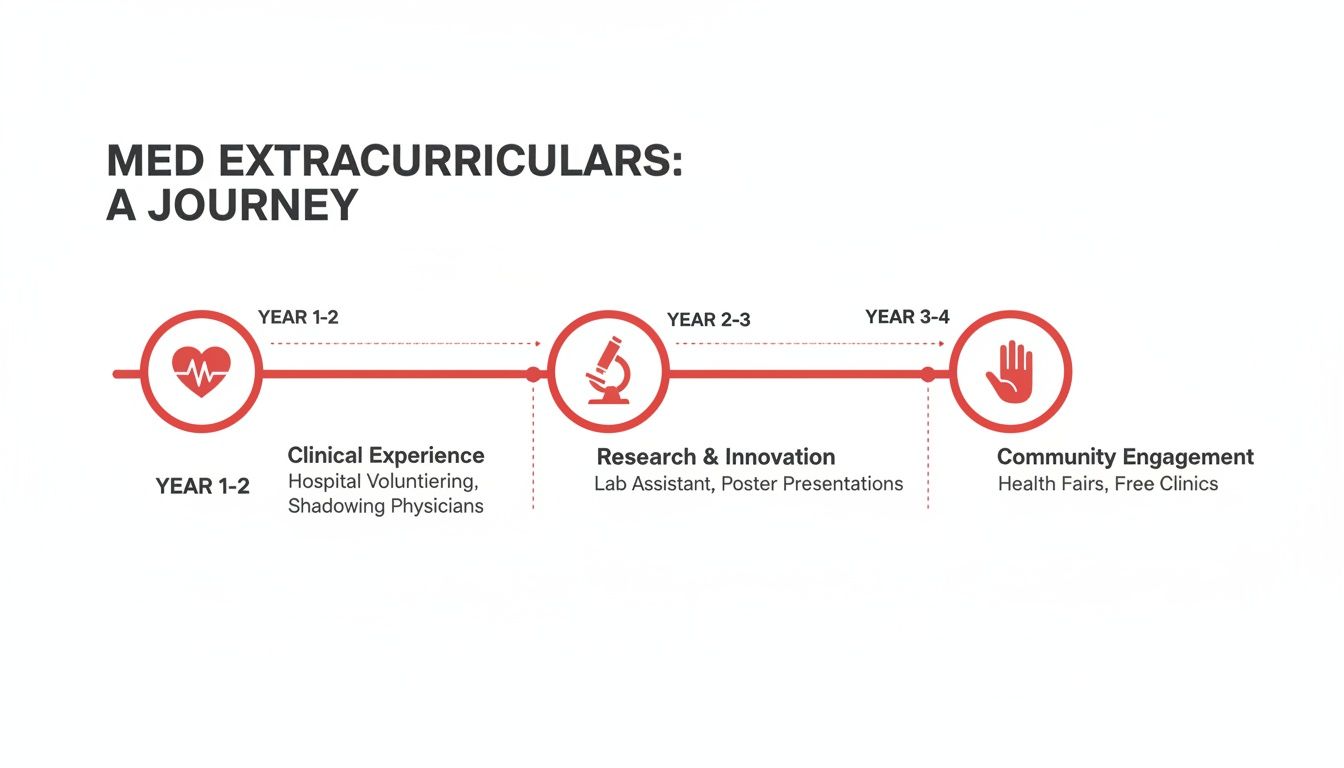
As you can see, a competitive application isn't built overnight. It's the result of sustained commitment to clinical work, research, and community service over several years.
Conquering Secondary Essays and Securing Strong Letters
Once your primary application is verified, the next wave hits: secondary, or supplemental, applications. Schools will start sending you their own specific essay prompts designed to see if you're a good fit for their unique mission. This is where you have to answer the crucial question, "Why our school?"
Generic, copy-and-pasted answers are an immediate red flag for admissions committees. A compelling secondary essay demonstrates genuine research and connects your specific experiences and goals to the school's unique strengths, be it their research opportunities, focus on rural medicine, or commitment to underserved communities.
At the same time, you'll be locking in your letters of recommendation. These letters are critical because they offer an outside perspective on your character and abilities from people who have seen you in action. You'll want a diverse set of recommenders:
- Two science professors who can speak to your academic horsepower.
- One non-science professor to show you're well-rounded.
- One to two extracurricular supervisors, like a research PI or a physician you shadowed, who can vouch for your personal qualities.
Start building these relationships early. When you ask, give your writers plenty of notice and a packet of materials (your CV, personal statement, and a reminder of your work with them) to help them write a killer, detailed letter.
Mastering the Medical School Interview
Getting an interview invitation is a huge win. It means a school already thinks you're a serious contender on paper. Now you just have to prove you're just as impressive in person. The interview is the ultimate test of your communication skills, empathy, and ability to think on your feet.
You’ll likely run into one of two formats:
- Traditional Interview: This is a classic one-on-one or small panel conversation. Be ready for questions about your motivation for medicine, your strengths and weaknesses, and your take on current healthcare challenges.
- Multiple Mini-Interview (MMI): This format is more like speed dating. You'll rotate through a series of short, timed "stations," each with a different scenario. It could be an ethical dilemma, a role-playing exercise with an actor, or a teamwork challenge with other applicants.
Success in either format comes down to practice. You need to be able to articulate your thoughts clearly under pressure and connect your personal experiences to the qualities of a great physician.
This whole process has a ton of moving parts. For a complete guide to staying organized, our medical school application checklist gives you a step-by-step framework so you don’t miss a single deadline or component. This final phase is your chance to turn that interview invitation into an acceptance letter.
Frequently Asked Questions About Medical School Requirements
The path to medical school is filled with complex requirements that can leave even the most prepared applicants feeling unsure. We get these questions all the time from pre-med students, so let's clear up some of the most common points of confusion.
How Important Is Research Experience?
It’s incredibly valuable, especially if you’re aiming for a research-heavy MD program. Meaningful research experience shows admissions committees (adcoms) that you have scientific curiosity and know how to think critically.
But let's be clear: this isn't about just washing beakers in a lab. Adcoms want to see that you were intellectually engaged—that you understood the project's goals and actually contributed to the work. While not every single school requires it (many DO programs are more flexible on this), strong research can absolutely make an application stand out.
Can I Get into Medical School with a Low GPA?
It’s a tough climb, but it’s definitely not impossible. A low GPA from your early college years can be overcome, but you need to prove you’ve changed course.
The most powerful tool you have here is a strong upward trend. If your grades improved dramatically over your junior and senior years, it tells a story of maturity and resilience. Back that up with a high MCAT score and stellar grades in a post-bacc or Special Master's Program, and you’ll build a compelling case that your recent performance is the real you.
What Is the Difference Between MD and DO Requirements?
At their core, the academic requirements for MD (allopathic) and DO (osteopathic) programs are very similar. Both expect a solid GPA, a competitive MCAT score, and the same prerequisite courses.
The real difference often comes down to philosophy and focus.
DO schools are well-known for their holistic review process. They often place more weight on an applicant's interest in primary care, commitment to community service, and a genuine understanding of osteopathic principles. Because of this, a letter of recommendation from a practicing DO is almost always a non-negotiable requirement.
How Many Clinical Hours Do I Need?
There’s no magic number here. Adcoms care far more about the quality of your experience than the sheer quantity of hours. Logging hundreds of hours without any meaningful reflection or learning won't impress anyone.
That said, you need to show a sustained commitment. A competitive applicant typically has at least 100-150 hours of direct clinical experience. This could come from shadowing, scribing, or volunteering in a hospital or clinic. This level of involvement proves you've seen what a physician's demanding role truly entails and you're still all in.
Building an application that gets you noticed is about more than just checking boxes; it’s about telling a compelling story. Ace Med Boards provides personalized admissions consulting to help you shape your narrative, play to your strengths, and give you the best possible shot at getting that acceptance letter. Schedule your free consultation with Ace Med Boards today.