The quest for the top internal medicine residencies is more than just consulting a list of prestigious names. It's a deeply personal and strategic process that involves aligning your specific applicant profile, from board scores and research experience to long-term career aspirations, with the programs that will best foster your growth. A successful Match hinges on building an intelligent, targeted application list, which requires moving beyond hearsay and leveraging powerful, data-driven resources.
This guide provides a comprehensive roundup of the essential digital tools every internal medicine applicant needs to master. We will bypass generic advice and dive directly into a strategic analysis of the most effective platforms available. From official databases that help you benchmark your competitiveness against matched applicants to specialty-specific resources that reveal crucial program outcomes like board pass rates, you will learn how to gain a distinct competitive advantage.
Think of this article as your strategic toolkit. For each platform, we will break down its core features, highlight its unique strengths, and provide actionable tips on how to integrate it into your application strategy. Our goal is to equip you with the knowledge to navigate the complex residency application process with confidence. You’ll learn how to transform your search from a broad, hopeful endeavor into a precise, data-informed mission to secure a spot at an internal medicine program that is a perfect fit for you.
1. Doximity Residency Navigator
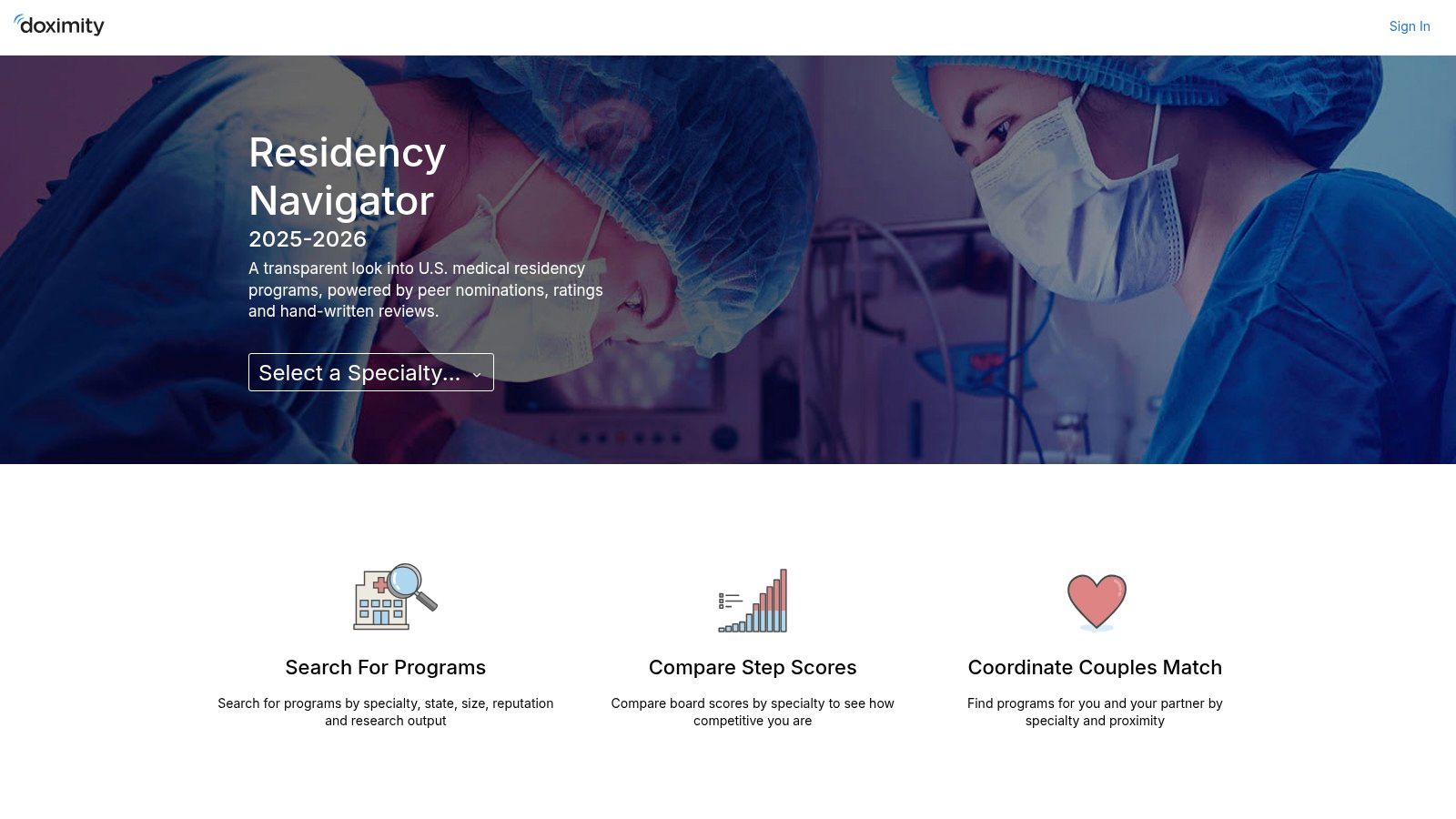
Doximity Residency Navigator stands as a foundational starting point for nearly every medical student beginning their search for the top internal medicine residencies. It functions as a comprehensive, physician-focused directory, offering sortable rankings and detailed program profiles that help you create an initial, broad list of potential programs.
Its primary draw is the data, which is powered by Doximity's vast network of U.S. physicians. This allows for unique insights, including reputation-based rankings derived from peer nominations from board-certified physicians.
Key Features and How to Use Them
Doximity excels at providing a high-level overview, allowing you to quickly filter and sort through hundreds of programs. The user interface is clean and intuitive, making it easy to navigate the vast amount of information.
- Sortable Rankings: You can sort internal medicine programs by Reputation or Research Output. The reputation score is based on surveys of physicians, offering a glimpse into how a program is perceived within the medical community. Research output is based on publications and NIH grants, crucial for applicants prioritizing academic careers.
- Detailed Filters: Narrow your search using essential filters like location (state or region), program size (number of residents), and program type (university-based, community-based). This helps you align your search with personal and professional priorities from the start.
- Alumni Outcomes: One of the most powerful features is the ability to see where a program's alumni have sub-specialized. You can view the top fellowship programs and specialties that graduates have matched into, providing a tangible measure of a program's success in preparing residents for competitive fellowships.
- Resident & Alumni Reviews: Get candid insights from current and former residents through anonymous "handwritten" reviews and satisfaction surveys. These often cover program culture, work-life balance, and training quality.
Actionable Tips for Applicants
To get the most out of Doximity, use it strategically as a discovery tool, not as your final decision-maker.
Start Broad, Then Go Deep:
Use the reputation and research rankings to build an initial list of 25-40 programs. Once you have this list, your next step is to visit each program's official website, speak to current residents, and gather more objective data to verify the information.
Expert Insight: Remember that reputation rankings are subjective. A program with a stellar reputation might not be the best personal fit for your career goals or learning style. Use the rankings as a guide, but always triangulate the data with other sources.
Leverage the "Careers" Tab:
When viewing a program, click the "Careers" tab to see alumni data. If you are set on a competitive fellowship like Cardiology or Gastroenterology, prioritize programs that consistently match their residents into top-tier fellowships in those fields. This data can be more valuable than a generalized reputation score.
Access and Final Verdict
| Feature | Details |
|---|---|
| Pricing | Free to use. |
| Access | Full access requires a Doximity account, which is free for U.S. medical students, residents, and physicians. |
| Unique Strength | Unmatched alumni outcome data and peer-based reputation rankings. |
Doximity is an indispensable first stop for identifying potential top internal medicine residencies. Its strength lies in its ability to quickly organize a vast landscape of programs based on reputation, research, and alumni success. While its subjective data should be balanced with further research, no other platform offers such a powerful, high-level view to kickstart your application strategy. The insights you gather can also be invaluable as you prepare for interviews; for a deeper dive, review our comprehensive guide to the medical residency interview process.
Website: https://www.doximity.com/residency
2. AMA FREIDA (Residency & Fellowship Database)
Where Doximity offers reputation-based rankings, the AMA's FREIDA database serves as the official, authoritative source for program logistics. It is the definitive directory of all ACGME-accredited programs, making it an essential tool for verifying the foundational details of any top internal medicine residencies you are considering. Think of it as the source of truth for program specifics.
FREIDA’s main value is its direct connection to the accrediting bodies. The information is standardized and comes straight from the programs themselves, ensuring you have the most accurate data for application requirements, program size, and contact information. It’s less about ranking and more about fact-checking.
Key Features and How to Use Them
FREIDA excels at providing objective, filterable data. While it lacks the peer reviews of other platforms, its structured, consistent presentation of program facts allows for direct, apples-to-apples comparisons of logistical details.
- Standardized Program Profiles: Every program listing follows the same format, making it easy to find key information like NRMP program codes, number of PGY-1 positions offered, work hours, and salary/benefits information. This consistency is crucial for organizational purposes.
- Comprehensive Filters: You can search for programs based on criteria that are often hard to find elsewhere, such as visa sponsorship (J-1 or H-1B), specific state licenses accepted, and detailed demographic data about the patient population and location.
- Specialty Guides: FREIDA offers high-level guides that outline the training requirements, match data, and workforce statistics for specialties like internal medicine. This is great for early-stage planning.
- Saved Searches & Comparison Tools: With a free AMA account, you can save programs to a personal dashboard and compare their features side-by-side. This is highly useful for narrowing down your final application list.
Actionable Tips for Applicants
Use FREIDA as your verification and logistics hub after building an initial list on a platform like Doximity.
Verify Everything:
Once you identify a program of interest, cross-reference its details on FREIDA. Check the number of available positions, application deadlines, and required USMLE/COMLEX scores. Program websites can sometimes be outdated, but FREIDA is regularly updated.
Expert Insight: Pay close attention to the "Program Director and Coordinator" contact information. When you have specific, appropriate questions that are not answered online, addressing your email to the correct person is a sign of professionalism and attention to detail.
Filter for "Must-Haves":
If you have non-negotiable requirements, like needing J-1 visa sponsorship or wanting a program in a specific type of urban setting, use FREIDA’s filters first. This can save you hours of research by immediately eliminating programs that do not meet your essential personal or logistical criteria before you get invested in them.
Access and Final Verdict
| Feature | Details |
|---|---|
| Pricing | Free for basic program search. |
| Access | Advanced features like the comparison dashboard and saving programs require a free AMA member account. |
| Unique Strength | Official, ACGME-verified data on all programs, presented in a standardized and reliable format. |
FREIDA is the indispensable logistical backbone of your residency search. While it won’t tell you which programs are the "best" in terms of reputation, it provides the objective, verified data necessary to ensure you are applying to programs that are a true logistical fit. It's the perfect second step for confirming that the top internal medicine residencies on your list align with your practical needs.
Website: https://freida.ama-assn.org
3. Residency Explorer
Residency Explorer is the essential data-driven tool for any applicant trying to realistically assess where they stand. Produced by the AAMC in partnership with leading medical organizations, this platform moves beyond subjective reputation and focuses on objective, source-verified data to help you compare your academic profile to previously matched applicants at specific top internal medicine residencies.
Its core function is to provide a reality check, allowing you to build a balanced program list based on hard data. By leveraging information directly from the AAMC, ACGME, NRMP, and other official sources, it offers an unparalleled level of accuracy and transparency, helping you understand your competitiveness for hundreds of programs nationwide.
Key Features and How to Use Them
Residency Explorer excels at providing granular, applicant-centric data that helps you categorize programs into reach, target, and safety tiers. The interface is designed for comparison, allowing you to see how you stack up against real, historical data.
- Applicant Competitiveness Visuals: After entering your USMLE/COMLEX scores, research experiences, and other credentials, the tool generates charts showing where you fall compared to applicants who previously matched at each program. This is crucial for gauging your match probability.
- Side-by-Side Program Comparison: You can select multiple programs and compare them directly on key objective attributes. This includes interview invitation data, salary and benefits, call schedules, and resident diversity statistics, all in one streamlined view.
- Program Snapshots: Each program profile provides a detailed summary of its characteristics, such as program size, setting (university vs. community), and specific curriculum tracks. This information is verified by the programs themselves, ensuring it's up-to-date.
- Robust Filtering: Start with a broad search and then narrow your list using filters like location (state, region, or distance from a city), program size, and specific program features. This helps you build a list that aligns with both your professional and personal priorities.
Actionable Tips for Applicants
Use Residency Explorer to ground your application strategy in reality and build a smart, balanced program list.
Build Your Tiers (Reach, Target, Safety):
After creating an initial list from sources like Doximity, plug those programs into Residency Explorer. Use the competitiveness charts to honestly assess each one. If your stats fall below the 25th percentile of previously matched applicants, classify it as a reach. If you're squarely in the middle (25th-75th percentile), it's a target. This data-driven approach is the most reliable way to ensure you apply to a balanced mix of programs.
Expert Insight: The "interviewed, but not ranked" data point is incredibly valuable. If a program interviews a high number of candidates with your scores but ultimately doesn't rank many of them, it might indicate a preference for other "soft" factors. Pay close attention to this to avoid wasting application fees on programs where you may not be a good holistic fit.
Filter for Lifestyle and Fit:
Don't just focus on scores. Use the comparison tool to evaluate factors like call frequency, vacation time, and salary relative to the cost of living. A prestigious program might be less appealing if its resident support and work-life balance metrics are not aligned with your needs. This objective data helps you look beyond reputation to find a program where you can truly thrive.
Access and Final Verdict
| Feature | Details |
|---|---|
| Pricing | Free to use. |
| Access | Requires an AAMC account, which is free for medical students and applicants participating in the ERAS/NRMP process. |
| Unique Strength | Source-verified data from AAMC, NRMP, and ACGME, enabling direct comparison of your profile to previously matched residents. |
Residency Explorer is the indispensable tool for building a realistic and strategic application list. While it lacks the subjective reputation rankings of other platforms, its strength lies in providing objective, verified data that empowers you to make informed decisions about the top internal medicine residencies for your specific profile. Use it to refine your initial list, identify hidden gems, and ensure you are applying smartly, not just widely.
Website: https://www.residencyexplorer.org
4. ERAS (MyERAS Application Portal and Guidance)
The Electronic Residency Application Service (ERAS) is not just a tool; it is the official gateway for applying to nearly all ACGME-accredited residency programs, including the top internal medicine residencies. Managed by the AAMC, this platform is the central nervous system of your application, where you will compile your documents, select programs, and ultimately submit your candidacy.
While other platforms help you discover programs, ERAS is where the application process becomes tangible. It is the definitive source for official timelines, fee structures, and the mechanics of program signaling. Understanding how to navigate its interface and requirements is a non-negotiable step in the residency match journey.
Key Features and How to Use Them
ERAS is a process-driven system designed for standardization and efficiency. Its main function is to deliver a complete, uniform application package to all the programs you select. Mastering its features is crucial for a smooth application season.
- MyERAS Program Search: The portal includes a directory where you can search for and save internal medicine programs. While less feature-rich than Residency Explorer, it serves as your final checklist, allowing you to manage the programs you are actively applying to.
- Centralized Document Hub: This is where you upload your CV, personal statement, photograph, and manage your letters of recommendation (LoRs). The system ensures program directors receive a consistent and complete package from every applicant.
- Program Signaling: ERAS is the official platform where you will assign your program signals. For internal medicine, this typically involves a set number of "gold" and "silver" signals to indicate your highest levels of interest, a critical strategic component of your application.
- Fee Calculator and Payment: The platform includes a built-in fee calculator that shows you exactly how much you will owe based on the number of programs you apply to. All payments are processed directly through the MyERAS portal.
Actionable Tips for Applicants
Using ERAS effectively is about organization and strategy, not just data entry. A meticulous approach can prevent costly errors and strengthen your application.
Prepare Documents Offline:
Do not write your CV or personal statement directly in the ERAS interface. Draft, edit, and finalize all narrative components in a separate word processor to ensure perfect grammar and formatting before copying them into the system. This is particularly vital for your personal statement; for inspiration, see these successful internal medicine personal statement examples.
Expert Insight: The ERAS platform is notoriously unforgiving with formatting. Preview every section multiple times before certifying and submitting your application. What looks good in a text editor may not render correctly in the final PDF that programs see.
Track Your LoRs Proactively:
Once you finalize your letter writers, generate the LoR Request form for each one through the portal. Politely follow up with your writers to ensure they have uploaded the letter well before the deadline. You are responsible for making sure your application is complete.
Access and Final Verdict
| Feature | Details |
|---|---|
| Pricing | Tiered fee structure. The cost increases significantly with the number of programs you apply to. |
| Access | Requires a unique ERAS token, which is distributed to applicants by their Designated Dean’s Office. |
| Unique Strength | The official, mandatory platform for application submission, document management, and program signaling. |
ERAS is the essential, unavoidable final step in your search for the top internal medicine residencies. Its primary role is logistical, serving as the official conduit between you and the programs. While it lacks the advanced search features of other tools, its importance cannot be overstated. A well-prepared and flawlessly executed ERAS application is the foundation upon which a successful match is built.
Website: https://students-residents.aamc.org/applying-residency/applying-residencies-eras
5. NRMP – Charting Outcomes in the Match
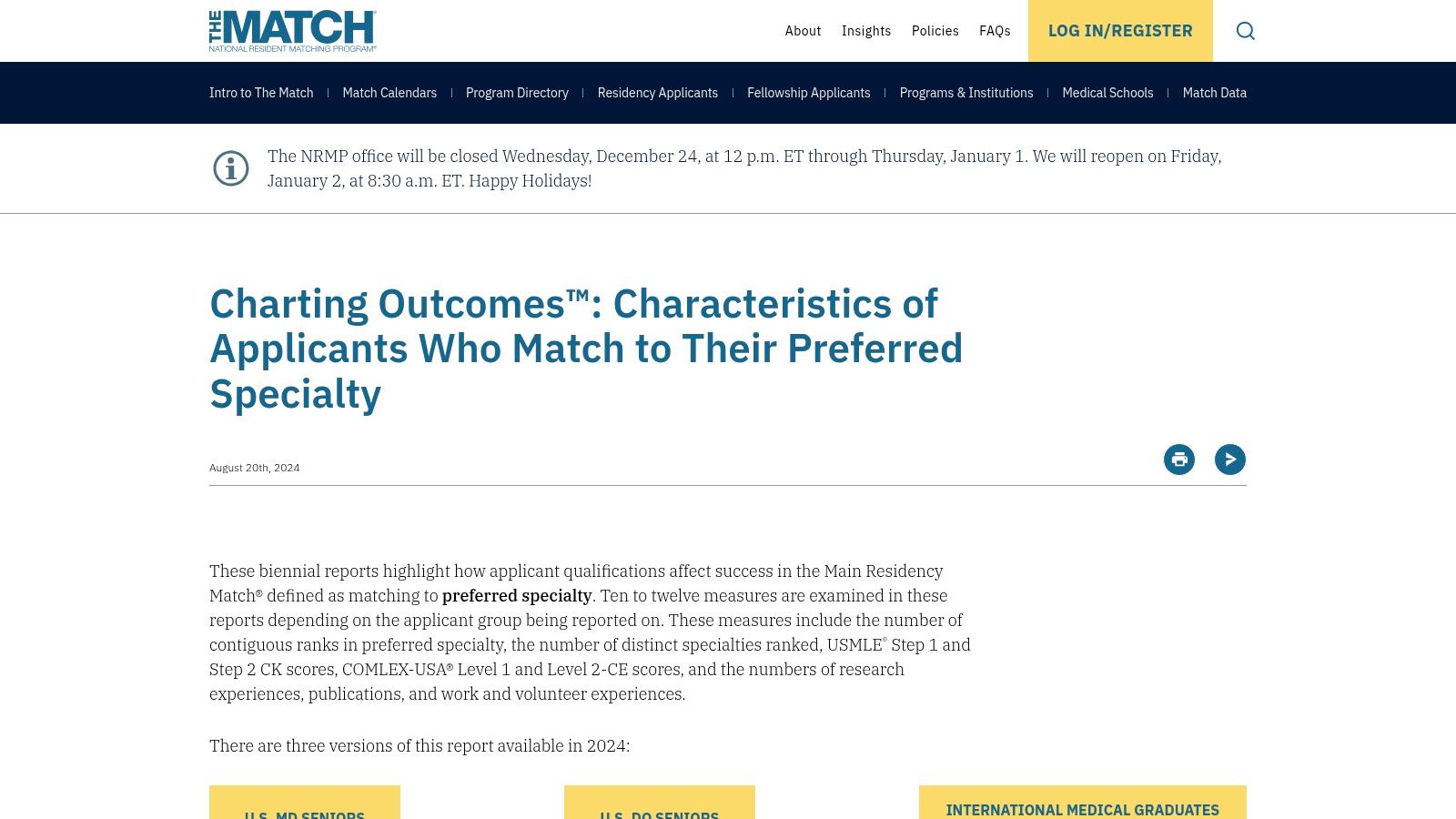
While not a program directory, the National Resident Matching Program (NRMP)’s Charting Outcomes in the Match is an essential data source for any student serious about matching into a top internal medicine residency. It provides an unvarnished, data-driven look at the characteristics of applicants who successfully matched into their preferred specialty, including Internal Medicine. This is where you calibrate your expectations and build a realistic application strategy.
The report’s power lies in its authority; the data comes directly from the Match itself. It helps answer the critical question, "How does my profile compare to applicants who successfully matched?" by providing concrete benchmarks for scores, research, and other key metrics.
Key Features and How to Use Them
NRMP’s Charting Outcomes is not a search tool but a strategic guide. It’s best used to understand the competitive landscape and assess your own candidacy with objective data, available in both interactive dashboards and comprehensive PDF reports.
- Applicant Characteristic Data: The report provides detailed statistics on matched applicants, including mean USMLE Step 1 and Step 2 CK scores, the number of research experiences, publications, and volunteer experiences. You can see clear data points for U.S. MD seniors, U.S. DO seniors, and International Medical Graduates (IMGs).
- Contiguous Ranks: See how far down their rank order list applicants had to go to match. This data illustrates the importance of interviewing at a sufficient number of programs to secure a good position on your final list.
- Specialty-Specific Reports: Filter the data specifically for Internal Medicine (Categorical) to see the exact profile of a successful applicant in your desired field. This allows you to set tangible goals for your application.
- Breakdowns by Applicant Type: The data is segmented by applicant type, which is crucial for DO students and IMGs. It provides a clear picture of what it takes for each cohort to be competitive, helping you tailor your application strategy accordingly.
Actionable Tips for Applicants
Use Charting Outcomes to ground your application strategy in reality, ensuring your school list and personal goals are aligned with historical match data.
Benchmark Your Profile:
Before you even start your application, compare your stats (exam scores, research output) to the mean and quartiles for matched applicants in Internal Medicine. If your scores are below the mean, you know you need to compensate with other strong elements, such as compelling letters of recommendation. You can get more insights from our comprehensive guide to residency letters of recommendation.
Expert Insight: Pay close attention to the tables showing the "Number of Contiguous Ranks." This data reveals how many programs applicants typically ranked to match. Use this to determine a target number of interviews to secure, which will inform how many programs you should apply to.
Set Realistic Application Targets:
Use the data to create a balanced program list. If your profile aligns with the 75th percentile of matched applicants, you can confidently apply to more competitive programs. If your profile is closer to the 25th percentile, you should build a broader list that includes more "safe" or community-based programs to maximize your chances.
Access and Final Verdict
| Feature | Details |
|---|---|
| Pricing | Free to access. |
| Access | The reports (PDF and interactive) are publicly available on the NRMP website. |
| Unique Strength | Authoritative, macro-level data direct from the source, providing objective benchmarks for applicant success. |
The NRMP's Charting Outcomes is a non-negotiable resource for data-driven applicants. It doesn't tell you which specific programs are the top internal medicine residencies, but it tells you exactly what it takes to match into the specialty. By using this data to assess your competitiveness and set strategic application goals, you can build a smarter, more effective approach to the Match.
6. ABIM – Residency Program Pass Rates
While reputation and research output are valuable, the American Board of Internal Medicine (ABIM) Pass Rate report offers a crucial, objective metric for evaluating the top internal medicine residencies. This annual report provides the three-year rolling average board pass rate for every accredited internal medicine program in the country, serving as a direct measure of how well a program prepares its residents for certification.
Using this data allows you to look past subjective opinions and see a tangible educational outcome. A consistently high pass rate is often a strong indicator of a robust curriculum, dedicated faculty, and a supportive learning environment that prioritizes board preparation alongside clinical training.
Key Features and How to Use Them
The ABIM website provides this data in a straightforward, no-frills report, typically a PDF or spreadsheet. It’s not an interactive search tool but a data source you must analyze yourself.
- Three-Year Rolling Pass Rates: The report shows a three-year aggregate pass rate for first-time takers. This smoothed average prevents one atypical year from skewing a program's data, offering a more stable and reliable picture of its performance over time.
- Program-by-Program Data: You can search the document (using Ctrl+F or Cmd+F) for specific programs on your list to quickly compare their board pass rates against one another and the national average.
- National Averages: The report includes national pass rate statistics. This provides essential context, allowing you to determine if a program's performance is average, below average, or truly exceptional.
Actionable Tips for Applicants
The ABIM data is most powerful when used as a validation tool for the programs you've already identified through platforms like Doximity and FREIDA.
Use Pass Rates as a Quality Filter:
Once you have your initial list of programs, cross-reference it with the ABIM report. A program with a pass rate consistently at or below the national average might be a red flag. Conversely, programs with rates in the high 90s or at 100% demonstrate a proven track record of educational excellence.
Expert Insight: Remember that board pass rates reflect both the quality of the training and the caliber of the residents the program attracts. A very high pass rate suggests a program excels at both teaching and resident selection, making it a competitive and desirable environment.
Incorporate Data into Your Interview Questions:
If a program you’re interested in has a slightly lower-than-expected pass rate, don’t automatically disqualify it. Instead, use it as an opportunity to ask insightful questions during your interview. You could ask, "I noticed the program's board pass rate has fluctuated in recent years. Could you share any new initiatives or curriculum changes the program has implemented to support resident board preparation?" This shows you've done your homework and are genuinely interested in the program's educational structure.
Access and Final Verdict
| Feature | Details |
|---|---|
| Pricing | Free to access. |
| Access | The report is publicly available on the ABIM website, typically found in the "Data and Reports" section. |
| Unique Strength | Provides the most objective, standardized, and outcomes-based metric for comparing the educational quality of IM programs. |
The ABIM Pass Rate report is an essential, data-driven resource for any serious applicant. While it lacks the user-friendly interface of other platforms, its objective data provides a critical counterbalance to subjective rankings. By integrating this information into your evaluation process, you can gain a more complete and accurate understanding of which programs truly excel at their core mission: training competent, board-certified internists.
Website: https://www.abim.org/about/data-and-reports/
7. Match A Resident
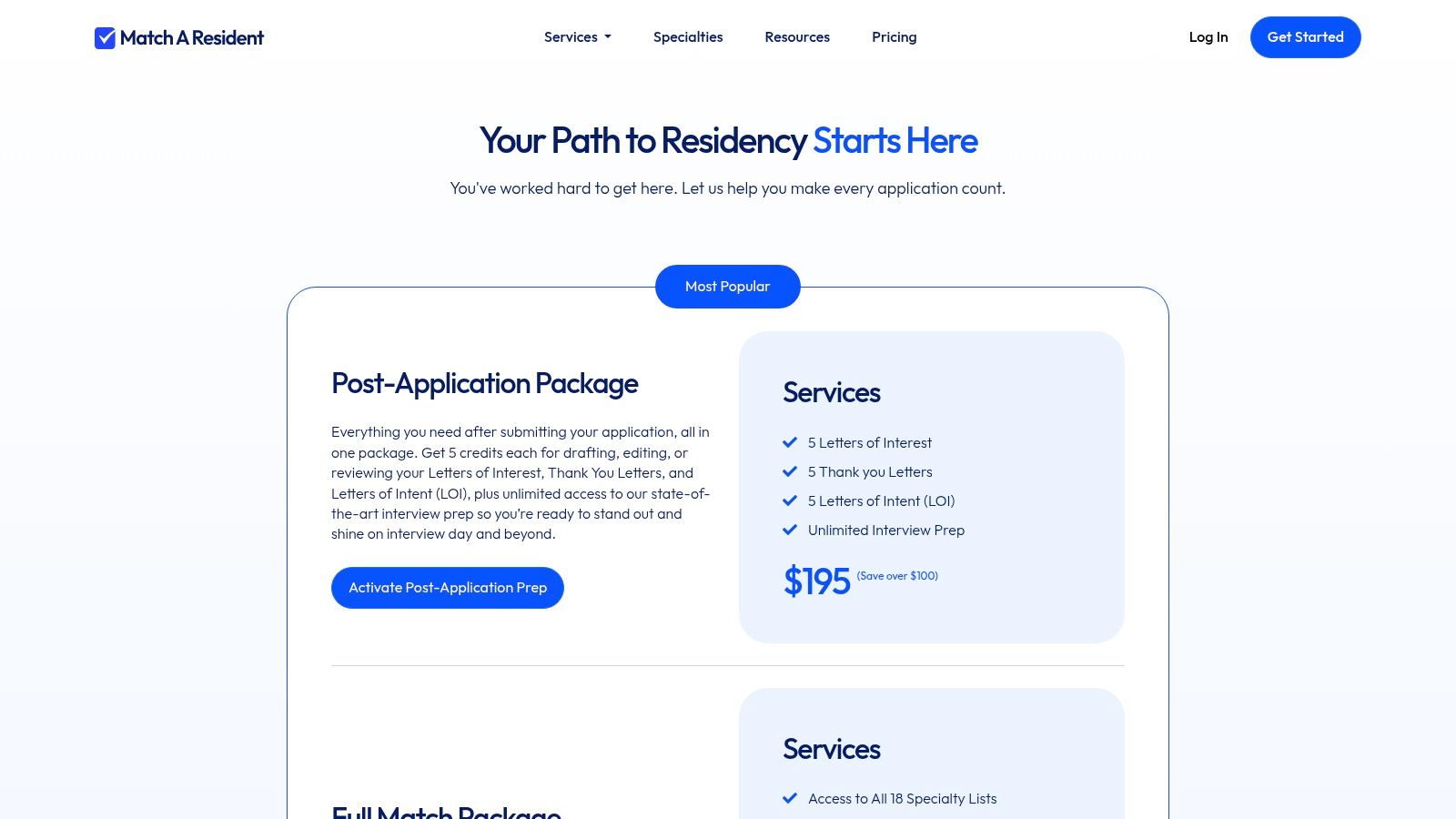
For applicants seeking a more targeted and data-driven approach, especially International Medical Graduates (IMGs), Match A Resident offers a specialized service to identify realistic program targets. Unlike broader databases, this platform focuses on providing curated lists and filters that help you understand which top internal medicine residencies are most likely to consider your specific profile.
Its core value lies in saving applicants time and resources by cutting through the noise. The platform analyzes historical match data to provide insights into program-specific preferences, such as visa sponsorship history and openness to IMG applicants, which are often difficult to find on official platforms.
Key Features and How to Use Them
Match A Resident is designed to move you from a massive list of potential programs to a smaller, more viable list of programs where you have a higher probability of receiving an interview.
- Customized Program Lists: The service generates a list of internal medicine programs tailored to your credentials, including USMLE/COMLEX scores, graduation year, and visa requirements. This immediately helps you focus your application efforts.
- IMG-Specific Filters: This is the platform's standout feature. You can filter programs based on their history of sponsoring J-1 and H-1B visas, the percentage of IMGs currently in the program, and whether they have interviewed or matched applicants with similar profiles in the past.
- SOAP and Contingency Planning: For applicants who may need to participate in the Supplemental Offer and Acceptance Program (SOAP), Match A Resident provides specific lists and tools to prepare for this high-stress period, offering a crucial safety net.
- Application Services: Beyond program lists, the platform offers add-on services like personal statement review, ERAS editing, and interview preparation to strengthen your overall application.
Actionable Tips for Applicants
To maximize the value of this paid service, integrate its data with information from official sources like FREIDA and Residency Explorer.
Create a Tiered Application Strategy:
Use the customized list to build a tiered application strategy: "safety" programs where you strongly match their historical profile, "target" programs where you are a competitive applicant, and a few "reach" programs. This data-driven approach helps you allocate your application budget effectively.
Expert Insight: The "IMG-friendliness" data is powerful but historical. Programs can and do change their criteria year to year. Use Match A Resident's data as a strong directional guide, not an absolute guarantee. Always verify core requirements on the program's official website.
Focus on "Previously Interviewed" Data:
Pay close attention to programs that have previously interviewed candidates with a profile similar to yours. This is often a more potent indicator of your chances than just looking at the number of IMGs in a program.
Access and Final Verdict
| Feature | Details |
|---|---|
| Pricing | Paid service with packages based on specialty and level of access. Prices are transparent on their website. |
| Access | Requires purchase of a specialty-specific package (e.g., Internal Medicine) for full list and filter access. |
| Unique Strength | Highly specific, actionable filters for IMG applicants, including visa sponsorship and interview history data. |
Match A Resident is a strategic investment for applicants, particularly IMGs, who need to optimize their application strategy. While it should be used to supplement, not replace, official resources, its unique data filters provide a significant competitive advantage in identifying the most receptive top internal medicine residencies for your profile. It transforms the overwhelming task of program selection into a manageable, data-informed process.
Website: https://matcharesident.com/pricing
Top 7 Internal Medicine Residency Resources — Quick Comparison
| Tool | Implementation Complexity 🔄 | Resource Requirements ⚡ | Expected Outcomes 📊 | Ideal Use Cases 💡 | Key Advantages ⭐ |
|---|---|---|---|---|---|
| Doximity Residency Navigator | Low 🔄 — web UI, optional sign-in | Low ⚡ — free tier, account for extras | Good 📊 — quick shortlist by reputation & research (triangulate) | Shortlisting name-brand or research-heavy IM programs | Large physician network & fast visual scanning ⭐ |
| AMA FREIDA (Residency & Fellowship Database) | Low 🔄 — standardized directory | Low–Medium ⚡ — free search; some tools need AMA membership | Reliable 📊 — authoritative program details and contacts | Verifying accreditation, contacts, and program basics | ACGME-linked, standardized program profiles ⭐ |
| Residency Explorer | Medium 🔄 — AAMC login; desktop recommended | Medium ⚡ — AAMC account required | Strong 📊 — objective fit metrics, interview-invite rates | Refining reach/target/safety lists based on competitiveness | Source-verified comparative data from multiple agencies ⭐ |
| ERAS (MyERAS) | Medium–High 🔄 — token access; process-driven workflow | High ⚡ — application fees scale with number applied | Definitive 📊 — submit/manage applications, fees, signaling | Applying to programs, managing timelines and payments | Official application portal; integrated with AAMC tools ⭐ |
| NRMP – Charting Outcomes in the Match | Low 🔄 — report-based (interactive/PDF) | Low ⚡ — publicly available reports | Informative 📊 — benchmarks for scores, interviews, ranks | Calibrating competitiveness and setting targets | Authoritative match outcome benchmarks ⭐ |
| ABIM – Residency Program Pass Rates | Low 🔄 — annual report format | Low ⚡ — public data | Objective 📊 — three-year rolling board pass-rate metric | Evaluating program training outcomes and education quality | Standardized, outcomes-based indicator of program strength ⭐ |
| Match A Resident | Low–Medium 🔄 — paid platform with services | Medium–High ⚡ — subscription/paid add-ons | Practical 📊 — focused lists (IMG-friendly), prep services | IMG applicants or those needing rapid filters and contingency tools | IMG/visa filters and hands-on application support (paid) ⭐ |
Integrate Your Insights and Ace Your Application
Navigating the path to securing a position at one of the top internal medicine residencies can feel like piecing together an intricate puzzle. You've just explored a comprehensive toolkit, moving beyond simple rankings to a more nuanced, data-driven approach. The true power lies not in using any single tool in isolation, but in synthesizing their unique strengths to build a complete picture of your ideal residency program and your own candidacy.
Think of it as a strategic intelligence mission. Doximity's Residency Navigator is your high-level reconnaissance tool, perfect for initial discovery and gauging alumni sentiment. But you can't stop there. You must ground those subjective insights with hard data.
Building a Data-Driven Application Strategy
Your next step is to cross-reference your initial list with the objective metrics found in tools like the AAMC's Residency Explorer and the ABIM's board pass rate reports. This is where you transform a "gut feeling" about a program into a calculated assessment. A program might have a prestigious name, but what are its three-year rolling board pass rates? Do the resident profiles in Residency Explorer align with your own academic and research background?
This crucial step helps you avoid the common pitfall of applying to programs based solely on reputation. A well-rounded application list includes a strategic mix of "reach," "target," and "safety" programs, all of which are defined by data, not just brand recognition.
Key Takeaway: Synthesize subjective reputation (Doximity) with objective performance indicators (ABIM pass rates, Residency Explorer data) to create a list of programs where you are both a good fit and a competitive applicant.
Grounding Your Expectations in Reality
Once you have a refined list, it’s time for a reality check. This is where the NRMP’s "Charting Outcomes in the Match" becomes your most valuable asset. This report is the definitive source for understanding what it actually takes to match. It provides a sobering, statistical look at the USMLE scores, research experiences, and other qualifications of applicants who successfully matched into internal medicine.
Use this data to honestly evaluate your own profile. Where do you stand relative to past successful applicants? Identifying potential gaps early allows you to address them proactively, whether through additional research, a strong personal statement that contextualizes your experiences, or targeted interview preparation. For IMGs and osteopathic students, specialized tools like Match A Resident can offer even more tailored data to refine this process further.
Finally, AMA FREIDA and the ERAS portal are your operational hubs. FREIDA ensures you have the most accurate, program-verified logistical details, while ERAS is the vehicle through which you will present your meticulously crafted application.
Your Actionable Next Steps
Your journey from here is about integration and execution. Don’t let this wealth of information overwhelm you; instead, use it to build a clear, step-by-step plan.
- Consolidate Your Research: Create a master spreadsheet. List your programs of interest and create columns for data points from each tool: Doximity rank, board pass rate, average Step scores from NRMP, research output, and unique program highlights from FREIDA.
- Categorize Your List: Based on your consolidated data and self-assessment, sort your programs into "reach," "target," and "likely" categories. A balanced list is a successful list.
- Tailor Your Application Materials: Use the specific program details you've gathered to customize your personal statement and ERAS experiences section for your top-choice programs. Show them you’ve done your homework.
- Prepare for Interviews: Revisit your research. When you get an interview invitation, you'll already have a deep understanding of the program's strengths and culture, allowing you to ask insightful questions and articulate why you are an excellent fit.
Successfully matching at a top internal medicine residency is the culmination of years of hard work, but it also requires a smart, strategic approach. By leveraging this toolkit, you move from being a passive applicant to an empowered, informed candidate who is in control of their future.
Crafting a standout application that effectively communicates your strengths is the final, critical piece of the puzzle. The expert advisors at Ace Med Boards specialize in helping applicants polish their personal statements, CVs, and interview skills to stand out in a competitive field. Let us help you translate your hard work into a successful match at one of the top internal medicine residencies. Explore our residency advising services today.