The total MCAT test time clocks in at a whopping 7 hours and 33 minutes, from the moment you check in to the final click. This isn't just an exam; it's a marathon designed to test your mental endurance just as much as your scientific knowledge. The day is a carefully orchestrated sequence of scored sections, administrative tasks, tutorials, and—most importantly—breaks.
Your MCAT Test Day Schedule at a Glance
Getting a handle on the full scope of your test day is the first step to building a rock-solid pacing strategy. Too many students fixate on the 6 hours and 15 minutes of actual testing time, completely overlooking the bigger picture. That extended "seated time" is a deliberate part of the challenge, built to see if you can maintain high-level critical thinking under prolonged pressure.
To really conquer the MCAT, you have to prepare for the entire day, not just the questions. This means having a game plan for your breaks, knowing what you'll eat, and figuring out how to manage your energy from the second you walk into the test center until you finally submit that last section.
Breaking Down the Full 7.5 Hours
Every single minute of your test day is mapped out. The schedule is tight and standardized, ensuring every test-taker has the same experience, from the initial check-in to the final survey.
This timeline gives you a simple, visual flow of how the day unfolds.
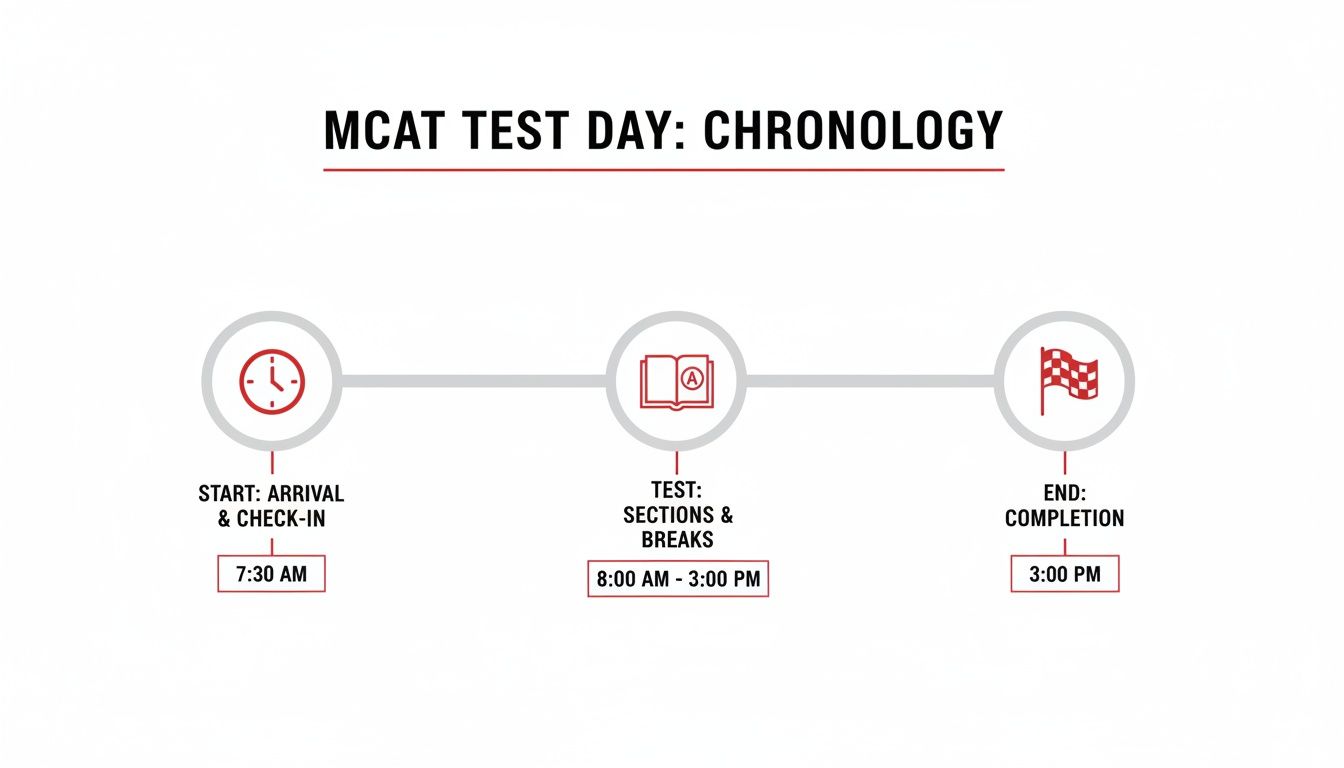
As you can see, the day involves a lot more than just the four core exam sections. There's a significant amount of time dedicated to breaks and administrative steps. For a more detailed look, the table below breaks down each event and its specific duration, helping you see exactly where every minute goes.
Complete MCAT Test Day Schedule Breakdown
This table provides a minute-by-minute breakdown of the entire MCAT test day, from check-in and tutorials to each section and break, totaling 7 hours and 33 minutes.
| Event | Duration (minutes) |
|---|---|
| Check-in Process | 30 |
| Examinee Agreement & Tutorial | 13 |
| Chem/Phys Section | 95 |
| Optional Break | 10 |
| CARS Section | 90 |
| Optional Lunch Break | 30 |
| Bio/Biochem Section | 95 |
| Optional Break | 10 |
| Psych/Soc Section | 95 |
| Void Question & Survey | 5 |
| Total Test Day Time | 453 (7 hours, 33 minutes) |
This detailed schedule is essential for planning your nutrition, hydration, and mental reset strategies. Knowing the exact timing allows you to prepare properly, ensuring you can maintain peak performance throughout this demanding exam.
Taking Apart the MCAT, Section by Section

Knowing the total test time is just the first step. To really nail your pacing, you have to get granular and look at each of the four sections individually. Each one is its own beast, demanding a different set of skills and a unique mental approach.
Think of the MCAT as a triathlon. Some legs are about raw scientific power, while another is a grueling marathon of critical reading. Understanding the specific timing, question count, and feel of each section is the key to building a winning strategy.
Chemical and Physical Foundations of Biological Systems (Chem/Phys)
This is the opening act. The Chem/Phys section is designed to test your command of the fundamental sciences, throwing 59 questions at you in 95 minutes. It’s a dense mix of general chemistry, organic chemistry, physics, and a dash of biology, all wrapped up in complex, passage-based problems.
The real challenge here is juggling intricate calculations with high-level conceptual reasoning, all while the clock is ticking down. You need to be able to pull formulas from memory and apply them to biological scenarios on the fly.
Critical Analysis and Reasoning Skills (CARS)
Often seen as the great equalizer—or the great terrorizer—of the MCAT, CARS is a pure test of your analytical and reading comprehension skills. It's different from the science sections, giving you 90 minutes to tackle 53 questions.
Here, you’ll work through dense passages pulled from the humanities and social sciences. The questions aren’t about what you know, but how you think. It's all about your ability to dissect arguments, infer meaning, and understand tone from the text provided. The slightly tighter time-per-question ratio means you need a rock-solid, efficient reading strategy. A great way to build this skill is by consistently working with high-quality MCAT CARS practice passages.
Don’t make the classic mistake of treating CARS like another science section. Success isn’t about recalling facts; it’s about your reasoning process. Your pacing has to leave enough room for deep, focused reading before you even touch the questions.
Biological and Biochemical Foundations of Living Systems (Bio/Biochem)
After you've refueled during the lunch break, you'll dive into the Bio/Biochem section. Structurally, it’s a mirror image of the first section, giving you 95 minutes to answer 59 questions.
This section goes deep on biology, biochemistry, and organic chemistry, all through the lens of living systems. You'll be parsing a lot of experimental data presented in passages, forcing you to analyze results and draw logical conclusions just like a researcher would.
Psychological, Social, and Biological Foundations of Behavior (Psych/Soc)
Welcome to the final leg of the marathon. The Psych/Soc section rounds out the day with another 95-minute, 59-question block. This part of the test covers your knowledge of introductory psychology, sociology, and the biological underpinnings of behavior.
While the content itself can feel more straightforward than, say, physics calculations, the real opponent here is mental fatigue. You've been in that chair for hours. Staying sharp, focused, and able to accurately recall key theories and terminology is the final hurdle to clear.
To help you visualize how these numbers translate into a pacing strategy, let's break it down in a table.
MCAT Section Timing and Pacing Goals
This table gives you a clear look at each section's timing and what it boils down to on a per-question basis.
| MCAT Section | Duration (minutes) | Number of Questions | Average Time Per Question |
|---|---|---|---|
| Chem/Phys | 95 | 59 | ~1 minute, 36 seconds |
| CARS | 90 | 53 | ~1 minute, 42 seconds |
| Bio/Biochem | 95 | 59 | ~1 minute, 36 seconds |
| Psych/Soc | 95 | 59 | ~1 minute, 36 seconds |
Remember, these are just averages. Some questions will take you 30 seconds, while others might demand a full three minutes. The goal is to internalize these timings so you develop an instinct for when you're on track and when you need to pick up the pace.
Mastering Your Breaks and Test Day Logistics

Crushing the MCAT test time isn't just about what you do during the scored sections. The moments in between—your arrival, the check-in process, and especially your breaks—are just as crucial to your overall performance.
Ignoring these logistics is a classic rookie mistake. It's like a marathon runner forgetting to plan their water stops; you might start strong, but you'll hit a wall when it matters most.
Your test day actually begins the moment you leave your house. Plan to show up at the testing center at least 30 minutes before your scheduled start. This gives you a nice, comfortable buffer to find parking, get your bearings, and handle the check-in without that frantic, rushed feeling. Showing up too early might leave you waiting outside, but arriving late is a gamble that could cost you your test slot.
The Check-In and Security Process
Be prepared: the check-in process is thorough. It’s designed for maximum security, so it’s not a quick wave-through. You’ll need to show an unexpired, government-issued photo ID. The test center staff will take your picture, get a digital signature, and run a security scan.
Every personal item—your phone, wallet, watch, and all study materials—must be stored away in an assigned locker. The only things you're allowed to bring into the testing room itself are your ID and your eyeglasses. The center provides you with a noteboard booklet and a marker for scratch work. Knowing this process inside and out prevents any last-minute surprises or stress.
Why You Should Never Skip a Break
The MCAT gives you three breaks: two 10-minute breaks and one 30-minute lunch break. They’re technically "optional," but here's some expert advice: treat them as mandatory. Skipping a break to "save time" is one of the single worst decisions you can make on test day.
Your brain is a muscle, and this exam is its Olympics. These breaks are your recovery periods. Use the full time to get away from the screen, stretch your legs, refuel, and mentally reset. It's absolutely essential for maintaining the razor-sharp focus you need for over six hours of brutal critical thinking.
During your breaks, you can go to your locker to grab food and water. Just remember, you can't access your phone or any study notes. Use the time to truly disconnect.
Packing Your Break-Time Essentials
You’re going to be burning through a shocking amount of mental energy, so packing the right fuel is key. Think of your snacks as a strategic part of your test-day toolkit.
- Sustained Energy: Go for complex carbs. A turkey sandwich on whole-wheat bread or a granola bar will give you lasting energy, not a quick spike and crash.
- Quick Boost: A piece of fruit or even a few pieces of candy can provide a fast glucose hit to fight off that mid-afternoon brain fog.
- Hydration is Key: Water, water, water. Steer clear of sugary sodas or energy drinks that will inevitably lead to a crash later.
- Keep It Light: Pack food that’s easy to eat and digest. A heavy, greasy meal is the fastest way to feel sluggish and sleepy right when you need to be sharpest.
By meticulously planning your arrival, knowing the check-in rules, and using every second of your breaks wisely, you set yourself up to conquer the entire MCAT test time, not just the questions on the screen.
How to Build a Winning Pacing Strategy

Knowing the section breakdowns is one thing; performing under the pressure of a ticking clock is another beast entirely. This is where top scorers really separate themselves from the pack. The goal isn't just to know the science but to develop a pacing strategy so ingrained it becomes second nature, freeing up your mental energy to focus on the questions, not the seconds.
Think of yourself as a quarterback in a two-minute drill. You know the total time on the clock, but a good QB also has a plan for every down and distance—a quick pass, a long shot, or even a scramble. A rigid, one-size-fits-all pacing plan won’t work on the MCAT. You need a flexible system that adapts to the flow of the exam.
The Power of Internal Checkpoints
Relying only on the final countdown is a classic mistake that leads to panic. Instead of waiting until the last 10 minutes to realize you're behind, you need to create internal checkpoints to monitor your progress along the way.
This simple technique stops you from getting blindsided by the clock. For a typical 95-minute, 59-question section, your checkpoints could look something like this:
- 30 minutes in: You should have answered around 20 questions.
- 60 minutes in: You should be finishing up question 40.
- 90 minutes in: All 59 questions should be answered, giving you a crucial 5 minutes for final review.
These aren’t absolute rules, but guideposts. If you’re consistently behind at that first 30-minute mark, you know it's time to pick up the pace for the rest of the section.
Implementing the Triage Method
One of the biggest time-sinks on the MCAT is getting stuck on a single, brutally difficult question. It feels like quicksand, pulling you down and stealing time from other, easier points. This is exactly where the triage method saves you.
Just like a doctor in an emergency room, you have to assess, prioritize, and act fast. Here’s how it works:
- Easy Questions (Green Light): You see it, you know it, you answer it. These are your quick wins. Bank these points immediately.
- Challenging but Doable (Yellow Light): You're pretty sure you know how to solve it, but it’s going to take a few minutes. Make your best educated guess, flag it for review, and move on.
- Extremely Difficult (Red Light): This question leaves you completely stumped. Don't let your ego get in the way. Make your best guess, flag it, and immediately get out of there.
This strategy ensures you bank points for every single question you definitely know how to answer before you spend valuable MCAT test time on the ones you might get wrong anyway. The goal is to maximize your score, not to be a hero on one impossible problem.
Balancing Speed and Accuracy
Pacing is a delicate dance. Go too fast, and you'll make careless mistakes. Go too slow, and you'll leave points on the table by not finishing. Finding that perfect rhythm only comes with one thing: practice.
This is why working through the 12 best MCAT practice tests under strictly timed, test-day conditions is completely non-negotiable. Full-length simulations are the only way to build the mental stamina and pacing instincts you need.
Each practice test is a chance to refine your checkpoints and master the triage method until it’s automatic. You'll learn to trust your gut—knowing when to push through a tough problem and when to cut your losses and move on.
When to Schedule Your MC-AT Exam
Figuring out your MCAT test time is about more than just the seven-and-a-half-hour ordeal on exam day. The real strategy involves zooming out and looking at the entire calendar year. Picking the right date can give you a massive advantage for your medical school application, shaping your study schedule and, frankly, your sanity.
Deciding when to take the plunge is deeply personal, and every option has its own set of pros and cons. When you choose to test dictates the entire rhythm and intensity of your preparation.
Common MC-AT Scheduling Timelines
Picking an exam date isn't just about finding a free Saturday; it's about strategically aligning months of intense preparation with your life's other demands and your application goals.
Here are the three most common paths students take:
During Junior Year: This is the classic route for traditional applicants. Taking the MCAT in the spring of your junior year lets you apply the moment the cycle opens. The major downside? You'll be juggling a full-throttle MCAT prep schedule with an already demanding course load. It's doable, but it’s a grind.
The Summer After Junior Year: This timeline is incredibly popular for good reason. It frees you from classes, letting you treat MCAT prep like a full-time job. The catch is that a late-summer test date might mean you submit your primary application without a score in hand, which can be a nail-biting experience for some.
During a Gap Year: Taking the exam after you've graduated offers the ultimate flexibility. You can work, get more clinical experience, and dedicate focused blocks of time to studying without academic pressure breathing down your neck. This is an increasingly common choice that removes the stress of trying to do everything at once.
My biggest piece of advice? Whatever timeline you choose, schedule your exam early enough to leave room for a potential retake. Ideally, you want your score back with at least two or three months to spare before your final application deadlines. This gives you a realistic window to regroup, re-prepare, and test again if you need to.
Post-Graduation Testing Trends
Don't feel pressured to test before you graduate. Taking the MCAT after finishing your undergrad is a totally normal—and often very smart—choice. It allows for an undivided focus on the exam and often leads to a more mature, effective approach to studying.
The data shows just how many roads lead to medical school. In 2023, 41.8% of test-takers sat for the exam within one year of finishing their degree, and another 32% took it one to two years later.
What's more, 13.5% tested three to four years after graduating, and 12.7% waited five years or more. This proves there's no single "right" timeline. You can dive deeper into these trends on the AAMC website. Our own guide on MCAT test dates can also help you map out the perfect schedule for your unique situation.
Understanding Extended Time Accommodations
For some students, the pressure of a ticking clock can be a major hurdle, preventing them from showing what they truly know. That's where MCAT testing accommodations come in. Extended time isn't about getting a leg up on the competition; it's about leveling the playing field so that every applicant has a fair shot.
If you have a documented disability that affects how you perform on timed exams, you can apply for accommodations directly through the AAMC. Be warned: the process requires detailed documentation from a qualified professional, so you’ll want to get the ball rolling on this far ahead of your planned test date.
How Extended Time Changes Your Test Day
The most common time extensions are time-and-a-half (1.5x) and double time (2x). This extra time is applied to each section of the test, and often, the breaks get extended too. It completely changes the dynamic of test day. A test with 1.5x time can easily stretch to over 10 hours, turning the exam into a true marathon of mental endurance.
This means your pacing strategy has to be completely rebuilt from the ground up. With 1.5x time, for example, a standard 95-minute science section balloons into roughly 143 minutes. While this gives you more room to breathe and think through questions, it also demands a whole new level of focus to stay sharp for that long.
The goal of accommodations is to provide fairness, not to guarantee a higher score. Research actually backs this up. One study found that the medical school acceptance rate for students who used extra time was almost identical to that of standard-time takers, with only a 0.6% difference. You can see the full breakdown in this research on MCAT accommodations and medical school acceptance.
It’s also important to see these accommodations as part of a bigger picture of support. If you think you might qualify, it's a good idea to explore various reasonable adjustments and accommodations for neurodevelopmental conditions. Understanding the full landscape can help you better articulate your needs and navigate the application process more effectively.
Your MCAT Timing Questions, Answered
Even with the best-laid plans, a few lingering questions about MCAT timing always seem to pop up. Let's clear up some of the most common ones so you can walk into test day with total confidence.
What Happens if I Finish a Section Early?
If you race through a section and finish with time to spare, you can use those extra minutes to review your answers—but only within that specific section. You won't be able to jump ahead to the next part of the exam or start your break early.
Think of this extra time as a gift. It's the perfect chance to go back to any questions you flagged, re-read tricky passages, and make sure you didn’t make any simple mistakes under pressure. Use every second you have.
How Long Should I Study for the MCAT?
The AAMC has crunched the numbers, and they report that most high-scoring students put in 300-350 hours of prep time, usually spread out over three to six months.
This isn't just about cramming facts. That extended timeline is critical for building the sheer mental stamina you'll need to survive a nearly 7.5-hour exam. Consistent practice with full-length tests is how you build the pacing and endurance to perform your best.
Are the Breaks on the MCAT Optional?
Technically, yes, the two 10-minute breaks and the 30-minute lunch break are optional. But skipping them is one of the most common—and costly—mistakes a student can make. I strongly advise against it.
Treat the MCAT like a marathon, not a sprint. Using your full break time to get up, stretch, refuel with a snack, and clear your head is a vital strategy. It helps you reset and avoid burnout, ensuring you have the mental energy to tackle the tougher sections later in the day.
At Ace Med Boards, we know that a great MCAT score is the first major milestone in your journey to becoming a physician. Our expert tutors offer one-on-one guidance to help you master the content, timing, and strategy you need to excel. See how we can help by booking a free consultation today at https://acemedboards.com.