When it comes to prepping for Step 1, your question bank is your single most important tool. With the exam now pass/fail, the game isn't about hitting a high score—it's about building a rock-solid foundation of clinical knowledge that will carry you through clerkships and the rest of your career.
Think of your Qbank less as a testing tool and more as your primary engine for learning. Choosing the right one is probably the biggest decision you'll make for your Step 1 prep.

This guide digs deep into the top USMLE Step 1 question banks, going way beyond just listing features. We’re going to dissect what actually makes a Qbank great:
- Question Fidelity: How well do the questions mimic the style, length, and weirdness of the real NBME exam?
- Explanation Depth: Are the explanations just glorified answer keys, or are they mini-lectures that actually build understanding?
- Performance Analytics: Can you use the data to pinpoint your weak spots and fix them, or is it just a bunch of useless charts?
- User Interface: Is the platform smooth and easy to use, or does it add friction to an already grueling study process?
Let's start with a quick look at the major players and what they're known for.
| Qbank Feature | UWorld | Amboss | Kaplan | Lecturio |
|---|---|---|---|---|
| Primary Strength | Exam Simulation | Library Integration | Foundational Learning | Video Integration |
| Question Count | ~3,600+ | ~2,700+ | ~3,300+ | ~2,200+ |
| Best For | Dedicated Study | Pre-clinical & Dedicated | Pre-clinical Years | Course Supplement |
| Unique Feature | "Gold Standard" Explanations | 5-Hammer Difficulty | Direct, Concept-Focused Qs | Bookmatcher with First Aid |
The Qbank market is bigger than ever, with resources like Lecturio and Medbullets now serving over 200,000 students a year. And the data shows that how you use them matters. A recent survey found that 88% of students use at least two Qbanks, and this group has a 96% pass rate—way higher than the 85% for students who stick to just one.
This tells a clear story: layering your resources strategically gives you a huge advantage. Understanding the current USMLE Step 1 pass rate makes it even more obvious that you need a bulletproof study plan. This guide is here to help you build one, starting with the right Qbank.
UWorld: A Deep Dive into the Gold Standard
Talk to any medical student about Step 1 prep, and one name will come up again and again: UWorld. Its reputation as the "gold standard" isn't just clever marketing; it’s a hard-earned consensus built over years of student success stories. But to really get the most out of it, you have to understand why it's so effective. Think of it less as a question bank and more as a complete learning ecosystem.
The real magic is in how closely its questions mirror the actual NBME exam. UWorld’s clinical vignettes are legendary for forcing you to connect basic science concepts to a clinical picture, not just spit back isolated facts. This is the exact mental gymnastics you’ll be doing on test day.
The Power of Exam-Like Questions
UWorld’s question-writing philosophy is all about realism. The stems are often long and packed with extra details, training you to slice through the noise and find what matters under pressure. This is a critical skill for keeping pace during the grueling eight-hour exam.
The answer choices are just as important. They’re crafted around common student mistakes, with tempting distractors that test whether you truly understand a concept or just recognize a buzzword. Getting a question wrong because you fell for a classic distractor is a powerful learning moment that UWorld delivers better than anyone.
Practicing with blocks that feel this real helps strip away exam-day anxiety and builds the mental stamina you need to perform at your best.
Explanations That Actually Teach
While the questions set the stage, the detailed explanations are where the real learning happens. Each one is like a mini-lecture. It doesn't just tell you the right answer; it meticulously breaks down why every other option is wrong. This approach is incredibly effective at closing knowledge gaps.
These explanations are loaded with high-quality medical illustrations, charts, and tables that make complex ideas stick. Seeing a pathological finding is so much more memorable than just reading about it.
A common mistake is treating UWorld like an assessment tool. It’s not. Its real power is as a primary learning resource. You should plan to spend at least twice as long reviewing a block of questions as you did answering them.
Many students find the explanations are so good they can replace textbooks for clarifying tricky topics, offering insights that are far more practical and exam-focused.
Turning Your Data into a Study Strategy
UWorld’s performance analytics are more than just a running score. The platform tracks your performance by subject and system, essentially drawing you a map of your strengths and weaknesses. When you see you’re consistently missing pharmacology questions in the cardiology block, you have a clear, actionable target for your content review.
You can then use these analytics to create custom blocks focused on your weak areas. This data-driven approach means you spend your time patching the specific holes in your knowledge instead of passively re-reading entire chapters. It turns the Qbank from a simple practice test into a personalized study planner.
Timed vs. Tutor Mode and the Second Pass
The debate between timed mode and tutor mode is a classic one. For your first pass, a hybrid approach usually works best. Use tutor mode for subjects you're just learning to get immediate feedback and solidify concepts. As you get closer to your dedicated study period, however, switching to timed, random blocks is essential for building your pacing and endurance.
UWorld is the undisputed leader for Step 1, with over 3,600 high-yield practice questions. User surveys consistently show that 85-90% of students scoring above 250 credit UWorld as their primary resource, often completing it twice. Top performers report that resetting the bank for a second pass can boost retention by up to 40%, helping to lock in concepts and improve pattern recognition. You can find more insights on the best USMLE practice questions here.
A second pass is a proven strategy. This time around, you’re not just learning the material; you're focusing on why you got questions wrong the first time and cementing those high-yield concepts you might have forgotten, ensuring they’re locked in for test day.
Comparing the Top UWorld Alternatives
While UWorld is the gold standard, a multi-Qbank strategy is often what separates a good score from a great one. The other top-tier USMLE Step 1 question banks aren't just UWorld clones; they bring unique strengths to the table that can fill critical gaps in your prep. The key is to think of them as powerful supplements, not replacements.
Let's break down the best UWorld alternatives—Amboss, Kaplan, and Lecturio—to see exactly where they shine and how they can fit into your study plan. Each serves a very different purpose, from building your M1 knowledge base to diving deep into clinical reasoning.
Amboss: The Integrated Knowledge Library
Amboss is much more than just a Qbank; it’s a powerful, interconnected medical library. Its biggest advantage is the seamless link between its 2,700+ questions and an incredibly deep knowledge base. This design turns every single question into a potential learning opportunity, letting you explore related concepts without ever leaving the platform.
When you're reviewing an Amboss question, you can instantly click on any medical term in the explanation to pull up a concise, high-yield summary from the library. This is a massive time-saver, perfect for clarifying concepts on the fly without breaking your study flow to open another book or tab.
Amboss really shines at teaching you how to think like a physician by layering information. Use its "Attending Tip" feature to get clinical pearls that connect basic science to real-world practice—an essential skill for the modern Step 1.
Another killer feature is its difficulty rating. Amboss assigns each question a "hammer" score from one to five, allowing you to tailor practice sessions with precision. Early on, you can stick to one- and two-hammer questions to build confidence. As you progress, you can challenge yourself with the four- and five-hammer questions that test the absolute deepest level of understanding.
Kaplan: Building Your Foundational Strength
Kaplan has been a trusted name in test prep for decades, and its USMLE Step 1 Qbank is designed to build a rock-solid foundation. With over 3,300 questions, its primary strength is reinforcing the concepts you learn during your preclinical coursework. Kaplan’s questions are often more direct and first-order than UWorld's, which makes them perfect for the early stages of learning.
If you just finished your cardiology block, doing Kaplan's cardiology questions is the perfect way to solidify what you just learned in class. The questions are structured to test core principles clearly, making sure you have a firm grasp of the basics before moving on to the complex, multi-step vignettes you'll find elsewhere.
Think of Kaplan as the ideal Qbank for your M1 and early M2 years. Using it alongside your curriculum helps you practice active recall and build the strong conceptual framework you need to crush more challenging resources like UWorld during your dedicated study period.
Lecturio: The Video and First Aid Integrator
Lecturio's unique value comes from its deep integration with multimedia learning tools. It connects its 2,200+ question bank directly to a huge library of expert video lectures and, most importantly, to the pages of First Aid for the USMLE Step 1. This makes it an exceptional tool for visual learners and anyone who uses First Aid as their study bible.
The "Bookmatcher" feature is a game-changer. After you answer a question, Lecturio points you to the exact page in First Aid that covers the topic. This creates an incredibly efficient feedback loop, allowing you to immediately review and annotate your primary text with insights you just gained from practice.
This flowchart shows how to think about using UWorld's different modes, a decision you'll face with any Qbank.
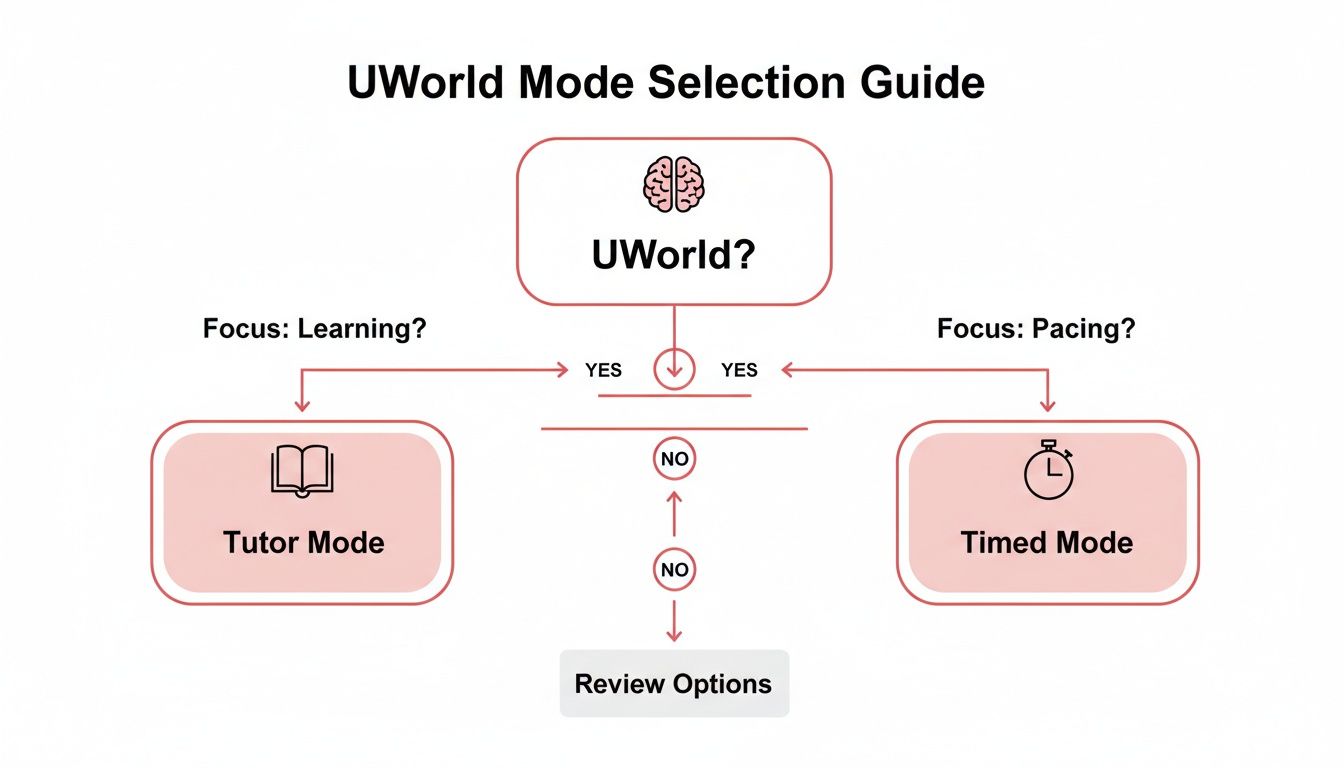
Tutor Mode is best for learning the "why" behind each answer, while Timed Mode is all about building exam-day pacing and stamina.
Plus, if a text explanation isn’t clicking, Lecturio links you to a short, relevant video lecture. This multi-modal approach helps reinforce concepts through different channels, which is proven to improve long-term retention.
USMLE Step 1 Question Bank Feature Comparison
To make the right choice, you need to match a Qbank's strengths to your specific learning needs and current study phase. This table cuts through the noise and lays out where each platform excels.
| Feature | UWorld | Amboss | Kaplan | Lecturio |
|---|---|---|---|---|
| Ideal Use Case | Dedicated study period; final prep and assessment. | Deepening knowledge during dedicated; reinforcing clinical context. | Building foundational knowledge during M1/M2 coursework. | Integrating question practice with video lectures and First Aid. |
| Question Style | Gold standard NBME style; multi-step clinical vignettes. | NBME-like with variable difficulty; often requires deep reasoning. | Direct and concept-focused; tests core principles clearly. | Variable; often designed to highlight concepts from videos. |
| Key Differentiator | The most accurate simulation of the real Step 1 exam. | Fully integrated medical library and tiered difficulty ratings. | Strong focus on preclinical concept reinforcement. | "Bookmatcher" for First Aid and seamless video lecture integration. |
| Best For Students Who | Are in their dedicated study period and need realistic exam practice. | Want to connect basic science to clinical application in one platform. | Need to solidify concepts learned in their medical school curriculum. | Are visual learners and use First Aid as their primary study text. |
Ultimately, the smartest approach is to use these USMLE Step 1 question banks to complement UWorld, not compete with it. Use Kaplan during your systems blocks, leverage Amboss for its incredible library during dedicated prep, and turn to Lecturio when you need to bridge a gap between a practice question and your First Aid notes. By layering these resources intelligently, you create a far more robust and personalized study plan.
How to Integrate Qbanks into Your Study Schedule
Buying a subscription to the best USMLE Step 1 question banks is the easy part. The real work—and what separates top scorers from those who just scrape by—is building a smart strategy that weaves those questions into your daily routine. Your approach needs to evolve as you move from your coursework to your dedicated study period, shifting from a tool for learning to a full-blown exam simulation engine.
Let's break down how to make your Qbank the driving force behind your Step 1 prep, not just an afterthought for self-assessment.

Pre-Dedicated Period: Building Your Foundation
During your M1 and M2 years, your Qbank isn't for simulating the exam; it's a powerful supplement to your classes. The goal here is simple: use active recall to make what you're learning in lecture actually stick.
- Pick the Right Tool for the Job: Start with a Qbank like Kaplan or Amboss. Their questions are often more direct and concept-focused, which is perfect for this stage. You don't need the complex, multi-step vignettes from UWorld just yet.
- Study by Subject: Just finished your cardiology block? Great. Jump into the cardiology questions in your Qbank. Make sure you use tutor mode so you get immediate explanations after every single question.
- Focus on the "Why": Forget about your percentage correct. Forget about speed. The only thing that matters right now is understanding why the right answer is right and, just as critically, why every wrong answer is wrong. This process builds the mental scaffolding you'll rely on for the harder questions down the road.
This consistent, low-stakes practice is what prevents that dreaded pre-dedicated panic and ensures the information is still there when you need it months later.
Dedicated Study Period: The UWorld Workflow
Welcome to the sprint. During your dedicated period, your primary Qbank—which for nearly everyone should be UWorld—is no longer a supplement. It is your study plan. The focus shifts from learning facts in isolation to integrating concepts and mastering the brutal pace of the real exam.
The single biggest mistake I see students make during dedicated is passively re-reading First Aid instead of doing and reviewing questions. You should be tackling 80-120 questions every single day and spending 2-3 times as long reviewing them as you did answering them.
A disciplined, systematic approach is the only way to get the full value out of UWorld. The workflow below turns it from a simple quiz into your most powerful teacher.
A Look at the Daily Grind:
- Build Stamina in the Morning: Kick off your day with two timed, random 40-question blocks back-to-back. This is non-negotiable. It mimics the fatigue and pressure of the actual exam, training your brain to stay sharp deep into the test.
- Review Like a Detective: This is where the real learning happens. Go through each block with a fine-toothed comb. For every single question—even the ones you got right—ask yourself:
- Can I explain the underlying pathophysiology of the correct answer choice from scratch?
- Can I articulate, in my own words, exactly why each distractor is wrong?
- What was the root of my error? A gap in knowledge? Misreading the stem? A failure in reasoning?
- Create Your Study Tools: As you review, you're actively identifying your weak points. Don't just acknowledge them; do something about it. Make Anki cards for concepts you consistently miss. Annotate a diagram in First Aid. Keep a running list of your common reasoning errors. This active creation process cements the knowledge far better than passively reading an explanation.
This daily rhythm of test, review, create means you're constantly finding and fixing your knowledge gaps. To keep your head in the game, it's essential to learn how to improve focus and prevent burnout during intense study, because this period is a marathon.
To make sure you're on the right track, you'll need to mix in full-length practice exams. To see how they fit into the bigger picture, check out our guide on using USMLE practice tests to gauge your progress and fine-tune your approach.
How Tutoring Amplifies Your Qbank Performance
Even with the best USMLE Step 1 question banks, it’s common to hit a wall. You might be grinding through hundreds of questions, diligently reviewing every explanation, yet your scores just aren’t budging. This is a classic plateau, and it's where personalized guidance can turn all that hard work into real, measurable progress.
A Qbank’s algorithm is great at telling you what you got wrong, but it can’t explain the why. Was it a genuine knowledge gap? A subtle misreading of the clinical vignette? Or is there a recurring test-taking habit you don’t even realize you have? An expert tutor acts like a human data analyst, digging into your performance metrics to spot the hidden patterns holding you back.
Beyond the Algorithm: Personalized Analysis
The real magic of tutoring is its power to diagnose the root cause of your mistakes. An algorithm might flag endocrinology as a weak area, but a good tutor can look closer and see that you consistently stumble when interpreting feedback loops or misread lab values specifically in thyroid questions.
This human-centered approach goes way beyond simple topic weaknesses. It identifies specific conceptual blind spots and flawed reasoning patterns. Getting this detailed diagnosis is the critical first step in building an improvement strategy that actually works.
Tutoring isn’t a substitute for your Qbank; it’s a catalyst that maximizes its value. We help you deconstruct complex questions, anticipate common distractor patterns, and build the clinical reasoning skills that algorithms can't teach.
For example, I once worked with a student who was consistently missing cardiology questions in UWorld despite feeling confident in the material. After reviewing their thought process, we discovered they were overlooking key details in the patient's history—a skill that requires guided practice, not just more passive review.
From Diagnosis to Targeted Strategy
Once those weak points are clearly identified, an expert tutor builds a targeted plan of attack. This isn't just about re-reading a chapter; it's about actively rewiring how you approach certain types of problems.
Here’s how this focused intervention looks in practice:
- Deconstructing Vignettes: Tutors teach you a systematic method for breaking down those long, complex question stems. You'll learn to quickly pull out the most relevant clinical data and tune out the noise.
- Recognizing Illness Scripts: You'll get better and faster at recognizing classic disease presentations, connecting the dots between symptoms, lab findings, and pathophysiology.
- Integrating Basic Sciences: A common struggle is applying foundational science concepts to clinical scenarios. A tutor can, for instance, help you connect the biochemistry of the urea cycle to a patient presenting with hyperammonemia in an Amboss question, making that link permanent.
This level of focused training is incredibly efficient. Instead of generic content review, you're working directly on the specific skills that will deliver the biggest score increases. For students looking to break through a performance plateau, a dedicated tutor for USMLE Step 1 can provide the structure and expert feedback needed to get there.
Ultimately, tutoring transforms your Qbank from a simple assessment tool into a dynamic learning instrument, ensuring you’re not just answering questions, but truly mastering the material for exam day.
Step 1 Qbank FAQs: Your Top Questions Answered
Diving into the world of USMLE Step 1 question banks brings up a lot of questions. It's totally normal. Getting straight answers helps you build a study plan that actually works, giving you the confidence you need. Let’s tackle the most common questions medical students have about picking and using Qbanks for Step 1 prep.
We'll cover everything from how many banks to juggle to the best ways to review questions, giving you practical advice to turn all that hard work into exam-day success.
How Many USMLE Step 1 Question Banks Should I Use?
For most students, two is the magic number. The classic, high-yield strategy is to use one Qbank (like Amboss or Kaplan) throughout your preclinical classes. This helps lock in concepts as you learn them, building a solid foundation from the start.
Then, during your dedicated study period, you switch over to your primary Qbank—usually UWorld—for serious exam simulation. This approach ensures you see different question styles and reinforces the same material from multiple angles, a proven way to boost retention.
But let's be real: quality beats quantity every single time. If you're short on time or cash, pour all your energy into mastering just one. A complete, deeply reviewed pass of UWorld is infinitely more valuable than just scratching the surface of several Qbanks.
When Is the Best Time to Start a Question Bank?
The best time to start is way earlier than you think—right in the middle of your preclinical years. Don't wait for dedicated to start practicing active recall. Fire up a Qbank like Kaplan or Amboss and use it alongside your med school curriculum.
For example, the moment you wrap up your renal block, jump straight into the renal questions on tutor mode. This hammers home what you just learned in the classroom and cements it into your long-term memory.
The intense, exam-simulation phase with your main Qbank (again, usually UWorld) should kick off about three to six months before your test date. Your final few weeks should be almost entirely focused on random, timed blocks to nail your pacing and build the mental stamina for the real deal.
The most effective review is an active one. Your goal isn't just to see the right answer but to understand the concept so deeply you could teach it. This means dissecting why every incorrect option is wrong, a process that solidifies your knowledge base.
What Is the Most Effective Way to Review Questions?
How you review matters more than how many questions you do. The secret to turning practice questions into permanent knowledge is a powerful review workflow. You should plan on spending at least twice as long reviewing a block as you spent answering it.
For every single question, you need a system:
- Analyze Every Option: Don't just nod at the right answer. Articulate exactly why it's correct and, just as importantly, why every other distractor is flat-out wrong. This is where the real learning happens.
- Diagnose Your Errors: If you missed a question, figure out precisely why. Was it a pure knowledge gap? Did you misread the clinical vignette? Or was it just a simple reasoning mistake?
- Consolidate What You Learned: Actively move that new knowledge somewhere permanent. Annotate the key takeaway into your copy of First Aid or make a targeted flashcard in Anki for that specific concept.
- Master the Visuals: Pay close attention to every image, lab report, and chart in the explanations. These are high-yield formats that pop up all the time on the actual exam.
Should I Use Timed Mode or Tutor Mode for My First Pass?
This is a classic dilemma, and the truth is, a hybrid approach works best for most students. Tutor mode is fantastic for your initial learning pass. It gives you instant feedback, letting you connect the dots right away before the memory fades.
However, timed mode is non-negotiable for building the stamina and time-management skills you'll need for the eight-hour beast of an exam. Early in your first pass, using tutor mode or a "timed tutor" mode is perfectly fine and very effective.
But as you get closer to your exam, especially in the final four to six weeks, you have to switch exclusively to timed, random 40-question blocks. It's the only way to truly simulate the pressure, pacing, and mental fatigue of the real USMLE Step 1.
At Ace Med Boards, we specialize in helping students turn their Qbank grind into real exam success. Our expert tutors dig into your performance data to find those hidden weaknesses and build a personalized strategy to fix them. Schedule your free consultation today and see how targeted guidance can make all your hard work pay off.