The USMLE Step 1 is the first of three major hurdles you'll clear on your path to becoming a licensed physician in the United States. It's a comprehensive, one-day exam that medical students typically tackle at the end of their second year.
More than just a test, Step 1 is designed to see if you can truly apply foundational science concepts to the actual practice of medicine. Passing this exam shows you've built a solid scientific bedrock for all your future clinical work.
What Every Med Student Needs to Know About Step 1
Think of the United States Medical Licensing Examination (USMLE) Step 1 as your fluency test in the language of medicine. It's not about reciting memorized facts; it’s about proving you can connect the dots between basic science principles—all that biochemistry, pharmacology, and pathology from your first two years—and real-world clinical situations.
This exam is a critical milestone, and it's on the radar for a wide range of future doctors.
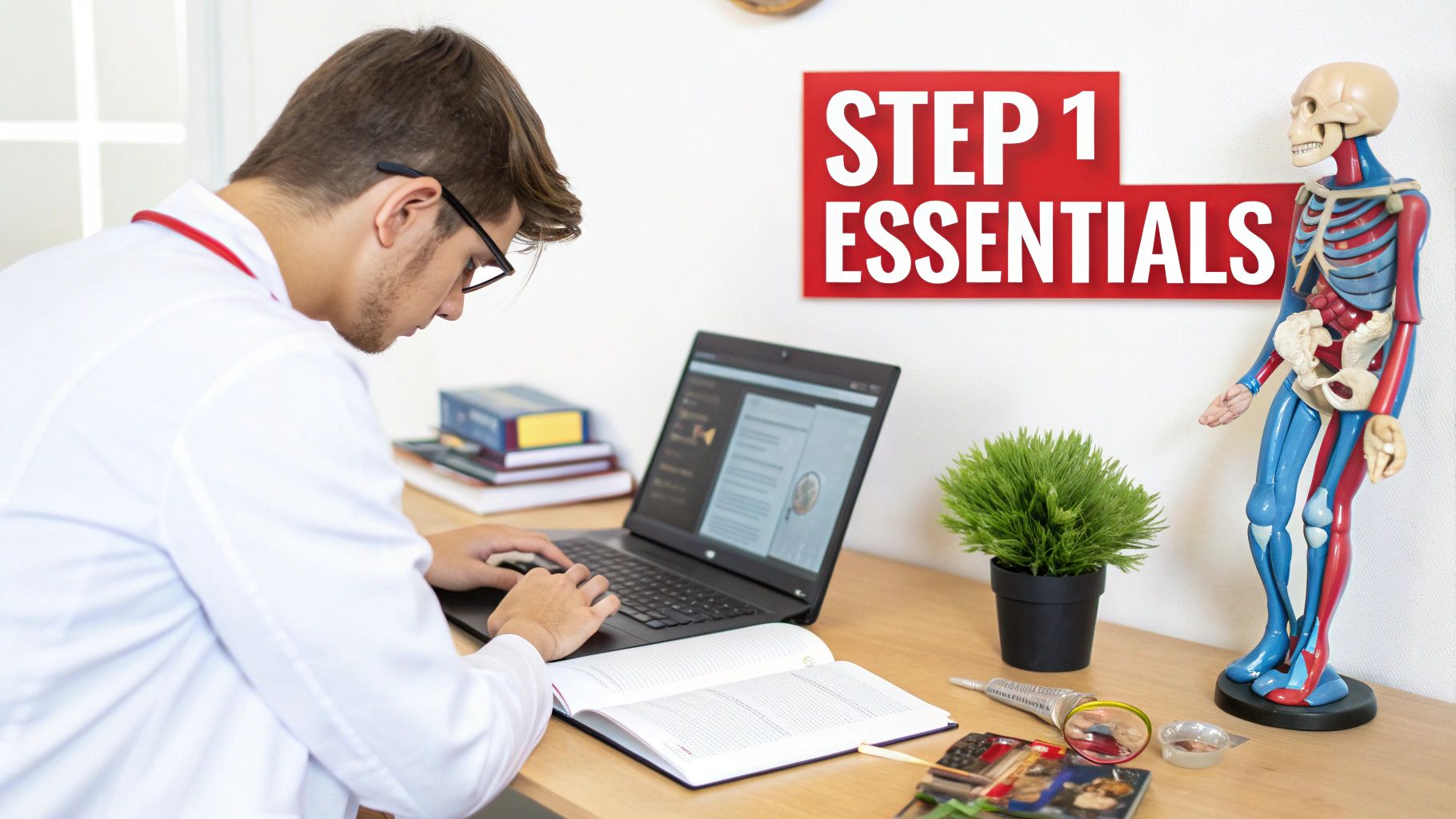
This includes:
- U.S. and Canadian medical students in M.D. programs, who usually sit for the exam right after their preclinical curriculum wraps up.
- Students in D.O. programs who choose to take the USMLE series in addition to their own COMLEX exams.
- International Medical Graduates (IMGs), for whom passing the USMLE exams is a mandatory step to become eligible for residency programs here in the States.
The Exam Day Experience
Get ready for a marathon. The USMLE Step 1 is an eight-hour gauntlet that tests your knowledge and your stamina in equal measure.
To give you a clearer picture, here’s a quick summary of what the day looks like.
USMLE Step 1 Exam at a Glance
| Exam Feature | Detail |
|---|---|
| Total Questions | 280 multiple-choice questions |
| Total Time | 8 hours |
| Exam Structure | 7 blocks of 60 minutes each |
| Questions per Block | Up to 40 questions |
| Pacing | Approximately 90 seconds per question |
| Break Time | 45 minutes total, which you can use between blocks as you see fit |
Mastering your time management is just as vital as knowing the material inside and out. For a deeper dive into the exam's format and how to strategically plan your day, you can explore a complete breakdown of USMLE Step 1.
The exam is designed to be a comprehensive assessment. Since its creation in 1992, over three million Step examinations have been administered globally, a testament to its role as a gatekeeper for the medical profession.
The Monumental Shift to Pass/Fail
Perhaps the biggest shake-up in the exam's long history happened in January 2022. That’s when USMLE Step 1 officially moved from a three-digit numerical score to a simple pass/fail result.
Before this change, the exam was scored on a scale where the national average hovered around 232. That three-digit number was a massive factor in residency applications, creating a high-pressure numbers game for students. With about 130,000 Step examinations given each year, the impact of this scoring system was huge.
This shift was a deliberate move to lower student stress and push residency programs toward a more holistic review of applicants. Now, instead of chasing a specific score, your mission is to demonstrate a competent command of the foundational sciences.
While this certainly eases some of the pressure, it also puts more weight on other parts of your application—things like your clinical grades, research, and your performance on the Step 2 CK exam. Passing is the new benchmark, and it has completely redefined what success on this pivotal exam looks like.
How the Pass/Fail Shift Changes Your Application Strategy
When the USMLE Step 1 went pass/fail on January 26, 2022, it wasn't just a minor tweak—it completely upended the residency application game. This move was a deliberate effort to dial down student burnout and push residency programs to look at applicants as whole people, not just a single three-digit number.
For years, the Step 1 score was the ultimate gatekeeper. Program directors, buried under thousands of applications, used it as a quick and dirty filter. This was especially true in hyper-competitive fields. To give you an idea, surveys showed that a staggering 77% of neurosurgery program directors relied on Step 1 scores to screen candidates right off the bat. The switch to pass/fail was meant to level the playing field, particularly for students from underrepresented backgrounds who were often put at a disadvantage by a system so fixated on one metric. You can dig deeper into the official reasoning in the FSMB's annual report on the USMLE.
The bottom line for you? The goal is no longer about chasing a magic number. It's about proving you have a rock-solid grasp of the foundational sciences. For a closer look at what that means, check out our guide on the USMLE Step 1 passing score.
The New Currency in Residency Applications
Without a Step 1 score to anchor their decisions, program directors are now putting way more weight on the other parts of your application. Your application is no longer defined by one data point; it’s a portfolio that tells the story of who you are as a future doctor.
Here are the pieces that have shot up in importance:
- USMLE Step 2 CK Score: This has effectively become the new objective benchmark. A killer Step 2 CK score is now your best bet for showing off your clinical knowledge and reasoning chops.
- Clinical Clerkship Grades: Your performance during third-year rotations is direct, real-world evidence of your skills. Nailing your clerkships—especially key ones like Internal Medicine or Surgery—speaks volumes.
- Letters of Recommendation (LORs): A powerful, personalized letter from a respected faculty member who knows you well is pure gold. It gives programs a window into your work ethic, clinical instincts, and professionalism that grades alone can't provide.
Crafting a Standout Application Strategy
Your strategy has to shift from acing one test to building a compelling, well-rounded narrative. Just passing isn't enough; you need to show you're excellent across the board.
Here’s how to do it:
- Dominate Your Clerkships: Treat every single rotation like it’s an audition for your future career. Show up early, stay late, ask smart questions, and be an indispensable part of the team. This is how you earn top grades and those glowing LORs.
- Pursue Meaningful Extracurriculars: Dive into research, volunteering, or leadership roles that you're genuinely passionate about. Program directors can spot a resume-padder from a mile away. Real, sustained commitment to a few activities is far more impressive than a laundry list of one-off experiences.
- Prepare for Step 2 CK Early: Don't put Step 2 CK prep on the back burner. Start weaving it into your third year. As you see patients on your rotations, constantly connect their conditions back to the foundational science you learned for Step 1. This makes the knowledge stick and prepares you for the exam long before your dedicated study period begins.
In this new landscape, your entire medical school journey is on display. Program directors are digging for evidence of sustained effort, intellectual curiosity, and the human qualities that make someone a truly great physician.
By pouring your energy into these areas, you can build an application that showcases your strengths far better than a single score ever could. It’s your chance to present yourself as the complete package—a candidate ready to crush residency and beyond. Your story is now your greatest asset.
Mastering the High-Yield Content That Matters Most
Preparing for the USMLE Step 1 can feel like trying to drink from a firehose. You’re facing two years of medical school packed into a single exam, and the sheer volume of information is staggering. The secret to success, however, isn't memorizing every last detail. It's about focusing your energy on the high-yield content that shows up again and again.
Think of it this way: the exam doesn't just ask you to list individual ingredients like pharmacology, pathology, or physiology. Instead, it gives you a clinical "recipe"—an organ system—and asks you how those ingredients work together. A single question won't just test a drug; it will test how that drug affects a diseased organ's function.
This integrated approach is what separates students who pass with confidence from those who struggle. You have to learn to see the connections and apply them in a clinical context.
The Art of Integrated Thinking
True mastery for Step 1 comes from pattern recognition. The exam is built on clinical vignettes that force you to pull information from multiple subjects at once. You’re not just recalling isolated facts; you're thinking like a physician, building a differential diagnosis, and understanding the core mechanisms at play.
Take a classic heart failure question. A single prompt could easily test your understanding of:
- Physiology: How the Frank-Starling mechanism is failing.
- Pathology: The cellular changes leading to cardiac remodeling.
- Pharmacology: The mechanism of action for ACE inhibitors or diuretics.
- Biochemistry: The role of the renin-angiotensin-aldosterone system (RAAS) in fluid retention.
This is the essence of high-yield studying. It’s about connecting the dots between these core subjects within the framework of a single organ system—exactly how the official USMLE content outline is structured.
With the exam now pass/fail, this foundational understanding is more important than ever. A passing score is just the first hurdle; residency programs will be looking at your entire application for signs of deep, integrated knowledge.
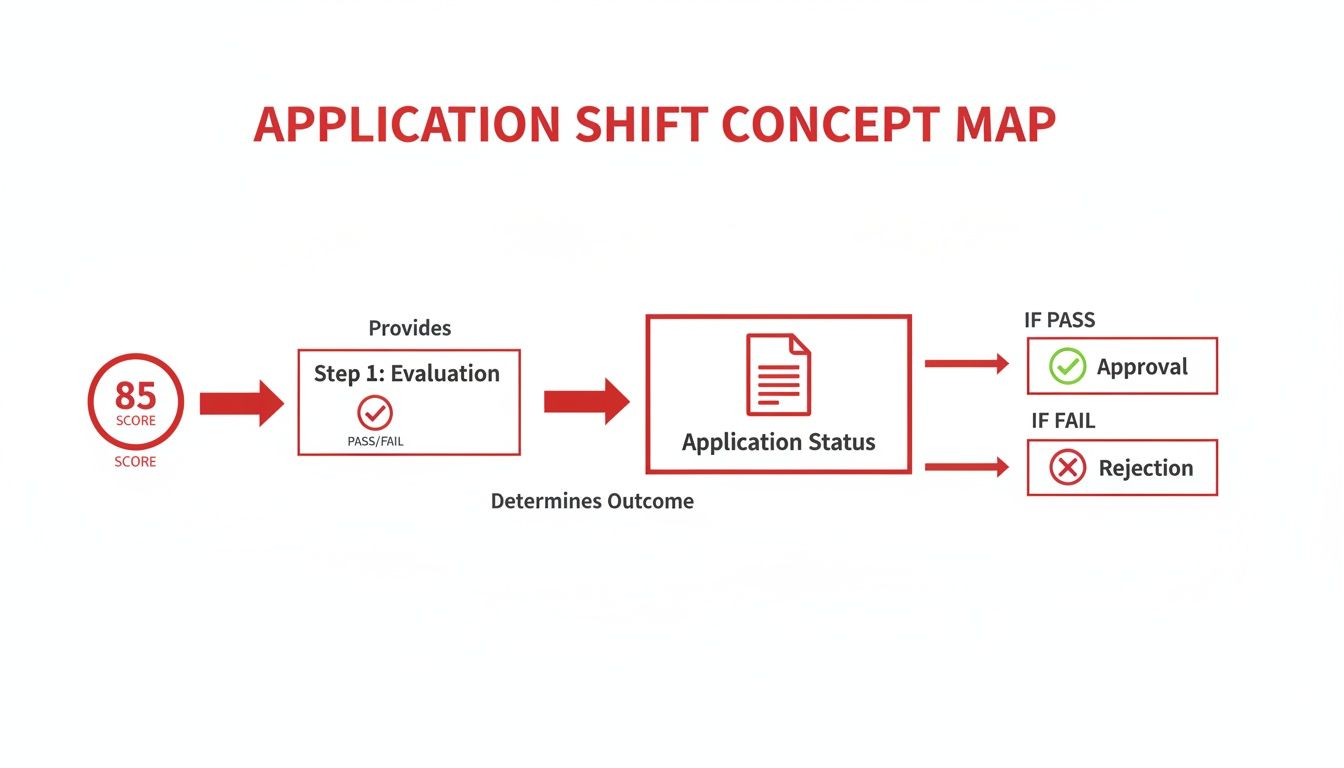
As you can see, passing just gets your foot in the door. Demonstrating true competence across your application is what ultimately matters.
Prioritizing High-Yield Systems and Disciplines
While everything is fair game, some topics are more equal than others. The USMLE provides a content breakdown, and smart students use it to their advantage. Based on the official specifications, general principles make up 13-17% of the exam, and behavioral sciences account for 8-12%. These, along with multisystem processes like immunology and microbiology, are the pillars you need to build your knowledge on.
The goal isn't to just collect facts, but to build a mental framework. When you see a patient presentation, a cascade of related pathology, physiology, and pharmacology should immediately spring to mind.
Below is a table that breaks down how the key scientific disciplines are woven into the major organ systems you'll be tested on. Use this to guide your integrated study approach.
High-Yield USMLE Step 1 Disciplines and Systems Integration
| Organ System | Key Disciplines Integrated | Example High-Yield Concepts |
|---|---|---|
| Cardiovascular | Physiology, Pathology, Pharmacology, Anatomy | Cardiac output regulation, heart failure pathophysiology, antihypertensive drug mechanisms, coronary artery anatomy |
| Pulmonary | Physiology, Pathology, Histology, Microbiology | Gas exchange principles (V/Q mismatch), COPD vs. asthma, lung cancer histology, common pneumonia pathogens |
| Renal | Physiology, Pharmacology, Pathology, Biochemistry | Glomerular filtration, acid-base balance, diuretic mechanisms, nephrotic vs. nephritic syndromes |
| Gastrointestinal | Anatomy, Physiology, Pathology, Microbiology | Liver function tests (LFTs), peptic ulcer disease, inflammatory bowel disease (IBD), H. pylori infection |
| Neurology | Anatomy, Pathology, Physiology, Pharmacology | Circle of Willis and stroke syndromes, neurodegenerative diseases (Alzheimer's, Parkinson's), neurotransmitter pathways |
| Endocrinology | Biochemistry, Physiology, Pharmacology, Pathology | HPA axis, diabetes mellitus types 1 & 2, thyroid hormone synthesis and regulation, adrenal pathologies |
| Reproductive | Anatomy, Endocrinology, Pathology, Histology | Menstrual cycle hormones, testicular and ovarian tumors, sexually transmitted infections, cervical dysplasia |
This table isn't exhaustive, but it highlights the integrated nature of the exam. Focusing on these high-level connections is far more effective than trying to memorize each subject in a vacuum.
A Practical Approach to High-Yield Content
So, how do you actually do this? You have to build this integrated model into your studying from day one. When you learn a new disease, don’t just memorize its definition. Instead, force yourself to answer a series of questions:
- Pathology: What is the underlying pathophysiology?
- Physiology: How does this disrupt normal function?
- Pharmacology: What drugs are used to treat it, and how do they work?
- Presentation: How would a patient with this condition show up in a clinical vignette?
By consistently asking these questions, you train your brain to think the way Step 1 demands. This moves you beyond rote memorization and toward the genuine clinical reasoning that will serve you not just on the exam, but for your entire medical career. This is how you work smarter, not just harder.
Building a Study Timeline That Prevents Burnout
Preparing for the USMLE Step 1 is a mental marathon, not a sprint. The most common pitfall I see isn't a lack of knowledge—it's burnout from a lack of a sustainable plan. A well-structured timeline is your single best defense, letting you build endurance for peak performance on exam day without sacrificing your well-being.
Let's be clear: your timeline is deeply personal. It depends entirely on your starting knowledge base, how fast you learn, and what other commitments you're juggling. There is no one-size-fits-all solution. The key is to start early and be ruthlessly realistic about what you can achieve each day.
This journey starts long before your official "dedicated" study period. The most successful students weave light, consistent review into their coursework months in advance. Think of this "pre-dedicated" phase as building your foundation—you're getting familiar with high-yield resources and slowly building knowledge so you aren't starting from scratch when the real push begins.
Comparing Dedicated Study Timelines
The "dedicated" period is that final, intensive stretch where your entire world shrinks to Step 1 prep. While the length varies, most students choose between two common approaches: the 6-week sprint or the 12-week marathon.
The 6-Week Sprint (Intense): This is an aggressive timeline demanding 8-10 hours of focused study every single day. It's a great fit for students who already have a strong preclinical foundation and can handle high-pressure environments. The main upside is efficiency, but the risk of burnout is significantly higher.
The 12-Week Marathon (Paced): This approach spreads the work over a longer period, usually involving 4-6 hours of study daily. It’s a much better option for students who need more time for content review or simply prefer a more balanced, less frantic schedule. This plan allows for deeper learning and is far more sustainable.
Choosing between them requires an honest self-assessment of your academic standing and mental stamina. The goal is to walk into the testing center sharp and confident, not completely exhausted.
Designing a Sustainable Weekly Schedule
Once you've picked your timeline, it's time to structure your weeks. A balanced schedule is non-negotiable. Grinding through question banks for 10 hours straight is a recipe for disaster; your brain needs different activities and scheduled rest to actually consolidate all that information.
Here’s a sample structure for a balanced study day that works well for many students:
- Morning (3-4 hours): Hit the new content review. Use your main resources to learn and understand concepts where you feel weak. Your mind is freshest in the morning, so tackle the tough stuff now.
- Afternoon (3-4 hours): Shift gears to active learning with question blocks. Do a timed 40-question block from a QBank, then—and this is critical—do a thorough review of every answer, right or wrong.
- Evening (1-2 hours): Use this time for lighter review. Think flashcards (Anki) or watching summary videos. This is your time to wind down and prep for the next day.
Your daily schedule must be non-negotiable about one thing: breaks. Short breaks every hour, a real lunch break away from your desk, and a hard cutoff time in the evening are essential for long-term retention.
Effective stress management is the glue that holds a sustainable schedule together. This includes exploring various strategies to reduce chronic stress and making exercise, nutrition, and sleep core components of your plan—not afterthoughts. For more detailed guidance, looking at a comprehensive schedule for USMLE Step 1 preparation can give you a solid template to build on.
Remember, the best timeline is the one you can actually stick with until exam day.
Choosing the Best Resources for Your Study Style
Walking into the USMLE Step 1 resource aisle feels like staring at a wall of options, and it’s easy to get overwhelmed. But here’s the secret: successful students don’t use every resource. They pick a handful of high-quality tools and master them.
Think of it like building a championship team. You don't need 50 players; you need a solid starting lineup where each player has a specific, complementary role. For Step 1, that starting lineup is almost universally known as "UFAP."
These three resources aren't just popular by chance; they work together seamlessly to cover foundational knowledge, pathology, and clinical application.
- UWorld (QBank): This is the undisputed MVP. The practice questions are tough, the interface mimics the real exam, and the explanations are so good they function as a primary learning tool. Seriously, dissecting UWorld's explanations is where the real learning happens.
- First Aid for the USMLE Step 1 (Book): This is your high-yield bible. It’s a dense but incredibly well-organized outline of nearly every testable concept on the exam. It’s not meant to be read cover-to-cover like a novel; it’s your central reference point.
- Pathoma (Videos/Text): Dr. Sattar is a legend for a reason. He takes the sprawling, intimidating subject of pathology and boils it down into a logical, easy-to-understand framework. Since pathology is a huge chunk of Step 1, mastering this is non-negotiable.
The magic happens when you weave them together. You might read the cardiology chapter in First Aid, watch the corresponding Pathoma videos to make sense of the disease processes, and then crush a block of UWorld questions on cardiology to see if you can apply that knowledge. This creates a powerful web of understanding that's far stronger than just cramming facts.

This setup is the classic scene for a reason. Combining video lessons with focused question practice and organized notes is the core of an effective Step 1 study plan. Platforms like UWorld are designed to simulate the actual test environment, so you're not just learning the content—you're getting comfortable with the testing experience itself.
Layering in Supplementary Tools
While UFAP is your core, adding a few supplementary resources tailored to your learning style can be a game-changer. What works wonders for your roommate might not click for you.
For instance, if you're a visual learner, staring at pages of text in First Aid might feel like a slow death. You need images, stories, and connections.
A common pitfall is falling into the "memorization trap." True learning for Step 1 requires understanding deep connections, not just cramming isolated facts from thousands of flashcards. This is where active learning tools become essential.
Here are some top-tier resources that students often add to their arsenal:
- SketchyMedical: Absolutely brilliant for memorizing microbiology and pharmacology. It uses wild, memorable visual stories to link bugs and drugs to their characteristics. You'll feel silly at first, but you will never forget which antibiotic causes red man syndrome.
- Boards and Beyond: Dr. Ryan's videos are perfect for students who feel their foundational science is a bit shaky. He explains high-yield topics clearly and methodically, often following the structure of First Aid.
- Anki: This is a spaced-repetition flashcard system that is incredibly powerful for long-term retention. Many students swear by pre-made decks (like AnKing) that link cards directly to First Aid, Pathoma, and Sketchy, ensuring you constantly review what you've learned.
Using Resources for Active Learning
Here’s the most common mistake med students make: they use their resources passively. Simply reading First Aid or watching a video isn't studying; it's just content exposure. You have to engage with it.
Your UWorld QBank should be your primary educational tool, not just an assessment. Don't fly through questions just to see your score. The real value is in the time you spend dissecting the explanations—for both right and wrong answers. Turn concepts you missed into Anki cards. Annotate key takeaways directly into your copy of First Aid. This transforms a passive QBank into an active learning machine.
Gauging Readiness with Practice Exams
Finally, you need a way to track your progress and get a feel for the real eight-hour marathon. That’s where practice exams come in.
NBME Self-Assessments: The National Board of Medical Examiners (NBME) offers a series of practice tests, and they are absolutely critical. Here’s why:
- They're written by the same people who create the actual USMLE Step 1, so the question style and phrasing are the most representative you'll find.
- They give you a score report that helps predict your likelihood of passing, providing a much-needed objective measure of where you stand.
You should sprinkle these strategically throughout your dedicated study period. Take one at the beginning to get a baseline, one in the middle to see how you're improving, and another a week or two before your test date to build confidence and simulate exam day. Digging into your performance on these is the single best way to find and fix any remaining weak spots before you walk into that testing center.
Answering Your Top USMLE Step 1 Questions
Trying to figure out the USMLE Step 1 can feel like navigating a maze in the dark. There's so much information out there, and it's easy to get overwhelmed. Let's cut through the noise and get straight to the answers you actually need.
We’ll tackle the big questions: how the pass/fail change really affects your study plan, when you should sit for the exam, what your practice scores actually mean, and the common mistakes that trip up even the sharpest students.
How Should My Study Strategy Change Now That Step 1 Is Pass/Fail?
The game has changed. Your mission is no longer about chasing a three-digit score but about building a rock-solid foundation of medical knowledge that will actually serve you for years to come. Think mastery, not memorization.
This deeper understanding is what will carry you through your third-year clinical rotations and, more importantly, give you a massive advantage on the scored Step 2 CK exam.
Instead of getting bogged down in obscure facts, focus on understanding the "why" behind every disease, treatment, and physiological pathway. It's the difference between memorizing a phrasebook and actually learning to speak the language of medicine. Stick with the gold-standard resources, but use them to build integrated knowledge, not just to cram facts.
Your real target should be consistently scoring well above passing on practice exams. Aiming for 65-70% or higher on your NBMEs gives you a comfortable buffer and proves you have the deep understanding that will pay dividends long after test day.
When Is the Best Time to Take the USMLE Step 1 Exam?
For nearly every U.S. medical student, the sweet spot is right at the end of your second year. This is the moment when all that preclinical science is as fresh as it's ever going to be.
This timing usually lines up with a 6 to 10-week dedicated study period just before you start your third-year rotations. The trick is to schedule your exam for the exact moment you're peaking—a peak you should be able to see clearly in your practice test scores. And a word to the wise: book your testing center slot months in advance, because the good ones fill up fast.
What Is a Safe Score on an NBME Practice Exam?
There's no official magic number, but the consensus among students and advisors is that consistently scoring above 65% on recent NBME self-assessments (Forms 25-31) puts you in a good position. Many students feel much more confident when they are regularly hitting the 70% mark or higher.
But here’s what’s more important than any single score: your trend. Are your scores consistent? Is the probability of passing (usually reported as >95-99% on your NBME score report) consistently high? A pattern of steady, reliable performance is the best indicator that you’re truly ready to walk in and pass.
What Are the Most Common Reasons Students Fail Step 1?
Failing Step 1 is rarely about one single thing. It’s usually a combination of a few classic pitfalls that, with a little foresight, are completely avoidable.
Here are the most common culprits:
- Not Enough Practice: Simply not finishing a major question bank like UWorld or doing too few questions to really hone your clinical reasoning.
- Shallow Review: Glancing at question explanations without digging into why the right answer is right and, just as crucially, why every other option is wrong.
- Ignoring Weak Spots: We all have subjects we don't like. Ignoring them and hoping they won't show up on the exam is a recipe for disaster.
- Running Out of Gas: Forgetting that Step 1 is an eight-hour marathon. If you haven't built up your mental endurance with full-length, timed practice tests, test day will feel brutal.
And finally, never underestimate burnout. It's a real and dangerous threat. Pushing yourself with an unsustainable study schedule that sacrifices sleep, nutrition, and mental breaks will absolutely tank your performance. A smart, balanced plan is your best defense.
At Ace Med Boards, we specialize in helping students like you build a winning strategy for the USMLE Step 1 and beyond. Our expert tutors provide personalized guidance to master high-yield content, conquer practice questions, and create a study plan that leads to success without the burnout. Start with a free consultation today to see how we can help you achieve your goals.