Even though the three-digit score is gone, the USMLE Step 1 pass rate has become the new high-stakes benchmark for every medical student. Think of it this way: the exam used to be a race where your final time determined your ranking. Now, it's a race where simply crossing the finish line is the only thing that matters.
Failing to cross that line can throw a major wrench in your residency match prospects.
What the Pass/Fail Change Really Means for Students
Before January 2022, Step 1 was all about that three-digit number. It was the metric that loomed over everyone, heavily influencing residency applications. The switch to a pass/fail system was meant to ease some of that pressure, but in reality, it just created a different kind of stress.
In this new era, a "Pass" is your non-negotiable ticket to even be considered a competitive applicant. A "Fail," on the other hand, is a significant red flag that you'll have to explain.
To really get what this shift means, you have to look at the numbers before the change. For years, the exam was a tough but generally predictable hurdle for most U.S. medical students.
Historical Pass Rates Before the Shift
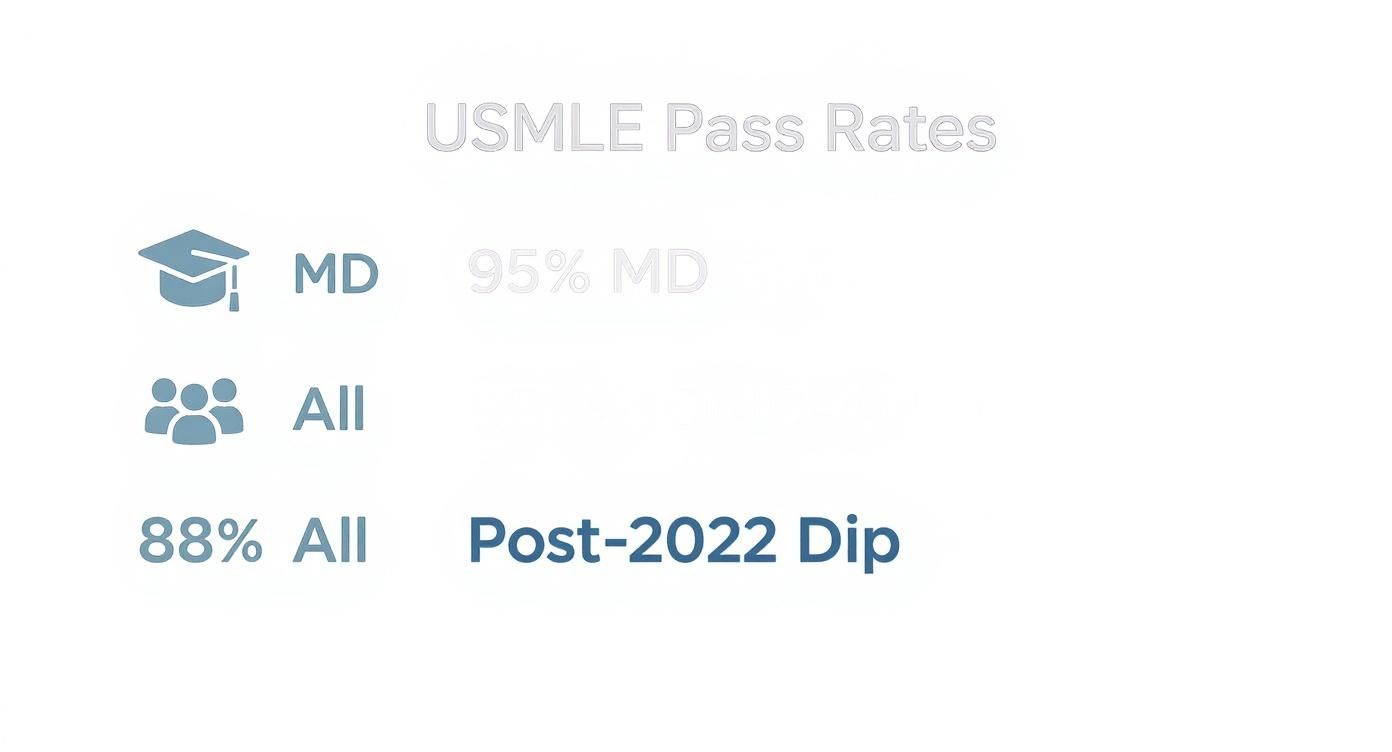
Before the switch, pass rates were consistently high, especially for students in U.S. and Canadian medical schools. Back in 2021, a remarkable 95% of MD students from these schools passed on their first attempt. The overall first-time pass rate for everyone—including international medical graduates (IMGs) and those repeating the exam—was a solid 88%.
This history of high performance set a clear standard. But then, something interesting happened. The move to pass/fail came with a surprising and very noticeable dip in pass rates across the board.
This guide will break down what these trends mean for US MDs, DOs, and IMGs, and give you real, actionable strategies to make sure you land on the right side of that passing line. For a deeper look, check out our guide on what makes up a USMLE Step 1 passing score and how the NBME figures it out.
The graphic below shows the key pass rate stats from before the change and highlights the recent downward trend.
This table gives a quick snapshot of how the pass/fail change has impacted different student groups.
USMLE Step 1 Pass Rate At a Glance Pre- and Post-Change
| Student Group | Typical Pass Rate (Pre-2022) | Observed Trend (Post-2022) |
|---|---|---|
| US & Canadian MD Students | ~95% | Noticeable decline |
| US DO Students | ~90% | Noticeable decline |
| US Citizen IMGs | ~60% | Slight decline |
| Non-US Citizen IMGs | ~75% | Slight decline |
| Overall (All First-Takers) | ~88% | Noticeable decline |
As the data shows, the pass rate for U.S. MD students was once almost a given. The dip since 2022 is a clear signal that no one can afford to take this exam lightly anymore.
Why Pass Rates Differ Between Student Groups

Not every medical student approaches Step 1 from the same starting line. The data reveals clear, persistent differences in the USMLE Step 1 pass rate among three major groups: U.S. MD students, U.S. DO students, and International Medical Graduates (IMGs).
Understanding these disparities isn’t about judging anyone's potential; it’s about realistically assessing the unique challenges each path presents and tailoring your preparation accordingly.
Historically, U.S. and Canadian MD students have consistently posted the highest pass rates. Before the big pass/fail shift in 2022, their first-time pass rates often hovered around a remarkable 95%. This isn’t surprising—the curricula at LCME-accredited schools are specifically designed to align with USMLE content and timelines.
For other groups, however, the path has always been a bit steeper. And in the pass/fail era, that trend has become even more pronounced.
A Closer Look at MD, DO, and IMG Performance
The move to a pass/fail system coincided with a drop in pass rates across the board, but the hit wasn't distributed equally. While MD students saw their rates dip, the decline was even sharper for other groups, widening the performance gap.
For example, 2023 data showed that while U.S. MD students maintained a 90% first-time pass rate, DO students were at 86%, and IMGs were significantly lower. This isn't just a statistical blip. It’s a direct reflection of the underlying differences in medical education, resources, and exam focus.
The pass/fail system was meant to reduce stress, but it inadvertently threw a spotlight on the resource and curriculum disparities that have always existed. A lower pass rate isn't a reflection of a student's ability but of the unique hurdles each group must clear.
So, let's break down exactly what's causing these varied outcomes.
The Reasons Behind the Disparities
Several key factors explain why the USMLE Step 1 pass rate varies so much between student populations. Think of it as different training regimens for the same championship fight.
Curricular Alignment and Resources:
- U.S. MD Schools: These programs are practically built around the USMLE. Curricula are often directly integrated with Step 1 prep, and students get structured preclinical years, dedicated study periods, and a ton of institutional resources—all geared toward this one exam.
- U.S. DO Schools: DO programs are just as rigorous, but they have to cover Osteopathic Manipulative Medicine (OMM), which isn't on the USMLE. This means DO students must master the same material as their MD peers and prepare for the COMLEX exam. They're essentially training for two high-stakes exams at once.
- International Medical Graduates (IMGs): IMGs face the biggest logistical challenge. Their med school curricula can vary wildly and often don't emphasize the specific content the USMLE prioritizes. They typically lack structured "dedicated" study periods and have to navigate their prep with fewer built-in resources, making self-discipline and external support absolutely essential.
These foundational differences in training create a fundamentally uneven playing field. For IMGs and many DO students, success demands bridging these gaps with highly focused, strategic self-study. Personalized guidance, like the tutoring offered by Ace Med Boards, can be invaluable for creating a study plan that fills specific knowledge gaps and mimics the structured support MD students receive.
Why More Students Are Failing in the Pass/Fail Era
It sounds completely backward, doesn't it? The USMLE Step 1, once a source of legendary stress because of its three-digit score, went pass/fail to ease the pressure on students. But since that change in 2022, the USMLE Step 1 pass rate has actually gone down.
This isn't just a statistical blip. It’s a direct result of deep psychological and institutional shifts. Once the primary driver—nailing a high score—vanished, so did a lot of the urgency that fueled intense, early, and comprehensive prep.
The new, seemingly simpler goal is just to "pass," which feels far less daunting than shooting for a 250+. As a result, many students are unintentionally walking into the exam underprepared for its true difficulty.
The Psychological Shift from Scored to Pass/Fail
Think about it like training for a marathon. If your goal is to finish in under three hours, your training is going to be meticulous, intense, and scientific. You'll track every mile, every meal, every minute of sleep. But if your only goal is to cross the finish line, your approach will likely be a lot more relaxed.
The high-score incentive forced a level of deep, foundational learning. Without that specific number to chase, the stakes just feel lower during the preclinical years. This leads to a subtle but critical drop in study intensity long before the dedicated study period ever starts.
The switch to pass/fail didn't make the exam any easier; it just changed the target. The mountain of content is just as high, but the new system creates a false sense of security. It fools students into preparing for a casual hike when they're actually about to climb Everest.
This change in mindset has real consequences. Students might put off serious prep or skim through material less thoroughly, working under the dangerous assumption that a "pass" is an easy bar to clear.
How Study Habits Changed After 2022
The data and stories from the trenches all point to the same pattern. With all the scoring pressure now shifted to Step 2 CK, many students are strategically (but mistakenly) dedicating less time and brainpower to Step 1. This overlooks a fundamental truth: Step 1 is the bedrock. It builds the foundational knowledge you absolutely need to succeed in clinical rotations and crush Step 2.
This de-prioritization shows up in a few common ways:
- Shorter Study Periods: Students are trying to cram for Step 1 in shorter "dedicated" periods, leaving little margin for error or for concepts to truly sink in.
- Less Rigorous Review: Without the pressure to master every low-yield detail for a top score, some students gloss over entire topics, missing the key concepts needed to even reach the passing threshold.
- Over-reliance on "High-Yield" Resources: While great for efficiency, focusing only on high-yield facts can leave massive, dangerous gaps in the basic science knowledge that the exam still tests with brutal rigor.
This cultural shift in studying has been a huge factor in the dropping pass rate. Students are simply preparing differently, and the exam results are reflecting that.
The Role of Medical School Curriculum Adjustments
Medical schools have also changed their approach in the pass/fail world, and it hasn't always been for the better. Seeing Step 1 as less of a priority, some institutions have made adjustments that inadvertently put their students at a disadvantage.
For instance, many schools have cut down their dedicated study periods. What used to be a standard 6-8 week protected block of time has been slashed to just 4 weeks in some programs. This forces students to cram an impossible amount of information into a totally inadequate timeframe.
On top of that, some preclinical curricula have shifted their focus away from the nitty-gritty basic sciences and more toward early clinical integration. While this sounds great in theory, it can leave students underprepared for the detailed pathophysiology and pharmacology questions that are the bread and butter of Step 1.
These institutional changes, combined with the psychological shift among students, have created a perfect storm for the drop in the USMLE Step 1 pass rate. Now more than ever, a smart, disciplined, and strategic preparation plan isn't just helpful—it's absolutely essential.
The True Cost of a Step 1 Failure on Your Residency Application

While the numbers and USMLE Step 1 pass rate statistics paint a grim picture, they don't fully capture the gut-punch of seeing a single word on your transcript: "Fail." With Step 1 now pass/fail, this isn't just a minor setback. It's a massive red flag that can dramatically change your path to residency.
Before, a low score was a hurdle. Today, a failed attempt is a brick wall.
Think of it this way: thousands of residency applications pour into the Electronic Residency Application Service (ERAS). Program directors don't have time to read every single one. They use automated filters, and a Step 1 failure is one of the easiest ways to thin the herd. Your application might get tossed into the digital trash bin before a real person even lays eyes on it.
The View from the Program Director's Chair
For a program director, a failed attempt immediately raises doubts. Do you have the foundational knowledge? Can you handle the intense pressure of residency? Even if they understand that bad days happen, the sheer volume of stellar applicants makes taking a risk on someone with a significant academic stumble a tough sell.
How much it hurts depends heavily on what you're aiming for.
- Hyper-Competitive Specialties: Dreaming of dermatology, neurosurgery, or orthopedics? A Step 1 failure is often a deal-breaker, plain and simple. These programs are flooded with perfect-on-paper candidates and can afford to be incredibly selective.
- Less Competitive Specialties: For fields like family medicine or psychiatry, a failure is still a serious problem, but it might not be an automatic rejection. These programs may be more willing to look at your application as a whole—but only if the rest of it is absolutely exceptional.
No matter the field, a failure puts you on the defensive. You're no longer just trying to stand out; you're trying to prove you belong in the first place.
A failed Step 1 attempt forces you to play defense for your entire application cycle. Your focus shifts from showcasing your strengths to mitigating a glaring weakness, a position no applicant wants to be in.
So You Failed. What's the Comeback Plan?
Getting a failing score is devastating. Let’s not sugarcoat it. But it doesn't have to be the end of your medical career. Recovering, however, demands a flawless game plan and an incredible amount of work. Your mission is to build a narrative of redemption—to prove that the failure was a fluke, not a reflection of your ability.
Your comeback strategy needs to be built on these non-negotiable pillars.
1. Crush Your Step 2 CK Score
This is your number one priority. Nothing counteracts a Step 1 failure more powerfully than a monster Step 2 CK score. A score in the 250s or 260s screams that you've mastered clinical knowledge and have the academic horsepower to thrive in residency.
2. Make Every Other Part of Your Application Shine
There's no room for mediocrity anywhere else. Your clinical grades, research experience, personal statement, and letters of recommendation all need to be top-tier. Hunt down meaningful research, honor every clerkship, and build strong relationships with faculty who can write glowing, personal letters about your resilience and growth. Knowing exactly what programs look at for ERAS will help you channel your energy effectively.
3. Address It Head-On
Don't hide from it. In your personal statement or an addendum, tackle the failure with honesty and maturity. Explain what you learned from the experience and, crucially, detail the concrete steps you took to fix your weaknesses. This is how you turn a red flag into a story of perseverance.
Passing the retake is just the first step. The real challenge is building an application so compelling that it forces program directors to look past that initial failure and see the capable, resilient physician you've become. This takes immense dedication, smart planning, and often, the right guidance to ensure every single piece of your application is as strong as it can possibly be.
Your Blueprint for a First-Time Pass
https://www.youtube.com/embed/Wygl1znnuiY
Knowing the stakes of a Step 1 failure is one thing. Building a rock-solid plan to avoid it is another beast entirely. With the USMLE Step 1 pass rate trending downward, a half-baked study strategy just won't cut it anymore. You need a disciplined, structured blueprint.
This isn't about grinding harder; it's about preparing smarter. The goal is to create a well-oiled machine that runs efficiently, keeps burnout at bay, and gives you the best possible shot at passing on your first attempt.
Building Your Dedicated Study Schedule
Your success starts with a realistic schedule. For most med students, a 6-8 week dedicated study period hits the sweet spot. Any shorter and you're just cramming, which leads to superficial learning. Any longer, and you risk forgetting early material and hitting a wall of burnout.
A common pitfall is drafting an ambitious 14-hour-a-day schedule that you can't possibly stick to past day three. Don't do that. Build a balanced, sustainable routine that carves out time for study blocks, breaks, exercise, and—most importantly—sleep.
Here's what a sane, effective day might look like:
- Morning (8 AM – 12 PM): Hit a UWorld block of 40 questions first thing, then spend the next 2-3 hours doing a deep, thorough review of every single question.
- Afternoon (1 PM – 5 PM): Shift to content review. Use what you got wrong in UWorld to guide your focus in resources like First Aid and Pathoma.
- Evening (6 PM – 8 PM): Keep it light. Maybe watch some review videos or run through some flashcards. Protect this time to decompress so you can get a full night's rest.
This kind of structure gives your day a rhythm, cuts down on decision fatigue, and ensures all your bases are covered.
Integrating Gold-Standard Resources Effectively
The next trap to avoid is resource overload. It's so tempting to buy every recommended book and subscription, but this usually leads to scattered, shallow learning. The real key is to pick a few high-yield resources and absolutely master them.
Think of it like building a house—you need a solid foundation, not a random pile of every brick you can find.
Your core resources—UWorld, First Aid, and Pathoma—aren't just a list of books. They're an interconnected ecosystem. You use UWorld to find your weaknesses, First Aid to fill in the knowledge gaps, and Pathoma to truly understand the 'why' behind the diseases.
This trio is the undisputed core of Step 1 prep for a reason. UWorld is your active learning engine. First Aid is your comprehensive reference bible. And Pathoma provides the essential pathophysiological framework that ties it all together.
You can sprinkle in supplemental tools like Sketchy or Anki to target specific weak spots, but they should never take the place of your core three. For a deeper dive, check out our guide on how to study for USMLE Step 1.
The Power of Active Recall and Practice Exams
Let’s be honest: passively reading a textbook or watching a video feels productive, but it often creates a false sense of confidence. Real, durable learning comes from active recall—the mental workout of pulling information out of your brain without looking. This is exactly what UWorld questions and flashcards force you to do.
Along the same lines, taking NBME practice exams is non-negotiable. They are, by far, the most accurate predictors of how you'll perform on the real deal. You should plan to take one every 1-2 weeks during your dedicated period. They serve two vital functions:
- Gauging Readiness: They give you an objective look at your progress and tell you if you're consistently scoring in the passing range.
- Simulating Test Day: They build the mental and physical stamina you need to survive a grueling 7-hour exam.
You're looking for a steady upward trend in your scores. The goal is to reach a point where you have a comfortable cushion above that magic passing score of 196 (which works out to roughly 65% correct).
Personalized Guidance for Pinpointing Weaknesses
Even with the best-laid plans, it’s incredibly difficult to see your own blind spots. This is where personalized guidance can be an absolute game-changer. An experienced tutor provides an objective eye, spotting subtle patterns in your mistakes that you’d likely miss on your own.
At Ace Med Boards, our tutors are experts in this diagnostic process. We dig into your UWorld stats and NBME reports with you to craft a study plan that zeroes in on your specific needs. It’s a targeted approach that makes sure every ounce of effort goes where it will have the biggest impact, building not just your knowledge base but your confidence, too. And remember, beyond the books, creating an optimal learning environment is a powerful, often-overlooked factor in successful prep.
Ultimately, passing Step 1 on the first try comes down to a deliberate, well-executed strategy. If you combine smart planning, focused resource use, and a commitment to active learning, you'll walk into that exam center feeling prepared and ready to succeed.
Answering Your Top Questions About the Step 1 Pass Rate

Let's cut through the noise. When it comes to the Step 1 pass rate, there's a lot of chatter and confusion. To help you build a rock-solid study plan, we've tackled some of the most pressing questions we hear from students every day.
This is all about giving you the straight answers you need to move forward with confidence and a clear picture of what's really at stake.
What Is the Passing Score for USMLE Step 1?
Even though your final report just shows "Pass" or "Fail," there is an internal score. To pass Step 1, you have to hit a score of 196 or higher on the USMLE's internal three-digit scale.
It's critical to know this isn't a percentage. Digging into historical NBME data, a 196 score generally means you need to answer about 60-65% of the questions correctly.
When you're taking NBME practice exams, your goal should be to consistently score well above this mark. You need a comfortable safety margin to account for test-day jitters and the simple fact that every exam form is slightly different.
How Many Times Can I Retake Step 1?
The official USMLE policy allows a maximum of four attempts for any Step exam. If you fail a fourth time, you become permanently ineligible to retake that Step, which effectively ends your path to becoming a licensed physician in the U.S.
But let's be blunt: leaning on those extra attempts is a terrible strategy. Even one failure is a massive red flag for residency programs, and it can sink your chances of matching into a competitive specialty. Your entire focus should be on passing the first time. Period.
Does a Step 1 Pass Matter Less Now?
This is a huge and dangerous misconception. While a "Pass" no longer makes you stand out like a 250+ score once did, its importance has actually shot through the roof.
Why? Because with every passing applicant looking the same on paper for this metric, a "Fail" becomes an even more glaring black mark on your record.
With a "Pass" as the new baseline, program directors now weigh other factors more heavily. Your Step 2 CK score, clinical grades, research, and letters of recommendation are where you'll have to shine.
Think of it like getting a ticket to the big game. You can't even get into the stadium without one, and a "Fail" means you're not even in the running.
What Should IMGs Know About the Pass Rate?
For International Medical Graduates (IMGs), the statistics paint a tougher picture. Historically, first-time pass rates for IMGs hover in the 70-75% range, while their US MD and DO peers often see rates of 85% or higher.
This gap isn't about ability; it highlights the unique hurdles IMGs face, from different preclinical curricula to the lack of a standardized, dedicated study period. For an IMG, passing on the first attempt isn't just a goal—it's an absolute necessity to be considered a competitive applicant. This makes a structured, comprehensive prep plan, often with outside expert guidance, even more critical for success.
Navigating these high stakes demands a plan built for a first-time pass. At Ace Med Boards, our expert tutors create personalized strategies that pinpoint your weaknesses and build the skills and confidence you need. Don't leave your medical future to chance—schedule a free consultation today and let's build your blueprint for success.