The medical school personal statement is more than just a requirement; it’s your single best opportunity to tell admissions committees who you are beyond your grades and MCAT score. This 5,300-character essay is where you connect your unique experiences, whether in a lab, a clinic, or your community, to your motivation for becoming a physician. A powerful statement can transform your application from a collection of metrics into a compelling narrative that resonates with faculty.
This guide moves beyond generic advice. We will dissect eight distinct medical school personal statement examples, providing a deep, line-by-line analysis to show you how and why they succeed. Each example is followed by strategic insights and actionable advice you can apply directly to your own writing. We will explore what makes each essay effective, identify common pitfalls to avoid, and offer templates to help you structure your own story.
The goal is not to have you copy these examples, but to give you a strategic framework for crafting your own authentic narrative. You will learn to:
- Connect disparate experiences into a cohesive theme.
- Demonstrate core competencies like empathy, resilience, and critical thinking.
- Articulate your "why medicine" with conviction and clarity.
By understanding the mechanics behind these successful essays, you'll be equipped to write a memorable statement that highlights your unique strengths and solidifies your commitment to a career in medicine. Let's begin.
1. Research-Focused Medical School Personal Statement
A research-focused personal statement frames your journey to medicine through the lens of scientific inquiry and discovery. This approach is ideal for applicants with significant, long-term research experience who aspire to a career in academic medicine, such as an MD/PhD, or plan to integrate research into their clinical practice. It demonstrates a deep, evidence-based curiosity and a commitment to advancing medical knowledge.
This type of essay goes beyond simply listing lab experiences. It constructs a narrative around a central research question or a pivotal moment of discovery. The goal is to show how your time in the lab shaped your desire to treat patients, connecting the molecular to the human and proving you see the bigger picture.
How It Works: The Strategic Framework
The core strategy is to link your bench work to the bedside. You are not just a scientist; you are an aspiring physician-scientist. This statement must show admissions committees that your research passion fuels your clinical ambitions, not the other way around.
A powerful research-focused essay often follows this structure:
- The Hook: Start with the "why" behind your research. What scientific question captured your imagination? What clinical problem were you trying to solve?
- The Process: Briefly describe your role and the research itself, but focus on the intellectual journey. What challenges did you overcome? What did you learn about the scientific process?
- The Connection: This is the most critical part. Explain the clinical relevance of your work. How did seeing the data make you think about the patients who could one day benefit?
- The Future: Conclude by articulating how you will unite your research skills and clinical goals in medical school and beyond.
Why It's a Top-Tier Approach
This method is highly effective for applicants targeting research-intensive institutions. It showcases a sophisticated understanding of medicine as a field that constantly evolves through scientific advancement.
Key Takeaway: A research-focused personal statement isn't just about what you did in the lab; it’s about how that experience forged your identity as a future physician dedicated to both healing patients and advancing the science that makes it possible. It is one of the most compelling medical school personal statement examples for demonstrating intellectual maturity.
2. Clinical Experience-Driven Personal Statement
A clinical experience-driven personal statement anchors your motivation for medicine in a powerful, hands-on patient encounter. This approach is perfect for applicants who have had transformative experiences as an EMT, a medical scribe, a clinical volunteer, or through extensive shadowing. It demonstrates firsthand exposure to the realities of patient care and a mature understanding of a physician's role.

This essay moves beyond simply stating you want to help people; it shows a specific moment where you witnessed, participated in, or were deeply moved by the act of care. The narrative focuses on a single, compelling story that reveals your empathy, resilience, and curiosity about the human side of medicine.
How It Works: The Strategic Framework
The strategy is to zoom in on one pivotal moment and use it as a lens to explore your broader commitment to medicine. Instead of listing every clinical activity, you select a single, defining story that encapsulates your motivation. You are not the hero of the story; you are the thoughtful observer and learner.
An effective clinical experience-driven statement typically follows this arc:
- The Hook: Begin in media res with a vivid, sensory description of a specific clinical scene. Set the stage and introduce the central patient or medical situation.
- The Experience: Detail your role and observations. What did you see, hear, or feel? Focus on the physician’s actions, the patient’s humanity, or a critical moment of communication.
- The Reflection: This is the core of the essay. Move from "what happened" to "what it meant." How did this experience challenge your assumptions or solidify your desire to become a doctor? What did you learn about empathy, ethics, or teamwork?
- The Future: Connect the lessons from this single experience to your future goals in medical school and as a physician. Show how it will guide your approach to patient care.
Why It's a Top-Tier Approach
This method is universally powerful because it puts the patient at the center of your story, which is exactly where they should be. It proves to admissions committees that you have "seen the life" and are pursuing medicine with your eyes wide open to its challenges and rewards.
Key Takeaway: A clinical experience-driven personal statement uses a single, meaningful patient story to prove your suitability for a career in medicine. It is one of the most effective medical school personal statement examples for showcasing the emotional intelligence and empathy essential for a great physician.
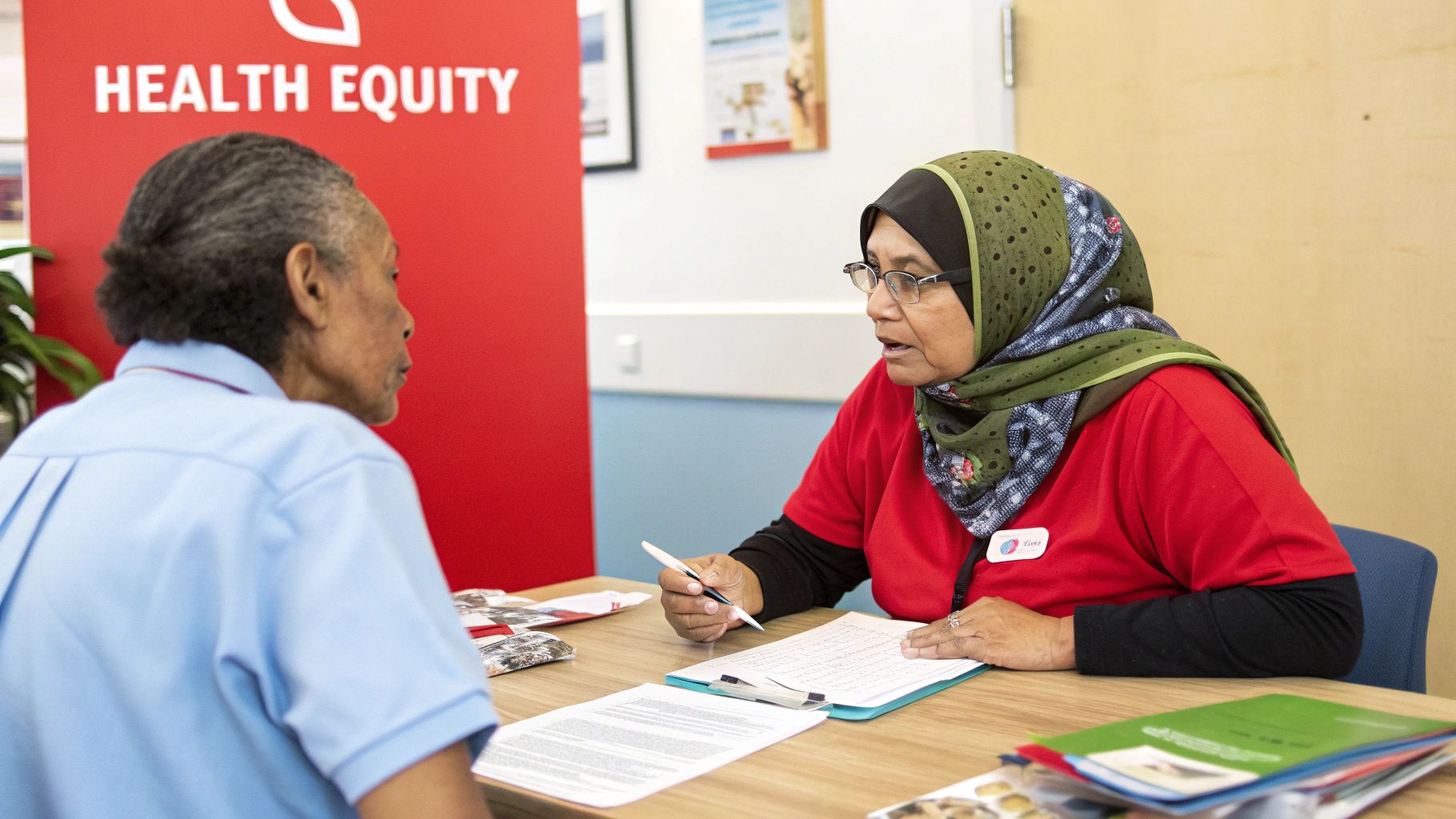
3. Community Service and Social Justice Personal Statement
A community service and social justice personal statement frames your motivation for medicine through your commitment to health equity and serving vulnerable populations. This approach is powerful for applicants with substantial, long-term experience in community health, advocacy, or service who are passionate about addressing the social determinants of health. It showcases empathy, cultural competency, and a deep understanding that a patient's well-being extends far beyond the clinic walls.
This essay moves past a simple recounting of volunteer hours. It builds a narrative around a specific community, a systemic barrier you witnessed, or a key relationship that illuminated the realities of healthcare disparities. The objective is to demonstrate how your service defined your path to medicine, connecting your advocacy work to your future role as a physician.
How It Works: The Strategic Framework
The central strategy is to link your direct community engagement with a sophisticated understanding of systemic health issues. You are not just a volunteer; you are an aspiring physician who sees patients as whole people within a complex social context. This statement must convince admissions committees that your commitment to social justice is the bedrock of your clinical ambitions.
A compelling community-focused essay often follows this structure:
- The Hook: Begin with a powerful, personal story from your service. Introduce a person or a specific challenge that reveals a systemic healthcare problem.
- The Immersion: Describe your role within the community. Focus on what you learned from the people you served, emphasizing listening and mutual respect over "saving" anyone.
- The Connection: This is the critical step. Explain how witnessing these social and economic barriers firsthand solidified your desire to become a physician. How will being a doctor empower you to be a more effective advocate?
- The Future: Conclude by articulating your vision for a career dedicated to underserved communities, whether in primary care, public health, or a specific specialty.
Why It's a Top-Tier Approach
This method is highly effective for applicants targeting schools with strong missions in primary care, community health, and serving underserved populations. It demonstrates humility, maturity, and an awareness of the complex realities of modern medicine that goes far beyond textbooks.
Key Takeaway: A social justice personal statement isn't about the hours you volunteered; it’s about how those experiences reshaped your perspective and ignited a passion for equitable care. It is one of the most powerful medical school personal statement examples for showcasing your humanism and commitment to the core tenets of medicine.
4. Non-Traditional Student Personal Statement
A non-traditional student personal statement leverages a unique life path, such as a prior career, significant gap years, or other unconventional experiences, to build a compelling narrative for medicine. This approach is ideal for applicants who are career-changers, veterans, parents, or anyone whose journey to medical school did not follow a direct route from undergraduate studies. It transforms what might be seen as a detour into a powerful testament of maturity, resilience, and a well-considered commitment to medicine.
This essay does not apologize for a different timeline; it celebrates it. It constructs a narrative that shows how experiences in other fields or life stages have provided unique skills and a grounded perspective that will enrich a medical school class and the profession. The goal is to prove that your decision to pursue medicine is deliberate, informed, and strengthened by your past.
How It Works: The Strategic Framework
The core strategy is to connect your past experiences directly to the core competencies of a physician. You are not just an applicant with an interesting backstory; you are a future doctor whose unique history provides a distinct advantage. Your statement must show admissions committees that your non-traditional path has prepared you exceptionally well for the rigors and humanistic demands of medicine.
A powerful non-traditional essay often follows this structure:
- The Hook: Start with a compelling story from your previous career or life experience that sparked your definitive shift toward medicine.
- The Bridge: Explain the skills you gained (e.g., leadership, empathy, problem-solving) and explicitly connect them to the practice of medicine. Address the timeline directly and confidently.
- The Confirmation: Describe the concrete steps you took to validate your new path, such as pre-med coursework, clinical volunteering, or research, proving your commitment is not a whim.
- The Future: Conclude by articulating a clear vision of how your unique background will make you a better physician and contribute to the diversity of your medical school class.
Why It's a Top-Tier Approach
This method is highly effective because it showcases a level of maturity and self-awareness that is often rare in younger applicants. It demonstrates that your decision to pursue medicine is not just a default next step but a conscious, intentional choice backed by real-world experience. If you are looking for more medical school personal statement examples, especially those tailored for unique journeys, exploring further resources can be highly beneficial. Learn more about personal statement examples on acemedboards.com.
Key Takeaway: A non-traditional personal statement reframes your unique journey as your greatest strength. It’s about demonstrating how your past career, military service, or life experiences didn’t delay your medical career but rather uniquely prepared you for it.
5. MD/PhD Dual–Degree Track Personal Statement
The MD/PhD personal statement is a highly specialized narrative designed for applicants seeking to become physician-scientists. It is not just a research-focused essay; it is an argument for why you need both degrees to achieve a specific career vision. This approach targets applicants with extensive, often multi-year research experience and a clear, sophisticated understanding of how they will bridge the gap between scientific discovery and clinical care.
This essay must demonstrate a mature commitment to a dual-track career. It weaves together your identity as a researcher with your aspirations as a clinician, showing admissions committees that your desire for both degrees is born from a genuine need to translate laboratory findings into patient treatments. The goal is to prove you are ready for the immense rigor of a Medical Scientist Training Program (MSTP) or similar dual-degree track.
How It Works: The Strategic Framework
The core strategy is to present an integrated vision of a physician-scientist career. You must convincingly argue that an MD alone or a PhD alone would be insufficient to accomplish your goals. Your narrative must justify the significant investment the institution will make in your training.
A successful MD/PhD statement often follows this structure:
- The Hook: Begin with a compelling research question or a clinical problem that can only be solved through a combined scientific and medical lens. This immediately establishes your dual focus.
- The Research Journey: Detail your significant research experiences, but focus on the "why." Explain how your projects led you to identify knowledge gaps that only a clinical perspective could fill.
- The Clinical Connection: Articulate moments where your research collided with the reality of human disease. Did a patient interaction inspire a new line of inquiry? Did your data reveal a pathway for a novel therapy?
- The Synthesis: This is the crux of the essay. Explicitly state why both the MD and PhD are indispensable for your future. Explain how clinical training will inform your research questions and how your scientific mindset will enhance patient care.
Why It's a Top-Tier Approach
This approach is non-negotiable for MD/PhD applicants and is highly effective when executed well. It showcases exceptional intellectual drive, resilience, and a long-term vision that aligns perfectly with the mission of top research universities and NIH-funded programs. It signals to admissions committees that you are not just an applicant, but a future leader in academic medicine.
Key Takeaway: An MD/PhD statement must be a manifesto for a career as a physician-scientist. It’s not about two separate paths; it’s about one integrated mission. This is one of the most demanding but powerful medical school personal statement examples for demonstrating you have the unique vision required for a dual-degree track.
6. Diversity and First-Generation Student Personal Statement
A diversity and first-generation student personal statement centers your unique background and identity as the primary motivation for pursuing medicine. This approach is powerful for applicants from underrepresented groups, including racial or ethnic minorities, first-generation college students, LGBTQ+ individuals, or those from socioeconomically disadvantaged backgrounds. It frames your personal journey as a source of resilience, empathy, and a distinct perspective on healthcare.

This essay moves beyond simply stating your identity. It constructs a narrative that shows admissions committees how your lived experiences have cultivated a deep commitment to addressing health disparities, promoting culturally competent care, and advocating for underserved communities. The goal is to connect your past to your future vision as a physician. For a deeper dive, learn more about how to write a diversity statement.
How It Works: The Strategic Framework
The core strategy is to demonstrate how your identity provides you with unique insights into the challenges patients face. You are not just an applicant with a specific background; you are an aspiring physician whose experiences will make you more compassionate, aware, and effective.
A compelling diversity-focused essay often follows this structure:
- The Hook: Start with a personal anecdote that illuminates a specific aspect of your identity and its intersection with healthcare. This could be a memory of navigating the healthcare system for a family member or witnessing a health disparity firsthand.
- The Process: Explain how this initial experience shaped your understanding of medicine. Discuss the challenges you overcame and the resilience you developed. Focus on showing, not just telling, how these events forged your character.
- The Connection: This is the most critical part. Connect your personal story to a broader commitment to health equity. How did your background inspire you to volunteer, conduct research on disparities, or engage in community advocacy?
- The Future: Conclude by articulating how your unique perspective will contribute to your medical school class and your future practice. State your specific goals, such as working in an underserved area or advocating for policy change.
Why It's a Top-Tier Approach
This method is highly effective because it showcases qualities that medical schools value: resilience, empathy, and a commitment to service. It allows you to transform potential disadvantages into strengths, demonstrating a maturity and perspective that other applicants may lack. This approach tells a memorable and authentic story that stands out.
Key Takeaway: A diversity-focused personal statement is not about fulfilling a quota; it’s about illustrating how your unique life experiences have prepared you to be a compassionate and socially conscious physician. It is one of the most powerful medical school personal statement examples for showing your capacity to connect with and serve a diverse patient population.
7. Gap Year and Personal Growth Personal Statement
A gap year personal statement transforms time taken away from the traditional pre-med path into a compelling narrative of maturity, focus, and intentional growth. This approach is perfect for applicants who deliberately pursued experiences like full-time clinical work, service programs, or other meaningful activities to confirm their commitment to medicine and develop skills that academia alone cannot provide. It reframes the "gap" as a foundational bridge to a medical career.
This essay moves beyond a simple chronological account of your time off. It constructs a narrative around a central theme of discovery or skill acquisition. The goal is to demonstrate how these experiences solidified your motivation and uniquely prepared you for the rigors of medical school, proving your time away was a strategic step forward, not a detour.
How It Works: The Strategic Framework
The core strategy is to present your gap year(s) as a period of deliberate self-investment that made you a stronger, more certain applicant. You must show admissions committees that your experiences were intentional and directly contributed to your readiness for a career in medicine. This transforms what could be seen as a delay into a clear advantage.
A powerful gap year essay often follows this structure:
- The Hook: Start with a moment from your gap year experience that crystallized your desire for medicine. This could be a patient interaction as an EMT, a challenge overcome in a service program, or an insight gained while working.
- The Intent: Clearly state the purpose of your gap year. What skills or clarity were you seeking? Frame it proactively, focusing on what you wanted to gain.
- The Transformation: Detail the specific skills and personal growth you achieved. Use concrete examples to show how you developed resilience, empathy, or a deeper understanding of healthcare systems.
- The Future: Conclude by connecting your newfound maturity and skills directly to how you will succeed in medical school and contribute to your future patient community.
Why It's a Top-Tier Approach
This method is highly effective because it showcases maturity, self-awareness, and real-world competence. It directly addresses any potential questions about your time away and turns it into one of your greatest strengths, proving you are not just academically prepared but also personally ready for the challenges ahead.
Key Takeaway: A gap year personal statement isn’t about justifying time off; it’s about illustrating how that time was purposefully used to forge a more resilient and insightful future physician. It is one of the best medical school personal statement examples for demonstrating maturity and a confirmed commitment to medicine.
8. International and IMO (International Medical Graduate) Personal Statement
An International Medical Graduate (IMG) or international applicant personal statement is designed to frame a unique educational and cultural journey for a US admissions audience. This approach is essential for applicants educated outside the United States who must translate their experiences, address potential biases, and articulate a compelling reason for pursuing medical training or residency in the US. It demonstrates resilience, a global perspective on healthcare, and a clear understanding of the American medical system.
This essay does more than list foreign credentials; it builds a narrative bridge between two different healthcare systems. The goal is to show admissions committees how your international background is a distinct advantage that will enrich their program and enhance patient care in a diverse society. It proactively addresses potential questions about your training, adaptability, and commitment to practicing in the US.
How It Works: The Strategic Framework
The core strategy is to showcase your global experience as a strength while demonstrating a sophisticated understanding of the US healthcare landscape. You are not just an applicant from another country; you are a future physician whose unique perspective is a valuable asset. This statement must convince committees that your international journey has uniquely prepared you for the rigors of American medical education and practice.
A powerful international or IMG statement often follows this structure:
- The Hook: Start with a compelling story from your clinical or educational experience abroad that sparked your desire to train in the US.
- The Bridge: Clearly and concisely explain your educational background. Connect the skills and knowledge you gained to the standards and expectations of US medical training.
- The "Why US?": This is the critical section. Articulate specific, well-researched reasons for choosing the American system. Go beyond generic praise and pinpoint programs, research opportunities, or specific clinical training methodologies you want to pursue.
- The Future: Conclude by explaining how you will integrate your international perspective into your future practice in the US, perhaps by serving multicultural communities or engaging in global health initiatives.
Why It's a Top-Tier Approach
This method is crucial for any applicant with significant international experience. It transforms potential liabilities, like an unfamiliar educational system, into strengths by highlighting adaptability, a diverse clinical background, and cross-cultural competence. For more details on navigating this path, see this complete IMG guide to the USMLE.
Key Takeaway: An IMG personal statement isn't about justifying your foreign education; it's about showcasing how that global experience has shaped you into a uniquely qualified and insightful candidate. It is one of the most important medical school personal statement examples for demonstrating that you can bridge cultures and contribute a valuable global perspective to a US medical program.
8 Medical School Personal Statement Types Compared
| Statement Type | 🔄 Implementation Complexity | ⚡ Resource Requirements | 📊 Expected Outcomes | 💡 Ideal Use Cases | ⭐ Key Advantages |
|---|---|---|---|---|---|
| Research-Focused Medical School Personal Statement | High — technical narrative + clear clinical linkage required | High — sustained lab work, publications, mentors | Strong fit for research-intensive programs; increases competitiveness for MD/PhD/research tracks | Applicants with measurable research experience and translational interests | Differentiates for research tracks; demonstrates scientific rigor ⭐⭐⭐ |
| Clinical Experience-Driven Personal Statement | Moderate — craft vivid patient encounters while protecting privacy | Moderate — shadowing, clinical roles, volunteer/paid experience | Broadly persuasive and commonly successful; shows practical readiness for medicine | Applicants with direct patient care (EMT, scribe, volunteer, clinical jobs) | Relatable demonstration of patient commitment and clinical understanding ⭐⭐ |
| Community Service and Social Justice Personal Statement | Moderate — requires cultural sensitivity and sustained engagement | Moderate–High — long-term community work, advocacy, partnerships | Strong for community/primary-care oriented schools; underscores equity commitment | Applicants with sustained service in underserved communities or public health focus | Aligns with mission-driven schools; shows values and community impact ⭐⭐ |
| Non-Traditional Student Personal Statement | Moderate — must credibly reframe gaps as strengths and future-focused | Low–Moderate — professional experience, life events, maturity examples | Differentiates applicant; conveys resilience and intentional career choice | Career-changers, veterans, parents, or those with extended breaks from academe | Offers unique perspective and maturity; explains timeline gaps effectively ⭐ |
| MD/PhD Dual-Degree Track Personal Statement | Very high — requires explicit research plan and dual-degree justification | Very high — major research record, publications, long-term mentorship | High payoff for MD/PhD admissions but highly selective; positions for funded training | Applicants aiming for physician-scientist careers with extensive prior research | Strongest evidence of research commitment; aligns with top research institutions ⭐⭐⭐⭐ |
| Diversity and First-Generation Student Personal Statement | Moderate — balance identity, agency, and future goals sensitively | Low–Moderate — lived experience, leadership, community engagement | Highly valued for diversity initiatives when authentic; powerful personal narrative | URM, first-gen, LGBTQ+, low-income, disability, or other underrepresented applicants | Provides authentic perspective on health equity; supports DEI missions ⭐⭐ |
| Gap Year and Personal Growth Personal Statement | Low–Moderate — clearly explain purpose and concrete gains | Varies — productive gap activities (service, work, research, travel) | Generally favorable if gap is purposeful; shows growth and preparedness | Applicants who used gap years for clinical exposure, service, or personal development | Demonstrates intentionality, maturity, and added readiness for medical school ⭐ |
| International and IMO (IMG) Personal Statement | High — must explain credentialing, cultural/linguistic adaptation | High — documentation, exams (USMLE), language proficiency, credential translation | Brings global perspective but may face administrative/credential hurdles | International grads, IMGs seeking US training or licensure | Cross-cultural competence and multilingual skills; diverse clinical exposure ⭐⭐ |
Crafting Your Story: Next Steps and Expert Guidance
Having explored a diverse collection of eight medical school personal statement examples, from the research-focused applicant to the non-traditional student, you are now equipped with a powerful toolkit. You’ve seen how different narratives can be structured, how to transform experiences into compelling insights, and how to avoid common pitfalls that can weaken an otherwise strong application. The most crucial takeaway is this: your personal statement is not about finding a magic formula, but about discovering and articulating your unique story.
The best essays are deeply personal, authentic, and reflective. They move beyond simply listing accomplishments and instead connect the dots, showing an admissions committee the person behind the CV. Your journey, your motivations, and your vision for a future in medicine are the true subjects of this essay.
Distilling the Core Principles from the Examples
Across all the examples analyzed, from the MD/PhD candidate to the community-focused applicant, several universal truths emerge. Mastering these principles will elevate your essay from good to unforgettable.
- Show, Don't Just Tell: Instead of stating you are compassionate, describe a specific patient interaction where your compassion made a difference. Rather than saying you are a curious researcher, narrate the moment a specific scientific question captured your imagination.
- The "Why Medicine" Thread: This is the narrative backbone of your statement. Every anecdote, reflection, and experience you include must ultimately connect back to this central question. It should be a clear, consistent thread woven throughout the entire essay.
- Reflection is Key: The most impactful statements are not just a series of events. They are built on thoughtful reflection. For each experience you share, you must explore its meaning. What did you learn about yourself? How did it change your perspective on medicine? How did it prepare you for the challenges ahead?
- Authenticity Over Perfection: Admissions committees read thousands of essays. They can spot inauthenticity and hyperbole. Your genuine voice, complete with its unique perspective and honest reflections, will always be more powerful than an attempt to fit a preconceived mold of the "perfect" applicant.
Your Actionable Roadmap to a Powerful Personal Statement
Now it's time to translate these insights into action. The journey of writing your personal statement begins not with a blank page, but with structured self-reflection.
- Brainstorm Your Core Experiences: Create a list of the 5-10 most formative experiences that have led you to medicine. Think about moments from clinical volunteering, research, community service, personal challenges, or your academic journey. For each, jot down not just what happened, but how it made you feel and what it made you think.
- Identify Your Central Theme: Look at your list. Is there a recurring theme? Perhaps it's a passion for patient advocacy, a fascination with the diagnostic process, or a commitment to addressing health disparities. This will become the central pillar of your narrative.
- Outline Your Narrative Arc: Structure your story. A classic and effective structure includes an engaging hook, a body that develops your theme through 2-3 key experiences, and a conclusion that synthesizes your journey and looks toward your future in medicine.
- Write the "Vomit Draft": Your first draft is for your eyes only. Don't worry about grammar, word count, or perfect phrasing. Just write. Get your ideas, stories, and reflections down on paper to create the raw material you will later refine.
- Revise, Refine, and Seek Feedback: This is where the magic happens. Edit for clarity, impact, and flow. Read your statement aloud to catch awkward phrasing. As you move towards finalizing your personal statement, remember that maintaining academic integrity is crucial; learn more about how to avoid plagiarism. Once you have a polished draft, seek feedback from trusted mentors, advisors, and peers.
Your personal statement is more than just a requirement; it is your single best opportunity to speak directly to the admissions committee. It’s your chance to share the unique combination of experiences, qualities, and motivations that will make you an exceptional physician. Embrace the process, trust your voice, and tell your story with conviction.
Ready to transform your draft into a compelling narrative that stands out? The expert advisors at Ace Med Boards specialize in helping pre-medical students craft powerful personal statements. We provide one-on-one guidance to help you find your theme, refine your story, and present your most authentic and impactful self. Visit Ace Med Boards to learn how our admissions consulting can help you secure your spot in medical school.